China – Upswings and Implications
July 11, 2022
Read Time 2 MIN
China Credit, Money Supply, Growth
China’s credit aggregates hit several right notes in June. Both the new yuan loans and total social financing were stronger than expected and well above the multi-year seasonal ranges. Corporate bond issuance flipped into positive from a sequential decline in May. A proxy for mortgages (long-term household lending) recovered nicely, and long-term and medium-term corporate lending showed the first positive annual growth (based on a 3-month moving average) since July 2021. The numbers strongly suggest that the stimulus is real and bringing results. China’s economic surprise index also improved visibly in the past month. So, is it a good time to finally upgrade China’s near-term growth projections (which were cut to 1.5% year-on-year for Q2, 4.58% for Q3 and 5% for Q4, respectively)? One big problem here is that the encouraging credit numbers were released at the same time as reports about new COVID outbreaks in China’s major cities. This continues to pose a major downside risk, especially for consumption.
Diverging China-U.S. Growth Trends?
If the COVID situation can be contained without further downward growth revisions, the diverging near-term growth outlooks in China and the U.S. (where the market prices in a growing risk of recession) can create interesting opportunities for the renminbi. The negative differential between government bond yields in China and the U.S. narrowed a bit lately and can decline further if the current growth trends persist. If there are no negative surprises on the outflows front, this can lead to the renminbi strength vs. U.S. dollar going forward.
China and EM Inflation
Another related question is if – and this is still a big “if” – China’s rebound is for real, what impact will this have on inflation. China is the only major emerging market where headline inflation is still below the target – even though it surprised to the upside in June (2.5% year-on-year). The supply-side nature of China’s stimulus should help to cap inflation pressures in the future. But we keep an eye on the price of pork, which is rebounding on a year-on-year basis, creating upside inflation risks. Low inflation in China helped to keep emerging markets (EM) “average” inflation (once we exclude such outliers as Turkey, Russia and Argentina) well below developed markets (DM) after the pandemic (light blue line on the chart below). Will this still be the case going forward? Stay tuned!
Chart at a Glance: China Is Key Not Only For EM Growth But Also For EM Inflation
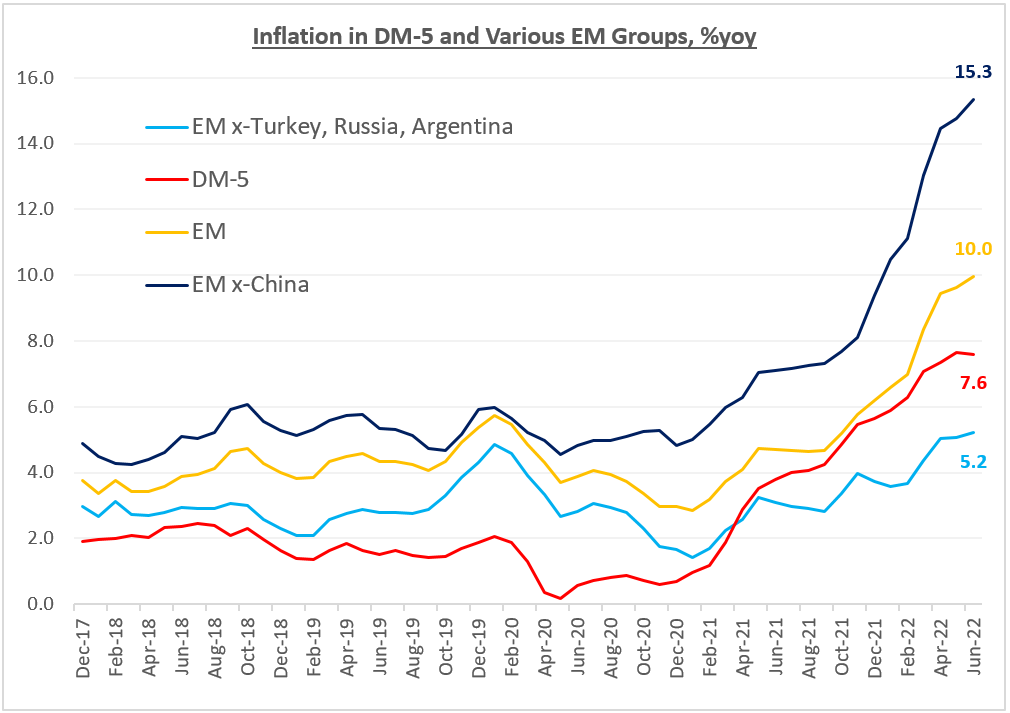
Source: VanEck Research; Bloomberg LP

DM - US, UK, Germany, Canada, Japan
Related Funds
DM - US, UK, Germany, Canada, Japan