EM Bonds Are Outperforming—Is Anyone Paying Attention?
July 07, 2025
Read Time 8 MIN
The VanEck Emerging Markets Bond Fund gained 3.76% in June, compared 2.60% for its benchmark, the 50% J.P. Morgan Government Bond Index-Emerging Markets Global Diversified (GBI-EM) and 50% J.P. Morgan Emerging Markets Bond Index (EMBI). Year to -date , the Fund is up 10.5%, compared to 7.3% and 5.0% for the Global Agg and 10-year Treasuries, respectively. During June, Zambia local currency and Ecuador in hard currency or US dollar led outperformers. We remain very bullish on local currency, while very cautious on US dollar duration. The Fund has around 60% in curated local currency, 40% in mostly higher-yielding US dollar-denominated bonds. Carry is 7.1%, yield to worst is 8.3%, and duration is 5.0.
Average Annual Total Returns* (%) (In USD)
| As of June 30, 2025 | |||||||||
| 1 Mo | 3 Mo | YTD | 1 Yr | 3 Yrs | 5 Yrs | 10 Yrs | |||
| Class A: NAV (Inception 07/09/12) | 3.71 | 6.87 | 10.51 | 13.04 | 10.68 | 4.77 | 3.35 | ||
| Class A: Maximum 5.75% load | -2.25 | 0.73 | 4.16 | 6.54 | 8.51 | 3.54 | 2.74 | ||
| Class I: NAV (Inception 07/09/12) | 3.76 | 7.00 | 10.54 | 13.33 | 11.04 | 5.08 | 3.64 | ||
| Class Y: NAV (Inception 07/09/12) | 3.91 | 7.12 | 10.82 | 13.51 | 11.03 | 5.04 | 3.59 | ||
| 50% GBI-EM/50% EMBI | 2.60 | 5.47 | 8.94 | 11.93 | 8.72 | 1.89 | 2.88 | ||
* Returns less than one year are not annualized.
Expenses: Class A: Gross 1.83%, Net 1.21%; Class I: Gross 1.37%, Net 0.86%; Class Y: Gross 1.33%, Net 0.96%. Expenses are capped contractually until 05/01/26 at 1.20% for Class A, 0.85% for Class I, 0.95% for Class Y. Caps exclude acquired fund fees and expenses, interest, trading, dividends, and interest payments of securities sold short, taxes, and extraordinary expenses.
The performance data quoted represents past performance. Past performance is not a guarantee of future results. Investment return and principal value of an investment will fluctuate so that an investor’s shares, when redeemed, may be worth more or less than their original cost. Performance may be lower or higher than performance data quoted. Please call 800.826.2333 or visit vaneck.com for performance current to the most recent month ended.
The “Net Asset Value” (NAV) of a Fund is determined at the close of each business day, and represents the dollar value of one share of the fund; it is calculated by taking the total assets of the fund, subtracting total liabilities, and dividing by the total number of shares outstanding. The NAV is not necessarily the same as the ETF’s intraday trading value. Investors should not expect to buy or sell shares at NAV.
We’ve been saying the same thing for 10 years. Namely, that emerging markets (EM) have low government debt, allowing independent central banks that pay high real interest rates, while developed markets (DM) such as the U.S. have high government debt and thus co-opted central banks that suppress interest rates. This story continues to unfold, but now it’s getting noticed. Developed markets in 2025 are further increasing the fiscal impulse (Europe on defense, theoretically, and the U.S. at least according to the CBO) at high levels of government debt, labile inflation concerns, and full employment. These are observations, not predictions. We’ve shown you the charts on record-low central bank allocations to US Treasuries. We’ve shown you the rising evolution of the inflation forecast for the US and the declining evolution of forecast for China (IMF). We’ve even written white papers showing the risk-adjusted returns of EM bonds compared to global bond categories, showing that simple backward-looking (over 20 years) optimizations say much higher allocations to EM bonds are merited. And year to date, EM bond returns are not just outperforming DM bonds, their performance is accelerating.
Exhibit 1 – EMFX Rallying YTD Despite “The Risks”

Source: VanEck Research, Bloomberg LP. Data as of June 2025.
US “tariff” discussions are about much more than “tariffs”. Most important to us, there is a currency chapter to the discussions – trade partners are not being allowed to devalue their way out of tariffs. This remains a bafflingly unique and outlier contrarian view of ours – that CNY and other currencies will revalue slowly over the next several years, supporting all EMFX. CNY has largely been fixed stronger in its daily fixings than the market-predicted level, since Donald Trump was elected President. Virtually all EMFX has rallied YTD, anchoring their inflation expectations and interest rates. And, EM central banks have kept rates much higher in real terms than their DM counterparts (which we’ve also charted), meaning the advent of Fed rate cuts should also accelerate rate rallies in EM. This has been going on for almost three decades now, initially to the great benefit of EM USD-denominated bonds whose spreads were high and where the inflow of dollars was impossible to ignore. The past six years, this reward for consistent orthodox policy spread to Asian local markets, whose yields collapsed as per the chart we use regularly, below. Many EMs such as China and most of Asia have lower inflation than DMs, making the EMFX appreciation argument straightforward, before invoking secret tariff chapters in negotiations or the status of the dollar (see our latest IMF takeaways for a full discussion).
Exhibit 2 – EM Asian Local Currency Bonds Rallied to Yields Lower than US

Source: VanEck Research, Bloomberg LP. Data as of June 2025.
CNH’s consistent outperformance (despite low interest rate differentials with the US) this year remains un-remarked upon. We remark on it, as it’s consistent with our view that there is re-valuation risk in CNY. This would reprice Asian and EMFX further, which is somewhat what the market is pricing. But to relatively no notice or fanfare. Go figure.
Exhibit 3 – CNH Rallies To Everyone’s Surprise and Nobody is Commenting
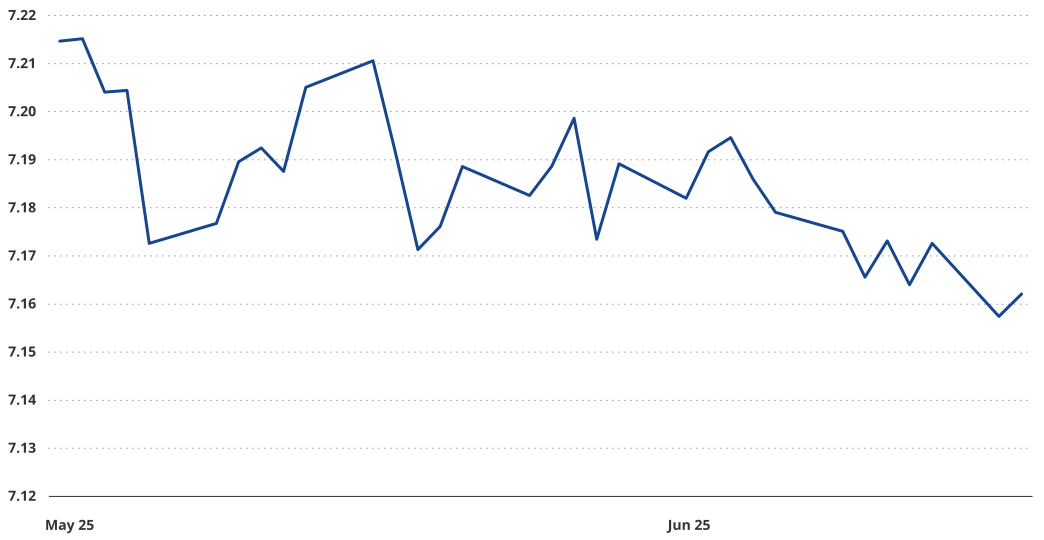
Source: VanEck Research, Bloomberg LP. Data as of June 2025.
EM bonds continue to outperform, the question is does anybody notice or care? In the past 5 years, our fund has returned +5.0% per year, the benchmark returned +1.8%, while the Global Agg returned -3.4% per year and Treasuries returned -1.7% per year. The table below tells the story neatly. This observed performance stands in strong contrast to the neutral net flow EM bonds have experienced over the past 10 years. To our eye, this strengthens the case for EM bonds. It also explains why so few are saying EMFX could be revalued upward, led by CNY – there’s great nervousness over taking market views, and a preference for index-tracking and AUM preservation. Nobody is invested in EM bonds. Whereas everyone is invested in US investment grade, Treasuries, the Global Agg, etc. We really don’t know what more to say.
Exhibit 4 – EM Bonds Outperform All Fixed Income For 5 years
| As of 6/30/2025 | MTD | YTD | 2024 | 2023 | 2022 | 2021 | 2020 | 5 Years |
| VanEck Emerging Markets Bond Fund I | 3.76 | 10.54 | 3.09 | 10.97 | -7.22 | -4.30 | 11.60 | 5.08 |
| 50%JPM GBI-EM GD and 50%JPM EMBI GD | 2.60 | 8.93 | 2.01 | 11.92 | -14.75 | -5.32 | 4.02 | 1.87 |
| ICE BofA Gbl Brd Mkt TR USD | 1.94 | 7.31 | -2.08 | 5.56 | -16.87 | -5.24 | 8.94 | -1.66 |
| FTSE Treasury Benchmark 10 Yr USD | 1.63 | 4.98 | -1.67 | 3.54 | -16.65 | -3.51 | 10.37 | -3.35 |
Source: VanEck Research, Morningstar. Data as of June 30 2025.
Recommended subscription
Exposure Types and Significant Changes
The changes to our top positions are summarized below. Our largest positions in June were Brazil, Malaysia, Thailand, South Africa, and China:
- We increased our local currency exposure in South Africa, Peru, and Chile. South Africa’s 2025 budget process is chugging along, despite occasional political hiccups, while inflation risks are to the downside. The latter leaves the central bank room to ease a bit more, but the board’s main focus now is on adopting a lower inflation target. In terms of our investment process, this improved the policy test score for the country. Chile and Peru are key beneficiaries of higher copper prices, which improves their technical test score. Pre-election noise in both countries is a potential complication, but Peru’s election are still far away, while Chile’s right and center-right can benefit from the left’s fragmentation.
- We also increased our hard currency sovereign exposure in Romania and Oman, and hard currency corporate exposure in Hong Kong. Romania’s political and policy risks subsided after the market-friendly presidential candidate won the presidential election, improving the policy test score for the country. Among the Gulf countries, Oman is the least exposed to potential Strait of Hormuz disruptions, which improves its technical and economic test scores. Regarding the corporate bond in Hong Kong, we sold a higher-price bond and bought a lower-priced security after the company failed to pay a coupon.
- Finally, we increased our hard currency sovereign exposure in Cote d’Ivoire, Angola, and Ghana. High oil prices should strengthen Angola’s technical and economic test scores. As regards Cote d’Ivoire, we are now less pessimistic about the election outcome as domestic political tensions are subsiding, improving the policy/politics test score for the country. Ghana’s staff-level agreement with the IMF and strong foreign trade results support the currency, improving the country’s debt/GDP metrics.
- We reduced our local currency exposure in Turkey and Kazakhstan. Turkey’s political noise is persistent, and the central bank is eager to start policy easing in a situation when regional geopolitical tensions are rising and might require more caution. In terms of our investment process, this worsened the policy/politics test score for the country. Kazakhstan is exposed to the on-going uncertainty about the resolution of the Russia-Ukraine conflict, which worsens the technical test score for the country.
- We also reduced our hard currency sovereign exposure in Nigeria and Senegal and hard currency corporate exposure in Israel. The latter reflected the recent spike in the Middle East geopolitical tensions, which worsened the politics and technical test scores for Israel. In Nigeria, most policy improvements are priced in – worsening the technical test score and making it difficult to find a fresh positive catalyst for a major rally. Senegal’s fiscal and debt struggles – including a surprising increase in the government’s debt/GDP ratio - complicate talks with the IMF, worsening the country’s policy test score.
- Finally, we reduced our hard currency sovereign exposure in Argentina and Ukraine. Argentina’s political backdrop is set to become noisier, and its external account (trade and current account) might deteriorate as the economy is recovering. This worsens the policy and economic test scores for the country. Ukraine’s ceasefire and a peace deal remain elusive, with the situation on the ground deteriorating in the past weeks together with the country’s politics test score.
EMBX | VanEck Emerging Markets Bond ETF
To receive more Emerging Markets Bonds insights, sign up in our subscription center.

DISCLOSURES
This is not an offer to buy or sell, or a recommendation to buy or sell any of the securities, financial instruments or digital assets mentioned herein. The information presented does not involve the rendering of personalized investment, financial, legal, tax advice, or any call to action. Certain statements contained herein may constitute projections, forecasts and other forward-looking statements, which do not reflect actual results, are for illustrative purposes only, are valid as of the date of this communication, and are subject to change without notice. Actual future performance of any assets or industries mentioned are unknown. Information provided by third party sources are believed to be reliable and have not been independently verified for accuracy or completeness and cannot be guaranteed. VanEck does not guarantee the accuracy of third party data. The information herein represents the opinion of the author(s), but not necessarily those of VanEck or its other employees.
Duration measures a bond's sensitivity to interest rate changes that reflects the change in a bond's price given a change in yield. This duration measure is appropriate for bonds with embedded options. Carry is the benefit or cost for owning an asset. Yield to worst is a measure of the lowest possible yield that can be received on a bond with an early retirement provision. Averages are market weighted. The yields presented do not represent the performance of the Fund. These statistics do not take into account fees and expenses associated with investments of the Fund.
All indices are unmanaged and include the reinvestment of all dividends, but do not reflect the payment of transaction costs, advisory fees or expenses that are associated with an investment in the Fund. Certain indices may take into account withholding taxes. An index's performance is not illustrative of the Fund's performance. Indices are not securities in which investments can be made.
The Fund's benchmark index (50% GBI-EM/50% EMBI) is a blended index consisting of 50% J.P. Morgan Government Bond Index-Emerging Markets (GBI-EM) Global Diversified and 50% J.P. Morgan Emerging Markets Bond Index (EMBI). The J.P. Morgan GBI-EM Global Diversified tracks local currency bonds issued by Emerging Markets governments. The J.P. Morgan EMBI Global Diversified tracks returns for actively traded external debt instruments in emerging markets, and is also J.P. Morgan's most liquid U.S. dollar emerging markets debt benchmark.
The Bloomberg Global Aggregate Index measures the performance of global investment grade fixed income securities.
The FTSE Treasury Benchmark 10 year measures the return of the 10 year U.S. Treasury.
ICE BofA Global Broad Market Index tracks the performance of investment grade debt publicly issued in the major domestic and eurobond markets, including sovereign, quasi-government, corporate, securitized and collateralized securities. ICE BofA Current 10-Year U.S. Treasury Index is comprised of the most recently issued 10-year U.S. Treasury note.
The MSCI ACWI Index is a global equity benchmark that captures large- and mid-cap stocks across 23 developed and 24 emerging markets, representing approximately 85% of the global investable equity universe.
The S&P 500 Index is a widely recognized U.S. equity benchmark that tracks 500 of the largest publicly traded companies, reflecting the performance of the core U.S. stock market.
Information has been obtained from sources believed to be reliable but J.P. Morgan does not warrant its completeness or accuracy. The Index is used with permission. The index may not be copied, used or distributed without J.P. Morgan's written approval. Copyright 2025, J.P. Morgan Chase & Co. All rights reserved.
You can lose money by investing in the Fund. Any investment in the Fund should be part of an overall investment program, not a complete program. The Fund is subject to risks which may include, but are not limited to, risks associated with active management, credit, credit-linked notes, currency management strategies, derivatives, emerging market issuers, energy sector, ESG investing strategy, foreign currency, foreign securities, hedging, high portfolio turnover, high yield securities, interest rate, market, non-diversified, operational, restricted securities, investing in other funds, sovereign bond, and special risks considerations of investing in African, Asian and Latin American issuers, all of which may adversely affect the Fund. Emerging market issuers and foreign securities may be subject to securities markets, political and economic, investment and repatriation restrictions, different rules and regulations, less publicly available financial information, foreign currency and exchange rates, operational and settlement, and corporate and securities laws risks. Derivatives may involve certain costs and risks such as liquidity, interest rate, and the risk that a position could not be closed when most advantageous.
Investing involves substantial risk and high volatility, including possible loss of principal. An investor should consider the investment objective, risks, charges and expenses of a Fund carefully before investing. To obtain a prospectus and summary prospectus, which contain this and other information, call 800.826.2333 or visit vaneck.com. Please read the prospectus and summary prospectus carefully before investing.
© 2025 Van Eck Securities Corporation, Distributor, a wholly-owned subsidiary of Van Eck Associates Corporation.
Related Funds
DISCLOSURES
This is not an offer to buy or sell, or a recommendation to buy or sell any of the securities, financial instruments or digital assets mentioned herein. The information presented does not involve the rendering of personalized investment, financial, legal, tax advice, or any call to action. Certain statements contained herein may constitute projections, forecasts and other forward-looking statements, which do not reflect actual results, are for illustrative purposes only, are valid as of the date of this communication, and are subject to change without notice. Actual future performance of any assets or industries mentioned are unknown. Information provided by third party sources are believed to be reliable and have not been independently verified for accuracy or completeness and cannot be guaranteed. VanEck does not guarantee the accuracy of third party data. The information herein represents the opinion of the author(s), but not necessarily those of VanEck or its other employees.
Duration measures a bond's sensitivity to interest rate changes that reflects the change in a bond's price given a change in yield. This duration measure is appropriate for bonds with embedded options. Carry is the benefit or cost for owning an asset. Yield to worst is a measure of the lowest possible yield that can be received on a bond with an early retirement provision. Averages are market weighted. The yields presented do not represent the performance of the Fund. These statistics do not take into account fees and expenses associated with investments of the Fund.
All indices are unmanaged and include the reinvestment of all dividends, but do not reflect the payment of transaction costs, advisory fees or expenses that are associated with an investment in the Fund. Certain indices may take into account withholding taxes. An index's performance is not illustrative of the Fund's performance. Indices are not securities in which investments can be made.
The Fund's benchmark index (50% GBI-EM/50% EMBI) is a blended index consisting of 50% J.P. Morgan Government Bond Index-Emerging Markets (GBI-EM) Global Diversified and 50% J.P. Morgan Emerging Markets Bond Index (EMBI). The J.P. Morgan GBI-EM Global Diversified tracks local currency bonds issued by Emerging Markets governments. The J.P. Morgan EMBI Global Diversified tracks returns for actively traded external debt instruments in emerging markets, and is also J.P. Morgan's most liquid U.S. dollar emerging markets debt benchmark.
The Bloomberg Global Aggregate Index measures the performance of global investment grade fixed income securities.
The FTSE Treasury Benchmark 10 year measures the return of the 10 year U.S. Treasury.
ICE BofA Global Broad Market Index tracks the performance of investment grade debt publicly issued in the major domestic and eurobond markets, including sovereign, quasi-government, corporate, securitized and collateralized securities. ICE BofA Current 10-Year U.S. Treasury Index is comprised of the most recently issued 10-year U.S. Treasury note.
The MSCI ACWI Index is a global equity benchmark that captures large- and mid-cap stocks across 23 developed and 24 emerging markets, representing approximately 85% of the global investable equity universe.
The S&P 500 Index is a widely recognized U.S. equity benchmark that tracks 500 of the largest publicly traded companies, reflecting the performance of the core U.S. stock market.
Information has been obtained from sources believed to be reliable but J.P. Morgan does not warrant its completeness or accuracy. The Index is used with permission. The index may not be copied, used or distributed without J.P. Morgan's written approval. Copyright 2025, J.P. Morgan Chase & Co. All rights reserved.
You can lose money by investing in the Fund. Any investment in the Fund should be part of an overall investment program, not a complete program. The Fund is subject to risks which may include, but are not limited to, risks associated with active management, credit, credit-linked notes, currency management strategies, derivatives, emerging market issuers, energy sector, ESG investing strategy, foreign currency, foreign securities, hedging, high portfolio turnover, high yield securities, interest rate, market, non-diversified, operational, restricted securities, investing in other funds, sovereign bond, and special risks considerations of investing in African, Asian and Latin American issuers, all of which may adversely affect the Fund. Emerging market issuers and foreign securities may be subject to securities markets, political and economic, investment and repatriation restrictions, different rules and regulations, less publicly available financial information, foreign currency and exchange rates, operational and settlement, and corporate and securities laws risks. Derivatives may involve certain costs and risks such as liquidity, interest rate, and the risk that a position could not be closed when most advantageous.
Investing involves substantial risk and high volatility, including possible loss of principal. An investor should consider the investment objective, risks, charges and expenses of a Fund carefully before investing. To obtain a prospectus and summary prospectus, which contain this and other information, call 800.826.2333 or visit vaneck.com. Please read the prospectus and summary prospectus carefully before investing.
© 2025 Van Eck Securities Corporation, Distributor, a wholly-owned subsidiary of Van Eck Associates Corporation.