Portfolio Optimization with EM Debt
October 27, 2025
Read Time 6 MIN
The Efficient Frontier
The diversification benefits of EM bonds, combined with the added potential of active management, support giving them a greater role in fixed income portfolios—even if that means reducing traditional DM-heavy exposure.
To understand the benefits of adding EM bonds to a strategic asset allocation, consider the Efficient Frontier, which is derived from the Modern Portfolio Theory (MPT), and suggests the most ‘efficient’ investment portfolios to generate returns for a set level of risk. The risk measure used is the standard deviation of returns.
Below, we show the output from using the frontier on global fixed income asset classes. These are the f ixed-income investments investors may consider in constructing their portfolios, including EM debt. Analysis of a historical data stream going back 20 years (using the 50/50 benchmark) shows that an optimal allocation to EM in a fixed income portfolio would have been around 27% for a mid-level volatility level of 7.5.
The Efficient Frontier is a formal framework used by investors for thinking about asset allocation, and we wouldn’t suggest an unbounded model. Considering portfolio limits, it’s likely that this optimal allocation of 27% is far higher than most investors maintain. The point is that the allocation should be higher than zero. It also means that the optimal allocation to other fixed-income categories in the analysis, which tend to be the largest and most popular allocations, like global aggregate or U.S. government bonds, is much lower than most investors maintain.
What Does the Efficient Frontier Say About the Optimal Level of EM Bonds?
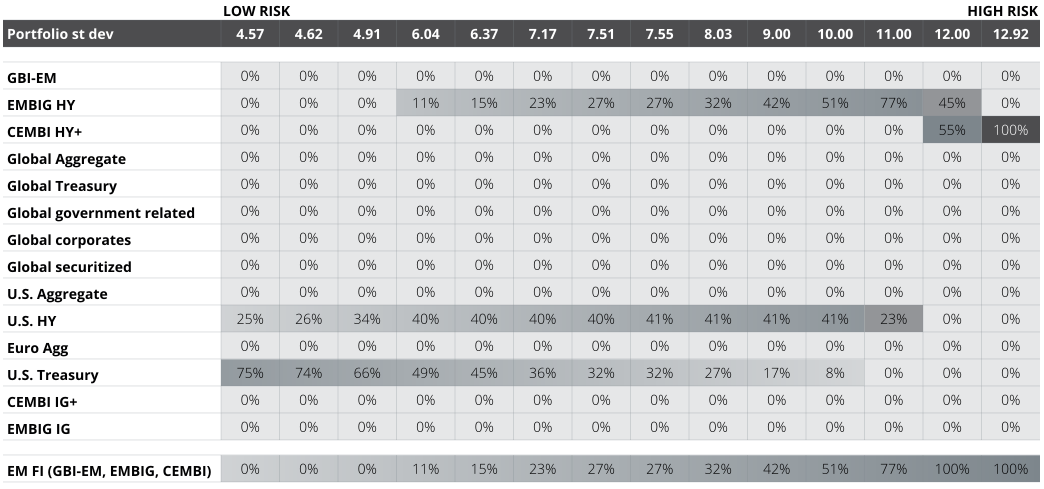
Source: VanEck Research; Bloomberg LP. Data as of December 2024. GBI-EM is represented by the J.P. Morgan Global Diversified Index; EMBIG HY is represented by the J.P. Morgan EMBI Global Diversified Investment Grade Index; CEMBI HY+ is represented by the J.P. Morgan CEMBI High Yield Index; Global Aggregate is represented by the Bloomberg Global Aggregate Bond Index; Global Treasury is represented by Bloomberg Global Treasury Index; Global government related is represented by Bloomberg Global Aggregate Government Related Index; Global corporates represented by Bloomberg Global Aggregate Corporate Index; Global securitized represented by Bloomberg Global Aggregate - Securitized Index; U.S. Aggregate represented by Bloomberg U.S. Aggregate Bond Index; U.S. HY represented by Bloomberg U.S. Corporate High Yield Bond Index; Euro Agg represented by Bloomberg Euro-Aggregate Index; U.S. Treasury represented by Bloomberg U.S. Treasury Index; CEMBI IG+ represented by J.P. Morgan CEMBI Investment Grade Index; EMBIG IG represented by J.P. Morgan EMBI Global Diversified Investment Grade Index; EM FI represented by an equally weighted blend of the J.P. Morgan GBI-EM Global Diversified Index, the J.P. Morgan EMBI Global Diversified Index and J.P. Morgan CEMBI Broad Diversified Index. Efficient frontier comprises investment portfolios that offer the highest expected return for a specific level of risk. Standard deviation measures how much the investment returns deviate from the mean of the probability distribution of investments. Past performance is not a guarantee of future results. Index performance is not representative of fund performance. It is not possible to invest directly in an index. Please see index definitions and other important disclosures at the end of this content.
EMBX | VanEck Emerging Markets Bond ETF
Track Record of Strong Outperformance
Adding EM bonds to a broader strategic asset allocation is a good way to enhance the efficiency of a 60/40 portfolio. Adding an actively managed approach can be even better. Because of the idiosyncrasies among the nations in the EM universe and the nuances across different bond types, we believe an active approach—such as the one employed by the VanEck Emerging Markets Bond ETF, which invests in hard-currency sovereign, local-currency sovereign, and hard-currency corporate bonds—is essential. This approach allows investors to potentially benefit from opportunities wherever they exist in the entire investment universe and sidestep potential problems in an increasingly uncertain world—generating a track record of outperformance over time.
The chart below shows fund performance versus other areas of fixed income. High nominal and real yields provide significant carry and added cushion to withstand market turbulence and a strong USD in recent years. Another contributing factor to outperformance has been its exposure to local-currency bonds, which can benefit from EMFX appreciation against the U.S. dollar. Your choice of fixed income category should not be a proxy decision on USD performance when you can avoid it. The fund and EM bonds overall have benefited from these dynamics, substantially outpacing U.S. and global fixed income.
Outperformance Over the Past 5 years

Source: VanEck Research, Bloomberg LP. Data as of June 2025. Past performance is no guarantee of future results. Index performance is not representative of fund performance. It is not possible to invest directly in an index. Fund performance current to the most recent month end is available by visiting vaneck.com or by calling 800.826.2333.
Average Annual Total Returns* (%) (In USD)
| as of 9/30/2025 | MTD | 3MO | YTD | 1 Year | 3 Years | 5 Years | 10 Years | Since Inception |
| VanEck Emerging Markets Bond ETF | 1.70 | 4.40 | 15.41 | 9.72 | 13.39 | 4.87 | 5.27 | 3.39 |
| 50%JPM GBI-EM GD and 50%JPM EMBI GD | 1.59 | 3.78 | 13.04 | 7.98 | 11.80 | 2.33 | 3.92 | 2.48 |
| ICE BofA Gbl Brd Mkt TR USD | 0.78 | 0.75 | 8.12 | 2.36 | 5.24 | -2.00 | 0.93 | 0.66 |
| ICE BofA Current 10-Y US Trsy TR USD | 0.94 | 1.81 | 6.93 | 1.35 | 2.85 | -3.08 | 0.53 | 0.74 |
Source: VanEck. EMBX Expense Ratio: Gross: 0.75% | Net: 0.75%
Van Eck Associates Corporation (the “Adviser”) will pay all expenses of the Fund, except for the fee payment under the investment management agreement, acquired fund fees and expenses, interest expense, offering costs, trading expenses, taxes and extraordinary expenses. Notwithstanding the foregoing, the Adviser has agreed to pay the offering costs until at least May 1, 2027. “Other Expenses” have been restated to reflect current fees.
The performance data quoted represents past performance. Past performance is not a guarantee of future results. Investment return and principal value of an investment will fluctuate so that an investor's shares, when redeemed, may be worth more or less than their original cost. Performance may be lower or higher than performance data quoted. Please call 800.826.2333 or visit http://vaneck.com for performance current to the most recent month ended.
Prior to 10/06/2025, the Fund operated as the VanEck Emerging Markets Bond mutual fund; performance shown before that date is that fund’s NAV performance (Class I, unadjusted for today’s ETF expenses).
Portfolio Benefits of EM Debt
It’s natural, then, for investors to wonder about risk. The Sharpe ratio combines the return measure with the volatility (risk) measure to quantify the relationship between the returns and risk. Staying within the U.S. investor’s bond menu, let’s look at the same data, showing the change in Sharpe to a US 60/40 portfolio from the addition of emerging markets bonds, as measured by a blend of hard and local currency bonds, and the VanEck Emerging Markets Bond ETF to a fixed income portfolio. Let’s consider how it changes the Sharpe ratio for each 1% of additional allocation of the benchmark, or the Fund, to a fixed income portfolio. You can see that the benchmark is additive, and the Fund more so. This is both about EM bonds and their relative attractiveness to DM bonds, as well as the evidence of the alpha achieved by the Fund. Alpha can be generated on top of the basic asset allocation decision to just add EM bonds.
Sharpe Ratios improve after adding EM Bonds to a U.S. 60/40 portfolio
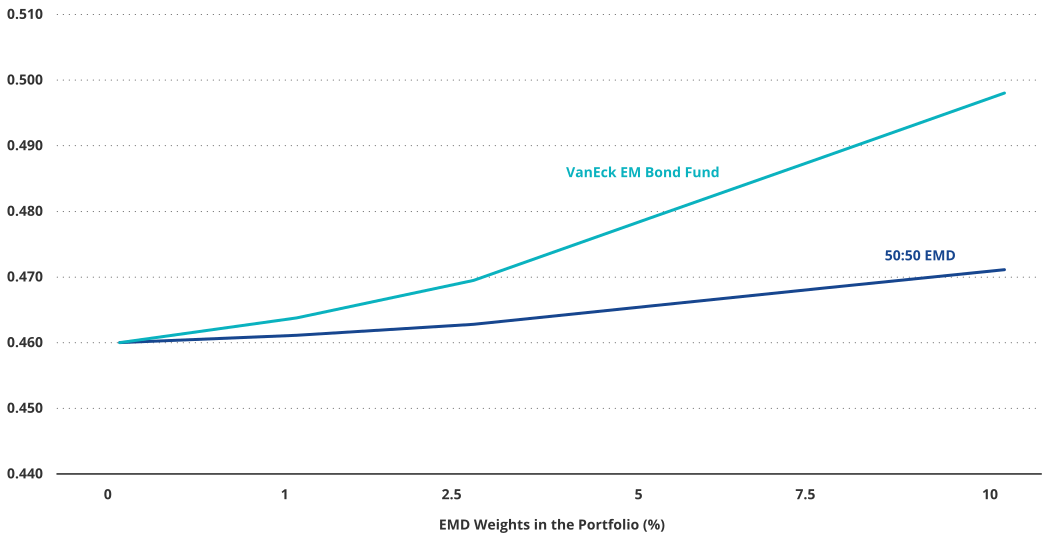
Source: VanEck Research, Bloomberg LP. 50:50 EMD is represented by the 50% J.P. Morgan Emerging Market Bond Global Diversified / 50% J.P. Morgan Government Bond-Emerging Market Global Diversified Index. US bond portfolio is represented by the Bloomberg US Bond Aggregate. The Sharpe ratio is a useful measure of risk-adjusted return, but it assumes normally distributed returns and may not fully reflect downside risk or extreme market volatility. Investors should evaluate it alongside other performance metrics when assessing fund risk and return. Sharpe ratio results are based on historical data, are sensitive to the selected period and risk-free rate, and may not fully capture asymmetric or non-normal return patterns. Sharpe ratio shown is based on performance over the 5-year period ending in June 2025. Calculated using 10-Year US Treasury yield as the risk-free rate. Past performance is no guarantee of future results. Index performance is not representative of fund performance. It is not possible to invest directly in an index. Please see index definitions and other important disclosures at the end of this content.
Recommended subscription
The bottom line? We think investors’ allocations to EM bond strategies that can capture alpha are too low.
VanEck Emerging Markets Bond Strategy
The VanEck Emerging Markets Bond ETF was one of the first blended emerging markets bond strategies in the market. The Strategy adopts a comprehensive approach, investing across the entire EM bond spectrum to maximize opportunity and manage risk in a complex global environment. Despite global disruptions such as the COVID pandemic, the war in Ukraine and economic troubles in China, the fund has consistently outperformed both global and U.S. bond benchmarks. VanEck’s active strategy, which focuses on fundamental value relative to bond risk premia, aims to capitalize on these shifts and avoid troubled issuers, making a compelling case for a diversified, actively managed EM bond allocation.
To receive more Emerging Markets Bonds insights, sign up in our subscription center.

IMPORTANT DISCLOSURES
This is not an offer to buy or sell, or a recommendation to buy or sell any of the securities, financial instruments or digital assets mentioned herein. The information presented does not involve the rendering of personalized investment, financial, legal, tax advice, or any call to action. Certain statements contained herein may constitute projections, forecasts and other forward-looking statements, which do not reflect actual results, are for illustrative purposes only, are valid as of the date of this communication, and are subject to change without notice. Actual future performance of any assets or industries mentioned are unknown. Information provided by third party sources are believed to be reliable and have not been independently verified for accuracy or completeness and cannot be guaranteed. VanEck does not guarantee the accuracy of third party data. The information herein represents the opinion of the speaker(s), but not necessarily those of VanEck or its other employees.
Emerging Market securities are subject to greater risks than U.S. domestic investments. These additional risks may include exchange rate fluctuations and exchange controls; less publicly available information; more volatile or less liquid securities markets; and the possibility of arbitrary action by foreign governments, or political, economic, or social instability.
The Fund’s benchmark index (50% GBI-EM/50% EMBI) is a blended index consisting of 50% J.P. Morgan Government Bond Index-Emerging Markets (GBI-EM) Global Diversified and 50% J.P. Morgan Emerging Markets Bond Index (EMBI). The J.P. Morgan GBI-EM Global Diversified tracks local currency bonds issued by Emerging Markets governments. The J.P. Morgan EMBI Global Diversified tracks returns for actively traded external debt instruments in emerging markets, and is also J.P. Morgan’s most liquid U.S dollar emerging markets debt benchmark.
ICE BofA Global Broad Market Index tracks the performance of investment grade debt publicly issued in the major domestic and eurobond markets, including sovereign, quasi-government, corporate, securitized and collateralized securities. ICE BofA Current 10-Year U.S. Treasury Index is comprised of the most recently issued 10-year U.S. Treasury note.
An investment in the VanEck Emerging Markets Bond ETF may be subject to risks which include, among others, risks related to active management, credit, credit-linked notes, currency management strategies, derivatives, emerging market issuers, ESG investing, foreign currency, foreign securities, hedging, high portfolio turnover, high yield securities, interest rate, market, non-diversified, operational, restricted securities, investing in other funds, sovereign bond, special risk considerations of investing in African, Asian, and Latin American issuers, authorized participant concentration, no guarantee of active trading market, trading issues, fund shares trading, premium/discount and liquidity of fund shares, and cash transactions risks, all of which may adversely affect the Fund. Emerging market issuers and foreign securities may be subject to securities markets, political and economic, investment and repatriation restrictions, different rules and regulations, less publicly available financial information, foreign currency and exchange rates, operational and settlement, and corporate and securities laws risks.
Investing involves substantial risk and high volatility, including possible loss of principal. An investor should consider the investment objective, risks, charges and expenses of the Funds carefully before investing. To obtain a prospectus and summary prospectus, which contain this and other information, call 800.826.2333 or visit vaneck.com. Please read the prospectus and summary prospectus carefully before investing.
© Van Eck Securities Corporation, Distributor, a wholly owned subsidiary of Van Eck Associates Corporation.
Related Funds
IMPORTANT DISCLOSURES
This is not an offer to buy or sell, or a recommendation to buy or sell any of the securities, financial instruments or digital assets mentioned herein. The information presented does not involve the rendering of personalized investment, financial, legal, tax advice, or any call to action. Certain statements contained herein may constitute projections, forecasts and other forward-looking statements, which do not reflect actual results, are for illustrative purposes only, are valid as of the date of this communication, and are subject to change without notice. Actual future performance of any assets or industries mentioned are unknown. Information provided by third party sources are believed to be reliable and have not been independently verified for accuracy or completeness and cannot be guaranteed. VanEck does not guarantee the accuracy of third party data. The information herein represents the opinion of the speaker(s), but not necessarily those of VanEck or its other employees.
Emerging Market securities are subject to greater risks than U.S. domestic investments. These additional risks may include exchange rate fluctuations and exchange controls; less publicly available information; more volatile or less liquid securities markets; and the possibility of arbitrary action by foreign governments, or political, economic, or social instability.
The Fund’s benchmark index (50% GBI-EM/50% EMBI) is a blended index consisting of 50% J.P. Morgan Government Bond Index-Emerging Markets (GBI-EM) Global Diversified and 50% J.P. Morgan Emerging Markets Bond Index (EMBI). The J.P. Morgan GBI-EM Global Diversified tracks local currency bonds issued by Emerging Markets governments. The J.P. Morgan EMBI Global Diversified tracks returns for actively traded external debt instruments in emerging markets, and is also J.P. Morgan’s most liquid U.S dollar emerging markets debt benchmark.
ICE BofA Global Broad Market Index tracks the performance of investment grade debt publicly issued in the major domestic and eurobond markets, including sovereign, quasi-government, corporate, securitized and collateralized securities. ICE BofA Current 10-Year U.S. Treasury Index is comprised of the most recently issued 10-year U.S. Treasury note.
An investment in the VanEck Emerging Markets Bond ETF may be subject to risks which include, among others, risks related to active management, credit, credit-linked notes, currency management strategies, derivatives, emerging market issuers, ESG investing, foreign currency, foreign securities, hedging, high portfolio turnover, high yield securities, interest rate, market, non-diversified, operational, restricted securities, investing in other funds, sovereign bond, special risk considerations of investing in African, Asian, and Latin American issuers, authorized participant concentration, no guarantee of active trading market, trading issues, fund shares trading, premium/discount and liquidity of fund shares, and cash transactions risks, all of which may adversely affect the Fund. Emerging market issuers and foreign securities may be subject to securities markets, political and economic, investment and repatriation restrictions, different rules and regulations, less publicly available financial information, foreign currency and exchange rates, operational and settlement, and corporate and securities laws risks.
Investing involves substantial risk and high volatility, including possible loss of principal. An investor should consider the investment objective, risks, charges and expenses of the Funds carefully before investing. To obtain a prospectus and summary prospectus, which contain this and other information, call 800.826.2333 or visit vaneck.com. Please read the prospectus and summary prospectus carefully before investing.
© Van Eck Securities Corporation, Distributor, a wholly owned subsidiary of Van Eck Associates Corporation.