The Curiously Unpopular Case for RMB/CNY Appreciation
August 12, 2025
Read Time 8 MIN
EMBX | VanEck Emerging Markets Bond ETF
Remember the consensus view for 2025 that tariffs would force China (and other emerging markets) to devalue their currencies? The opposite happened, spectacularly so, with the Chinese Yuan (CNY) at its strongest level since November 2024 and EM local currency debt up around 12% as of 7/30/25. Why did this happen and what does it mean? CNY strength is a key component (among others). For China’s authorities, a stable or strong CNY is consistent with their goal of renminbi (RMB) internationalization. It supports consumers’ real incomes and wealth. It anchors inflation and expectations. Therefore, it addresses key imbalances and arguably makes a case for fiscal stimulus. It further contains trade war risks that would clearly arise should China simply devalue to compensate for tariffs. For many EMs, it means a new landscape of upward pressure on their currencies. We lay out the ongoing and surprisingly unpopular case for RMB appreciation below.
1. CNY is already cheap. Using the BIS real effective exchange rate model (which simply measures value incorporating inflation differentials with trading partners), Exhibit 1 shows more specifically that CNY is almost 30% undervalued on this basis. (The dollar is overvalued on this basis, and if we took the chart back farther you’d see it’s near record-high over-valuation on the BIS model.)
Exhibit 1 – CNY REER Cheap, USD Not
Real Effective Exchange Rates - USD and CNY

Source: BIS via Bloomberg LP. Data as of June 2025.
2. The roots of this CNY undervaluation – low Chinese inflation relative to US inflation – look set to continue. Exhibit 2 shows the evolution of the IMF’s Chinese and US inflation forecasts – China’s has been downward-revised and US’s has been upward-revised. This should have and has led to USD weakness against CNY. We should add that the CNY’s strength and stability this year should reinforce China’s de-/dis-inflation dynamic, and USD weakness and volatility this year could reinforce or reignite the United States’ inflationary dynamic.
Exhibit 2 – US Inflation Forecast Rising, China’s Declining
Evolution of 2025 Inflation Forecasts
(Median, percent, year over year)

Source: IMF via Bloomberg LP. Data as of April 2025.
3. China has significant net asset surpluses with the US (and the world), meaning it owns more USD assets than the US owns of CNY assets. The net international investment position is a popular way to measure this, now significant, imbalance. This is a balance sheet or stock measure, not a flow measure. We make this distinction because the primary response from economists was to analyze China’s balance of payments statistics to “solve” for the “flow” of Chinese exports. If that’s your framing, of course further CNY devaluation should have happened in order to boost exports and make imports dearer, because the economist is solving that problem. But, due to China’s NIIP it can manage the currency stronger, an option it didn’t previously have – it does not have to devalue and it has not been devaluing, in fact the daily foreign exchange (FX) fixes have been regularly stronger for CNY than the bank-predicted levels in 2025. So, what was/is the right economic analysis this time? We continue to think that the correct framework is that the stock of USD assets owned by China are what is being activated. China’s (and others’) USD assets are being sold and reshored to China or to other non-US shores. This is an opinion, as the data will speak more clearly later, but it seems to be the only explanation for what to many has been surprising strength in CNY this year. (Speaking of external balance sheet strength, China and many EMs are net creditors in USD as well – they have more USD in reserves than government debt in USD, underlining credit quality in dollars.)
Exhibit 3 – China Owns More of US Than Vice Versa
Net International Investment Position - U.S. and China (bn USD)

Source: IMF via Bloomberg LP. Data as of June 2025.
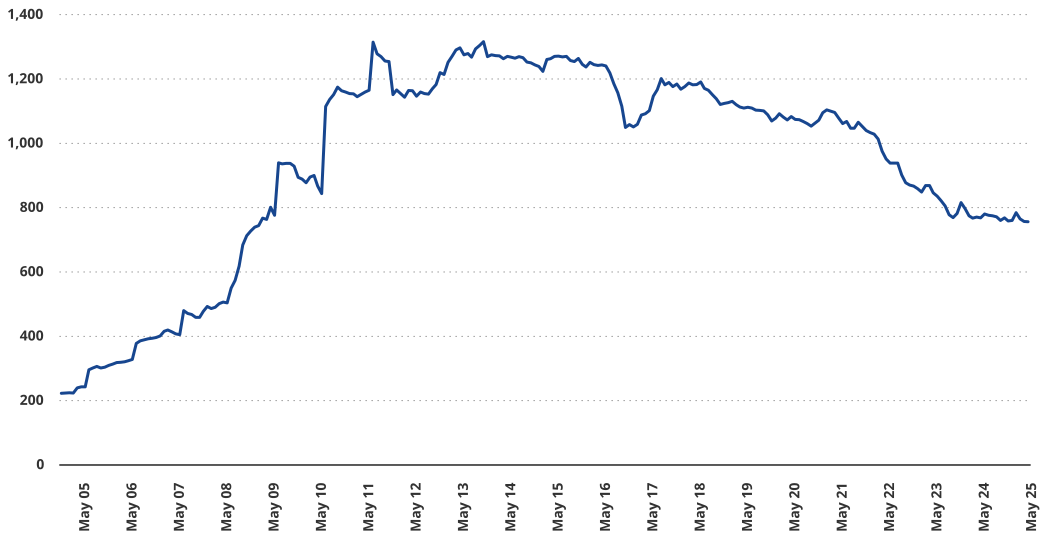
4. PBOC is using fewer US Treasuries in reserves, and there’s more to go, arguably. You see the data and trend below. We would strongly observe that unlike global central bank’s as surveyed by the IMF, China’s reserves are still nearly four times their lowest levels, while global central bank holdings of US Treasuries are hovering at their lowest levels. This points to further downside risk in Chinese ownership of US Treasuries and thus upward pressure on US yields and/or downward pressure on the USD. Conversely, we should add that Chinese Government Bonds (CGBs) are increasingly demanded as reserve assets, but that process is intentionally opaque and will only be clear when it is established. We should also acknowledge that state bank holdings are reasonably looked at as part of the Venn diagram capturing central bank holdings, but we don’t think that’s worth delving into here. Also, when we are country economists, we do not take reporting of gold reserves too trustingly, but the true (higher) amounts likely reinforce our point. A final reference should be made to US sanctions risks which have clearly changed the attractiveness of US Treasuries to reserve managers, and which is especially alive in countries that could move to a more adversarial relationship.
Exhibit 4 – China Is Already Reducing US Treasury Exposure
China's UST Holdings, bn USD
Source: Bloomberg LP. Data as of June 2025.
Recommended subscription
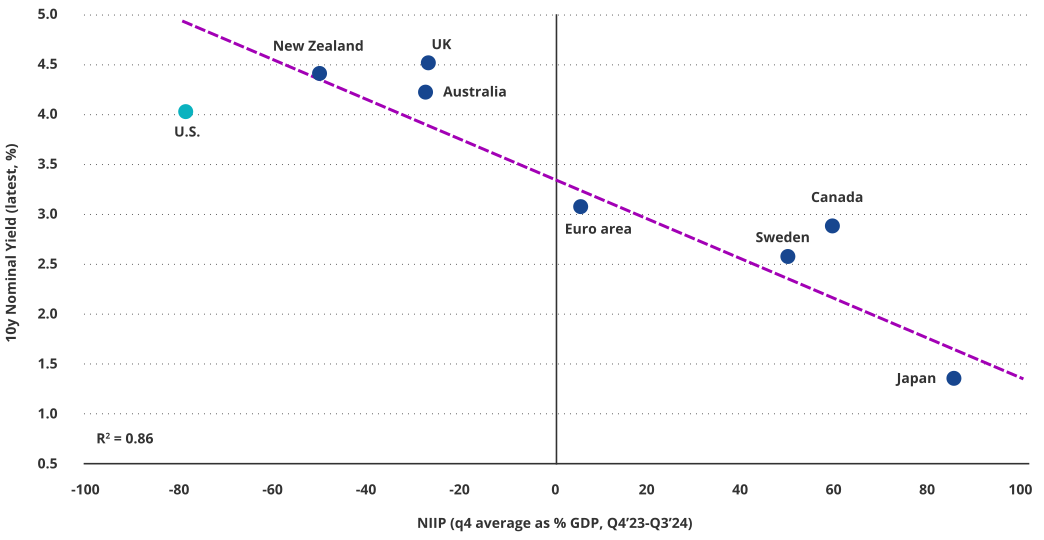
5. The rubber hits the road on our NIIP framing because US dependence on fiscal financing (remember, the US borrows from China and Japan) should be reflected in a different risk/reward profile for onshore Chinese or Japanese Treasury buyers. One way of measuring this precisely is cross-currency swap spreads. An onshore Chinese or Japanese buyer will typically hedge any US Treasuries into CNY or JPY. But, given FX hedging costs, the hedge treasury in Japan pays around ¼ of the yield of a simple unhedged JGB. We’ve shown this in other publications. Another way to look at it is to use the NIIP framework to see how much higher US yields “should” be to incorporate this fact. We show this below, and it points to USD over-valuation/US Treasury over-valuation (yields too low).
Exhibit 5 – What US NIIP Might Mean For US Rates/USD
A simple NIIP framework implies more USD weakness needed unless US yields rise more than peers
Source: Deutsche Bank, Bloomberg LP, Haver Analytics. Data as of June 2025.
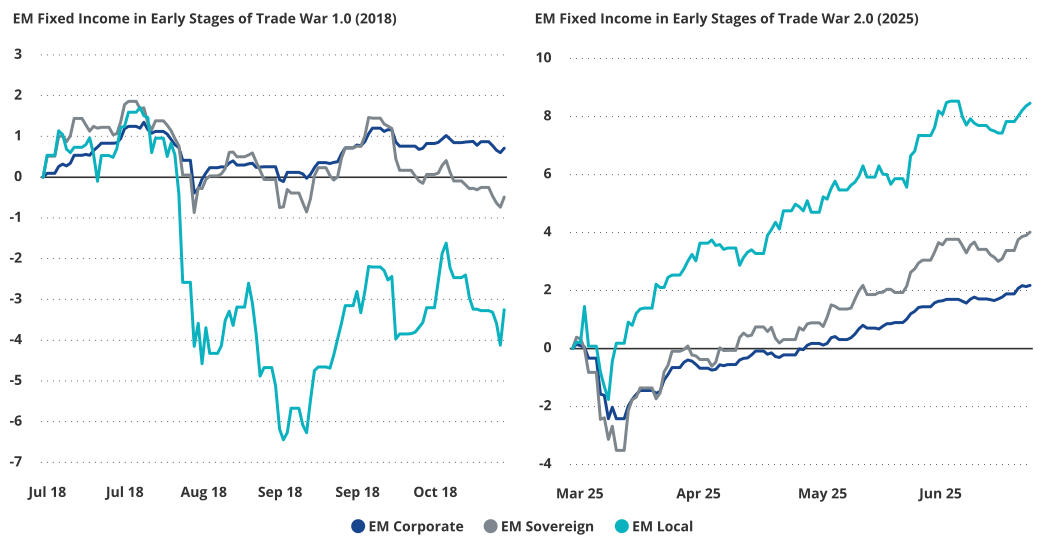
6. Tariff game theory supports RMB appreciation. Let’s get a history lesson out of the way. If you expect official statements on currency arrangements, don’t hold your breath and don’t trade bonds or currencies. Given that many say we are in Nixonian times, we’ll refer to the Smithsonian Agreement of December 1971. This was negotiated for months prior to its announcement. Official references to currencies remain highly controlled if allowed at all, in all countries. So, the idea that the market will “know” with official clarity about currency arrangements is a non-starter, in our view. What’s our understanding? The simplest version is that key trading partners are being told that if they devalue after a trade deal (to be humorously extreme about it) would be a deal-killer. Reread that – you can’t weaken your currency and maybe you have to strengthen it if you don’t want another round of tariff trouble. We aren’t getting into the nature of the agreements which can be vague and weak or specific and strong…because they cannot be known, only surmised. But now further remember your pile of USD assets we noted in the NIIP above. So, you’re sitting on a net pile of USD and you know USD has to go down versus your own shore’s/currency’s assets. What will you do? Exhibit 6 has the answer: you bring your USD onshore or to other non-US shores). EM assets are reacting positively to Trump Tariffs v.2, and the market continues to scramble for an explanation.
Exhibit 6 – Trump 1 Hurt EM, Trump 2 Helping…Why?
Source: VanEck Research, Bloomberg LP.
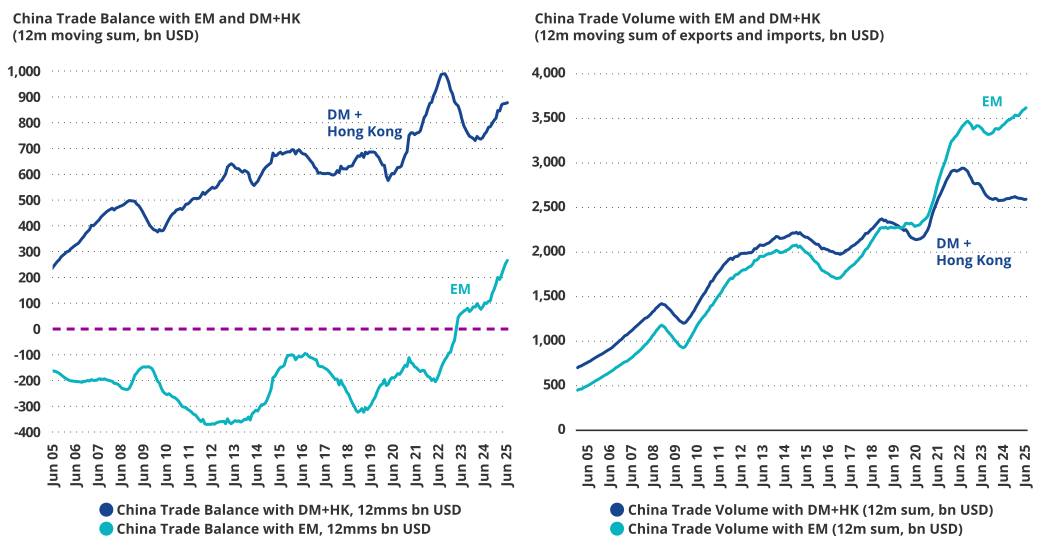
7. This has significant positive implications for EM. There’s not just one currency cross anymore, CNY is more important to many EMs than USD. Exhibit 7 shows a couple versions of this. On the left you see the China/EM trade balance rising secularly against the China/DM trade balance. On the right you see trade volume between China/EM surging above the volume of China/DM trade. There are obviously big country variations (Mexico is uniquely very exposed to the US, for example, whereas Chile and Brazil are much less so), which we discuss in our other publications.
Exhibit 7 - CNY Is More Important than USD to Many EMs
Source: VanEck Research; Bloomberg LP. Data as of June 2025.
8. So you think China’s currency is risky; EM currencies, too? Well, if you think volatility is a measure of risk, Exhibit 8 shows the remarkable stability of CNY compared to JPY and USD. It’s not the scope for this note, but we’ve written elsewhere about “fiscal dominance” characterizing many DMs – government debt is so high that monetary policy loses meaning and traction, which we see as underneath this volatility in DM currencies. We add a bonus Exhibit 9 showing how all of EM local bond market volatility appears to be in a similar regime now relative to higher DM bond volatility. This underlines the centrality of CNY for EMs more broadly. Note that currency stability supports Chinese authorities’ objective of internationalizing the RMB, increases consumers’ real income and wealth, and anchors inflation and inflation expectations. It also, to our conjecture, prevents upsetting a US that would surely retaliate if the currency was simply devalued to compensate for tariffs.
Exhibit 8 – CNY Stable Versus USD and JPY
Exchange Rate volatility Trends (CNY vs JPY)

Source: Bloomberg LP. Data as of July 2025.
Bonus Exhibit 9 – EM Local Bonds Less Volatile Than DM Bonds
EM Local Bonds vs DM Sovereigns - 90-day Total Return Volatility (%)
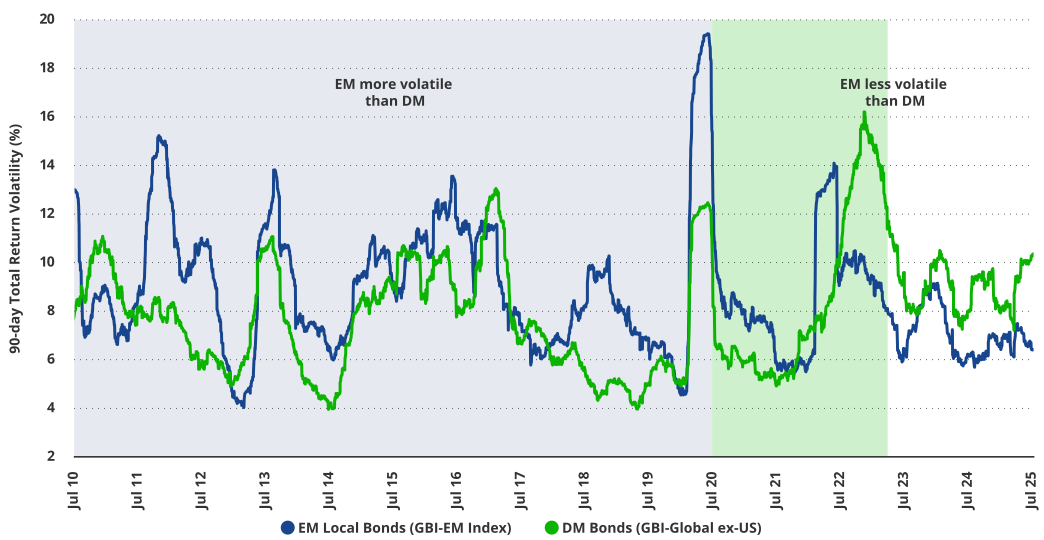
Source: VanEck Research, Bloomberg LP. Data as of July 2025.
The evidence for Chinese currency appreciation in 2025 is building. A structurally undervalued CNY, persistent inflation divergence with the U.S., and China’s strong external balance sheet all support a stronger currency. Meanwhile, de-risking from U.S. Treasuries and growing trade ties between China and EMs are redefining global FX dynamics. In this context, CNY stability is not only consistent with China’s policy goals—it may be central to a new era of EM financial strength.
To receive more Emerging Markets Bonds insights, sign up in our subscription center.

IMPORTANT DISCLOSURES
Please note that VanEck may offer investments products that invest in the asset class(es) or industries included herein.
This is not an offer to buy or sell, or a recommendation to buy or sell any of the securities, financial instruments or digital assets mentioned herein. The information presented does not involve the rendering of personalized investment, financial, legal, tax advice, or any call to action. Certain statements contained herein may constitute projections, forecasts and other forward-looking statements, which do not reflect actual results, are for illustrative purposes only, are valid as of the date of this communication, and are subject to change without notice. Actual future performance of any assets or industries mentioned are unknown. Information provided by third party sources are believed to be reliable and have not been independently verified for accuracy or completeness and cannot be guaranteed. VanEck does not guarantee the accuracy of third-party data. The information herein represents the opinion of the author(s), but not necessarily those of VanEck or its other employees.
Emerging Market securities are subject to greater risks than U.S. domestic investments. These additional risks may include exchange rate fluctuations and exchange controls; less publicly available information; more volatile or less liquid securities markets; and the possibility of arbitrary action by foreign governments, or political, economic or social instability.
Investments in commodities can be very volatile and direct investment in these markets can be very risky, especially for inexperienced investors.
Investments in emerging markets bonds may be substantially more volatile, and substantially less liquid, than the bonds of governments, government agencies, and government-owned corporations located in more developed foreign markets. Emerging markets bonds can have greater custodial and operational risks, and less developed legal and accounting systems than developed markets.
All investing is subject to risk, including the possible loss of the money you invest. As with any investment strategy, there is no guarantee that investment objectives will be met and investors may lose money. Diversification does not ensure a profit or protect against a loss in a declining market. Past performance is no guarantee of future results.
© Van Eck Associates Corporation.
Related Funds
IMPORTANT DISCLOSURES
Please note that VanEck may offer investments products that invest in the asset class(es) or industries included herein.
This is not an offer to buy or sell, or a recommendation to buy or sell any of the securities, financial instruments or digital assets mentioned herein. The information presented does not involve the rendering of personalized investment, financial, legal, tax advice, or any call to action. Certain statements contained herein may constitute projections, forecasts and other forward-looking statements, which do not reflect actual results, are for illustrative purposes only, are valid as of the date of this communication, and are subject to change without notice. Actual future performance of any assets or industries mentioned are unknown. Information provided by third party sources are believed to be reliable and have not been independently verified for accuracy or completeness and cannot be guaranteed. VanEck does not guarantee the accuracy of third-party data. The information herein represents the opinion of the author(s), but not necessarily those of VanEck or its other employees.
Emerging Market securities are subject to greater risks than U.S. domestic investments. These additional risks may include exchange rate fluctuations and exchange controls; less publicly available information; more volatile or less liquid securities markets; and the possibility of arbitrary action by foreign governments, or political, economic or social instability.
Investments in commodities can be very volatile and direct investment in these markets can be very risky, especially for inexperienced investors.
Investments in emerging markets bonds may be substantially more volatile, and substantially less liquid, than the bonds of governments, government agencies, and government-owned corporations located in more developed foreign markets. Emerging markets bonds can have greater custodial and operational risks, and less developed legal and accounting systems than developed markets.
All investing is subject to risk, including the possible loss of the money you invest. As with any investment strategy, there is no guarantee that investment objectives will be met and investors may lose money. Diversification does not ensure a profit or protect against a loss in a declining market. Past performance is no guarantee of future results.
© Van Eck Associates Corporation.