Before the Crowd: Central Asia’s New Investment Window
July 06, 2026
Read Time 6 min
Key Takeaways
- Central Asia is becoming more investable to international investors, but each country tells a different story and requires a different approach.
- Uzbekistan is bringing major state-owned companies to public markets for the first time, representing one of the most significant privatization programs in emerging markets today.
- Kazakhstan offers compelling value in select companies, particularly in digital payments and uranium, as interest rates begin to turn.
- New trade routes, a wave of IPOs, and exposure to gold, uranium, and copper create a distinct opportunity across the region.
Why Central Asia, Why Now
In May 2026, VanEck’s Emerging Markets portfolio management team traveled to Uzbekistan, Kazakhstan, and Georgia to meet with governments, central banks, companies, and upcoming IPO candidates.
For years, Central Asia had the ingredients emerging markets (EM) investors traditionally look for: young populations, low financial and services penetration, strategic geography, and world-class natural resources. The bottleneck was not the macro story but rather whether that story could be supported by structural reform, sustainable institutions, and investable opportunities. This is beginning to change.
Global trade is being rerouted away from Russia, emphasizing the region’s role as a transit corridor. Commodity demand for uranium and gold is rising. Governments are selling stakes in major state-owned businesses for the first time. These are not incremental developments. They are structural shifts that are beginning to create a genuine investment opportunity for clients willing to look beyond the more familiar corners of emerging markets.
The key insight from the trip is that this is not one trade. Uzbekistan and Kazakhstan are two core Central Asian stories, each requiring a distinct investment approach. Georgia, while not part of Central Asia proper, enters the picture through its role in the emerging Middle Corridor trade route and as an additional equity opportunity we cover within the fund.
Uzbekistan — The Market Is Now Open
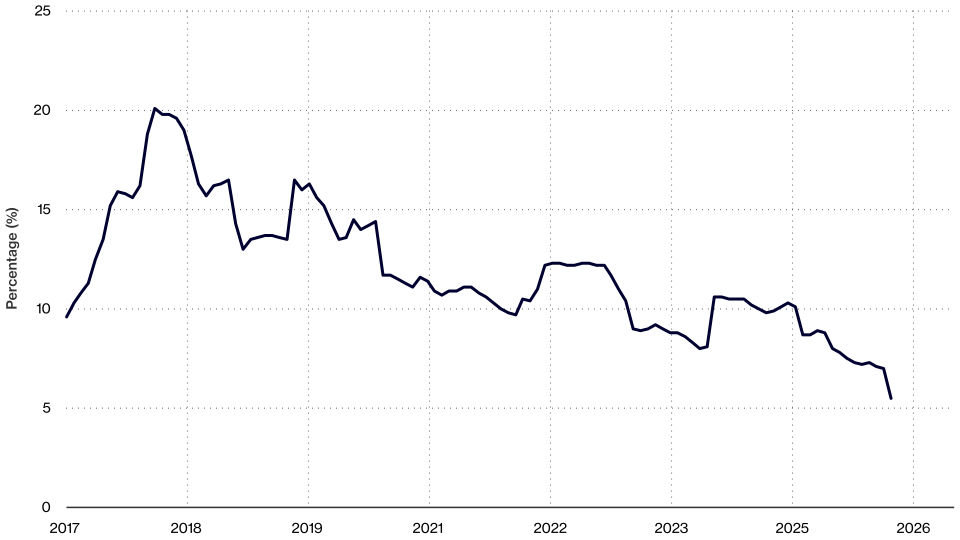
Uzbekistan is the most compelling structural growth story in the region. The economy is growing at nearly 8%[1], and average wages have doubled over the past three years[2], a shift that is driving first-time demand for banking, modern retail, and digital services. Inflation is falling, and interest rates are expected to decline over the next two years as the central bank gains confidence that its 5% inflation target[3]is within reach. Fiscal management is more disciplined than most investors expect: public debt is low, the budget is transparent, and the government has followed through on difficult reforms, including sharp increases in energy prices, despite the short-term pain they cause.
The political dynamics have been key to these positive economic changes. For the first 25 years of its independence, Uzbekistan was one of the most closed economies in the former Soviet Union. Since President Mirziyoyev came to power in 2016, the country has seen a series of structural reforms. The country’s progress going forward will continue to remain closely tied to the President’s agenda, with his mandate running through 2030. While the direction of policy has been consistent, any shift in political or social dynamics, or in the priorities of key decision-makers, would need to be monitored carefully.
The developing capital markets story is equally significant. The UZNIF IPO in May, nearly $700M and heavily oversubscribed[4], proved that global investors are ready to engage with Uzbekistan. A government decree has committed to bringing 12 more major state-owned companies to market by 2028, covering sectors from gold mining and uranium to telecoms, aviation, and banking.[5]
The main risks to watch are valuation and execution. With limited listed history, early IPOs in Uzbekistan can attract higher valuation driven by scarcity demand. Entry discipline is essential. Beyond valuation, many of the companies coming to market still have deep state-sector roots and are adapting to public market standards. The opportunity is real but investors will need to see tangible progress on governance, disclosure, and minority shareholder alignment before participating.
Tariff-Related Inflation Spike Is Fading; FX Still Matters
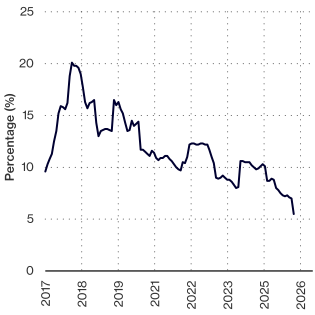
Uzbekistan CPI, Year-on-Year
Source: Central Bank of Uzbekistan
Kazakhstan — A Value Market With Selective Structural Winners
Kazakhstan requires a different lens. This is a larger, more mature economy than Uzbekistan where the right framing is not high growth but value with specific catalysts, as select companies are attractively priced relative to what they deliver, and several near-term triggers have the potential to close that gap.
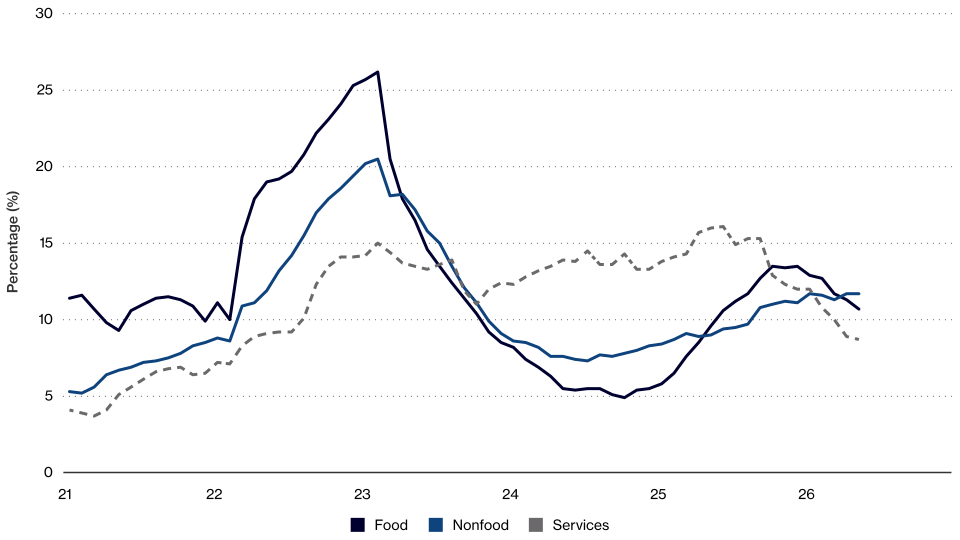
Interest rates are elevated, with the central bank's policy rate near 18%[6], but the disinflation trend is clear, and a cutting cycle already underway. Oil production has plateaued following the completion of a major field expansion, meaning future economic growth will increasingly depend on diversification beyond oil into a broader range of sectors. It is in uranium where the structural case is perhaps most compelling: Kazakhstan produces roughly 30% of the world's supply at a time when a global shortage is building and new mines take decades to develop.[7]
Looking ahead, Kazakhstan's IPO pipeline adds further opportunity. KTZ, the national railway and a direct beneficiary of the Middle Corridor trade route, is targeting a listing in late 2026.
Disinflation Is Underway but Policy Rate Remains Tight
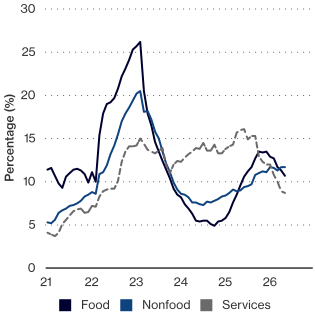
Kazakhastan Inflation by Component, Year-on-Year
Source: National Statistical Agency of Kazakhstan
Recommended subscription
The Middle Corridor — A New Trade Route Takes Shape
One of the most underappreciated themes connecting all three countries is the emergence of the Middle Corridor, a new trade route running from China through Central Asia, across the Caspian Sea, and into Europe via the Caucasus and Turkey. It is gaining real traction as a direct alternative to routing goods through Russia.
For Kazakhstan, the financial impact is already visible. KTZ, the national railway, earns roughly 70 cents of operating profit for every dollar of transit revenue, far above the margins it generates on regulated domestic freight.[8]China-to-Europe rail's share of total trade has risen from roughly 2% before 2022 to around 5% today, and there is meaningful runway from here.[9]
While Georgia is not a Central Asian market, it sits at the western end of the corridor and its GDP growth of nearly 9%[10]in early 2026 reflects that positioning. That said, its investment case is increasingly shaped by politics: the ruling party has consolidated power, EU membership has been paused until end-2028, and foreign direct investment has slowed. We stay invested through specific high-quality assets but do not underwrite Georgia as a clean convergence story.
An important nuance for investors: this route does not disappear if the war in Ukraine ends. As long as sanctions on Russia remain in place, businesses will continue to use the alternative corridor. The opportunity is durable, not transient. Centrum, an Uzbekistan-based logistics company, illustrates the commercial scale of what is possible, growing revenue from $100M to over $1B in just four years by positioning itself at the center of China-to-Europe cargo flows.[11]
A Developing IPO PipelineUzbekistan is preparing to bring assets to public markets that have simply never been available to outside investors. The scale is significant, and the quality of some of these businesses are among the largest and most strategically important in their respective industries.
Navoi Gold is the standout. It is the world's fourth largest gold producer[12], generating $7B in annual operating profit at a 64% margin[13]. When it lists, it could be one of the largest emerging markets IPOs in years. Navoi Uranium and AMMC add exposure to a uranium supply shortage and critical minerals demand respectively, at a time when both themes are attracting significant global investor attention.
Uzum, Uzbekistan's only unicorn, represents the consumer technology angle. A Tencent-backed super-app combining e-commerce, payments, and lending, it is targeting an IPO valuation of approximately $6B[14], the region's closest equivalent to what Kaspi became for Kazakhstan. Kazakhstan's own pipeline includes KTZ, Otbasy Bank, and potentially KMG, adding depth to an already active new-issue calendar across the region.
What This Means for Investors
Central Asia is in the early stages of opening its markets to outside investors. The combination of real economic growth, a pipeline of historically significant IPOs, commodity exposure in gold, uranium, and copper, and a rewiring of global trade routes makes this a distinctive opportunity, one that is difficult to replicate elsewhere in the emerging markets universe.
Our approach reflects the nuance the situation requires. In Uzbekistan, we are optimistic on the long-term direction but disciplined on entry valuation, as scarcity can drive prices ahead of fundamentals. In Kazakhstan, we see a more favorable backdrop taking shape as rates fall and the market begins to price in the underlying quality of select businesses. In Georgia, we stay invested through our highest-conviction position while keeping broader country exposure measured until the political picture improves.
Early engagement in markets like these, before they become widely followed and before the narrative is consensus, is precisely the kind of opportunity we have been built to identify and act on.
Our Positioning Across Central Asia
Across the region, our VanEck Emerging Markets Fund remains selective.
UZNIF* (0.17% of Fund Net Assets*), Uzbekistan's national privatization fund, holds stakes in 13 major state-owned enterprises (SOEs) spanning energy, aviation, banking, and telecoms.[15]As the first sizable IPO out of Uzbekistan, it is the clearest signal that the country's capital markets are open for business and gives investors access to assets that were simply unavailable until very recently.
The structure draws on a well-established playbook: Romania's Fondul Proprietatea, created in 2005 to hold stakes in Romanian state-owned companies during that country's own privatization transition. Franklin Templeton, which managed Fondul Proprietatea through that process, is applying a similar investment philosophy to Uzbekistan through UZNIF. Past performance of a separate fund in a different country and period is not indicative of future results.
OTP* (1.1% of Fund Net Assets*), is the largest commercial bank in Hungary and a leading regional bank in Central and Eastern Europe. In 2023, the bank entered Uzbekistan by acquiring an 80% stake of Ipoteka, the largest mortgage lender in Uzbekistan.[16]The bank has meaningful exposure to the country's developing housing market and growing middle class.
We believe Kaspi* (1.4% of Fund Net Assets*), Kazakhstan's dominant payments, ecommerce, and lending platform, is well positioned to benefit as interest rates begin to fall. High rates have created near-term headwinds, but the core franchise continues to grow strongly, with Kazakhstan orders up over 40% year-over-year in Q1 2026.[17]We view the current pressure as cyclical rather than structural, and expect the business to benefit as the rate environment eases.
Lion Finance Group, previously known as Bank of Georgia* (1.4% of Fund Net Assets*), Georgia's leading bank with a dominant position in a highly profitable two-bank market, is our preferred way to access the country's strong economic growth. We believe the company will continue to grow its Armenian operations, benefiting from Armenia's lower banking penetration and rapid loan growth, which also reduces its exposure to Georgia's domestic political situation.
Positioning for Growth
Our meetings across Uzbekistan, Kazakhstan, and Georgia reinforced one clear conclusion: Central Asia is no longer a region to watch from a distance. The macro foundations are improving, a historic IPO pipeline is taking shape, and the Middle Corridor trade route is already generating measurable economic impact. The opportunity is real, but it is not uniform. Uzbekistan offers access to assets that have simply never been available to outside investors; Kazakhstan rewards patience and selectivity as rates begin to fall; Georgia remains a high-conviction position held with measured country exposure. What connects all three is timing. Markets like these re-rate quickly once the narrative becomes consensus.
Emerging Markets Fund - Class A
To receive more Emerging Markets Equity insights, sign up in our subscription center.

Important Disclosures
1 Bloomberg, Central Bank of Uzbekistan as of 3/31/2026
2 National Statistics Committee of the Republic of Uzbekistan, ending in 2025
3 Central Bank of Uzbekistan
4 UZNIF, May 2026
5 UZNIF company information; decree was signed in April 2025
6 National Bank of Kazakhstan as of March 2026
7 Kazatomprom (company data) as of May 2026
8 KTZ, May 2026
9 KTZ, May 2026
10 Bloomberg Q1 2026
11 Centrum, FY2021-2025
12 Navoi Gold, FY2025
13 Navoi Gold, FY2025
14 Uzum. Valuation target is management ambition. The latest round implied $2.3 billion in March 2026 pre money
15 UZNIF as of May 2026
16 OTP as of June 2023
17 Kaspi as of May 2026
* Net assets as of 6/30/2026
All indices listed are unmanaged indices and include the reinvestment of all dividends, but do not reflect the payment of transaction costs, advisory fees or expenses that are associated with an investment in the Fund. Certain indices may take into account withholding taxes. An index’s performance is not illustrative of the Fund’s performance. Indices are not securities in which investments can be made.
The MSCI Emerging Markets Investable Market Index (IMI) captures large, mid, small-cap cap representation across emerging markets (EM) countries. The index covers approximately 99% of the free float-adjusted market capitalization in each country.
The MSCI EM IMI Growth Index is a benchmark that captures the performance of large and mid-cap securities exhibiting growth characteristics within the MSCI Emerging Markets Investable Market Index (IMI).
This is not an offer to buy or sell, or a recommendation to buy or sell any of the securities, financial instruments or digital assets mentioned herein. The information presented does not involve the rendering of personalized investment, financial, legal, tax advice, or any call to action. Certain statements contained herein may constitute projections, forecasts and other forward-looking statements, which do not reflect actual results, are for illustrative purposes only, are valid as of the date of this communication, and are subject to change without notice. Actual future performance of any assets or industries mentioned are unknown. Information provided by third party sources are believed to be reliable and have not been independently verified for accuracy or completeness and cannot be guaranteed. VanEck does not guarantee the accuracy of third party data. The information herein represents the opinion of the author(s), but not necessarily those of VanEck or its other employees.
You can lose money by investing in the Fund. Any investment in the Fund should be part of an overall investment program, not a complete program. The Fund is subject to risks which may include, but are not limited to, risks associated with active management, consumer discretionary sector, direct investments, emerging market issuers, ESG investing strategy, financials sector, foreign currency, foreign securities, industrials sector, information technology sector, market, operational, restricted securities, investing in other funds, small- and medium-capitalization companies, special purpose acquisition companies, special risk considerations of investing in Brazilian, Chinese, Indian, Latin American and Taiwanese issuers, and Stock Connect risks, all of which may adversely affect the Fund. Emerging market issuers and foreign securities may be subject to securities markets, political and economic, investment and repatriation restrictions, different rules and regulations, less publicly available financial information, foreign currency and exchange rates, operational and settlement, and corporate and securities laws risks. Small- and medium-capitalization companies may be subject to elevated risks. Investments in Chinese issuers may entail additional risks that include, among others, lack of liquidity and price volatility, currency devaluations and exchange rate fluctuations, intervention by the Chinese government, nationalization or expropriation, limitations on the use of brokers, and trade limitations.
Investing involves substantial risk and high volatility, including possible loss of principal. Bonds and bond funds will decrease in value as interest rates rise. An investor should consider the investment objective, risks, charges and expenses of a fund carefully before investing. To obtain a prospectus and summary prospectus, which contain this and other information, call 800.826.2333 or visit vaneck.com. Please read the prospectus and summary prospectus carefully before investing.
© Van Eck Securities Corporation, Distributor, a wholly owned subsidiary of Van Eck Associates Corporation.
Related Funds
Important Disclosures
1 Bloomberg, Central Bank of Uzbekistan as of 3/31/2026
2 National Statistics Committee of the Republic of Uzbekistan, ending in 2025
3 Central Bank of Uzbekistan
4 UZNIF, May 2026
5 UZNIF company information; decree was signed in April 2025
6 National Bank of Kazakhstan as of March 2026
7 Kazatomprom (company data) as of May 2026
8 KTZ, May 2026
9 KTZ, May 2026
10 Bloomberg Q1 2026
11 Centrum, FY2021-2025
12 Navoi Gold, FY2025
13 Navoi Gold, FY2025
14 Uzum. Valuation target is management ambition. The latest round implied $2.3 billion in March 2026 pre money
15 UZNIF as of May 2026
16 OTP as of June 2023
17 Kaspi as of May 2026
* Net assets as of 6/30/2026
All indices listed are unmanaged indices and include the reinvestment of all dividends, but do not reflect the payment of transaction costs, advisory fees or expenses that are associated with an investment in the Fund. Certain indices may take into account withholding taxes. An index’s performance is not illustrative of the Fund’s performance. Indices are not securities in which investments can be made.
The MSCI Emerging Markets Investable Market Index (IMI) captures large, mid, small-cap cap representation across emerging markets (EM) countries. The index covers approximately 99% of the free float-adjusted market capitalization in each country.
The MSCI EM IMI Growth Index is a benchmark that captures the performance of large and mid-cap securities exhibiting growth characteristics within the MSCI Emerging Markets Investable Market Index (IMI).
This is not an offer to buy or sell, or a recommendation to buy or sell any of the securities, financial instruments or digital assets mentioned herein. The information presented does not involve the rendering of personalized investment, financial, legal, tax advice, or any call to action. Certain statements contained herein may constitute projections, forecasts and other forward-looking statements, which do not reflect actual results, are for illustrative purposes only, are valid as of the date of this communication, and are subject to change without notice. Actual future performance of any assets or industries mentioned are unknown. Information provided by third party sources are believed to be reliable and have not been independently verified for accuracy or completeness and cannot be guaranteed. VanEck does not guarantee the accuracy of third party data. The information herein represents the opinion of the author(s), but not necessarily those of VanEck or its other employees.
You can lose money by investing in the Fund. Any investment in the Fund should be part of an overall investment program, not a complete program. The Fund is subject to risks which may include, but are not limited to, risks associated with active management, consumer discretionary sector, direct investments, emerging market issuers, ESG investing strategy, financials sector, foreign currency, foreign securities, industrials sector, information technology sector, market, operational, restricted securities, investing in other funds, small- and medium-capitalization companies, special purpose acquisition companies, special risk considerations of investing in Brazilian, Chinese, Indian, Latin American and Taiwanese issuers, and Stock Connect risks, all of which may adversely affect the Fund. Emerging market issuers and foreign securities may be subject to securities markets, political and economic, investment and repatriation restrictions, different rules and regulations, less publicly available financial information, foreign currency and exchange rates, operational and settlement, and corporate and securities laws risks. Small- and medium-capitalization companies may be subject to elevated risks. Investments in Chinese issuers may entail additional risks that include, among others, lack of liquidity and price volatility, currency devaluations and exchange rate fluctuations, intervention by the Chinese government, nationalization or expropriation, limitations on the use of brokers, and trade limitations.
Investing involves substantial risk and high volatility, including possible loss of principal. Bonds and bond funds will decrease in value as interest rates rise. An investor should consider the investment objective, risks, charges and expenses of a fund carefully before investing. To obtain a prospectus and summary prospectus, which contain this and other information, call 800.826.2333 or visit vaneck.com. Please read the prospectus and summary prospectus carefully before investing.
© Van Eck Securities Corporation, Distributor, a wholly owned subsidiary of Van Eck Associates Corporation.