INDZ ETF: Question & Answer
Read Time 6 MIN
India is one of the highest-returning major equity markets outside the United States, yet it remains an immaterial weight in global equity benchmarks. The country's structural growth story—driven by reform momentum, favorable demographics, and rapid technology adoption—continues to expand the investment opportunity.
However, India is also a high-dispersion market where a relatively small subset of companies drives the majority of index returns, making broad, passive exposure a costly approach. This blog is intended to answer frequently asked questions about investing in Indian equities and, more specifically, the VanEck India Select ETF (INDZ) .
- What is the VanEck India Select ETF (INDZ)
- Why does India require a selective investment approach?
- What makes India an attractive investment opportunity?
- How does the INDZ investment process work?
- How is the INDZ portfolio constructed?
- What risk controls does INDZ employ?
- When might INDZ underperform its benchmark?
- What are the risks of investing in Indian equities?
- Who manages INDZ?
- How can INDZ fit into a portfolio?
- How to Buy VanEck ETFs?
What is the VanEck India Select ETF (INDZ)?
The VanEck India Select ETF (INDZ) is an actively managed exchange-traded fund that seeks long-term capital appreciation by providing selective exposure to Indian equities across market capitalizations. Rather than tracking a broad market-cap weighted index, INDZ uses a disciplined, multi-step investment process designed to identify companies with strong long-term return profiles, high capital efficiency, and resilient business models. The fund is benchmarked against the MSCI India IMI Index, which covers large-, mid-, and small-cap segments of the Indian market.
INDZ trades on the NYSE Arca, has a net expense ratio of 0.75%, and anticipates annual dividend distributions. For more information on INDZ, visit the product webpage here.
Why does India require a selective investment approach?
India's equity returns are driven by a much smaller subset of stocks than the U.S. market. Over the last twenty years, approximately 1.7% of Indian stocks generated 50% of index returns, compared to roughly 2.7% in the U.S. Similarly, only about 7% of Indian stocks generated 90% of index returns, versus nearly 12% in the U.S. This means that capturing most of the market's gains in India requires far greater security selection rather than broad index exposure.
Smaller Subset of Companies Drive Returns in India
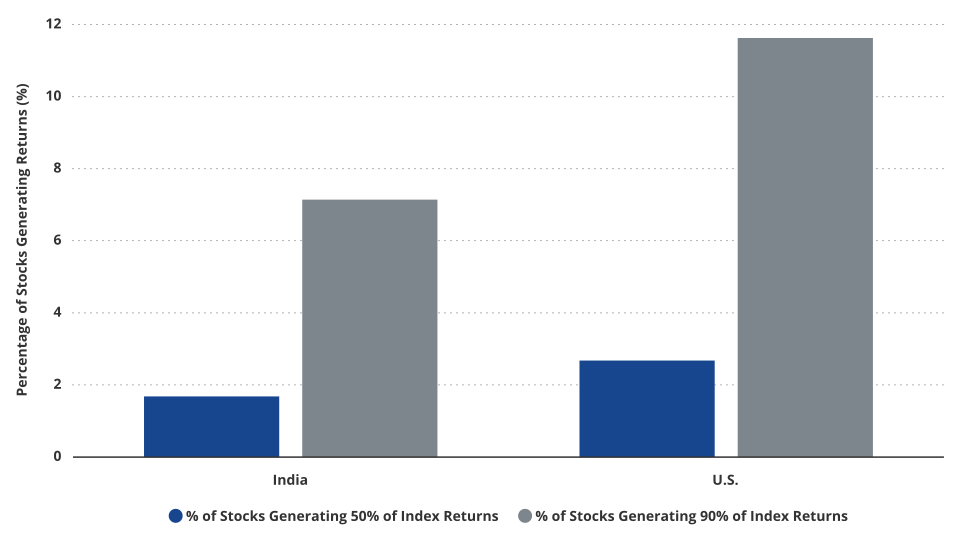
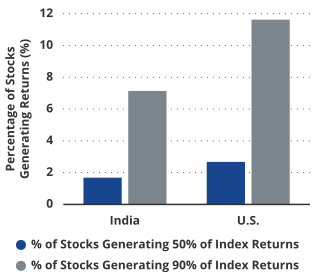
Source: VanEck, FactSet. Data as of February 28, 2006 - January 31, 2026. India is represented by the MSCI India Index. U.S. is represented by the S&P 500 Index. Past performance is no guarantee of future results. Index performance is not representative of fund performance. It is not possible to invest directly in an index.
Recommended subscription
Market-cap weighted indexes allocate capital indiscriminately across businesses with widely divergent quality, durability, and return potential. This structure embeds persistent performance drag by diluting exposure to the companies that matter most for long-term compounding. In a market where dispersion is this pronounced, owning everything equally is costly. Selectivity is essential to capturing durable returns.
What makes India an attractive investment opportunity?
India has delivered the highest equity returns among major economies outside the U.S. over the past two decades, with an annualized return profile that mirrors the growth characteristics of the U.S. market. India's GDP growth rate has significantly exceeded that of other major regions, and Indian companies have demonstrated a strong ability to translate that economic growth into shareholder value, generating meaningful excess stock returns above GDP growth over time.
Looking forward, India's investment case is supported by several independent structural drivers that form a self-reinforcing compounding system: policy and institutional reform, physical infrastructure build-out, digital infrastructure and technology adoption, favorable demographics, and rising consumer aspirations. When these forces align, they attract capital, talent, and innovation, which in turn improves profitability and returns on invested capital, funding the next cycle of growth.
How does the INDZ investment process work?
The INDZ ETF is actively managed but follows a repeatable, rules-driven framework. Twice a year, the portfolio goes through a full rebalance designed to keep the strongest businesses and remove the weakest. The process starts with a broad universe of over 1,200 Indian public companies and narrows it down through a series of filters:
- Quality and durability: First, the process identifies companies with long track records of growing capital over time. The team also adds select earlier-stage companies with high conviction based on active research. This step narrows the universe to roughly 275 names.
- Earnings strength: Next, any company showing signs of weakening profitability or declining returns on capital is removed, bringing the list down to about 150.
- Valuation: Companies that appear overvalued relative to their own historical pricing are cut, leaving around 70 to 100 names.
- Portfolio construction: The remaining companies are ranked and assembled into a focused portfolio of 60 to 90 holdings, with position sizes and sector weights governed by defined risk controls.
Between resets, ongoing research and risk oversight allow the portfolio to adapt to changing conditions, with off-cycle trades executed selectively when warranted.
How is the INDZ portfolio constructed?
The portfolio uses a core-satellite framework that balances stability with innovation. The core sleeve is anchored in large-cap companies with stable, compounding returns and serves as a volatility dampener for the portfolio. Surrounding this core are satellite positions in mid- and small-cap businesses that represent innovative, scalable lifecycle winners and early-stage disruptors, where return dispersion and mispricing tend to be most pronounced.
Position sizes are governed by a modified equal-weight approach, which helps prevent any single position from dominating risk or returns. Minimum liquidity thresholds and institutional risk controls limit concentration and tracking error. Together, this structure allows the portfolio to pursue long-term growth across India's most compelling companies without sacrificing diversification or risk discipline.
What risk controls does INDZ employ?
Risk management is built into every stage of the portfolio's lifecycle. Exposures are formally reviewed at each semiannual rebalance and monitored on a monthly basis to make sure the portfolio stays within its intended risk profile.
The framework sets clear boundaries around how much of the portfolio can go into any single stock, sector, or market cap segment, and it limits how far the portfolio can drift from the benchmark before action is taken. If the portfolio moves outside those boundaries between rebalances, the portfolio manager will trade to bring it back in line. Independent oversight is provided by the VanEck Multi-Asset Solutions group and the Investment Committee.
When might INDZ underperform its benchmark?
Like any disciplined, long-term strategy, there will be periods where INDZ lags its benchmark. This is expected, and it tends to happen in a few specific environments:
When smaller companies sell off broadly. The portfolio holds more mid- and small-cap names than the index, which can mean more volatility during periods of market stress, even though these are the areas where the best opportunities tend to emerge.
When value stocks lead the market. INDZ naturally tilts toward companies with strong growth characteristics. When the market favors cheaper, slower-growing stocks, that tilt can weigh on short-term relative performance.
When momentum takes over. The strategy avoids overpaying for stocks, which means it may sit out short-term rallies driven by hype or momentum rather than fundamentals.
These are deliberate trade-offs. The goal is long-term compounding, not chasing whatever is working in the moment.
What are the risks of investing in Indian equities?
Investing in India involves several key risk considerations:
- Political and regulatory risk stems from the fact that India's regulatory and policy environment materially influences economic outcomes; shifts in government policy or political stability may affect market conditions and investment returns.
- Economic and currency risk includes emerging market macro risks such as currency volatility, capital flow restrictions, and potential government intervention affecting capital mobility.
- Corporate governance risk reflects the fact that reporting and disclosure standards in India may differ from developed markets, potentially affecting information quality and timeliness.
- Market and liquidity risk arise because Indian equity markets may experience higher volatility and lower liquidity, particularly in smaller-cap securities, and foreign investment limits may impact execution during periods of stress.
Who manages INDZ?
INDZ is managed by Angus Shillington, who brings 32 years of global equity markets experience spanning portfolio management, research, trading, and institutional distribution across developed and emerging markets, including over 16 years at VanEck. He also serves as Deputy Portfolio Manager for the VanEck Emerging Markets Fund. Prior to VanEck, Mr. Shillington held senior leadership roles, including Managing Director and Head of International Equity at ABN AMRO NA, overseeing global equities and equity derivatives platforms, as well as positions at BNP Paribas and ABN AMRO in Asia and the U.S. The INDZ portfolio is subject to oversight by VanEck's Investment Committee.
How can INDZ fit into a portfolio?
INDZ can serve as a dedicated India allocation within a broader emerging markets or international equity portfolio. Given that India remains underrepresented in global equity benchmarks relative to its return potential and economic growth profile, INDZ provides a way for investors to express a targeted view on India's structural growth story with the benefit of active security selection. The fund's selective, quality-focused approach is designed to complement broader emerging market or international holdings by concentrating exposure on the subset of Indian companies best positioned to compound value over time.
Ready to invest in INDZ? Visit the fund page for the fact sheet, holdings, performance, and more.
How to buy VanEck ETFs?
INDZ | VanEck India Select ETF
To receive more Emerging Markets Equity insights, sign up in our subscription center.

Disclosures
This is not an offer to buy or sell, or a recommendation to buy or sell any of the securities, financial instruments or digital assets mentioned herein. The information presented does not involve the rendering of personalized investment, financial, legal, tax advice, or any call to action. Certain statements contained herein may constitute projections, forecasts and other forward-looking statements, which do not reflect actual results, are for illustrative purposes only, are valid as of the date of this communication, and are subject to change without notice. Actual future performance of any assets or industries mentioned are unknown. Information provided by third party sources are believed to be reliable and have not been independently verified for accuracy or completeness and cannot be guaranteed. VanEck does not guarantee the accuracy of third party data. The information herein represents the opinion of the author(s), but not necessarily those of VanEck or its other employees.
MSCI India IMI Index is designed to measure the performance of the large, mid and small cap segments of the Indian market
MSCI India Index is designed to measure the performance of the large and mid cap segments of the Indian market.
The S&P 500 Index consists of 500 widely held common stocks covering the leading industries of the U.S. economy.
Index returns are not Fund returns and do not reflect any management fees or brokerage expenses. Certain indices may take into account withholding taxes. Investors can not invest directly in the Index. Returns for actual Fund investors may differ from what is shown because of differences in timing, the amount invested and fees and expenses. Index returns assume that dividends have been reinvested.
An investment in the Fund may be subject to risks which include, among others, special risk considerations of investing in Indian issuers, active management, materials sector, health care sector, consumer discretionary sector, depository receipts, emerging market issuers, equity securities, large-capitalization companies, financials sector, foreign currency, foreign securities, high portfolio turnover, industrial sector, market, new fund, non-diversified, operational, small- and medium-capitalization companies, authorized participant concentration, no guarantee of active trading market, trading issues, fund shares trading, premium/discount risk and liquidity of fund shares, and cash transactions risks, all of which may adversely affect the Fund. Emerging market issuers and foreign securities may be subject to securities markets, political and economic, investment and repatriation restrictions, different rules and regulations, less publicly available financial information, foreign currency and exchange rates, operational and settlement, and corporate and securities laws risks. Small- and medium-capitalization companies may be subject to elevated risks.
Investing involves substantial risk and high volatility, including possible loss of principal. An investor should consider the investment objective, risks, charges and expenses of the Fund carefully before investing. To obtain a prospectus and summary prospectus, which contains this and other information, call 800.826.2333 or visit vaneck.com/etfs. Please read the prospectus and summary prospectus carefully before investing.
© Van Eck Securities Corporation, Distributor, a wholly owned subsidiary of Van Eck Associates Corporation.
Related Funds
Disclosures
This is not an offer to buy or sell, or a recommendation to buy or sell any of the securities, financial instruments or digital assets mentioned herein. The information presented does not involve the rendering of personalized investment, financial, legal, tax advice, or any call to action. Certain statements contained herein may constitute projections, forecasts and other forward-looking statements, which do not reflect actual results, are for illustrative purposes only, are valid as of the date of this communication, and are subject to change without notice. Actual future performance of any assets or industries mentioned are unknown. Information provided by third party sources are believed to be reliable and have not been independently verified for accuracy or completeness and cannot be guaranteed. VanEck does not guarantee the accuracy of third party data. The information herein represents the opinion of the author(s), but not necessarily those of VanEck or its other employees.
MSCI India IMI Index is designed to measure the performance of the large, mid and small cap segments of the Indian market
MSCI India Index is designed to measure the performance of the large and mid cap segments of the Indian market.
The S&P 500 Index consists of 500 widely held common stocks covering the leading industries of the U.S. economy.
Index returns are not Fund returns and do not reflect any management fees or brokerage expenses. Certain indices may take into account withholding taxes. Investors can not invest directly in the Index. Returns for actual Fund investors may differ from what is shown because of differences in timing, the amount invested and fees and expenses. Index returns assume that dividends have been reinvested.
An investment in the Fund may be subject to risks which include, among others, special risk considerations of investing in Indian issuers, active management, materials sector, health care sector, consumer discretionary sector, depository receipts, emerging market issuers, equity securities, large-capitalization companies, financials sector, foreign currency, foreign securities, high portfolio turnover, industrial sector, market, new fund, non-diversified, operational, small- and medium-capitalization companies, authorized participant concentration, no guarantee of active trading market, trading issues, fund shares trading, premium/discount risk and liquidity of fund shares, and cash transactions risks, all of which may adversely affect the Fund. Emerging market issuers and foreign securities may be subject to securities markets, political and economic, investment and repatriation restrictions, different rules and regulations, less publicly available financial information, foreign currency and exchange rates, operational and settlement, and corporate and securities laws risks. Small- and medium-capitalization companies may be subject to elevated risks.
Investing involves substantial risk and high volatility, including possible loss of principal. An investor should consider the investment objective, risks, charges and expenses of the Fund carefully before investing. To obtain a prospectus and summary prospectus, which contains this and other information, call 800.826.2333 or visit vaneck.com/etfs. Please read the prospectus and summary prospectus carefully before investing.
© Van Eck Securities Corporation, Distributor, a wholly owned subsidiary of Van Eck Associates Corporation.