Gold Equities and the Trust Gap
June 05, 2026
Read Time 9 MIN
Key Takeaways:
- Gold mining fundamentals are strong, yet many investors continue to overlook equities
- Trust, built through transparency, consistent delivery, and disciplined capital allocation, is key to a sector re-rating
- Smart consolidation and elite management teams are critical to attracting long-term institutional capital
*Index performance is not illustrative of fund or product performance. It is not possible to invest directly in an index. Past performance is no guarantee of future results.
Gold Equities and the Trust Gap
The gold price closed at $4,540.26 per ounce on May 29 — down $77.59 per ounce, or 1.68% for the month. Positively, the gold mining stocks posted gains, despite gold’s loss for the month. The MarketVector Global Gold Miners Index (MVGDXTR)1 was up 1.11% for the month, while the MVIS Global Junior Gold Miners (MVGDXJTR)2 was up 2.08%.
Trust Is the Missing Commodity in Gold Equities
The Australian Financial Review (AFR) Mining Summit took place in Perth on May 27, 2026. We had the opportunity to participate in a panel: “Wall Street to Australia: Setting the Scene for Global Gold,” and shared our perspective on the dynamics we see at play in gold equity markets today. We have a long history as managers of precious metal investment strategies. Today, everything seems to be going right in the sector, but it still doesn’t get much attention. We talked about how to make the gold equity case compelling enough and consistent enough that the broader investment community starts to see what we see: owning the miners is worth it despite all the additional complexity and risk. We made a direct case to gold mining companies about what we think are some of the steps this industry can take to help put gold equities on the radar of global investors. The title of our presentation said it plainly: “Trust is the missing commodity in gold equities.”
Why Aren't Generalist Investors Buying Gold Mining Stocks?
We started with the obvious question, “Why isn’t capital flowing into gold mining equities?” Gold is trading near all-time highs. Producers are carrying the strongest balance sheets they've had in a generation. Margins are at record levels, and free cash flow is strong. Management teams, by and large, are showing more discipline than this sector has historically been known for. By almost every conventional measure, the conditions for a sustained re-rating of gold equities are firmly in place.
And yet generalist investors are largely absent. The capital that could flow into this sector — that this sector deserves — is sitting on the sidelines, going into physical gold ETFs, or being deployed somewhere else entirely. The operating leverage, the dividend growth, the exploration upside that owning the miners offers over simply holding the metal — none of it appears to be compelling enough to draw in the broader investment community.
That is the central paradox we put to the room. Everything is aligned. So why isn't the capital flowing?
What Investors Are Really Saying About Gold Equities
We spend a lot of time talking to existing and potential clients about gold equities, and the same theme emerges in almost every conversation. It's not skepticism about gold. It's a lack of trust in gold equities as the right vehicle to get exposure to it.
In our presentation at the AFR summit, we laid out some of the most common fears that may be keeping generalist capital on the sidelines:
- Poorly-conceived M&A
The worry that management will spend the windfall on acquisitions that destroy value rather than return it.
- Cost creep
The expectation that guidance will slip just as gold's strength should be flowing through to earnings.
- Dividend fragility
The concern that distributions will disappear the moment the cycle turns.
- Low returns
The experience of mediocre project development and unnecessary overhead eating into what should be strong margins.
- Hard-to-manage risk
Geopolitical, environmental, social — that feels too opaque for generalist allocators to underwrite with confidence.
These fears are not irrational. They are the accumulated memory of a sector that has let investors down in the past. Acknowledging that history honestly, rather than dismissing it, was an important part of the message we delivered.
How Gold Mining Companies Can Build Investor Trust
The heart of our presentation was a framework — six principles that, consistently applied, we believe have the potential to convert skeptical capital into committed shareholders. We weren't speaking to investors in the room. Our message was directed to management teams across this industry.
- Protect gold price leverage
Defend margins and resist hedging. The primary reason investors choose gold equities over the metal is leverage to the gold price. Hedging away too much of that upside removes the central investment proposition.
- Meet your numbers
Set guidance you can beat and then meet it or beat it — every time. A consistent track record of delivery compounds into a valuation premium. Under-promise, over-deliver is not just a communication strategy; it is a cultural signal that investors read clearly.
- Define value creation
State publicly what metrics you use to measure it — ROIC target, hurdle rate for new projects, cash flow per share, etc. — and then report against them every period. If a company won't measure it, the market won't believe it.
- Be accountable
This is a complex and risky business, and things will go wrong. The test is not whether problems arise, but how management responds when they do. Own it early, explain it clearly, and show what has changed.
- Keep it simple
One strategy, consistently executed. The best gold companies are boring in the best possible way. Additional complexity — too many jurisdictions, too many pivots, too many competing priorities — is a red flag for anyone trying to build lasting conviction.
- Justify M&A and then track it
Almost every company announces an acquisition with a detailed synergy case. Almost no track or disclose whether those synergies were actually delivered. Same applies to organic projects and their expected returns. That silence is corrosive. This single change would do a great deal for sector re-rating.
The Scarcest Resource: Elite Management
Management is a large component of a company’s success and for sure the foundation of investor trust — yet elite leadership may be the scarcest resource in the entire industry. We talk a great deal about Tier 1 assets, but what this sector truly needs more of is Tier 1 teams: operators with the skill and discipline to produce gold profitably from even the most challenging deposits.
We talked about what elite management actually looks like in practice: a proven track record through a full cycle, not just a bull market; operational credibility built on genuine technical and regional expertise; capital allocation discipline applied to both organic growth and M&A; communication quality that is transparent under pressure; organizational stability and succession depth beyond the CEO; and real skin in the game through personal ownership and compensation structures tied to long-term performance.
Right now, this sector has more companies and assets than it has great management teams to run them. Poor leadership destroys value at every stage of the mining cycle — and we've all seen it. This is a core structural risk that, in our view, calls for consolidation across the sector.
The Consolidation Case
We were direct about where we stand on sector consolidation: the case for it is real, but the type of consolidation matters enormously. Not all deals are created equal, and we wanted to be specific.
What we support is regional and geographic consolidation — hub-and-spoke district models where assets share infrastructure, equipment, labor, and technical expertise, and where the synergies are real and achievable. Portfolio rationalization, thoughtful entry-level equity investments in earlier-stage companies, and multi-party transactions structured to achieve the best outcome — these are the kinds of moves that we believe have the best potential to create durable value.
What we push back on is consolidation for scale alone. Increased cross-continent complexity, diluted management focus, synergies promised and never measured, integration risk chronically underestimated — these are the patterns that erode trust across the whole peer group, including the well-run companies that don't deserve to be tarred with the same brush.
What we want to see is growth that makes genuine strategic sense: manageable portfolios of no more than six to eight operations, regional know-how that can be meaningfully leveraged, clearly stated synergy cases, and honest post-mortems. The deeper argument ties directly back to management scarcity — the most powerful thing consolidation can achieve is placing more assets into fewer, better hands. Scale also matters for a practical reason: most institutional mandates have minimum liquidity thresholds. A fragmented sector of small-caps is structurally difficult for large generalist allocators to own, regardless of how compelling the gold story is.
The Re-Rating for Gold Equities
We closed our presentation with an optimistic message. The idea that trust is the foundation. Build it, and the capital will come. A small allocation from the generalist pool has large implications for the whole sector. Companies that earn that trust should also be able to retain their shareholders through downturns if they can consistently demonstrate the ability to navigate the cycles.

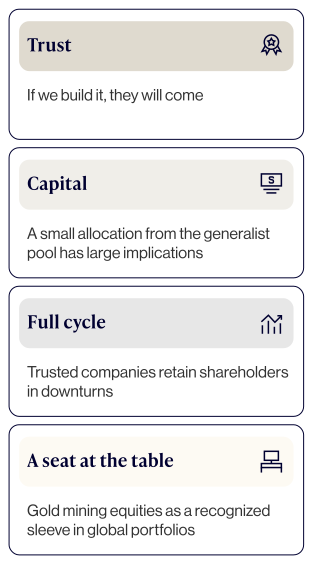
The opportunity in front of this sector is larger than the next quarterly result or the next resource upgrade. If the industry stays on its current path — disciplined, transparent, accountable — gold mining equities can earn something that has long eluded them: a permanent place on the radar of global investors. A recognized allocation sleeve, held structurally, alongside other real assets in sophisticated portfolios around the world. Not owned opportunistically when gold spikes but held because the case is compelling and the trust has been built. The rerating the sector has long been waiting for feels genuinely within reach.
To receive more Gold Investing insights, sign up in our subscription center.

Important Disclosures
All company, sector, and sub-industry weightings as of May 31, 2026, unless otherwise noted.
Please note that VanEck may offer investment products that invest in the asset class(es) or industries included in this communication.
This is not an offer to buy or sell, or a solicitation of any offer to buy or sell any of the securities mentioned herein. The information presented does not involve the rendering of personalized investment, financial, legal, or tax advice. Certain statements contained herein may constitute projections, forecasts and other forward-looking statements, which do not reflect actual results.
Please note that the information herein represents the opinion of the author, but not necessarily those of VanEck, and this opinion may change at any time and from time to time. Non-VanEck proprietary information contained herein has been obtained from sources believed to be reliable but not guaranteed. Not intended to be a forecast of future events, a guarantee of future results or investment advice. Historical performance is not indicative of future results. Current data may differ from data quoted. Any graphs shown herein are for illustrative purposes only. No part of this material may be reproduced in any form, or referred to in any other publication, without express written permission of VanEck.
Diversification does not assure a profit or protect against loss.
Nothing in this content should be considered a solicitation to buy or an offer to sell shares of any investment in any jurisdiction where the offer or solicitation would be unlawful under the securities laws of such jurisdiction, nor is it intended as investment, tax, financial, or legal advice. Investors should seek such professional advice for their particular situation and jurisdiction.
1 MarketVector Global Gold Miners Index (MVGDXTR) tracks the overall performance of companies involved in the gold mining industry. 2 MVIS Global Junior Gold Miners Index (MVGDXJTR), which is intended to track the overall performance of small-capitalization companies that are involved primarily in the mining for gold and/or silver.
Any indices listed are unmanaged indices and include the reinvestment of all dividends, but do not reflect the payment of transaction costs, advisory fees or expenses that are associated with an investment in a Fund. Certain indices may take into account withholding taxes. An index’s performance is not illustrative of a Fund’s performance. Indices are not securities in which investments can be made.
MarketVector Global Gold Miners Index is the exclusive property of MarketVector Indexes GmbH (a wholly owned subsidiary of VanEck), which has contracted with a third party calculation agent to maintain and calculate the Index. The agent uses its best efforts to ensure that the Index is calculated correctly. Irrespective of its obligations towards MarketVector Indexes GmbH, the agent has no obligation to point out errors in the Index to third parties.
MVIS Global Junior Gold Miners Index is the exclusive property of MarketVector Indexes GmbH (a wholly owned subsidiary of VanEck), which has contracted with a third party calculation agent to maintain and calculate the Index. The agent uses its best efforts to ensure that the Index is calculated correctly. Irrespective of its obligations towards MarketVector Indexes GmbH, the agent has no obligation to point out errors in the Index to third parties.
Investments in commodities can be very volatile and direct investment in these markets can be very risky, especially for inexperienced investors.
Gold investments are subject to the risks associated with concentrating its assets in the gold industry, which can be significantly affected by international economic, monetary and political developments. Investments in gold may decline in value due to developments specific to the gold industry. Foreign gold security investments involve risks related to adverse political and economic developments unique to a country or a region, currency fluctuations or controls, and the possibility of arbitrary action by foreign governments, or political, economic or social instability. Gold investments are subject to risks associated with investments in U.S. and non-U.S. issuers, commodities and commodity-linked derivatives, commodities and commodity-linked derivatives tax, gold-mining industry, derivatives, emerging market securities, foreign currency transactions, foreign securities, other investment companies, management, market, non-diversification, operational, regulatory, small- and medium-capitalization companies and subsidiary risks.
All investing is subject to risk, including the possible loss of the money you invest. As with any investment strategy, there is no guarantee that investment objectives will be met and investors may lose money. Diversification does not ensure a profit or protect against a loss in a declining market. Past performance is no guarantee of future performance.
© Van Eck Associates Corporation
666 Third Avenue | New York, NY 10017
Important Disclosures
All company, sector, and sub-industry weightings as of May 31, 2026, unless otherwise noted.
Please note that VanEck may offer investment products that invest in the asset class(es) or industries included in this communication.
This is not an offer to buy or sell, or a solicitation of any offer to buy or sell any of the securities mentioned herein. The information presented does not involve the rendering of personalized investment, financial, legal, or tax advice. Certain statements contained herein may constitute projections, forecasts and other forward-looking statements, which do not reflect actual results.
Please note that the information herein represents the opinion of the author, but not necessarily those of VanEck, and this opinion may change at any time and from time to time. Non-VanEck proprietary information contained herein has been obtained from sources believed to be reliable but not guaranteed. Not intended to be a forecast of future events, a guarantee of future results or investment advice. Historical performance is not indicative of future results. Current data may differ from data quoted. Any graphs shown herein are for illustrative purposes only. No part of this material may be reproduced in any form, or referred to in any other publication, without express written permission of VanEck.
Diversification does not assure a profit or protect against loss.
Nothing in this content should be considered a solicitation to buy or an offer to sell shares of any investment in any jurisdiction where the offer or solicitation would be unlawful under the securities laws of such jurisdiction, nor is it intended as investment, tax, financial, or legal advice. Investors should seek such professional advice for their particular situation and jurisdiction.
1 MarketVector Global Gold Miners Index (MVGDXTR) tracks the overall performance of companies involved in the gold mining industry. 2 MVIS Global Junior Gold Miners Index (MVGDXJTR), which is intended to track the overall performance of small-capitalization companies that are involved primarily in the mining for gold and/or silver.
Any indices listed are unmanaged indices and include the reinvestment of all dividends, but do not reflect the payment of transaction costs, advisory fees or expenses that are associated with an investment in a Fund. Certain indices may take into account withholding taxes. An index’s performance is not illustrative of a Fund’s performance. Indices are not securities in which investments can be made.
MarketVector Global Gold Miners Index is the exclusive property of MarketVector Indexes GmbH (a wholly owned subsidiary of VanEck), which has contracted with a third party calculation agent to maintain and calculate the Index. The agent uses its best efforts to ensure that the Index is calculated correctly. Irrespective of its obligations towards MarketVector Indexes GmbH, the agent has no obligation to point out errors in the Index to third parties.
MVIS Global Junior Gold Miners Index is the exclusive property of MarketVector Indexes GmbH (a wholly owned subsidiary of VanEck), which has contracted with a third party calculation agent to maintain and calculate the Index. The agent uses its best efforts to ensure that the Index is calculated correctly. Irrespective of its obligations towards MarketVector Indexes GmbH, the agent has no obligation to point out errors in the Index to third parties.
Investments in commodities can be very volatile and direct investment in these markets can be very risky, especially for inexperienced investors.
Gold investments are subject to the risks associated with concentrating its assets in the gold industry, which can be significantly affected by international economic, monetary and political developments. Investments in gold may decline in value due to developments specific to the gold industry. Foreign gold security investments involve risks related to adverse political and economic developments unique to a country or a region, currency fluctuations or controls, and the possibility of arbitrary action by foreign governments, or political, economic or social instability. Gold investments are subject to risks associated with investments in U.S. and non-U.S. issuers, commodities and commodity-linked derivatives, commodities and commodity-linked derivatives tax, gold-mining industry, derivatives, emerging market securities, foreign currency transactions, foreign securities, other investment companies, management, market, non-diversification, operational, regulatory, small- and medium-capitalization companies and subsidiary risks.
All investing is subject to risk, including the possible loss of the money you invest. As with any investment strategy, there is no guarantee that investment objectives will be met and investors may lose money. Diversification does not ensure a profit or protect against a loss in a declining market. Past performance is no guarantee of future performance.
© Van Eck Associates Corporation
666 Third Avenue | New York, NY 10017