Gold Pullback: Why the Long-Term Investment Case Remains Intact
July 10, 2026
Read Time 6 MIN
Key Takeaways:
- Gold's recent pullback reflects shifting macro conditions, while the long-term outlook for gold remains intact.
- Persistent inflation, geopolitical risks and lower real interest rates could continue to support gold prices.
- Gold stocks remain well positioned, supported by strong cash flow, healthy margins and attractive valuations.
Gold Pullback: Why the Long-Term Investment Case Remains Intact
A Volatile Start to 2026
Gold price volatility increased in the first half of 2026. Intraday, gold traded as high as $5,595 on January 29. On June 30, it traded at its year-to-date low of $3,943 but managed to close just above the $4,000 mark – ending the month at $4,008.02 per ounce. Gold declined 14.14% in the month of June and was down 7.21% year-to-date. The gold stocks lagged the metal, as expected during a period of declining gold prices. The MarketVector Global Gold Miners Index (MVGDXTR)1 fell 15.54% in June, down 12.41% year to date.
Gold Pulls Back as Markets Shift Toward Risk Assets
After reaching new all-time highs of nearly $5,600 per ounce in early January, gold prices have come under pressure from a stronger U.S. dollar and expectations for higher interest rates since the beginning of the war with Iran. The dominant macro narrative has become self-reinforcing: higher oil prices keep inflation expectations elevated, elevated inflation expectations keep the Federal Reserve (“Fed”) on hold, a Fed on hold keeps real yields elevated, and elevated real yields support the U.S. dollar, weighing on gold.
As a result, many commodity analysts have reduced their gold price forecasts for 2026. However, even after those downward revisions, at present, the consensus mean estimate (as per Bloomberg data) for average annual gold prices stands at around $4,700 for 2026 and 2027, and above $4,000 for 2028 and 2029. Analysts at Goldman Sachs, Citigroup and Deutsche Bank forecast gold at or above $5,000 in 2027. (Source: Bloomberg. For illustrative purposes only. Not intended as a prediction of future results. Past performance is no guarantee of future results.)
At the end of June, the apparent end of the conflict in the Middle East further eroded gold’s safe-haven appeal, as markets have shifted toward a risk-on environment and equity markets trade near recently established highs. Gold is now trading around $4,000 per ounce, representing an approximately 25% pullback from its January highs. However, gold stocks remain the best-performing asset class over the past year, while gold continues to outperform most other major asset classes.
Gold Assets Continue to Hold Their Ground
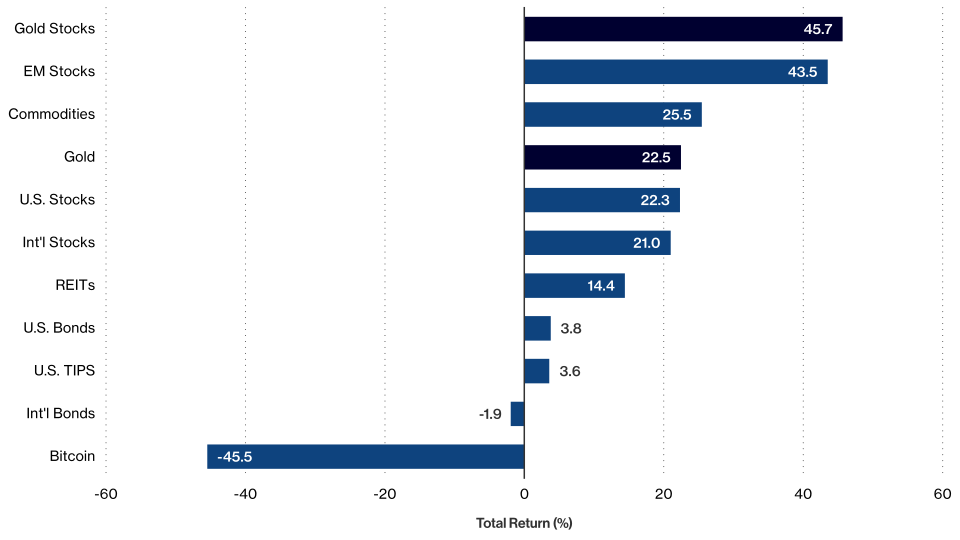
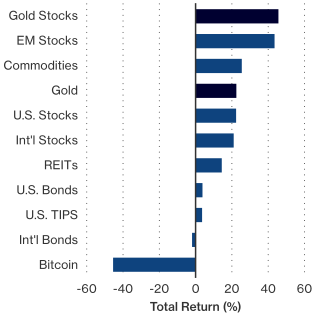
Source: Morningstar. Data as of June, 2026. “Gold Stocks” represented by MV Global Gold Miners Index (net of fees). “U.S. Stocks” represented by the S&P 500 Index. “EM Stocks” represented by MSCI Emerging Markets Index. “REITs” represented by FTSE NAREIT All Equity REITs Index. “International (Int’l) Stocks” represented by MSCI AC World ex USA Index. “Commodities” represented by Bloomberg Commodity Index. “U.S. TIPS” represented by Bloomberg U.S. TIPS (1-3 Year) Index. “U.S. Bonds” represented by Bloomberg U.S. Aggregate Bond Index. “International (Int’l) Bonds” represented by Bloomberg Global Aggregate ex US Index. Past performance is not indicative of future results. It is not possible to directly invest in an index. Investing involves risk, including possible loss of principal.
Looking Beyond Short-Term Volatility
Gold price volatility and the recent pullback may be weighing on investors. However, in our view, it is important to look past near-term noise. The continued strength in equity markets suggests a degree of optimism that could be tested. We believe investors may wish to reassess the risks associated with heightened geopolitical tensions, the prolonged effects of the Middle East conflict on the global economy and, importantly, the outlook for inflation.
Why Gold Could Continue to Benefit
A prolonged “Fed on hold” environment could contribute to lower, or even negative, real rates over time, a backdrop that has historically been among the most favorable for gold. In that scenario, gold has often played a prominent role as a diversifier and potential hedge for investors seeking portfolio protection and diversification. Gold stocks, in our view, may also be considered as part of a diversified allocation.
Even Fed hikes have not always been negative for gold. According to World Gold Council data covering 44 Fed hikes from March 1997 through July 2023, gold positively surprised on hike days more than 50% of the time.
Central Banks Continue to Support Gold Demand
Central bank gold statistics for May, also published by the World Gold Council, show that central banks remain committed to gold, with net monthly buying near record levels, and 89% of surveyed central bankers expecting global gold reserves to increase in the next 12 months.
Strong, regionally diversified central bank buying and resilient investment demand from Asia continue to underpin gold demand at current levels. A return of Western investor participation, similar to what happened in 2025, could provide additional support and may contribute to further upside in the gold market. Gold has historically performed well during periods when central bank activity and investment together account for more than 30% of total demand.
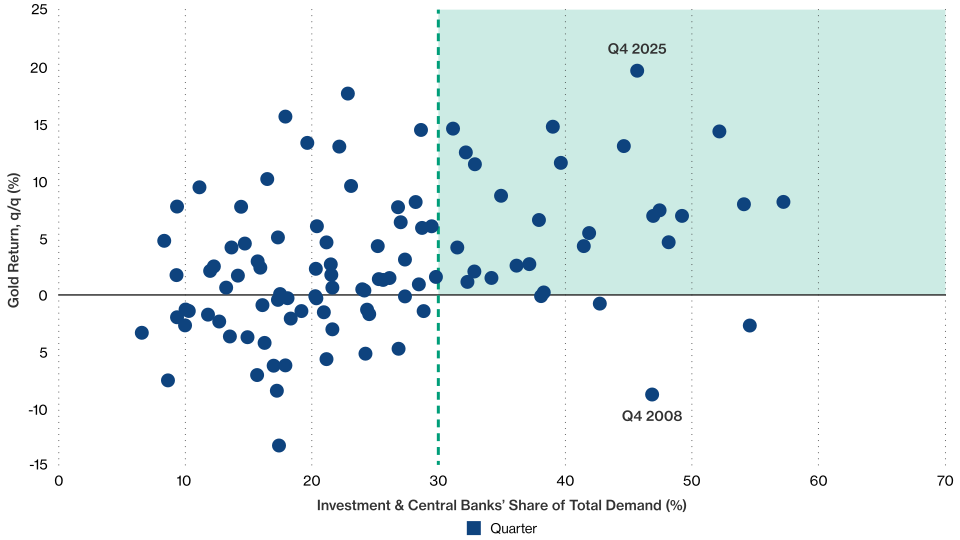
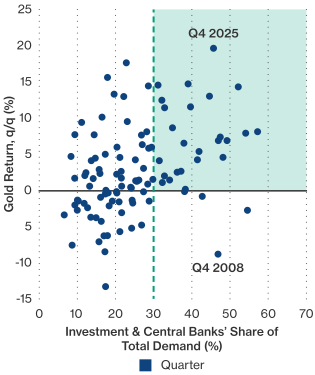
Source: World Gold Council, as of June 2026.
Why Gold Stocks May Still Offer Opportunity
Gold stocks have historically outperformed the metal itself in rising gold price environments. However, investors may not need to wait for the next leg higher in gold to begin increasing exposure. At current gold prices, these companies are already generating record cash flow, as Q1 2026 earnings made abundantly clear. Gold has traded at an average price of approximately $4,700 per ounce so far in 2026. With all-in sustaining costs for the sector estimated to average below $2,000 per ounce in 2026, margins remain very strong even at $4,000 gold. This gives companies the ability to finance growth, pay dividends and repurchase shares. Gold stocks continue to trade at valuations that remain low relative to historical levels, while the sector appears to be in strong financial and operational health by historical standards. Current equity prices appear to reflect more conservative assumptions than those implied by prevailing gold prices.
If investors rotate capital away from sectors with much richer valuations, particularly against a backdrop of rising pullback risk, gold stocks could be beneficiaries.
To receive more Gold Investing insights, sign up in our subscription center.

Important Disclosures
1 MarketVector Global Gold Miners Index (MVGDXTR) tracks the overall performance of companies involved in the gold mining industry.
All company, sector, and sub-industry weightings as of June 30, 2026, unless otherwise noted.
Please note that VanEck may offer investment products that invest in the asset class(es) or industries included in this communication.
This is not an offer to buy or sell, or a solicitation of any offer to buy or sell any of the securities mentioned herein. The information presented does not involve the rendering of personalized investment, financial, legal, or tax advice. Certain statements contained herein may constitute projections, forecasts and other forward-looking statements, which do not reflect actual results.
Please note that the information herein represents the opinion of the author, but not necessarily those of VanEck, and this opinion may change at any time and from time to time. Non-VanEck proprietary information contained herein has been obtained from sources believed to be reliable but not guaranteed. Not intended to be a forecast of future events, a guarantee of future results or investment advice. Historical performance is not indicative of future results. Current data may differ from data quoted. Any graphs shown herein are for illustrative purposes only. No part of this material may be reproduced in any form, or referred to in any other publication, without express written permission of VanEck.
Diversification does not assure a profit or protect against loss.
Nothing in this content should be considered a solicitation to buy or an offer to sell shares of any investment in any jurisdiction where the offer or solicitation would be unlawful under the securities laws of such jurisdiction, nor is it intended as investment, tax, financial, or legal advice. Investors should seek such professional advice for their particular situation and jurisdiction.
Bitcoin is a decentralized digital currency, without a central bank or single administrator, that can be sent from user to user on the peer-to-peer Bitcoin network without the need for intermediaries. Bloomberg Commodity Index is a broadly diversified index that tracks the commodity markets through commodity futures contracts and is made up of exchange-traded futures on physical commodities, which are weighted to account for economic significance and market liquidity. Bloomberg Global Aggregate ex USD Index measures the performance of global investment grade fixed-rate debt markets that excludes U.S. dollar-denominated securities. Bloomberg U.S. Aggregate Bond Index is a broad-based benchmark that measures the investment grade, U.S. dollar-denominated, fixed-rate taxable bond market. Bloomberg U.S. TIPS (1-3 Year) Index measures the performance of the U.S. treasury inflation-linked bond market of obligations with maturities of 1-3 years. Bloomberg U.S. Treasury 1-3 Year Index measures U.S. dollar-denominated, fixed-rate, nominal debt issued by the US Treasury. To be included in the index, securities must have at least one and up to, but not including, three years to maturity. FTSE NAREIT All Equity REITs Index is a free-float adjusted, market capitalization-weighted index of U.S. Equity REITs. Constituents of the Index include all tax-qualified REITs with more than 50 percent of total assets in qualifying real estate assets other than mortgages secured by real property. LBMA Gold Price is used as a global benchmark for gold and gold derivative assets, facilitating the international trade of the metal at a common value. MSCI Emerging Markets Index tracks large and mid-cap representation across emerging markets countries. MSCI AC World ex USA Index covers a large portion of the global equity opportunity set outside of the United States. It includes large and mid-cap stocks from 22 developed market countries and 24 emerging market countries. S&P 500 Index is widely regarded as the best single gauge of large-cap U.S. equities. The index is a float-adjusted, market-cap-weighted index of 500 leading U.S. companies from across all market sectors including information technology, telecommunications services, utilities, energy, materials, industrials, real estate, financials, health care, consumer discretionary, and consumer staples.
The S&P 500 Index is a product of S&P Dow Jones Indices LLC and/or its affiliates and has been licensed for use by Van Eck Associates Corporation. Copyright © 2026 S&P Dow Jones Indices LLC, a division of S&P Global, Inc., and/or its affiliates. All rights reserved. Redistribution or reproduction in whole or in part are prohibited without written permission of S&P Dow Jones Indices LLC. For more information on any of S&P Dow Jones Indices LLC’s indices please visit www.spdji.com. S&P® is a registered trademark of S&P Global and Dow Jones® is a registered trademark of Dow Jones Trademark Holdings LLC. Neither S&P Dow Jones Indices LLC, Dow Jones Trademark Holdings LLC, their affiliates nor their third party licensors make any representation or warranty, express or implied, as to the ability of any index to accurately represent the asset class or market sector that it purports to represent and neither S&P Dow Jones Indices LLC, Dow Jones Trademark Holdings LLC, their affiliates nor their third party licensors shall have any liability for any errors, omissions, or interruptions of any index or the data included therein.
Any indices listed are unmanaged indices and include the reinvestment of all dividends, but do not reflect the payment of transaction costs, advisory fees or expenses that are associated with an investment in a Fund. Certain indices may take into account withholding taxes. An index’s performance is not illustrative of a Fund’s performance. Indices are not securities in which investments can be made.
MarketVector Global Gold Miners Index is the exclusive property of MarketVector Indexes GmbH (a wholly owned subsidiary of VanEck), which has contracted with a third party calculation agent to maintain and calculate the Index. The agent uses its best efforts to ensure that the Index is calculated correctly. Irrespective of its obligations towards MarketVector Indexes GmbH, the agent has no obligation to point out errors in the Index to third parties.
Investments in commodities can be very volatile and direct investment in these markets can be very risky, especially for inexperienced investors.
Gold investments are subject to the risks associated with concentrating its assets in the gold industry, which can be significantly affected by international economic, monetary and political developments. Investments in gold may decline in value due to developments specific to the gold industry. Foreign gold security investments involve risks related to adverse political and economic developments unique to a country or a region, currency fluctuations or controls, and the possibility of arbitrary action by foreign governments, or political, economic or social instability. Gold investments are subject to risks associated with investments in U.S. and non-U.S. issuers, commodities and commodity-linked derivatives, commodities and commodity-linked derivatives tax, gold-mining industry, derivatives, emerging market securities, foreign currency transactions, foreign securities, other investment companies, management, market, non-diversification, operational, regulatory, small- and medium-capitalization companies and subsidiary risks.
All investing is subject to risk, including the possible loss of the money you invest. As with any investment strategy, there is no guarantee that investment objectives will be met and investors may lose money. Diversification does not ensure a profit or protect against a loss in a declining market. Past performance is no guarantee of future performance.
© Van Eck Associates Corporation
666 Third Avenue | New York, NY 10017
Important Disclosures
1 MarketVector Global Gold Miners Index (MVGDXTR) tracks the overall performance of companies involved in the gold mining industry.
All company, sector, and sub-industry weightings as of June 30, 2026, unless otherwise noted.
Please note that VanEck may offer investment products that invest in the asset class(es) or industries included in this communication.
This is not an offer to buy or sell, or a solicitation of any offer to buy or sell any of the securities mentioned herein. The information presented does not involve the rendering of personalized investment, financial, legal, or tax advice. Certain statements contained herein may constitute projections, forecasts and other forward-looking statements, which do not reflect actual results.
Please note that the information herein represents the opinion of the author, but not necessarily those of VanEck, and this opinion may change at any time and from time to time. Non-VanEck proprietary information contained herein has been obtained from sources believed to be reliable but not guaranteed. Not intended to be a forecast of future events, a guarantee of future results or investment advice. Historical performance is not indicative of future results. Current data may differ from data quoted. Any graphs shown herein are for illustrative purposes only. No part of this material may be reproduced in any form, or referred to in any other publication, without express written permission of VanEck.
Diversification does not assure a profit or protect against loss.
Nothing in this content should be considered a solicitation to buy or an offer to sell shares of any investment in any jurisdiction where the offer or solicitation would be unlawful under the securities laws of such jurisdiction, nor is it intended as investment, tax, financial, or legal advice. Investors should seek such professional advice for their particular situation and jurisdiction.
Bitcoin is a decentralized digital currency, without a central bank or single administrator, that can be sent from user to user on the peer-to-peer Bitcoin network without the need for intermediaries. Bloomberg Commodity Index is a broadly diversified index that tracks the commodity markets through commodity futures contracts and is made up of exchange-traded futures on physical commodities, which are weighted to account for economic significance and market liquidity. Bloomberg Global Aggregate ex USD Index measures the performance of global investment grade fixed-rate debt markets that excludes U.S. dollar-denominated securities. Bloomberg U.S. Aggregate Bond Index is a broad-based benchmark that measures the investment grade, U.S. dollar-denominated, fixed-rate taxable bond market. Bloomberg U.S. TIPS (1-3 Year) Index measures the performance of the U.S. treasury inflation-linked bond market of obligations with maturities of 1-3 years. Bloomberg U.S. Treasury 1-3 Year Index measures U.S. dollar-denominated, fixed-rate, nominal debt issued by the US Treasury. To be included in the index, securities must have at least one and up to, but not including, three years to maturity. FTSE NAREIT All Equity REITs Index is a free-float adjusted, market capitalization-weighted index of U.S. Equity REITs. Constituents of the Index include all tax-qualified REITs with more than 50 percent of total assets in qualifying real estate assets other than mortgages secured by real property. LBMA Gold Price is used as a global benchmark for gold and gold derivative assets, facilitating the international trade of the metal at a common value. MSCI Emerging Markets Index tracks large and mid-cap representation across emerging markets countries. MSCI AC World ex USA Index covers a large portion of the global equity opportunity set outside of the United States. It includes large and mid-cap stocks from 22 developed market countries and 24 emerging market countries. S&P 500 Index is widely regarded as the best single gauge of large-cap U.S. equities. The index is a float-adjusted, market-cap-weighted index of 500 leading U.S. companies from across all market sectors including information technology, telecommunications services, utilities, energy, materials, industrials, real estate, financials, health care, consumer discretionary, and consumer staples.
The S&P 500 Index is a product of S&P Dow Jones Indices LLC and/or its affiliates and has been licensed for use by Van Eck Associates Corporation. Copyright © 2026 S&P Dow Jones Indices LLC, a division of S&P Global, Inc., and/or its affiliates. All rights reserved. Redistribution or reproduction in whole or in part are prohibited without written permission of S&P Dow Jones Indices LLC. For more information on any of S&P Dow Jones Indices LLC’s indices please visit www.spdji.com. S&P® is a registered trademark of S&P Global and Dow Jones® is a registered trademark of Dow Jones Trademark Holdings LLC. Neither S&P Dow Jones Indices LLC, Dow Jones Trademark Holdings LLC, their affiliates nor their third party licensors make any representation or warranty, express or implied, as to the ability of any index to accurately represent the asset class or market sector that it purports to represent and neither S&P Dow Jones Indices LLC, Dow Jones Trademark Holdings LLC, their affiliates nor their third party licensors shall have any liability for any errors, omissions, or interruptions of any index or the data included therein.
Any indices listed are unmanaged indices and include the reinvestment of all dividends, but do not reflect the payment of transaction costs, advisory fees or expenses that are associated with an investment in a Fund. Certain indices may take into account withholding taxes. An index’s performance is not illustrative of a Fund’s performance. Indices are not securities in which investments can be made.
MarketVector Global Gold Miners Index is the exclusive property of MarketVector Indexes GmbH (a wholly owned subsidiary of VanEck), which has contracted with a third party calculation agent to maintain and calculate the Index. The agent uses its best efforts to ensure that the Index is calculated correctly. Irrespective of its obligations towards MarketVector Indexes GmbH, the agent has no obligation to point out errors in the Index to third parties.
Investments in commodities can be very volatile and direct investment in these markets can be very risky, especially for inexperienced investors.
Gold investments are subject to the risks associated with concentrating its assets in the gold industry, which can be significantly affected by international economic, monetary and political developments. Investments in gold may decline in value due to developments specific to the gold industry. Foreign gold security investments involve risks related to adverse political and economic developments unique to a country or a region, currency fluctuations or controls, and the possibility of arbitrary action by foreign governments, or political, economic or social instability. Gold investments are subject to risks associated with investments in U.S. and non-U.S. issuers, commodities and commodity-linked derivatives, commodities and commodity-linked derivatives tax, gold-mining industry, derivatives, emerging market securities, foreign currency transactions, foreign securities, other investment companies, management, market, non-diversification, operational, regulatory, small- and medium-capitalization companies and subsidiary risks.
All investing is subject to risk, including the possible loss of the money you invest. As with any investment strategy, there is no guarantee that investment objectives will be met and investors may lose money. Diversification does not ensure a profit or protect against a loss in a declining market. Past performance is no guarantee of future performance.
© Van Eck Associates Corporation
666 Third Avenue | New York, NY 10017