Why Gold Miners Are More Resilient Than Their Costs Suggest
August 06, 2026
Read Time 7 min
Key Takeaways
- Gold remained above $4,000 per ounce in July, while gold mining equities experienced a volatile month.
- Rising production costs remain an important consideration, but gold prices have risen much faster than mining costs during the current cycle.
- Strong margins continue to support free cash flow, disciplined capital allocation and investment in future production.
Why Gold Miners Are More Resilient Than Their Costs Suggest
A Steady Month for Gold, A Volatile One for Gold Miners
Gold posted a small gain (+0.95%) for the month, closing at $4,046.15 on July 31, two days after the U.S. Federal Reserve announced its decision to keep rates unchanged at its July meeting. Gold has continued to hold above $4,000 per ounce as investors continued to assess the outlook for monetary policy and the next Federal Open Market Committee meeting, scheduled for September 16.
According to the World Gold Council’s Q2 2026 Gold Demand Trends report, total gold demand held steady at 1,269 tonnes, unchanged year over year and up 1% quarter over quarter, with weaker investment demand offset by stronger central bank buying. It was a volatile month for gold mining equities, bouncing back early in July before losing steam as gold pulled back. The MarketVector Global Gold Miners Index (MVGDXTR)1 was down 1.26% for the month.
The Impact of Rising Production Costs on Gold Miners
One of the most common concerns we hear from investors considering an allocation to gold mining equities is the risk that they will get crushed by rising production costs. This is a valid concern in an environment defined by geopolitical tension, elevated energy prices, and persistent inflation. But we think it is largely overstated. There is something very unique and interesting about the gold mining sector; the very forces investors most fear could pressure gold miners are, in many cases, the same forces that drive gold prices higher.
To understand why miners are better positioned than their cost structures initially suggest, it helps to start with gold itself. Gold has a well-documented historical relationship with inflation. During the inflationary surge of the 1970s, gold appreciated dramatically in real terms. During the post-2008 quantitative easing era and again following COVID-era stimulus, gold responded to the same monetary and fiscal forces that were driving up the cost of everything else.
This matters enormously for miners. Unlike most industrial companies, where rising input costs squeeze margins with no corresponding revenue offset, gold miners benefit from a natural hedge: the very macroeconomic environment that pressures their cost structure, including inflation, currency debasement, and monetary uncertainty has historically pushed their primary revenue driver, the gold price, higher at the same time. This is a structural feature of the asset class that we don’t think is widely recognized.
The current gold bull run has delivered something the 2000–2011 cycle largely failed to: sustained margin expansion. Today's miners have taken a fundamentally different approach by maintaining rigorous cost discipline, driving operational improvements to counter industry-wide cost inflation, and adopting conservative mineral resource strategies anchored to gold prices well below spot. They have also avoided the grade deterioration that plagued earlier cycles. The result is that gold prices have risen far faster than mining costs, pushing margins to historical record levels.
The Geopolitical Link: Why Energy Fears Can Support the Gold Price
This “natural hedge” we highlight for the gold mining industry is visible today in energy markets. Investors look at elevated oil and diesel prices and reasonably worry about mining operating costs. But it is worth pausing on why energy prices are elevated. A primary driver is geopolitical instability, including conflict in the Middle East, the war in Ukraine, fragmentation of global supply chains and growing resource nationalism. They are precisely the type of conditions under which gold has historically served its most important role: a safe haven asset in times of uncertainty.
What Does It Cost to Mine an Ounce of Gold?
Part of the reason energy cost fears are overstated is that many investors overestimate how much of the cost structure is actually fuel-driven. The reality of a typical all-in sustaining cost (AISC) breakdown looks something like this:
- Labor: ~35–50% of AISC, representing the single largest cost driver
- Fuel and energy: ~15–20% of AISC
- Consumables (steel, explosives, reagents, tires): ~15-20%
- Other/Royalties: ~10–20%
Take Newmont’s 2026 direct operating cost breakdown (chart below). Newmont, the largest gold mining company in the world, assumed a Brent price of $70 per barrel for 2026. It estimates that for every $10/barrel move in the price of Brent crude, its costs would move +/- $60 million, which is about $11 per ounce of gold produced. That is very manageable, particularly at current gold price levels, where operating margins remain exceptionally strong.
Direct Operating Costs by Category
Percentage breakdown for 2026 remains largely in line with 2025
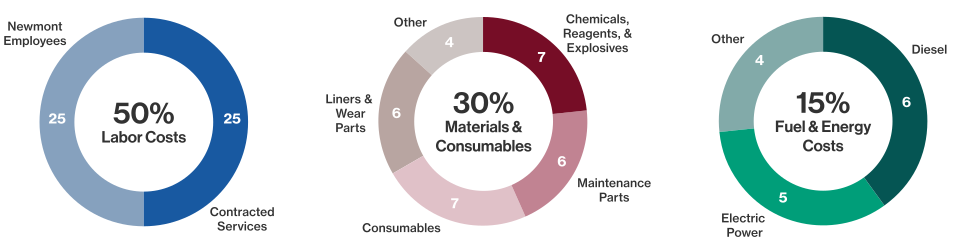
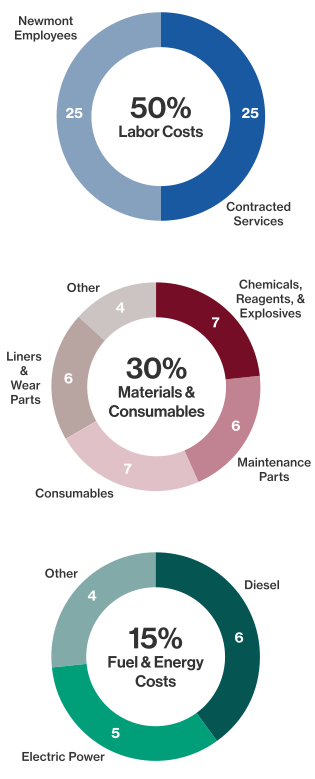
Source: Newmont. Data as of 6/30/2026. Represents results based on 2026 Guidance. ”Other” category of 5% primarily includes freight, technology-related costs, employee administrative costs, rents and operating leases.
The oil price sensitivity is there, but it is not the dominant cost factor. It is one component among several. Many miners meaningfully reduce their fuel exposure through long-term supply contracts, renewable sources of energy, and active hedging programs.
The Math Behind Gold Mining Margins
Gold companies’ earnings season kicked off at the end of July. Overall, we estimate that operating results have been mostly in line with expectations so far, and Q2 all-in sustaining costs are on average coming in below the $2,000 per ounce level. With gold trading around $4,000 per ounce at present, the sector is generating operating margins of roughly $2,000 per ounce, among the widest in the industry's history.
Even under a stress scenario in which gold prices remain flat and costs rise 10–15%, the sector may continue to generate substantial free cash flow per ounce. The margin cushion built up at current gold prices is meaningful. Companies do not need gold to keep rising to remain highly profitable. They need gold to remain broadly range-bound, which is a much lower bar.
This resilience matters because it changes what miners can do with their cash. We expect senior and mid-tier companies in the gold space to remain committed to:
- Growing and/or sustaining dividends
- Executing share buyback programs
- Paying down debt and strengthening balance sheets
- Funding exploration and organic growth programs without having to rely on equity issuance or elevated gold price assumptions
This is capital allocation discipline in a strong earnings environment, and it is a meaningful shift from how the industry has historically behaved.
What This Means for Gold Investors
The concern about cost inflation for gold miners is not unfounded. In our research and evaluation of these companies, we are intensely focused on the cost trends, and during our frequent management meetings, they are always a key topic. However, when viewed in full context, the cost outlook for this industry is not quite as concerning as it may seem at first glance. Gold miners operate with a natural inflation hedge on the revenue side. Their largest cost driver is labor, not fuel. Their energy exposure, while real, is partially hedged and structurally smaller than many assume. And the geopolitical forces driving energy prices higher are among the most reliable catalysts for gold price appreciation.
Today, gold miners are generating the kind of free cash flow that allows them to reward shareholders, service obligations and invest in future production, all without needing a heroic gold price assumption. They are, in many respects, in the strongest financial position the sector has seen in years.
For investors considering an allocation who are worried about cost pressures eroding the opportunity, we would suggest reframing the question. The risk is not that margins collapse under cost pressure. The more relevant question is whether investors are placing too much emphasis on cost pressures without giving equal weight to the sector's strong margins and cash generation.
To receive more Gold Investing insights, sign up in our subscription center.

Important Disclosures
All company, sector, and sub-industry weightings as of July 31, 2026 unless otherwise noted.
Newmont Corporation (NEM US) comprised 6.5% of the VanEck International Investors Gold Fund’s net assets as of July 31, 2026.
Nothing in this content should be considered a solicitation to buy or an offer to sell shares of any investment in any jurisdiction where the offer or solicitation would be unlawful under the securities laws of such jurisdiction, nor is it intended as investment, tax, financial, or legal advice. Investors should seek such professional advice for their particular situation and jurisdiction.
¹ MarketVector Global Gold Miners Index (MVGDXTR) tracks the overall performance of companies involved in the gold mining industry.
Any indices listed are unmanaged indices and include the reinvestment of all dividends, but do not reflect the payment of transaction costs, advisory fees or expenses that are associated with an investment in a Fund. Certain indices may take into account withholding taxes. An index’s performance is not illustrative of a Fund’s performance. Indices are not securities in which investments can be made.
Investments in commodities can be very volatile and direct investment in these markets can be very risky, especially for inexperienced investors.
MarketVector Global Gold Miners Index is the exclusive property of MarketVector Indexes GmbH, which has contracted with Solactive AG to maintain and calculate the Index. Solactive AG uses its best efforts to ensure that the Index is calculated correctly. Irrespective of its obligations towards MarketVector Indexes GmbH, Solactive AG has no obligation to point out errors in the Index to third parties.
This is not an offer to buy or sell, or a recommendation to buy or sell any of the securities or financial instruments mentioned herein. The information presented does not involve the rendering of personalized investment, financial, legal, tax advice, or any call to action. Certain statements contained herein may constitute projections, forecasts and other forward-looking statements, which do not reflect actual results, are for illustrative purposes only, are valid as of the date of this communication, and are subject to change without notice. Actual future performance of any assets or industries mentioned are unknown. Information provided by third party sources are believed to be reliable and have not been independently verified for accuracy or completeness and cannot be guaranteed. VanEck does not guarantee the accuracy of third party data. The information herein represents the opinion of the author(s), but not necessarily those of VanEck or its other employees.
Historical performance is not indicative of future results. Current data may differ from data quoted. Any graphs shown herein are for illustrative purposes only. No part of this material may be reproduced in any form, or referred to in any other publication, without express written permission of VanEck.
Sustainable investing strategies aim to consider and in some instances integrate the analysis of environmental, social and governance (ESG) factors into the investment process and portfolio. ESG investing is qualitative and subjective by nature, and there is no guarantee that the factors utilized by VanEck or any judgment exercised by VanEck will reflect the opinions of any particular investor. Information regarding responsible practices is obtained through voluntary or third-party reporting, which may not be accurate or complete, and VanEck is dependent on such information to evaluate a company’s commitment to, or implementation of, responsible practices. Socially responsible norms differ by region. There is no assurance that the socially responsible investing strategy and techniques employed will be successful. An investment strategy may hold securities of issuers that are not aligned with ESG principles.
About VanEck International Investors Gold Fund: You can lose money by investing in the Fund. Any investment in the Fund should be part of an overall investment program, not a complete program. The Fund is subject to risks which may include, but are not limited to, risks associated with active management, commodities and commodity-linked instruments, commodities and commodity-linked instruments tax, derivatives, direct investments, emerging market issuers, ESG investing strategy, foreign currency, foreign securities, gold and silver mining companies, market, non-diversified, operational, regulatory, investing in other funds, small- and medium-capitalization companies, special risk considerations of investing in Australian and Canadian issuers, subsidiary investment risk, and tax risks (with respect to investments in the Subsidiary), all of which may adversely affect the Fund. Emerging market issuers and foreign securities may be subject to securities markets, political and economic, investment and repatriation restrictions, different rules and regulations, less publicly available financial information, foreign currency and exchange rates, operational and settlement, and corporate and securities laws risks. Small- and medium-capitalization companies may be subject to elevated risks. Derivatives may involve certain costs and risks such as liquidity, interest rate, and the risk that a position could not be closed when most advantageous. Investments in the gold industry can be significantly affected by international economic, monetary and political developments. The Fund’s overall portfolio may decline in value due to developments specific to the gold industry.
Diversification does not assure a profit or protect against loss.
Investing involves substantial risk and high volatility, including possible loss of principal. An investor should consider the investment objective, risks, charges and expenses of a Fund carefully before investing. To obtain a prospectus and summary prospectus, which contain this and other information, call 800.826.2333 or visit vaneck.com. Please read the prospectus and summary prospectus carefully before investing.
© 2026 Van Eck
Important Disclosures
All company, sector, and sub-industry weightings as of July 31, 2026 unless otherwise noted.
Newmont Corporation (NEM US) comprised 6.5% of the VanEck International Investors Gold Fund’s net assets as of July 31, 2026.
Nothing in this content should be considered a solicitation to buy or an offer to sell shares of any investment in any jurisdiction where the offer or solicitation would be unlawful under the securities laws of such jurisdiction, nor is it intended as investment, tax, financial, or legal advice. Investors should seek such professional advice for their particular situation and jurisdiction.
¹ MarketVector Global Gold Miners Index (MVGDXTR) tracks the overall performance of companies involved in the gold mining industry.
Any indices listed are unmanaged indices and include the reinvestment of all dividends, but do not reflect the payment of transaction costs, advisory fees or expenses that are associated with an investment in a Fund. Certain indices may take into account withholding taxes. An index’s performance is not illustrative of a Fund’s performance. Indices are not securities in which investments can be made.
Investments in commodities can be very volatile and direct investment in these markets can be very risky, especially for inexperienced investors.
MarketVector Global Gold Miners Index is the exclusive property of MarketVector Indexes GmbH, which has contracted with Solactive AG to maintain and calculate the Index. Solactive AG uses its best efforts to ensure that the Index is calculated correctly. Irrespective of its obligations towards MarketVector Indexes GmbH, Solactive AG has no obligation to point out errors in the Index to third parties.
This is not an offer to buy or sell, or a recommendation to buy or sell any of the securities or financial instruments mentioned herein. The information presented does not involve the rendering of personalized investment, financial, legal, tax advice, or any call to action. Certain statements contained herein may constitute projections, forecasts and other forward-looking statements, which do not reflect actual results, are for illustrative purposes only, are valid as of the date of this communication, and are subject to change without notice. Actual future performance of any assets or industries mentioned are unknown. Information provided by third party sources are believed to be reliable and have not been independently verified for accuracy or completeness and cannot be guaranteed. VanEck does not guarantee the accuracy of third party data. The information herein represents the opinion of the author(s), but not necessarily those of VanEck or its other employees.
Historical performance is not indicative of future results. Current data may differ from data quoted. Any graphs shown herein are for illustrative purposes only. No part of this material may be reproduced in any form, or referred to in any other publication, without express written permission of VanEck.
Sustainable investing strategies aim to consider and in some instances integrate the analysis of environmental, social and governance (ESG) factors into the investment process and portfolio. ESG investing is qualitative and subjective by nature, and there is no guarantee that the factors utilized by VanEck or any judgment exercised by VanEck will reflect the opinions of any particular investor. Information regarding responsible practices is obtained through voluntary or third-party reporting, which may not be accurate or complete, and VanEck is dependent on such information to evaluate a company’s commitment to, or implementation of, responsible practices. Socially responsible norms differ by region. There is no assurance that the socially responsible investing strategy and techniques employed will be successful. An investment strategy may hold securities of issuers that are not aligned with ESG principles.
About VanEck International Investors Gold Fund: You can lose money by investing in the Fund. Any investment in the Fund should be part of an overall investment program, not a complete program. The Fund is subject to risks which may include, but are not limited to, risks associated with active management, commodities and commodity-linked instruments, commodities and commodity-linked instruments tax, derivatives, direct investments, emerging market issuers, ESG investing strategy, foreign currency, foreign securities, gold and silver mining companies, market, non-diversified, operational, regulatory, investing in other funds, small- and medium-capitalization companies, special risk considerations of investing in Australian and Canadian issuers, subsidiary investment risk, and tax risks (with respect to investments in the Subsidiary), all of which may adversely affect the Fund. Emerging market issuers and foreign securities may be subject to securities markets, political and economic, investment and repatriation restrictions, different rules and regulations, less publicly available financial information, foreign currency and exchange rates, operational and settlement, and corporate and securities laws risks. Small- and medium-capitalization companies may be subject to elevated risks. Derivatives may involve certain costs and risks such as liquidity, interest rate, and the risk that a position could not be closed when most advantageous. Investments in the gold industry can be significantly affected by international economic, monetary and political developments. The Fund’s overall portfolio may decline in value due to developments specific to the gold industry.
Diversification does not assure a profit or protect against loss.
Investing involves substantial risk and high volatility, including possible loss of principal. An investor should consider the investment objective, risks, charges and expenses of a Fund carefully before investing. To obtain a prospectus and summary prospectus, which contain this and other information, call 800.826.2333 or visit vaneck.com. Please read the prospectus and summary prospectus carefully before investing.
© 2026 Van Eck