Commodities Are Inexpensive, But No One Owns Them
September 04, 2026
Read Time 3 min
Key Takeaways
- Commodities have pulled in $188 billion since 1997. Equities pulled in $1.1 trillion. Bonds pulled in $5.3 trillion.
- Real assets add diversification to portfolios, relative to stocks and bonds.
- Versus U.S. stocks, commodities are trading near their cheapest levels since the 1970s
Commodities Are Inexpensive, but No One Owns Them
Three Decades of Skipping Commodity Allocations
Since 1997, U.S. commodity funds have attracted about $188 billion in cumulative net flows. Equity funds attracted roughly $1.1 trillion. Bond funds attracted roughly $5.3 trillion.
Commodity allocations have never exceeded about 2% of fund assets. Today they sit below 1%.
Exhibit 1: Commodities Have Been Chronically Under-Owned
U.S. Fund Category Cumulative Net Flows
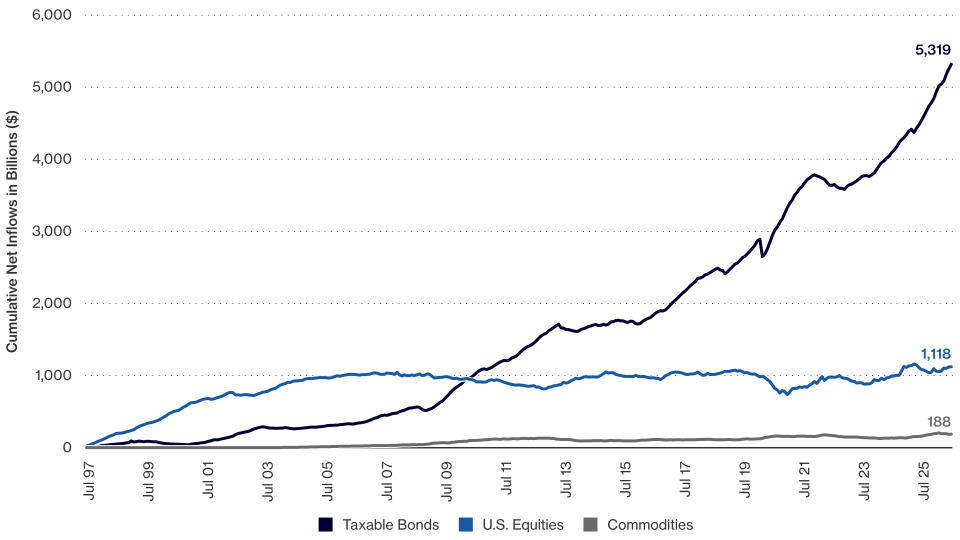

Source: Morningstar. Data as of June 2026.
Allocations to commodities have never topped 2% of assets, and sit below 1% today. And, versus U.S. stocks, commodities are trading near their lowest levels in decades.
Recommended subscription
Diversification Is The Name Of The Game
Diversification is the name of the game for asset allocators.
Over the past 30 years, commodities have shown almost zero correlation to bonds and very low correlation to stocks.
The more useful number sits one row over. Commodities correlate just 0.21 to the S&P 500 Technology Sector, lower than to the broad index itself.
That matters because of where portfolios actually sit today. Investors are heavily exposed to U.S. technology whether they chose to be or not. Look at the S&P 500. Real asset exposure, we believe, offers a return profile genuinely differentiated from that concentration rather than a slightly diluted version of it.
Exhibit 2: Commodities Add Low Correlation and Diversification
Commodities: 30-Year Correlation vs. Equities and Bonds


Source: Morningstar. Data as of June 30, 2026. “Commodities” = Bloomberg Commodity Index; “Int’l Bonds” = Bloomberg Global Aggregate ex. USD Index; “Int’l Stocks” = MSCI World ex. USA Index; “U.S. Stocks” = S&P 500 Index; “U.S. Bonds” = Bloomberg U.S. Aggregate Bond Index; “U.S. Tech Stocks” = S&P 500 Technology Sector Index. Past performance not indicative of future results. Index descriptions included at the end of this presentation.
Now Is a Good Entry Point, From a Value Perspective
The case for allocating to real assets isn't only a just a diversification story.
Versus U.S. Stocks, commodities are trading near their cheapest levels since the 1970s. Comparable extremes have historically preceded commodity outperformance, as supply tightens and prices revert to the mean.
Exhibit 3: Commodities Remain Historically Cheap vs. Stocks
Total Return Price Ratio - Commodities vs. U.S. Stocks


Source: VanEck, Bloomberg Data as of June 2026. Past performance not indicative of future results. Index descriptions included at the end of this commentary.
How Much to Allocate to Real Assets?
We believe investors should consider 10%, funded evenly from both sides, turning a traditional 60/40 into 55/35/10. Sourcing it entirely from bonds is the more common approach, but if the reason to own real assets is that stocks and bonds have started moving together, then both sides of the pair should give up some ground. Ten percent isn't enough to rescue a portfolio or to wreck one, and that's the point: zero is a position too, and it's a bet we wouldn't make with an entire portfolio.
To receive more Model Portfolio insights, sign up in our subscription center.


Important Disclosures
Index Definitions
Bloomberg Commodity Index: a broadly diversified index that tracks the performance of futures contracts on physical commodities across energy, metals, agriculture and livestock, weighted to limit concentration in any single commodity or sector.
Bloomberg Global Aggregate ex USD Index: a measure of investment grade debt from developed and emerging markets outside the United States, including treasury, government-related, corporate and securitized fixed rate bonds.
Bloomberg U.S. Aggregate Bond Index: a measure of the U.S. dollar-denominated, investment grade, taxable bond market, including treasuries, government-related and corporate securities, and securitized debt.
MSCI World ex USA Index: a free float-adjusted market capitalization index that measures equity market performance of developed markets excluding the United States.
S&P 500 Index: a market capitalization-weighted index of 500 leading publicly traded U.S. companies, widely regarded as a gauge of large cap U.S. equities.
S&P 500 Technology Sector Index: a subset of the S&P 500 Index comprising those constituents classified within the information technology sector under the Global Industry Classification Standard.
S&P GSCI Index: a production-weighted index of principal physical commodity futures contracts, designed to measure investment performance in the commodity markets.
Index returns are not Fund returns and do not reflect any management fees or brokerage expenses. Certain indices may take into account withholding taxes. Investors can not invest directly in the Index. Returns for actual Fund investors may differ from what is shown because of differences in timing, the amount invested and fees and expenses. Index returns assume that dividends have been reinvested.
Risk Considerations
This is not an offer to buy or sell, or a recommendation to buy or sell any of the securities, financial instruments or digital assets mentioned herein. The information presented does not involve the rendering of personalized investment, financial, legal, tax advice, or any call to action. Certain statements contained herein may constitute projections, forecasts and other forward-looking statements, which do not reflect actual results, are for illustrative purposes only, are valid as of the date of this communication, and are subject to change without notice. Actual future performance of any assets or industries mentioned are unknown. Information provided by third party sources are believed to be reliable and have not been independently verified for accuracy or completeness and cannot be guaranteed. VanEck does not guarantee the accuracy of third party data. The information herein represents the opinion of the author(s), but not necessarily those of VanEck or its other employees.
The models are not mutual funds or other types of securities and will not be registered with the Securities and Exchange Commission as investment companies under the Investment Company Act of 1940, as amended, and no units or shares of the models will be registered under the Securities Act of 1933, as amended, nor will they be registered with any state securities regulator. Accordingly, the models are not subject to compliance with the requirements of such acts. The models may also invest in digital assets, which are subject to significant risk and are not suitable for all investors.
All investing is subject to risk, including the possible loss of the money you invest. As with any investment strategy, there is no guarantee that investment objectives will be met and investors may lose money. Diversification does not ensure a profit or protect against a loss in a declining market. Past performance is no guarantee of future results.
© Van Eck Associates Corporation.
Intelligently-designed exposure across asset classes for diversified portfolios
Important Disclosures
Index Definitions
Bloomberg Commodity Index: a broadly diversified index that tracks the performance of futures contracts on physical commodities across energy, metals, agriculture and livestock, weighted to limit concentration in any single commodity or sector.
Bloomberg Global Aggregate ex USD Index: a measure of investment grade debt from developed and emerging markets outside the United States, including treasury, government-related, corporate and securitized fixed rate bonds.
Bloomberg U.S. Aggregate Bond Index: a measure of the U.S. dollar-denominated, investment grade, taxable bond market, including treasuries, government-related and corporate securities, and securitized debt.
MSCI World ex USA Index: a free float-adjusted market capitalization index that measures equity market performance of developed markets excluding the United States.
S&P 500 Index: a market capitalization-weighted index of 500 leading publicly traded U.S. companies, widely regarded as a gauge of large cap U.S. equities.
S&P 500 Technology Sector Index: a subset of the S&P 500 Index comprising those constituents classified within the information technology sector under the Global Industry Classification Standard.
S&P GSCI Index: a production-weighted index of principal physical commodity futures contracts, designed to measure investment performance in the commodity markets.
Index returns are not Fund returns and do not reflect any management fees or brokerage expenses. Certain indices may take into account withholding taxes. Investors can not invest directly in the Index. Returns for actual Fund investors may differ from what is shown because of differences in timing, the amount invested and fees and expenses. Index returns assume that dividends have been reinvested.
Risk Considerations
This is not an offer to buy or sell, or a recommendation to buy or sell any of the securities, financial instruments or digital assets mentioned herein. The information presented does not involve the rendering of personalized investment, financial, legal, tax advice, or any call to action. Certain statements contained herein may constitute projections, forecasts and other forward-looking statements, which do not reflect actual results, are for illustrative purposes only, are valid as of the date of this communication, and are subject to change without notice. Actual future performance of any assets or industries mentioned are unknown. Information provided by third party sources are believed to be reliable and have not been independently verified for accuracy or completeness and cannot be guaranteed. VanEck does not guarantee the accuracy of third party data. The information herein represents the opinion of the author(s), but not necessarily those of VanEck or its other employees.
The models are not mutual funds or other types of securities and will not be registered with the Securities and Exchange Commission as investment companies under the Investment Company Act of 1940, as amended, and no units or shares of the models will be registered under the Securities Act of 1933, as amended, nor will they be registered with any state securities regulator. Accordingly, the models are not subject to compliance with the requirements of such acts. The models may also invest in digital assets, which are subject to significant risk and are not suitable for all investors.
All investing is subject to risk, including the possible loss of the money you invest. As with any investment strategy, there is no guarantee that investment objectives will be met and investors may lose money. Diversification does not ensure a profit or protect against a loss in a declining market. Past performance is no guarantee of future results.
© Van Eck Associates Corporation.