October Market Recap: When a Late-Cycle Economy Meets an Early-Cycle Tech Boom
November 14, 2025
Read Time 7 MIN
Key Takeaways
- Debt Meets Disruption: Fiscal excess is fueling innovation and instability
- AI’s Three Phases: Builders spend, Adopters save, Automators replace
- Scarcity Is the Hedge: Gold, Bitcoin, and commodities remain the opt-outs
When a Late-Cycle Economy Meets an Early-Cycle Tech Boom
Debt Meets Disruption
Congratulations to Zohran Mamdani, New York City’s new mayor — bringing socialism to the capital of capitalism.
It’s the perfect symbol of a world straining under inflation, inequality, and automation. Populism was inevitable. Now we’ll see how far it goes.
We’re in a strange place — a late-cycle economy colliding with an early-cycle innovation boom. Debt is piling up just as disruption accelerates. The U.S. is simultaneously at the end of a credit cycle and the beginning of a historic investment cycle in AI, automation, and energy. Debt meets disruption — and that collision will define the next decade.
The Three Phases of AI
We see AI unfolding in three clear phases:
- Builders – the companies creating and powering the technology.
- Adopters – the companies using it to drive efficiency and cut costs.
- Automators – the convergence of AI and robotics that will redefine labor and productivity.
Most of the world is still in phase 1. A few leaders are moving into phase 2. And the first signs of phase 3 are beginning to appear.
Phase 1 - Builders Still Building
The builders are proving both the promise and the price of AI — and investors are starting to question what the bill looks like.
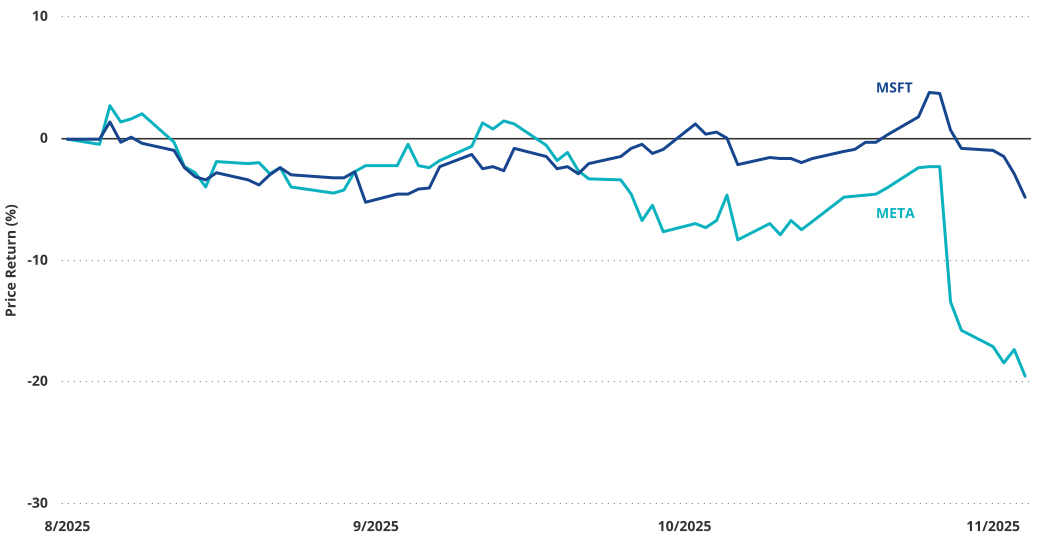
- Microsoft: $77 billion in revenue and $30 billion in profit, but investors focused on rising AI-infrastructure costs and cautious guidance.
- Meta: 26% revenue growth, but the stock fell after management warned that AI spending will remain elevated — a reminder that building the future isn’t cheap.
Both stocks declined after reporting. The “price” of AI isn’t just the chips and servers — it’s the strain on cash flow, the pressure on margins, and the patience it demands from investors.
This is what Phase 1 looks like in real time: the world’s largest technology firms pouring capital into compute, cloud, and data infrastructure while markets demand to know when it pays off.
The story is shifting from growth at any cost to growth with accountability. The “build” phase is still running, but markets are starting to ask the right question: when does all this spending translate into profits?
MSFT and META Dip: AI Spending Strains Balance Sheets
Source: Bloomberg, as of 11/6/2025. Past performance is no guarantee of future results.
Phase 2 - Adopters Reshape Work
While investors questioned the Builders’ soaring budgets, the Adopters are showing how AI can improve efficiency — and reshape work in the process.
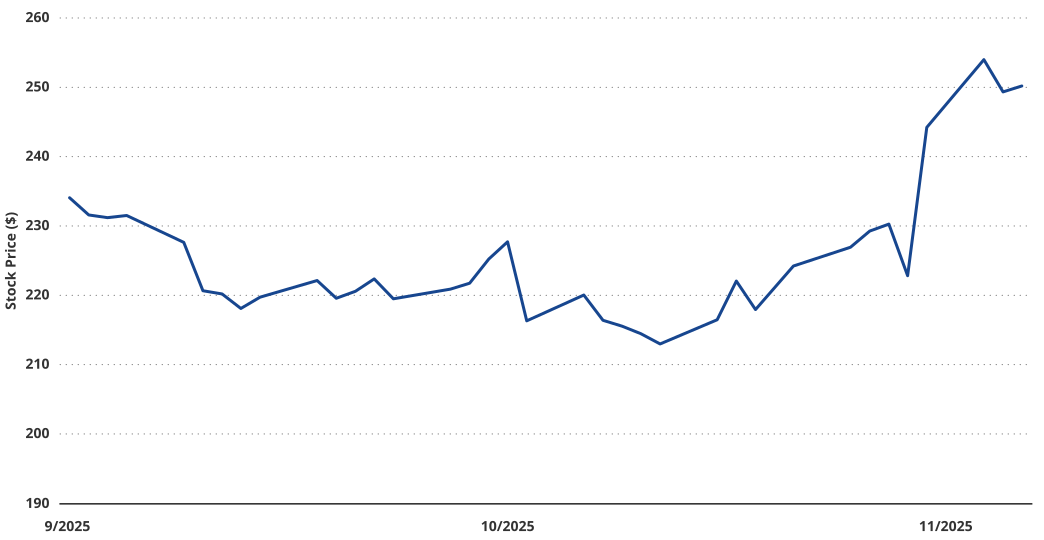
Amazon, the second-largest U.S. employer, offered one of the clearest examples in October. Its shares rose about 11% after earnings as revenue climbed roughly 13% year-over-year to $180 billion and profit surged nearly 40%. Growth in AWS — up ~20% to $33 billion — reassured investors that Amazon is turning AI investments into results.
Amazon Rises: AI-Adoption Efficiencies Enhances Outlook
Source: Bloomberg, as of 11/5/2025. Past performance is no guarantee of future results.
Earlier in the year, CEO Andy Jassy had noted that AI would allow Amazon to operate more efficiently and reduce the need for some corporate roles. That message has since become visible in the data: the company has announced about 14k corporate job cuts, with plans to eliminate as many as 30k positions. Its own automation and machine-learning tools are increasingly handling tasks once done by analysts, managers, and recruiters. Investors rewarded evidence that adoption is improving productivity and lowering costs, not just driving spending.
Accenture followed a similar path. It’s a business built to cut costs and modernize — exactly what AI does. The irony is rich: the company that spent decades automating people out of jobs is now being automated itself. Earlier this year, it announced 11,000 layoffs as part of a pivot toward AI, but the threat runs deeper. Generative AI can now do much of what Accenture sells — writing code, analyzing data, and redesigning workflows — potentially cutting the firm out entirely. The stock is down nearly 30% this year, as the market starts to price in that risk.
The data echo the headlines. A recent Economist analysis, based on a study of 300,000 companies, found that firms integrating AI into daily operations are already reducing junior-level roles 7.7% faster than those that haven’t, while senior positions remain stable. It’s a subtle but telling signal: AI isn’t replacing managers yet — it’s replacing the people who once worked for them. This is a peek behind the curtain of what’s coming — the early outlines of a labor market being quietly rewritten. Phase 2 isn’t a corporate trend; it’s the new operating model.
AI Has Heightened Impact for Junior Employees

Source: “Generative AI as seniority-biased technological change” by S.M. Hosseini & G. Lichtinger, SSRN working paper, 2025.
Recommended subscription
Phase 3 - Automation Takes the Floor
Some companies have entered phase 3, but what’s experimental today will soon be standard. Inside Amazon’s warehouses, Blue Jay — a new AI-powered robotic arm — now picks, sorts, and consolidates roughly 75% of items, guided by Project Eluna. This AI system that manages workflow and predicts bottlenecks. For now, this is early-stage automation at scale — limited to logistics — but it’s a preview of what’s next. When the second-largest employer in America builds machines that can replace both managers and movers, it’s more than efficiency — it’s evolution. Amazon is in the early innings of phase 3, but its scale ensures the ripple effects won’t stay contained.
AI will bring extraordinary productivity gains — but also widespread job displacement. This will be a structural shift, not a temporary shock. The U.S. will eventually be forced to support displaced workers through larger social spending. Add that to the tab.
Debt, Liquidity, and the Opt-Out
While technology races ahead, the financial system keeps falling behind. The U.S. is choking on debt and entering a massive capital-expenditure cycle to win at all costs — in technology, efficiency, and energy independence. Fiscal restraint doesn’t fit. Gold and Bitcoin have both corrected sharply after extraordinary runs. Bitcoin, which topped $125,000 earlier this year, recently fell back below $100,000. Gold hit $4,356 before slipping under $4,000. These are meaningful moves, but they’re not signs of weakness — they’re the natural volatility of assets built on conviction rather than cash flow.
We said last month that gold’s bull market would come with higher volatility — and it has. The long-term setup hasn’t changed: the world is spending to fund progress, not to pay down debt. In that environment, scarce assets remain the opt-outs — stores of value that can’t be printed to fund excess.
And here’s our view: in six months, we believe you’ll wish you bought these assets at today’s prices. We also believe they could go lower first. The only thing we know for sure is that trying to pick the bottom is a loser’s game. Don’t be cute. Nibble at it. Volatility is your friend.
Late-Cycle Credit Risk
Jamie Dimon recently likened the emergence of bad loans to spotting cockroaches — if you see one, there are more. He’s right, but this isn’t about a few bad borrowers. It’s about being late cycle, when the economy still looks strong, markets are confident, and the ugly side of excess starts to show.
The worst loans are made at the best of times. Private credit has exploded to more than $1.6 trillion, fueled by investors chasing yield and convinced that risk has been engineered out of the system. Regional banks, meanwhile, are being squeezed by higher funding costs and a wall of commercial-real-estate refinancing that doesn’t work at current rates. The market is catching on. The S&P® Regional Banks Select Industry Index (SPSIRBKT) and the MarketVector Alternative Asset Managers Index (MVAALTTR) have both materially underperformed the broader market since September, when these risks began to surface. Together, they capture two ends of the same problem — the lenders that fund private credit and the funds that rely on that funding.
This isn’t 2008 — bank capital is stronger — but the pattern is familiar. Risk migrates, leverage builds, and when the music stops, losses move from private to public balance sheets. Credit stress becomes fiscal stress.
Lenders Lag the Broad Market

Source: Bloomberg, as of 11/6/2025. Past performance is no guarantee of future results.
The GENIUS Act and Digital Demand
Amid all of this, new forces are shaping liquidity in unexpected ways.
The GENIUS Act is quietly creating structural buyers of dollars and Treasuries by requiring stablecoins to hold reserves in short-term U.S. debt.
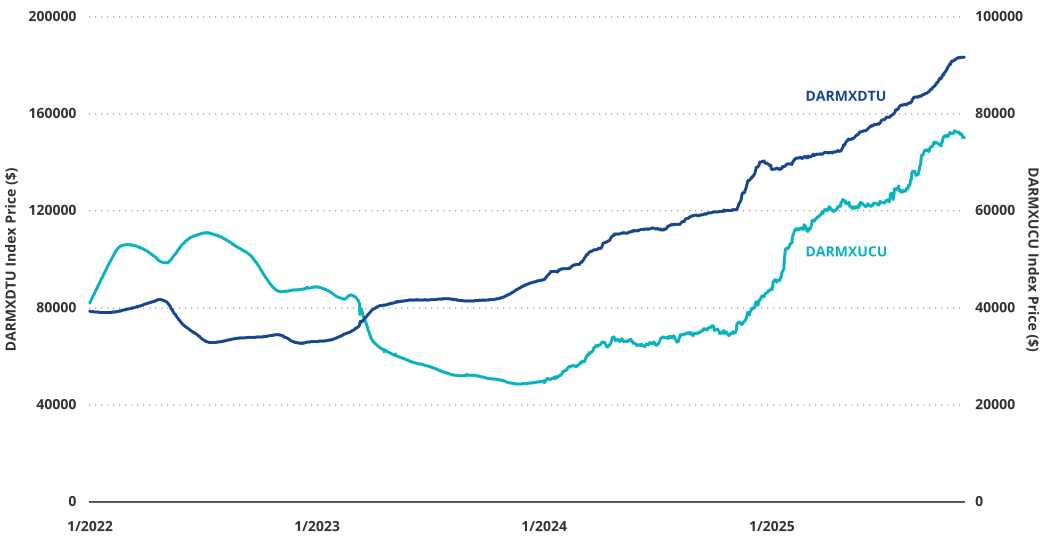
That policy change is already visible in the data. The market capitalizations of USDT and USDC have surged since the election, accelerating as regulatory clarity improved. More stablecoin use means more Treasury demand — digital dollars backed by real T-bills.
It’s ironic that digital assets were once viewed as a risk to the dollar. Now stablecoins are extending the reach of the dollar in a world seemingly desperate to de-dollarize. In that regard, the GENIUS Act really was genius.
Stablecoins Accelerate Demand for USD
Source: Bloomberg, as of 11/6/2025. Past performance is no guarantee of future results.
Debt
Fiscal excess is fueling innovation and instability.
AI’s Three Phases
Builders spend, Adopters save, Automators replace.
De-Dollarization
Stores of value to hedge against deficits, debt, and geopolitics.
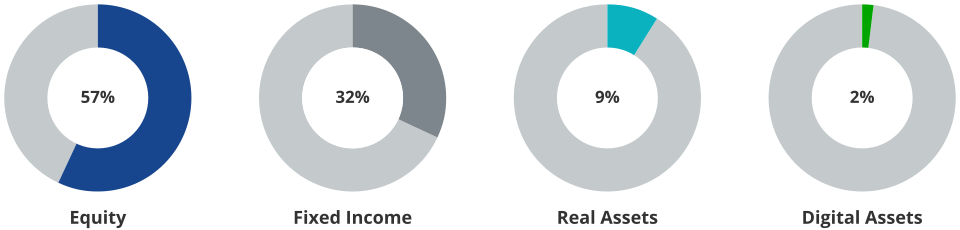
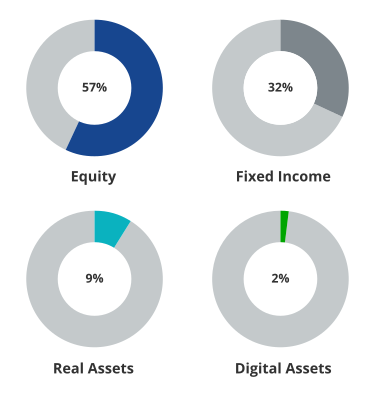
Today’s predominant macro forces are driving the key themes and exposures in VanEck’s models, including the core allocation of the VanEck Wealth Builder Plus Portfolios. The allocations below are representative of the Moderate Portfolio.
To receive more Model Portfolio insights, sign up in our subscription center.


Important Disclosures
This is not an offer to buy or sell, or a recommendation to buy or sell any of the securities, financial instruments or digital assets mentioned herein. The information presented does not involve the rendering of personalized investment, financial, legal, tax advice, or any call to action. Certain statements contained herein may constitute projections, forecasts and other forward-looking statements, which do not reflect actual results, are for illustrative purposes only, are valid as of the date of this communication, and are subject to change without notice. Actual future performance of any assets or industries mentioned are unknown. Information provided by third party sources are believed to be reliable and have not been independently verified for accuracy or completeness and cannot be guaranteed. VanEck does not guarantee the accuracy of third party data. The information herein represents the opinion of the author(s), but not necessarily those of VanEck or its other employees.
Digital asset investments are subject to significant risk and may not be suitable for all investors. Digital asset prices are highly volatile, and the value of digital assets, can rise or fall dramatically and quickly. If their value goes down, there’s no guarantee that it will rise again. As a result, there is a significant risk of loss of your entire principal investment.
Any projections, market outlooks or estimates in this material are forward-looking statements and are based upon certain assumptions that are solely the opinion of VanEck. Any projections, outlooks or assumptions should not be construed to be indicative of the actual events which will occur. Further, any information regarding portfolio composition, portfolio composition methodology, investment process or limits, or valuation methods of evaluating companies and markets are intended as guidelines which may be modified or changed by VanEck at any time in its sole discretion without notice.
The portfolio holdings presented represent securities held as of the period indicated and may not be representative of current or future investments. Such data may vary for each client in the strategy due to, but not limited to, asset size, market conditions, client guidelines and the diversity of portfolio holdings. Portfolio holdings are subject to change without notice and are being provided for illustrative purposes only. Nothing contained herein should be construed as (i) an offer to buy any security or (ii) a recommendation as to the advisability of investing in, purchasing or selling any security. This material is being provided for illustrative purposes only. Past performance is no guarantee of future results.
All investing is subject to risk, including the possible loss of the money you invest. As with any investment strategy, there is no guarantee that investment objectives will be met and investors may lose money. Diversification does not ensure a profit or protect against a loss in a declining market. Past performance is no guarantee of future results.
© Van Eck Associates Corporation.
Intelligently-designed exposure across asset classes for diversified portfolios
Important Disclosures
This is not an offer to buy or sell, or a recommendation to buy or sell any of the securities, financial instruments or digital assets mentioned herein. The information presented does not involve the rendering of personalized investment, financial, legal, tax advice, or any call to action. Certain statements contained herein may constitute projections, forecasts and other forward-looking statements, which do not reflect actual results, are for illustrative purposes only, are valid as of the date of this communication, and are subject to change without notice. Actual future performance of any assets or industries mentioned are unknown. Information provided by third party sources are believed to be reliable and have not been independently verified for accuracy or completeness and cannot be guaranteed. VanEck does not guarantee the accuracy of third party data. The information herein represents the opinion of the author(s), but not necessarily those of VanEck or its other employees.
Digital asset investments are subject to significant risk and may not be suitable for all investors. Digital asset prices are highly volatile, and the value of digital assets, can rise or fall dramatically and quickly. If their value goes down, there’s no guarantee that it will rise again. As a result, there is a significant risk of loss of your entire principal investment.
Any projections, market outlooks or estimates in this material are forward-looking statements and are based upon certain assumptions that are solely the opinion of VanEck. Any projections, outlooks or assumptions should not be construed to be indicative of the actual events which will occur. Further, any information regarding portfolio composition, portfolio composition methodology, investment process or limits, or valuation methods of evaluating companies and markets are intended as guidelines which may be modified or changed by VanEck at any time in its sole discretion without notice.
The portfolio holdings presented represent securities held as of the period indicated and may not be representative of current or future investments. Such data may vary for each client in the strategy due to, but not limited to, asset size, market conditions, client guidelines and the diversity of portfolio holdings. Portfolio holdings are subject to change without notice and are being provided for illustrative purposes only. Nothing contained herein should be construed as (i) an offer to buy any security or (ii) a recommendation as to the advisability of investing in, purchasing or selling any security. This material is being provided for illustrative purposes only. Past performance is no guarantee of future results.
All investing is subject to risk, including the possible loss of the money you invest. As with any investment strategy, there is no guarantee that investment objectives will be met and investors may lose money. Diversification does not ensure a profit or protect against a loss in a declining market. Past performance is no guarantee of future results.
© Van Eck Associates Corporation.