Stagflation May Be the New Base Case: Why It Matters
July 31, 2026
Read Time 6 MIN
Key Takeaways
- Real U.S. GDP decelerated from +4.4% in Q3 2025 to +0.5% in Q4 2025, before rebounding to +2.1% in Q1 2026. Meanwhile, core PCE inflation rose +3.4% year-over-year in May 2026, well above the Fed's 2% target.
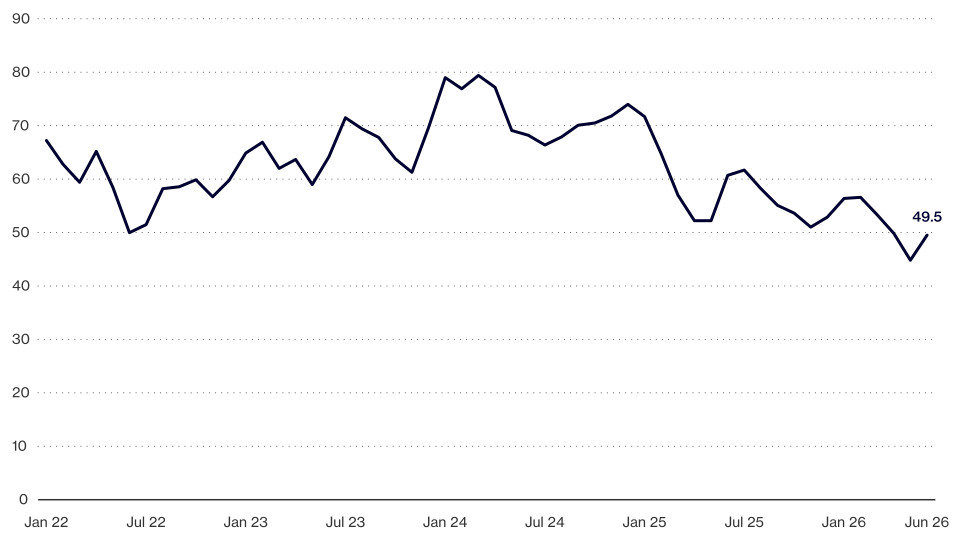
- Consumer sentiment has declined -18.5% over the past year, with the University of Michigan index at 49.5 in June 2026. Year-ahead inflation is expected to remain high at 4.6%.
- Traditional 60/40 portfolios have historically struggled when growth slows, and inflation stays high simultaneously. In stagflationary conditions, real assets like gold, commodities, and TIPS have served as potential diversifiers for investors seeking to manage this risk.
Opening
Once considered a relic of the 1970s, the pressure of stagflation is again weighing on U.S. consumers and investors. With GDP growth slowing sharply, core inflation running well above the Federal Reserve's 2% target, and consumer confidence near historic lows, the question circulating in the market right now is a simple one: is stagflation now a base-case reality, and how should I hedge my portfolio? In this piece, we break down what the data is showing, why the problem has been so difficult for policymakers to fix, and what it could imply for how investors diversify.
How Is the Data Signaling Stagflation?
The current macro landscape captures stagflation's causality at a smaller scale: growth is cooling while inflation stays sticky above the Fed's 2% target. Three forces help explain how those two conditions, slow growth and persistent inflation, come to coexist:
- Supply-side shocks: Tariffs, energy spikes, and other global disruptions raise the cost of inputs and imported goods across the economy. Those higher costs drive prices up even as activity slows, creating the simultaneous inflation and stagnation that define stagflationary pressure.
- A policy trap: The Fed's policy tool, interest-rate hikes, works against inflation driven by a fast-growing economy. When price pressure comes instead from supply constraints and rising costs, higher rates risk deepening the slowdown without fully taming inflation. The 1970s showed the other side: a "stop-go" Fed that eased too soon let inflation get stuck at high levels. Today the bind shows up as a Fed stuck on hold, unable to cut or hike cleanly.
- Unanchored inflation expectations: Once households and businesses anticipate high inflation, it gets built into wages and prices, making it self-reinforcing even as the economy weakens. Elevated readings like the 4.6% year-ahead inflation expectation are possible indicators that stagflationary pressure is starting to build.
How Do Tariffs Drive Inflation?
Tariffs raise the cost of imported goods and intermediate inputs, and those higher costs pass through the supply chain into the prices consumers ultimately pay. Because this pressure stems from rising costs rather than a fast-growing economy, the Fed's primary lever of raising interest rates is a blunt instrument against it. Higher rates can further slow an economy that is already decelerating without directly relieving the tariff- and supply-driven costs pushing prices higher. This is why today's scenario is so difficult to resolve with monetary policy alone.
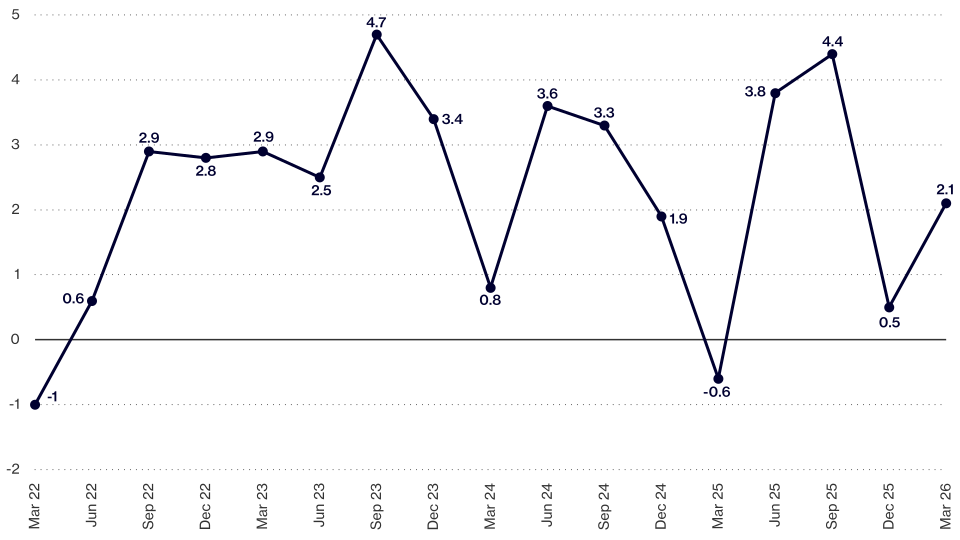
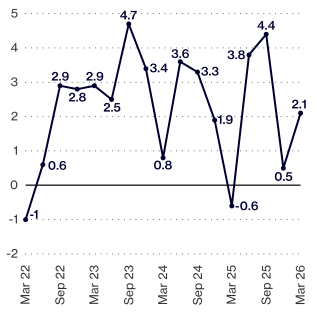
- After expanding +4.4% in Q3 2025, real GDP slowed sharply to just +0.5% in Q4 2025 before a partial rebound to +2.1% in Q1 2026; a pronounced deceleration when measured against the prior pace.1
U.S. Real GDP Growth Has Slowed Sharply from Its 2025 Peak
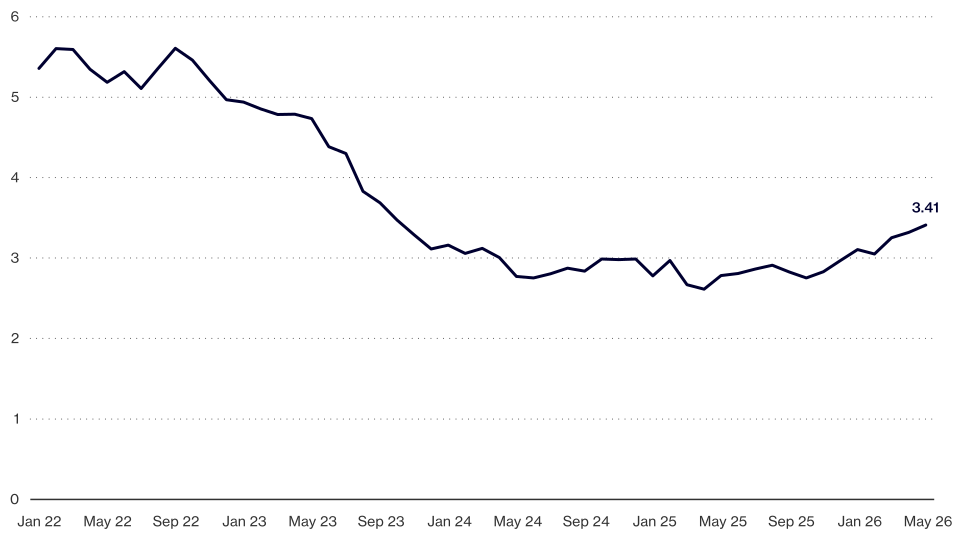
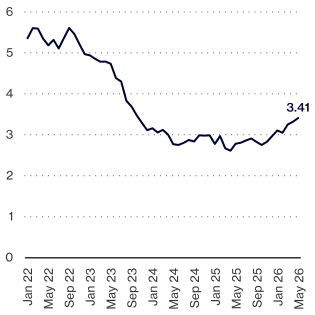
- Core personal consumption expenditures (PCE), the Fed's preferred inflation gauge which excludes food and energy, rose +3.4% year-over-year in May 2026, with headline PCE at +4.1%.2 The Fed targets 2% PCE inflation over the longer run,3 so both readings sit well above the line.
Core PCE Remains Well Above the Fed's 2% Target
How the Fed Is Combatting Inflation
Caught between a slowing economy and above-target inflation, the Fed has voted to stay on hold, keeping its policy rate at 3.50–3.75% since December 2025. The decision reflects a difficult balancing act: cutting rates risks re-accelerating inflation, while hiking risks deepening the slowdown. With both pressures persisting, there is no clear path. The strain is increasingly visible in how households feel. Consumer sentiment has fallen by 18.5% over the past year, with the University of Michigan index at 49.5 in June 2026 (a level historically linked to severe economic stress). Year-ahead inflation expectations remain elevated at 4.6%.4 Expectations that stay this high risk becoming self-fulfilling, which is another reason why the Fed is reluctant to declare the fight over.
Consumer Confidence Has Fallen to Levels Tied to Severe Economic Stress
How Does Stagflation Impact the Traditional 60/40 Portfolio?
The 60/40 portfolio model rests on a powerful assumption: when stocks fall, high-quality bonds rise, cushioning the blow. Stagflation challenges that assumption.
Impact on Bonds
Fixed income is designed to provide stability and balance to a portfolio. But bond payouts are fixed, so when inflation runs hot, the real value of those payments erodes and prices fall. More damaging for diversification, stocks and bonds tend to move together in high-inflation regimes rather than offsetting one another. The very negative correlation that makes 60/40 work in normal times can flip positive during inflation, leaving investors exposed to drawdowns in both sleeves when they expect protection.
Impact on Equities
In stagflation, businesses must pay more to operate but sell less, squeezing profitable revenues from both directions. High rates pile on, and the hardest hit is expensive growth stocks. The 1970s offered us a vivid illustration: the broad U.S. market delivered close to zero real return across the decade, the era's premier growth stocks fell the furthest, and companies with genuine pricing power held up far better than the index.
Recommended subscription
What Stagflation Means for Investors
The takeaway is not to predict a single outcome, but to prepare for several. The end goal is a portfolio that remains resilient not just in favorable scenarios, but across the full range stagflation can produce, from a fragile soft landing to a more entrenched stretch of slow growth and sticky prices. That resilience comes from owning diversified assets whose return drivers are differentiated from mainstream stocks and bonds.
How to Position Your Portfolio for Stagflation
A diversified allocation to real assets such as gold, commodities, TIPS, and infrastructure is a battle-tested strategy that can hedge the simultaneous pressure stagflationary conditions place on equities and bonds.5,6 Each plays a distinct role: gold as a monetary hedge and store of value, commodities as direct exposure to the input costs driving inflation, TIPS as explicit inflation-linked bonds, and infrastructure as real, cash-generative assets with inherent pricing power.
VanEck has helped investors access these exposures for decades. We have offered access to gold since 1956, when we launched INIVX, the first U.S. open-ended gold-equity mutual fund. In 2006, we launched GDX, the world's first gold miners ETF.
Today that product suite has expanded to span the real-asset spectrum: gold and gold-mining equities (GDX) alongside deliverable physical gold (OUNZ); broad commodities (PIT); natural-resource equities (HAP); and a diversified multi-real-asset allocation (RAAX). Together, these products let investors assemble the kind of multi-scenario, real-asset diversification to address stagflation pressure.
To receive more Model Portfolio insights, sign up in our subscription center.


Important Disclosures
Sources
1 GDP (Third Estimate), Industries, Corporate Profits, State GSP, and State Personal Income, 1st Quarter 2026 (bea.gov)
2 Personal Income and Outlays, May 2026 (BEA)
4 Surveys of Consumers (University of Michigan Surveys of Consumers)
5 PGIM Quantitative Solutions, Portfolio Implications of a Higher US Inflation Regime, May 2022.
6 PGIM Multi-Asset Solutions, Real Assets, Inflation & Portfolio Performance, February 2025.
This is not an offer to buy or sell, or a recommendation to buy or sell any of the securities, financial instruments or digital assets mentioned herein. The information presented does not involve the rendering of personalized investment, financial, legal, tax advice, or any call to action. Certain statements contained herein may constitute projections, forecasts and other forward-looking statements, which do not reflect actual results, are for illustrative purposes only, are valid as of the date of this communication, and are subject to change without notice. Actual future performance of any assets or industries mentioned are unknown. Information provided by third party sources are believed to be reliable and have not been independently verified for accuracy or completeness and cannot be guaranteed. VanEck does not guarantee the accuracy of third party data. The information herein represents the opinion of the author(s), but not necessarily those of VanEck or its other employees.
VanEck Merk Gold ETF (“OUNZ,” or the “Trust”)
The material must be preceded or accompanied by a prospectus. Before investing you should carefully consider the VanEck Merk Gold ETF's investment objectives, risks, charges and expenses.
Investing involves significant risk, including possible loss of principal. The Trust is not an investment company registered under the Investment Company Act of 1940 or a commodity pool for the purposes of the Commodity Exchange Act. Shares of the Trust are not subject to the same regulatory requirements as mutual funds. Because shares of the Trust are intended to reflect the price of the gold held in the Trust, the market price of the shares is subject to fluctuations similar to those affecting gold prices. Additionally, shares of the Trust are bought and sold at market price, not at net asset value (“NAV”). Brokerage commissions will reduce returns.
The request for redemption of shares for gold is subject to a number of risks including but not limited to the potential for the price of gold to decline during the time between the submission of the request and delivery. Delivery may take a considerable amount of time depending on your location.
This content is published in the United States for residents of specified countries. Investors are subject to securities and tax regulations within their applicable jurisdictions that are not addressed on this content. Nothing in this content should be considered a solicitation to buy or an offer to sell shares of any investment in any jurisdiction where the offer or solicitation would be unlawful under the securities laws of such jurisdiction, nor is it intended as investment, tax, financial, or legal advice. Investors should seek such professional advice for their particular situation and jurisdiction.
Commodities and commodity-index linked securities may be affected by changes in overall market movements and other factors such as weather, disease, embargoes, or political and regulatory developments, as well as trading activity of speculators and arbitrageurs in the underlying commodities.
Trust shares trade like stocks, are subject to investment risk and will fluctuate in market value. The value of Trust shares relates directly to the value of the gold held by the Trust (less its expenses), and fluctuations in the price of gold could materially and adversely affect an investment in the shares. The price received upon the sale of the shares, which trade at market price, may be more or less than the value of the gold represented by them. The Trust does not generate any income, and as the Trust regularly issues shares to pay for the Sponsor’s ongoing expenses, the amount of gold represented by each Share will decline over time. Investing involves risk, and you could lose money on an investment in the Trust. For a more complete discussion of the risk factors relative to the Trust, carefully read the prospectus.
The Sponsor for the Trust is Merk Investments, LLC. The Marketing Agent for the Trust is Van Eck Securities Corporation.
© Merk Investments LLC & © Van Eck Associates Corporation
VanEck Mutual Fund and ETF Risk Disclosures
The principal risks of investing in VanEck ETFs and mutual funds include, but are not limited to, sector, market, economic, political, foreign currency, world event, index tracking, active management, social media analytics, derivatives, blockchain, commodities and non-diversification risks, as well as fluctuations in net asset value and the risks associated with investing in less developed capital markets. VanEck ETFs may also be subject to authorized participant concentration, no guarantee of active trading market, trading issues, passive management, fund shares trading, premium/discount risk and liquidity of fund shares risks. VanEck ETFs or mutual funds may loan their securities, which may subject them to additional credit and counterparty risk. ETFs or mutual funds that invest in high-yield securities are subject to subject to risks associated with investing in high-yield securities; which include a greater risk of loss of income and principal than funds holding higher-rated securities; concentration risk; credit risk; hedging risk; interest rate risk; and short sale risk. ETFs or mutual funds that invest in companies with small capitalizations are subject to elevated risks, which include, among others, greater volatility, lower trading volume and less liquidity than larger companies. Please see the prospectus of each Fund for more complete information regarding each Fund’s specific risks.
Investing involves substantial risk and high volatility, including possible loss of principal. An investor should consider the investment objective, risks, charges and expenses of the Fund carefully before investing. To obtain a prospectus and summary prospectus, which contains this and other information, call 800.826.2333 or visit vaneck.com. Please read the prospectus and summary prospectus carefully before investing.
© Van Eck Securities Corporation, Distributor, a wholly owned subsidiary of Van Eck Associates Corporation.
Intelligently-designed exposure across asset classes for diversified portfolios
Important Disclosures
Sources
1 GDP (Third Estimate), Industries, Corporate Profits, State GSP, and State Personal Income, 1st Quarter 2026 (bea.gov)
2 Personal Income and Outlays, May 2026 (BEA)
4 Surveys of Consumers (University of Michigan Surveys of Consumers)
5 PGIM Quantitative Solutions, Portfolio Implications of a Higher US Inflation Regime, May 2022.
6 PGIM Multi-Asset Solutions, Real Assets, Inflation & Portfolio Performance, February 2025.
This is not an offer to buy or sell, or a recommendation to buy or sell any of the securities, financial instruments or digital assets mentioned herein. The information presented does not involve the rendering of personalized investment, financial, legal, tax advice, or any call to action. Certain statements contained herein may constitute projections, forecasts and other forward-looking statements, which do not reflect actual results, are for illustrative purposes only, are valid as of the date of this communication, and are subject to change without notice. Actual future performance of any assets or industries mentioned are unknown. Information provided by third party sources are believed to be reliable and have not been independently verified for accuracy or completeness and cannot be guaranteed. VanEck does not guarantee the accuracy of third party data. The information herein represents the opinion of the author(s), but not necessarily those of VanEck or its other employees.
VanEck Merk Gold ETF (“OUNZ,” or the “Trust”)
The material must be preceded or accompanied by a prospectus. Before investing you should carefully consider the VanEck Merk Gold ETF's investment objectives, risks, charges and expenses.
Investing involves significant risk, including possible loss of principal. The Trust is not an investment company registered under the Investment Company Act of 1940 or a commodity pool for the purposes of the Commodity Exchange Act. Shares of the Trust are not subject to the same regulatory requirements as mutual funds. Because shares of the Trust are intended to reflect the price of the gold held in the Trust, the market price of the shares is subject to fluctuations similar to those affecting gold prices. Additionally, shares of the Trust are bought and sold at market price, not at net asset value (“NAV”). Brokerage commissions will reduce returns.
The request for redemption of shares for gold is subject to a number of risks including but not limited to the potential for the price of gold to decline during the time between the submission of the request and delivery. Delivery may take a considerable amount of time depending on your location.
This content is published in the United States for residents of specified countries. Investors are subject to securities and tax regulations within their applicable jurisdictions that are not addressed on this content. Nothing in this content should be considered a solicitation to buy or an offer to sell shares of any investment in any jurisdiction where the offer or solicitation would be unlawful under the securities laws of such jurisdiction, nor is it intended as investment, tax, financial, or legal advice. Investors should seek such professional advice for their particular situation and jurisdiction.
Commodities and commodity-index linked securities may be affected by changes in overall market movements and other factors such as weather, disease, embargoes, or political and regulatory developments, as well as trading activity of speculators and arbitrageurs in the underlying commodities.
Trust shares trade like stocks, are subject to investment risk and will fluctuate in market value. The value of Trust shares relates directly to the value of the gold held by the Trust (less its expenses), and fluctuations in the price of gold could materially and adversely affect an investment in the shares. The price received upon the sale of the shares, which trade at market price, may be more or less than the value of the gold represented by them. The Trust does not generate any income, and as the Trust regularly issues shares to pay for the Sponsor’s ongoing expenses, the amount of gold represented by each Share will decline over time. Investing involves risk, and you could lose money on an investment in the Trust. For a more complete discussion of the risk factors relative to the Trust, carefully read the prospectus.
The Sponsor for the Trust is Merk Investments, LLC. The Marketing Agent for the Trust is Van Eck Securities Corporation.
© Merk Investments LLC & © Van Eck Associates Corporation
VanEck Mutual Fund and ETF Risk Disclosures
The principal risks of investing in VanEck ETFs and mutual funds include, but are not limited to, sector, market, economic, political, foreign currency, world event, index tracking, active management, social media analytics, derivatives, blockchain, commodities and non-diversification risks, as well as fluctuations in net asset value and the risks associated with investing in less developed capital markets. VanEck ETFs may also be subject to authorized participant concentration, no guarantee of active trading market, trading issues, passive management, fund shares trading, premium/discount risk and liquidity of fund shares risks. VanEck ETFs or mutual funds may loan their securities, which may subject them to additional credit and counterparty risk. ETFs or mutual funds that invest in high-yield securities are subject to subject to risks associated with investing in high-yield securities; which include a greater risk of loss of income and principal than funds holding higher-rated securities; concentration risk; credit risk; hedging risk; interest rate risk; and short sale risk. ETFs or mutual funds that invest in companies with small capitalizations are subject to elevated risks, which include, among others, greater volatility, lower trading volume and less liquidity than larger companies. Please see the prospectus of each Fund for more complete information regarding each Fund’s specific risks.
Investing involves substantial risk and high volatility, including possible loss of principal. An investor should consider the investment objective, risks, charges and expenses of the Fund carefully before investing. To obtain a prospectus and summary prospectus, which contains this and other information, call 800.826.2333 or visit vaneck.com. Please read the prospectus and summary prospectus carefully before investing.
© Van Eck Securities Corporation, Distributor, a wholly owned subsidiary of Van Eck Associates Corporation.