How Municipal Bond Yields Look Relative to History
December 01, 2025
Read Time 4 MIN
Key Takeaways:
- High-yield muni yields stay elevated, potentially offering rare above-average, tax-free income potential.
- Spreads remain stable and balanced, signaling healthy credit conditions across muni markets.
- After-tax yields beat corporates, giving investors strong income efficiency with lower risk.
How Municipal Bond Yields Look Relative to History
Municipal bond investors continue to find meaningful income opportunities. While interest rates have come down from their peaks, yields across the muni market remain attractive by historical standards. Strong credit fundamentals and steady demand have helped preserve that value even as the broader rate environment has shifted.
Within that landscape, high-yield municipal bonds stand out. Even as rates have eased, yields remain elevated relative to history, allowing investors to capture above-average income while maintaining exposure to an asset class with a strong credit record. After years of muted returns, the market has effectively reset, creating an income profile not seen in more than a decade.
Yields Remain Elevated Compared with History
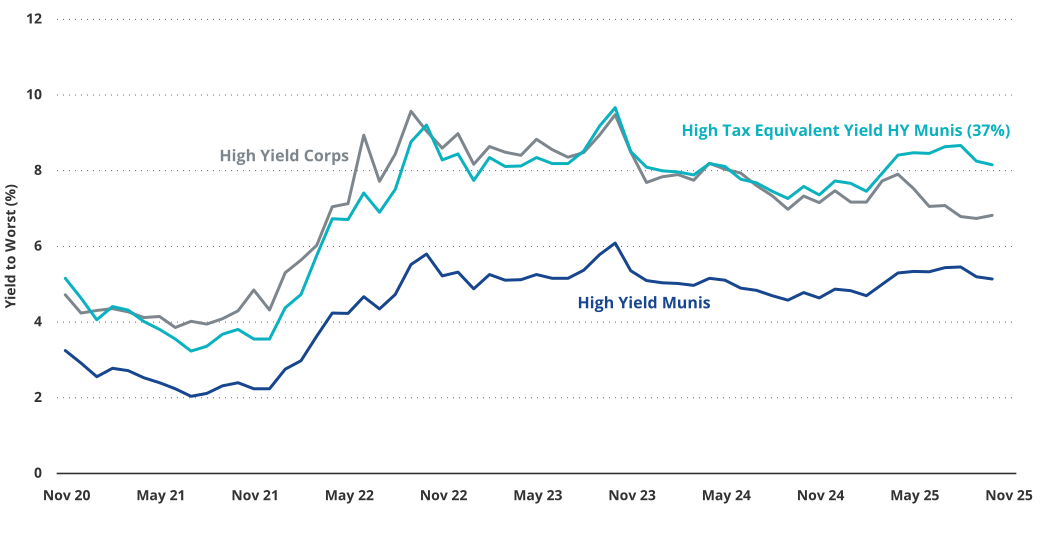
High-yield muni yields have risen sharply since 2020, climbing from below 3% to around 5% and holding near those levels for much of the past two years. These elevated yields mark a sharp break from the low-rate years of the last cycle, giving investors a chance to lock in meaningful, tax-exempt income while the opportunity lasts.
In 2025, high-yield munis cheapened further for several sector-specific reasons. Their longer-dated maturity profile made them more sensitive to curve steepening mid-year, while renewed credit scrutiny in areas such as charter schools, private higher education, and senior living added to spread widening. Heavy new-issue supply, wider concessions, and bouts of risk-off sentiment in broader credit markets also created periodic volatility and attractive entry points.
Absolute Yields and Taxable Equivalent Yield
Source: ICE Data Indices as of 11/1/2025. This is not an offer to buy or sell, or a recommendation to buy or sell any of the securities mentioned herein. Past performance not indicative of future results. Index performance is not representative of fund performance. It is not possible to invest directly in an index. See index definitions at end.
HYD | VanEck High Yield Muni ETF
The chart above shows the taxable-equivalent yield (TEY), the yield a taxable bond would need to offer to match a muni’s after-tax income, based on a 37% federal tax bracket. On that basis, a 5% tax-free yield equates to roughly 8% taxable-equivalent income. Since mid-2024, the TEY on the ICE High Yield Municipal Bond Index has exceeded the yield on the ICE BofA U.S. High Yield Corporate Index, underscoring how high-yield munis continue to deliver competitive after-tax income with stronger credit quality and lower default risk.
Credit Spreads Reflect a Healthy Market
Credit Spread – HY Muni vs AAA Muni (Bps)

Source: ICE Data Indices as of 11/1/2025. Past performance is no guarantee of future results.
Recommended subscription
The spread between high-yield and AAA-rated municipal bonds currently sits near 1.66%, modestly above the four-year average of roughly 1.56%. This mild widening points to valuations that remain balanced, offering incremental yield advantage without suggesting any credit stress.
As the chart shows, spreads have fluctuated within a narrow range since 2021, tightening through periods of strong demand and widening briefly during heavier issuance or short-term volatility. The current level places high-yield munis in a steady, well-functioning market where investors continue to receive reasonable compensation for taking on additional credit exposure.
That steadiness stands out in a landscape where other credit sectors have shown greater variability. High-yield muni issuers, typically hospitals, housing authorities, and education-related projects, have demonstrated durable credit strength across cycles. With fundamentals solid and spreads sitting slightly above their recent average, the sector continues to offer appealing income potential without excessive risk.
The Power of Tax-Exempt Income
Nominal vs Taxable Equivalent Yields

Source: ICE Data as of 9/30/2025. For illustrative purposes only. Past performance is no guarantee of future results.
The chart above shows how tax treatment influences real income potential. With nominal yields holding near the upper end of recent ranges, the tax-exempt advantage of municipals remains substantial. When adjusted for taxes, municipal high yield offers a clearer edge in after-tax income compared with taxable high yield. For investors in higher brackets, that differential translates directly into retained income rather than return lost to taxes.
That efficiency helps keep municipal high yield competitive, even as broader interest rates have moderated. In an environment where nominal yields across sectors have converged, the ability to preserve more of what’s earned continues to set municipals apart.
Why Invest in High Yield Munis Now?
Yields remain elevated, spreads are stable, and municipal credit is on firm footing. Market fundamentals are well supported, with recession risks appearing contained and state and local issuers continuing to benefit from steady tax revenues and disciplined balance sheets. High issuance and temporary flow volatility earlier in the year helped cheapen valuations, leaving investors with more attractive entry points at today’s levels.
For investors seeking diversified exposure, VanEck’s High Yield Muni ETF (HYD) provides efficient access to this market through a single, liquid vehicle. With credit fundamentals intact and after-tax yields that continue to compare favorably to corporate high yield, high-yield munis offer one of the most balanced and tax-efficient sources of income available in fixed income today.
To receive more Municipal Bonds insights, sign up in our subscription center.

Important Disclosures
This is not an offer to buy or sell, or a recommendation to buy or sell any of the securities, financial instruments or digital assets mentioned herein. The information presented does not involve the rendering of personalized investment, financial, legal, tax advice, or any call to action. Certain statements contained herein may constitute projections, forecasts and other forward-looking statements, which do not reflect actual results, are for illustrative purposes only, are valid as of the date of this communication, and are subject to change without notice. Actual future performance of any assets or industries mentioned are unknown. Information provided by third party sources are believed to be reliable and have not been independently verified for accuracy or completeness and cannot be guaranteed. VanEck does not guarantee the accuracy of third party data. The information herein represents the opinion of the author(s), but not necessarily those of VanEck or its other employees.
U.S. Corporate High Yield Bonds: Based on ICE BofA US High Yield Index and Municipal High-Yield Bonds: Based on ICE Core High Yield & Unrated Municipal Index. See end for index descriptions. Yield to worst is the lowest yield that a buyer can expect among the reasonable alternatives, such as yield to maturity, yield to call, and yield to refunding.
Tax-equivalent yield is used by investors to compare yields on taxable and tax-exempt securities after accounting for federal taxes (excluding AMT). Taxable-equivalent yield represents the yield a taxable bond would have to earn in order to match after taxes the yield available on a tax-exempt municipal bond. Taxable-Equivalent Yield = Tax Free Municipal Bond Yield/(1 –Tax Rate).
Tax equivalent yield calculated based on federal income tax rate. State, local and alterative minimum taxes have not been considered in the analysis.
Please note that depending on your tax bracket, the potential tax equivalent returns may be higher or lower. Past performance is not a guarantee of future results.
Index Definitions
ICE BofA US Municipal Securities Index: tracks the performance of US dollar denominated investment grade tax-exempt debt publicly issued by US states and territories, and their political subdivisions, in the US domestic market.
ICE Broad High Yield Crossover Municipal Index: is a subset of ICE BofA US Municipal Securities Index including all securities rated AAA.
ICE BofA US High Yield Index: tracks the performance of US dollar denominated below investment grade corporate debt publicly issued in the US domestic market.
ICE Core High Yield & Unrated Municipal Index: tracks the performance of U.S. dollar denominated high yield tax exempt debt publicly issued in the U.S. domestic market by U.S. states and territories as well as their political subdivisions.
An investment in the Fund may be subject to risks which include, among others, municipal securities, high yield securities, credit, interest rate, call, private activity bonds, industrial development bond, health care bond, California, New York, market, operational, sampling, index tracking, tax, authorized participant concentration, no guarantee of active trading market, trading issues, passive management, fund shares trading, premium/discount and liquidity of fund shares, and index-related concentration risks, all of which may adversely affect the Fund. High-yield municipal bonds are subject to greater risk of loss of income and principal than higher-rated securities, and are likely to be more sensitive to adverse economic changes or individual municipal developments than those of higher-rated securities. Municipal bonds may be less liquid than taxable bonds. A portion of the dividends you receive may be subject to the federal alternative minimum tax (AMT). There is no guarantee that the Fund's income will be exempt from federal, state or local income taxes, and changes in those tax rates or in alternative minimum tax rates or in the tax treatment of municipal bonds may make them less attractive as investments and cause them to lose value. Capital gains, if any, are subject to capital gains tax.
Investing involves substantial risk and high volatility, including possible loss of principal. An investor should consider the investment objective, risks, charges and expenses of a Fund carefully before investing. To obtain a prospectus and summary prospectus, which contain this and other information, call 800.826.2333 or visit vaneck.com. Please read the prospectus and summary prospectus carefully before investing.
© Van Eck Securities Corporation, Distributor, a wholly owned subsidiary of Van Eck Associates Corporation
Related Funds
Important Disclosures
This is not an offer to buy or sell, or a recommendation to buy or sell any of the securities, financial instruments or digital assets mentioned herein. The information presented does not involve the rendering of personalized investment, financial, legal, tax advice, or any call to action. Certain statements contained herein may constitute projections, forecasts and other forward-looking statements, which do not reflect actual results, are for illustrative purposes only, are valid as of the date of this communication, and are subject to change without notice. Actual future performance of any assets or industries mentioned are unknown. Information provided by third party sources are believed to be reliable and have not been independently verified for accuracy or completeness and cannot be guaranteed. VanEck does not guarantee the accuracy of third party data. The information herein represents the opinion of the author(s), but not necessarily those of VanEck or its other employees.
U.S. Corporate High Yield Bonds: Based on ICE BofA US High Yield Index and Municipal High-Yield Bonds: Based on ICE Core High Yield & Unrated Municipal Index. See end for index descriptions. Yield to worst is the lowest yield that a buyer can expect among the reasonable alternatives, such as yield to maturity, yield to call, and yield to refunding.
Tax-equivalent yield is used by investors to compare yields on taxable and tax-exempt securities after accounting for federal taxes (excluding AMT). Taxable-equivalent yield represents the yield a taxable bond would have to earn in order to match after taxes the yield available on a tax-exempt municipal bond. Taxable-Equivalent Yield = Tax Free Municipal Bond Yield/(1 –Tax Rate).
Tax equivalent yield calculated based on federal income tax rate. State, local and alterative minimum taxes have not been considered in the analysis.
Please note that depending on your tax bracket, the potential tax equivalent returns may be higher or lower. Past performance is not a guarantee of future results.
Index Definitions
ICE BofA US Municipal Securities Index: tracks the performance of US dollar denominated investment grade tax-exempt debt publicly issued by US states and territories, and their political subdivisions, in the US domestic market.
ICE Broad High Yield Crossover Municipal Index: is a subset of ICE BofA US Municipal Securities Index including all securities rated AAA.
ICE BofA US High Yield Index: tracks the performance of US dollar denominated below investment grade corporate debt publicly issued in the US domestic market.
ICE Core High Yield & Unrated Municipal Index: tracks the performance of U.S. dollar denominated high yield tax exempt debt publicly issued in the U.S. domestic market by U.S. states and territories as well as their political subdivisions.
An investment in the Fund may be subject to risks which include, among others, municipal securities, high yield securities, credit, interest rate, call, private activity bonds, industrial development bond, health care bond, California, New York, market, operational, sampling, index tracking, tax, authorized participant concentration, no guarantee of active trading market, trading issues, passive management, fund shares trading, premium/discount and liquidity of fund shares, and index-related concentration risks, all of which may adversely affect the Fund. High-yield municipal bonds are subject to greater risk of loss of income and principal than higher-rated securities, and are likely to be more sensitive to adverse economic changes or individual municipal developments than those of higher-rated securities. Municipal bonds may be less liquid than taxable bonds. A portion of the dividends you receive may be subject to the federal alternative minimum tax (AMT). There is no guarantee that the Fund's income will be exempt from federal, state or local income taxes, and changes in those tax rates or in alternative minimum tax rates or in the tax treatment of municipal bonds may make them less attractive as investments and cause them to lose value. Capital gains, if any, are subject to capital gains tax.
Investing involves substantial risk and high volatility, including possible loss of principal. An investor should consider the investment objective, risks, charges and expenses of a Fund carefully before investing. To obtain a prospectus and summary prospectus, which contain this and other information, call 800.826.2333 or visit vaneck.com. Please read the prospectus and summary prospectus carefully before investing.
© Van Eck Securities Corporation, Distributor, a wholly owned subsidiary of Van Eck Associates Corporation