Long-Duration Munis Offer Rare Value in a Shifting Rate Environment
December 01, 2025
Read Time 4 MIN
Key Takeaways:
- The Fed’s rate cuts may spark a rally in long-term bonds, favoring long-duration munis.
- Record muni issuance is boosting yields, creating rare value in long maturities.
- Long-duration munis now out-yield Treasuries after taxes for high-income investors.
The Fed’s Rate Cuts May Ignite a Long-Bond Rally
After holding steady for most of 2025, the Federal Reserve has now delivered two consecutive rate cuts in September and October, lowering the federal funds rate to a 3.75–4.0% range. Markets increasingly appear to be pricing in a broader easing cycle, and even the possibility of renewed quantitative support if growth softens.
When the Fed starts easing the impact often shows up first, and most dramatically, in long-term bonds. In a rate-cutting environment, yields across the long end of the curve could have room to compress; a scenario that shines favor on high-quality, long-duration municipal bonds. These tax-exempt instruments tend to outperform as rates fall, benefiting from both income and price appreciation.
At the same time, record new-issue supply has weighed on prices. SIFMA data shows that 2025 issuance has been approaching near historic highs, roughly $495 billion year-to-date through October, up almost 9% year-over-year with forecasts calling for total issuance to exceed 2024’s record year.
Record Municipal Bond Issuance Creates Value Opportunities
This surge in long-maturity supply has pressured valuations and boosted yields, with the Muni-to-Treasury yield ratio climbing to near-parity marking a rare alignment in nominal income potential. For high earning investors, that equivalence translates into a significant after-tax yield premium, underscoring long-duration munis’ relative value at current levels.
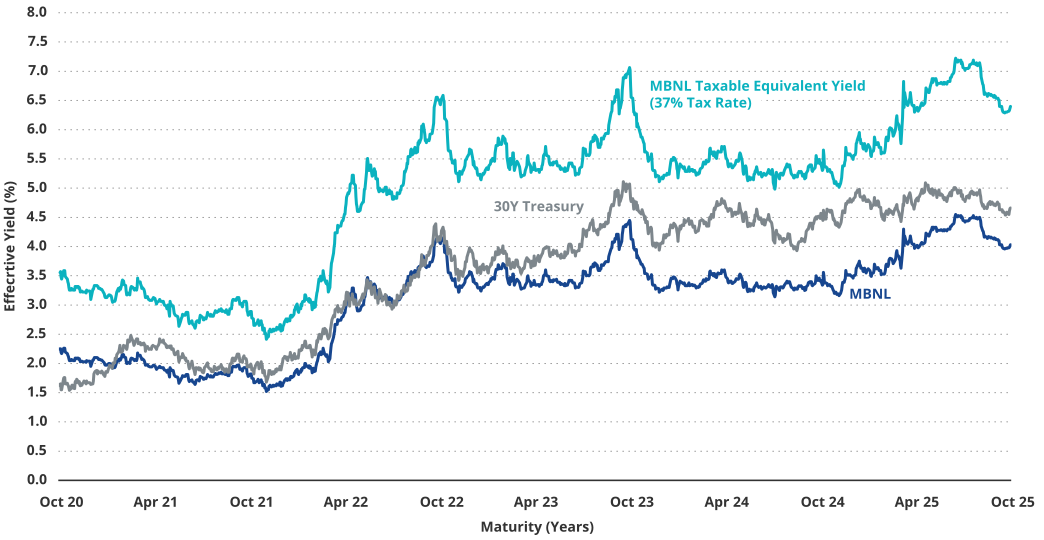
Yield to Maturity: MBNL vs 30Yr Treasuries

Source: ICE Data Indices. As of 10/31/2025. Past performance is not a guarantee of future results. Index performance is not representative of fund performance. It is not possible to invest directly in an index.
Treasury Trap for the Tax Brackets
At five-year highs, long duration municipal bonds now out-yield Treasuries where it counts: after tax. As the graph shows, long Investment Grade Munis (tracked by MBNL) now yield approximately on par with, or slightly below, comparable 30Y Treasuries. Yet because Municipal Bond interest income is tax-exempt at the state, and sometimes even local level, their taxable-equivalent yield far exceeds that of Treasuries for investors in high income brackets.
MBNL vs 30Yr Treasury: Effective Yields as of 10/31/2025
Source: ICE Data Indices. As of 10/31/2025. MBNL Represented by “ICE Long AMT-Free Broad National Municipal Bond Index (MBNL)” Tracks long-maturity, investment-grade U.S. municipal bonds that are exempt from the alternative minimum tax (AMT). 30Y Treasury Represented by “ICE U.S. Treasury 30-Year Index” Measures the performance of U.S. dollar–denominated, fixed-rate Treasury securities with approximately 30 years to maturity. Past performance is not a guarantee of future results. Index performance is not representative of fund performance. It is not possible to invest directly in an index.
Recommended subscription
For income-oriented investors, the relative value proposition for munis is notably significant. The graphic above illustrates the taxable equivalent yield (TEY) required for a Treasury investor to match the income produced by long-dated municipal bonds. In the current environment, a long duration muni yielding roughly 4.1% translates to a TEY of nearly 6.8% for investors in the highest federal bracket; a yield well above comparable 30-year Treasuries. Even at lower tax rates, the advantage goes to munis: 30Y Treasuries would need to yield significantly more than 5.5% to compete on a post-tax basis. With both markets offering multi-year-high nominal yields, the post-tax spread tilts decisively towards long-duration municipal bonds.
Through a broader lens, the relative income advantage of long-duration municipal bonds becomes even more apparent. As of October 31, 2025 investment-grade long munis yield roughly 4.6% on a tax-exempt basis equivalent to 6.1% for investors in the 24% bracket and 7.3% for those in the 37% bracket. That taxable-equivalent income rivals or surpasses what income investors are earning from high-yield corporates or emerging-market debt. Even when compared with traditional core bond benchmarks like the Bloomberg U.S. Aggregate Index or investment grade corporates, the post-tax income from long munis stands out. In short, today’s market offers a rare alignment: municipal yields competitive with riskier assets, but without taking on their inherent asset class risks - an opportunity reflected in MLN's portfolio of long-term, tax-exempt municipal bonds.
Yield to Maturity as of 10/31/2025

Source: Bloomberg. As of 10/31/2025.
The example assumes a 37% and 24% federal income tax. Bloomberg U.S. Corporate High Yield Bond Index (LF98STAT Index), Bloomberg EM USD Bond Index (EMUSSTAT Index), Bloomberg U.S. Corporate Bond Index (LUACSTAT Index), Bloomberg U.S. Aggregate Bond Index (LBUSSTAT Index), Bloomberg U.S. Treasury Bond Index (LUATSTAT Index), Bloomberg U.S. Municipal Bond Index (LMBISTAT Index), Bloomberg Global Aggregate ex-USD Bond Index (LG38STAT Index). Indexes are unmanaged, do not incur management fees, costs and expenses and cannot be invested in directly. Past performance is no guarantee of future results. Index performance is not representative of fund performance. It is not possible to invest directly in an index.
Long-Duration Munis Offer Rare Value Today
Assuming credit and tax dynamics remain stable, the current policy shift leaves long-duration munis well positioned to regain an edge… and MLN offers investors transparent, broad municipal market exposure to such a possible scenario. The VanEck Long Municipal Bond ETF is a passive, exchange-traded fund which tracks the ICE Long AMT-Free Broad National Municipal Bond Index (MBNL); targeting long-maturity, investment-grade income from municipal bonds - a segment well positioned to benefit from lower Fed interest rates.
To receive more Municipal Bonds insights, sign up in our subscription center.

Important Disclosures
Index Descriptions
ICE Long AMT-Free Broad National Municipal Bond Index (MBNL): Tracks long-maturity, investment-grade U.S. municipal bonds that are exempt from the alternative minimum tax (AMT).
ICE U.S. Treasury 30-Year Index: Measures the performance of U.S. dollar–denominated, fixed-rate Treasury securities with approximately 30 years to maturity.
Bloomberg U.S. Corporate High Yield Bond Index: Represents U.S. dollar–denominated, non-investment-grade, fixed-rate corporate bonds.
Bloomberg EM USD Bond Index: Tracks U.S. dollar–denominated sovereign, quasi-sovereign, and corporate bonds from emerging-market issuers.
Bloomberg U.S. Corporate Bond Index: Measures investment-grade, fixed-rate, taxable corporate bonds issued by U.S. corporations.
Bloomberg U.S. Aggregate Bond Index: A broad benchmark covering U.S. investment-grade taxable bonds, including Treasuries, agencies, corporates, MBS, and ABS.
Bloomberg U.S. Treasury Bond Index: Represents the performance of U.S. dollar–denominated, fixed-rate Treasury securities with at least one year to maturity.
Bloomberg U.S. Municipal Bond Index: Tracks investment-grade, long-term, tax-exempt municipal bonds issued by U.S. state and local entities.
Bloomberg Global Aggregate ex-USD Bond Index: Measures investment-grade government, corporate, and securitized bonds issued outside the United States and not denominated in U.S. dollars.
This is not an offer to buy or sell, or a recommendation to buy or sell any of the securities, financial instruments or digital assets mentioned herein. The information presented does not involve the rendering of personalized investment, financial, legal, tax advice, or any call to action. Certain statements contained herein may constitute projections, forecasts and other forward-looking statements, which do not reflect actual results, are for illustrative purposes only, are valid as of the date of this communication, and are subject to change without notice. Actual future performance of any assets or industries mentioned are unknown. Information provided by third party sources are believed to be reliable and have not been independently verified for accuracy or completeness and cannot be guaranteed. VanEck does not guarantee the accuracy of third party data. The information herein represents the opinion of the author(s), but not necessarily those of VanEck or its other employees.
All indices are unmanaged and include the reinvestment of all dividends, but do not reflect the payment of transaction costs, advisory fees or expenses that are associated with an investment in the Fund. Certain indices may take into account withholding taxes. An index's performance is not illustrative of the Fund's performance. Indices are not securities in which investments can be made.
An investment in the Fund may be subject to risks which include, among others, municipal securities, credit, interest rate, California, New York, Texas, call, health care bond, special tax bond, market, operational, sampling, index tracking, tax, authorized participant concentration, no guarantee of active trading market, trading issues, passive management, fund shares trading, premium/discount and liquidity of fund shares, and index-related concentration risks, all of which may adversely affect the Fund. Municipal bonds may be less liquid than taxable bonds. There is no guarantee that the Fund's income will be exempt from federal, state or local income taxes, and changes in those tax rates or in alternative minimum tax rates or in the tax treatment of municipal bonds may make them less attractive as investments and cause them to lose value. Capital gains, if any, are subject to capital gains tax. The Fund's assets may be concentrated in a particular sector and may be subject to more risk than investments in a diverse group of sectors.
Investing involves substantial risk and high volatility, including possible loss of principal. An investor should consider the investment objective, risks, charges and expenses of a Fund carefully before investing. To obtain a prospectus and summary prospectus, which contain this and other information, call 800.826.2333 or visit vaneck.com. Please read the prospectus and summary prospectus carefully before investing.
© Van Eck Securities Corporation, Distributor, a wholly owned subsidiary of Van Eck Associates Corporation.
Related Funds
Important Disclosures
Index Descriptions
ICE Long AMT-Free Broad National Municipal Bond Index (MBNL): Tracks long-maturity, investment-grade U.S. municipal bonds that are exempt from the alternative minimum tax (AMT).
ICE U.S. Treasury 30-Year Index: Measures the performance of U.S. dollar–denominated, fixed-rate Treasury securities with approximately 30 years to maturity.
Bloomberg U.S. Corporate High Yield Bond Index: Represents U.S. dollar–denominated, non-investment-grade, fixed-rate corporate bonds.
Bloomberg EM USD Bond Index: Tracks U.S. dollar–denominated sovereign, quasi-sovereign, and corporate bonds from emerging-market issuers.
Bloomberg U.S. Corporate Bond Index: Measures investment-grade, fixed-rate, taxable corporate bonds issued by U.S. corporations.
Bloomberg U.S. Aggregate Bond Index: A broad benchmark covering U.S. investment-grade taxable bonds, including Treasuries, agencies, corporates, MBS, and ABS.
Bloomberg U.S. Treasury Bond Index: Represents the performance of U.S. dollar–denominated, fixed-rate Treasury securities with at least one year to maturity.
Bloomberg U.S. Municipal Bond Index: Tracks investment-grade, long-term, tax-exempt municipal bonds issued by U.S. state and local entities.
Bloomberg Global Aggregate ex-USD Bond Index: Measures investment-grade government, corporate, and securitized bonds issued outside the United States and not denominated in U.S. dollars.
This is not an offer to buy or sell, or a recommendation to buy or sell any of the securities, financial instruments or digital assets mentioned herein. The information presented does not involve the rendering of personalized investment, financial, legal, tax advice, or any call to action. Certain statements contained herein may constitute projections, forecasts and other forward-looking statements, which do not reflect actual results, are for illustrative purposes only, are valid as of the date of this communication, and are subject to change without notice. Actual future performance of any assets or industries mentioned are unknown. Information provided by third party sources are believed to be reliable and have not been independently verified for accuracy or completeness and cannot be guaranteed. VanEck does not guarantee the accuracy of third party data. The information herein represents the opinion of the author(s), but not necessarily those of VanEck or its other employees.
All indices are unmanaged and include the reinvestment of all dividends, but do not reflect the payment of transaction costs, advisory fees or expenses that are associated with an investment in the Fund. Certain indices may take into account withholding taxes. An index's performance is not illustrative of the Fund's performance. Indices are not securities in which investments can be made.
An investment in the Fund may be subject to risks which include, among others, municipal securities, credit, interest rate, California, New York, Texas, call, health care bond, special tax bond, market, operational, sampling, index tracking, tax, authorized participant concentration, no guarantee of active trading market, trading issues, passive management, fund shares trading, premium/discount and liquidity of fund shares, and index-related concentration risks, all of which may adversely affect the Fund. Municipal bonds may be less liquid than taxable bonds. There is no guarantee that the Fund's income will be exempt from federal, state or local income taxes, and changes in those tax rates or in alternative minimum tax rates or in the tax treatment of municipal bonds may make them less attractive as investments and cause them to lose value. Capital gains, if any, are subject to capital gains tax. The Fund's assets may be concentrated in a particular sector and may be subject to more risk than investments in a diverse group of sectors.
Investing involves substantial risk and high volatility, including possible loss of principal. An investor should consider the investment objective, risks, charges and expenses of a Fund carefully before investing. To obtain a prospectus and summary prospectus, which contain this and other information, call 800.826.2333 or visit vaneck.com. Please read the prospectus and summary prospectus carefully before investing.
© Van Eck Securities Corporation, Distributor, a wholly owned subsidiary of Van Eck Associates Corporation.