SHYD: Efficient Access to Hard-to-Access HY Munis
September 15, 2025
Read Time 4 MIN
Key Takeaways:
- Most high-yield muni issuance is long-dated, making short maturities under 10 years rare. Limited supply and investors holding to maturity make them even harder to access.
- Short HY munis currently deliver about 290 basis points of extra tax-equivalent yield over short IG munis. They provide higher income without meaningfully extending duration.
- Short HY munis remain undervalued but rising demand could drive spread compression. The unusually steep muni 2s10s curve also presents a relative value opportunity in the 1-12 year segment.
SHYD: Efficient Access to Hard-to-Access HY Munis
The municipal high-yield market is predominantly composed of long-dated bonds, with maturities often extending 20 years or more. This structure reflects the nature of the projects being financed-such as infrastructure, transportation, healthcare and development-which inherently require long-term funding. Given the speculative profile of high-yield issuers, locking in financing over extended horizons is generally preferred, making shorter-dated issuance far less common.
As a result, high-yield (HY) municipal bonds with maturities under 10 years remain scarce. Issuers rarely bring such deals to market, as longer amortization schedules better align with project cash flows and provide greater flexibility for refinancing or restructuring. In the secondary market, the limited supply is compounded by investor behavior: those who hold short-dated HY paper often keep it to maturity, as it offers attractive near-term yield without committing capital for decades. This dynamic restricts turnover and makes sourcing short HY bonds particularly challenging.
In this environment, the VanEck Short High Yield Muni ETF (SHYD) stands out as an efficient vehicle for accessing a segment of the municipal market that is both scarce and difficult to source directly. By providing diversified exposure to over 220 unique obligors rated BBB+ or below, SHYD enables investors to capture the premium potential of municipal high yield while maintaining the benefits of a transparent, liquid, and passively managed ETF structure.
Short HY Munis: Positioning Early in a Market Poised for Spread Compression
Short HY municipal bonds present a particularly attractive investment opportunity in the current market environment. On a tax-equivalent basis, they offer close to 290 basis points of incremental yield compared with short investment-grade munis, and they do so without meaningfully extending duration. This makes them an efficient way to capture enhanced income while maintaining a conservative stance on interest-rate risk.
Higher Yield without Extended Duration
| Duration | YTW | TEY @ 35% | |
| Short HY Muni 1-12 Yr Maturity | 4.35 | 4.79 | 7.37 |
| Short IG Muni 1-10 Yr Maturity AAA-A | 3.89 | 2.9 | 4.46 |
| Broad HY Muni | 8.48 | 5.43 | 8.35 |
| Broad IG Muni | 7.7 | 3.75 | 5.77 |
Source: ICE Data Services. As of 8/31/25.See important disclosures for definitions and additional information.

Source: ICE Data Services. As of 8/31/25. See important disclosures for definitions and additional information.
Currently, short-dated HY paper on average still offers wider spreads relative to the long end of the curve. This dynamic exists because many high-yield muni investors traditionally prefer locking in rates through longer-term maturities, aligning with the 20+ year issuance profile of much of the sector. As a result, shorter-dated HY bonds have historically been under-owned and undervalued, leaving spread levels more elevated compared with their long-dated securities.
However, we are beginning to observe growing demand for shorter-dated HY paper in the secondary market. This development is important for investors, as increased buying interest could gradually lead to spread compression in the short HY segment. While this may reduce the current yield premium, it also highlights the advantage of positioning early to capture value before spreads tighten further. For now, short HY munis continue to offer a compelling balance of yield pickup, manageable duration, and defensive positioning, making them a valuable component for investors seeking income while carefully navigating rate risk.
Opportunity in the Steep Muni 2s10s Curve: Positioning Ahead of Curve Convergence
Treasury VS. Muni 2s10 Spread
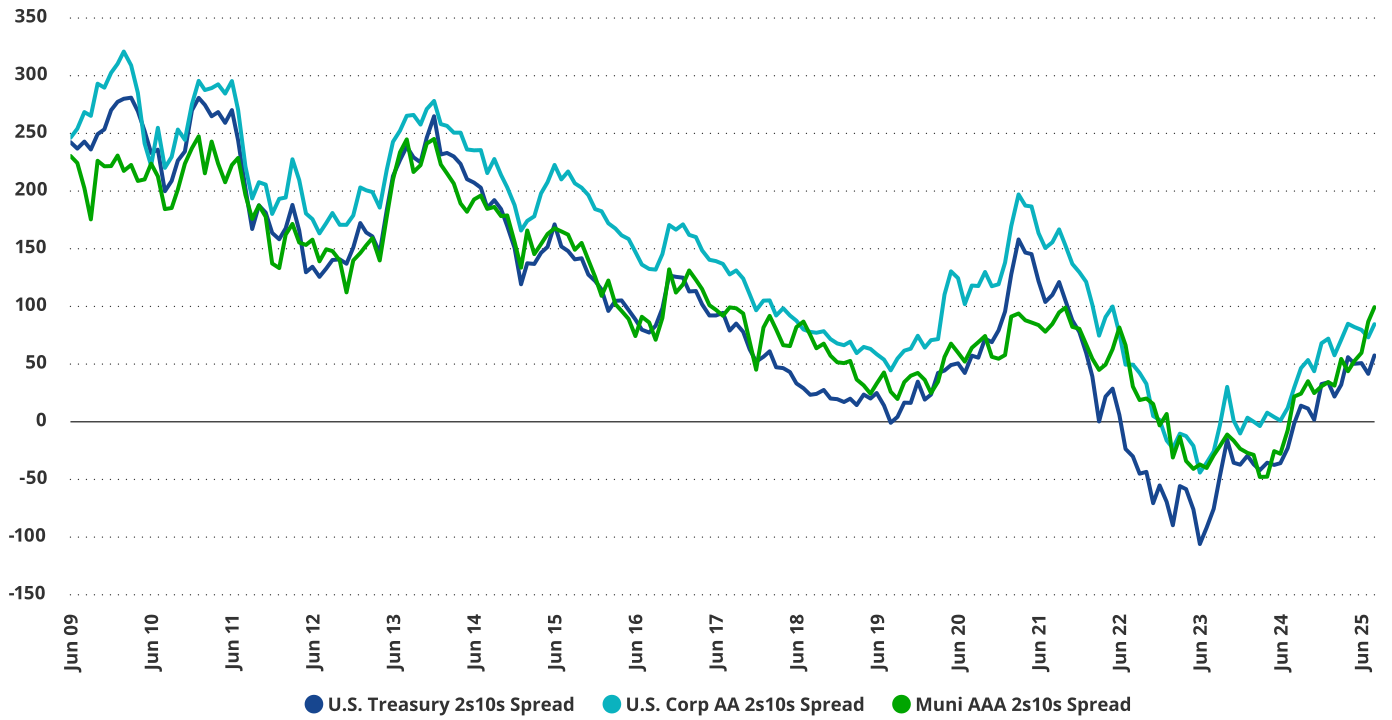
Source: ICE Data Services and Bloomberg. As of 8/31/25. See important disclosures for additional information.
Recommended subscription
As of the end of August, the Muni AAA 2s10s spread had widened by nearly 70 basis points year-to-date, compared with only about 25 basis points of steepening in the Treasury 2s10s curve over the same period. The municipal 2s10s curve currently stands out as the steepest among major fixed income markets, diverging meaningfully from both U.S. Treasuries and high-grade corporates. Historically, the muni 2s10s spread has tended to track more closely with, or even remain tighter than, the Treasury curve. This unusual steepness highlights a relative value dislocation between munis and other high-quality fixed income markets.
SHYD | VanEck Short High Yield Muni ETF
SHYD provides targeted exposure to the 1-12 year segment of the municipal curve, an area where we see a compelling opportunity. With the muni curve unusually steep relative to other fixed income markets, investors will benefit from both attractive levels of tax-exempt income and the potential for improving relative value in the short-to-intermediate market.
To receive more Municipal Bonds insights, sign up in our subscription center.

Important Disclosures
This is not an offer to buy or sell, or a recommendation to buy or sell any of the securities, financial instruments or digital assets mentioned herein. The information presented does not involve the rendering of personalized investment, financial, legal, tax advice, or any call to action. Certain statements contained herein may constitute projections, forecasts and other forward-looking statements, which do not reflect actual results, are for illustrative purposes only, are valid as of the date of this communication, and are subject to change without notice. Actual future performance of any assets or industries mentioned is unknown. Information provided by third party sources are believed to be reliable and have not been independently verified for accuracy or completeness and cannot be guaranteed. VanEck does not guarantee the accuracy of third-party data. The information herein represents the opinion of the author(s), but not necessarily those of VanEck or its other employees.
Taxable equivalent yields are used by investors to compare yields on taxable and tax-exempt securities after accounting for federal income taxes. TEY represents the yield a taxable bond investment would have to earn in order to match, after deducting federal income taxes, the yield available on a tax-exempt municipal bond investment. TEY = Tax-Free Municipal Bond Yield/(1 -Tax Rate).
Duration measures a bond's sensitivity to interest rate changes that reflects the change in a bond's price given a change in yield. This duration measure is appropriate for bonds with embedded options. Yield to worst is a measure of the lowest possible yield that can be received on a bond with an early retirement provision. Averages are market weighted. The yields presented do not represent the performance of the Fund. These statistics do not take into account fees and expenses associated with investments of the Fund.
An investment in the Fund may be subject to risks which include, among others, municipal securities, credit, interest rate, high yield securities, industrial development bond, Illinois, New York, call, private activity bonds, market, operational, sampling, index tracking, tax, authorized participant concentration, no guarantee of active trading market, trading issues, passive management, fund shares trading, premium/discount and liquidity of fund shares, and index-related concentration risks, all of which may adversely affect the Fund. High-yield municipal bonds are subject to greater risk of loss of income and principal than higher-rated securities, and are likely to be more sensitive to adverse economic changes or individual municipal developments than those of higher-rated securities. Municipal bonds may be less liquid than taxable bonds. A portion of the dividends you receive may be subject to the federal alternative minimum tax (AMT).There is no guarantee that the Fund's income will be exempt from federal, state or local income taxes, and changes in those tax rates or in alternative minimum tax rates or in the tax treatment of municipal bonds may make them less attractive as investments and cause them to lose value. Capital gains, if any, are subject to capital gains tax. The Fund's assets may be concentrated in a particular sector and may be subject to more risk than investments in a diverse group of sectors.
Investing involves substantial risk and high volatility, including possible loss of principal. An investor should consider the investment objective, risks, charges and expenses of a fund carefully before investing. To obtain a prospectus and summary prospectus, which contain this and other information, call 800.826.2333 or visit vaneck.com. Please read the prospectus and summary prospectus carefully before investing.
© Van Eck Securities Corporation, Distributor, a wholly owned subsidiary of Van Eck Associates Corporation.
666 Third Avenue, New York, NY 10017
Related Funds
Important Disclosures
This is not an offer to buy or sell, or a recommendation to buy or sell any of the securities, financial instruments or digital assets mentioned herein. The information presented does not involve the rendering of personalized investment, financial, legal, tax advice, or any call to action. Certain statements contained herein may constitute projections, forecasts and other forward-looking statements, which do not reflect actual results, are for illustrative purposes only, are valid as of the date of this communication, and are subject to change without notice. Actual future performance of any assets or industries mentioned is unknown. Information provided by third party sources are believed to be reliable and have not been independently verified for accuracy or completeness and cannot be guaranteed. VanEck does not guarantee the accuracy of third-party data. The information herein represents the opinion of the author(s), but not necessarily those of VanEck or its other employees.
Taxable equivalent yields are used by investors to compare yields on taxable and tax-exempt securities after accounting for federal income taxes. TEY represents the yield a taxable bond investment would have to earn in order to match, after deducting federal income taxes, the yield available on a tax-exempt municipal bond investment. TEY = Tax-Free Municipal Bond Yield/(1 -Tax Rate).
Duration measures a bond's sensitivity to interest rate changes that reflects the change in a bond's price given a change in yield. This duration measure is appropriate for bonds with embedded options. Yield to worst is a measure of the lowest possible yield that can be received on a bond with an early retirement provision. Averages are market weighted. The yields presented do not represent the performance of the Fund. These statistics do not take into account fees and expenses associated with investments of the Fund.
An investment in the Fund may be subject to risks which include, among others, municipal securities, credit, interest rate, high yield securities, industrial development bond, Illinois, New York, call, private activity bonds, market, operational, sampling, index tracking, tax, authorized participant concentration, no guarantee of active trading market, trading issues, passive management, fund shares trading, premium/discount and liquidity of fund shares, and index-related concentration risks, all of which may adversely affect the Fund. High-yield municipal bonds are subject to greater risk of loss of income and principal than higher-rated securities, and are likely to be more sensitive to adverse economic changes or individual municipal developments than those of higher-rated securities. Municipal bonds may be less liquid than taxable bonds. A portion of the dividends you receive may be subject to the federal alternative minimum tax (AMT).There is no guarantee that the Fund's income will be exempt from federal, state or local income taxes, and changes in those tax rates or in alternative minimum tax rates or in the tax treatment of municipal bonds may make them less attractive as investments and cause them to lose value. Capital gains, if any, are subject to capital gains tax. The Fund's assets may be concentrated in a particular sector and may be subject to more risk than investments in a diverse group of sectors.
Investing involves substantial risk and high volatility, including possible loss of principal. An investor should consider the investment objective, risks, charges and expenses of a fund carefully before investing. To obtain a prospectus and summary prospectus, which contain this and other information, call 800.826.2333 or visit vaneck.com. Please read the prospectus and summary prospectus carefully before investing.
© Van Eck Securities Corporation, Distributor, a wholly owned subsidiary of Van Eck Associates Corporation.
666 Third Avenue, New York, NY 10017