The Muni Brief: Big Flows, Low Drama
June 17, 2026
Read Time 3 MIN
Key Takeaways:
- YTD realized volatility for broad investment grade munis is roughly 4–6%, versus 13–20%+ for major equity indices.
- Muni Sharpe ratios have held up well, supported by low volatility and solid underlying credit quality.
- Tax-equivalent yields (TEY) remain comparatively attractive on both investment grade and high yield munis.
The Muni Brief is an ongoing series of commentaries from VanEck Senior Municipal Strategist James Colby, examining current topics in the municipal bond market through the lens of the muni investor.
Record Flows
Munis continue to roll. Investors have poured roughly $24 billion in net flows into U.S. muni ETFs year-to-date, and last month set an all-time record with more than $7 billion in net inflows: the highest monthly total ever. That is big news.
Muni ETFs: May 2026 Posts Record Inflows
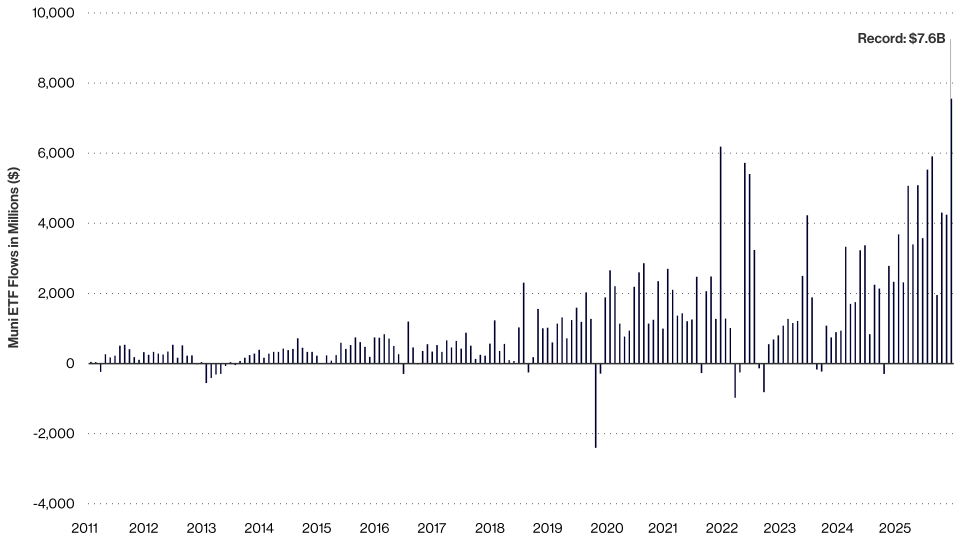
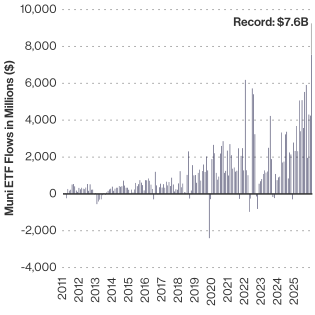
Source: Morningstar. As of 5/31/26.
The Volatility Gap
Year-to-date realized volatility for broad investment grade munis has run roughly 4–6% annualized. Major equity benchmarks ranged from about 13% for the Dow to 20%+ for the Nasdaq-100. Short-intermediate munis have been quieter still, around 2%.
Equities and municipal bonds are different asset classes with different risk and return characteristics; this comparison is for context and is not a recommendation to substitute one for the other.
Historically, that gap has reflected the nature of muni issuers rather than short-term market conditions. State and local governments, school districts, and public utilities are not subject to the earnings surprises and sentiment-driven re-ratings that move stock prices.
30 Years of Equity vs. Municipal Realized Volatility
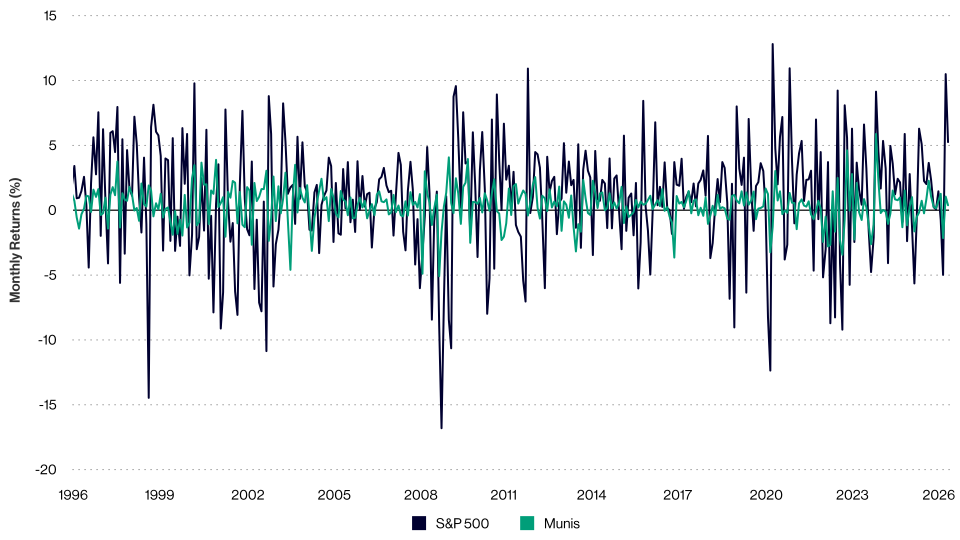
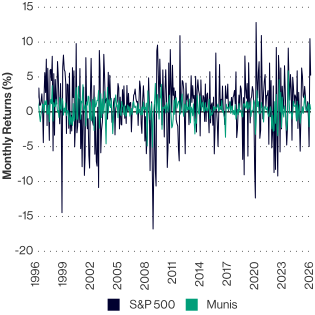
Source: Morningstar. As of 5/31/26.
Past performance is no guarantee of future results. Volatility shown is historical and may not persist.
Recommended subscription
The Real Scorecard: Risk-Adjusted Returns
Judged on absolute return alone, munis look modest this year. But on a risk-adjusted basis the story changes: muni Sharpe ratios have held up well, precisely because volatility has stayed low and solid credit quality keeps it that way (Source: Morningstar, May 2026). Investors who maintained municipal exposure sidestepped the drawdowns that equity-heavy positioning delivered in late March.
The Yield Tells the Other Half of the Story
Low volatility is only part of the appeal. The other part is what munis pay. Yields on both investment grade and high yield municipal bonds remain comparatively attractive, and once you account for their federal tax exemption, the gap widens further. On a tax-equivalent basis, high grade munis are out-yielding Treasuries across much of the curve, as the chart below shows. For an investor in a high bracket, that after-tax income stream is hard to replicate in taxable fixed income.
As with all bonds, municipals are subject to interest-rate risk — prices generally fall when rates rise — and to credit risk, which is greater for high yield issuers.
Muni Tax-Equivalent Yields Compared to Treasuries
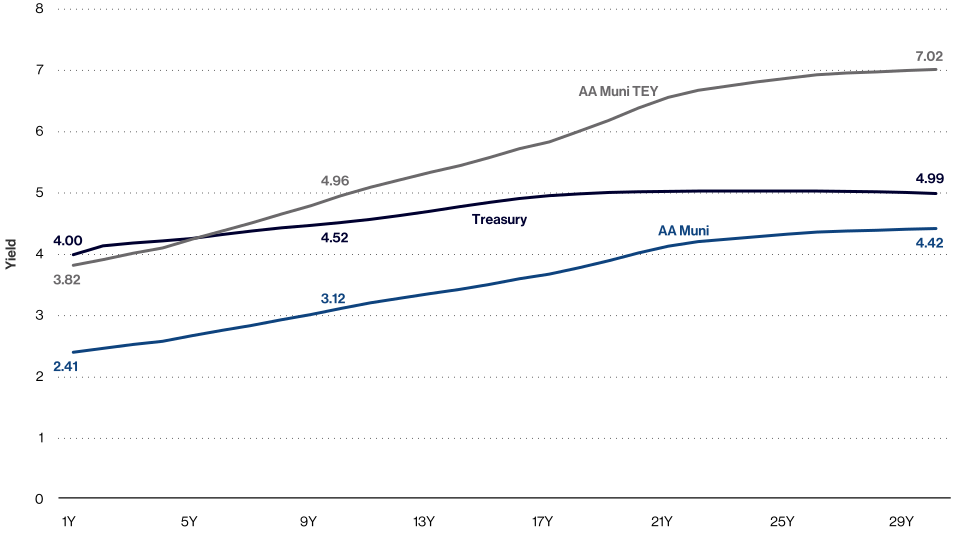
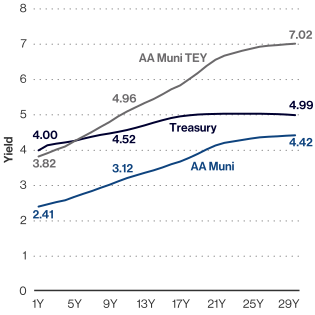
Source: ICE Indices. As of 6/9/26. TEY based on 37% tax rate.
Unlike Treasuries, which are backed by the full faith and credit of the U.S. government and whose income is exempt from state tax, municipal bonds carry credit and call risk and may be subject to state and local taxes.
Final Thoughts
The case is not complicated. As long as investors remain cautious about where new money goes, municipals may continue to attract flows, and the numbers this year explain why. Investors looking for exposure can access the municipal market through VanEck’s muni ETF suite, spanning high yield and investment grade across short, intermediate, and long durations.
To receive more Municipal Bonds insights, sign up in our subscription center.

IMPORTANT DISCLOSURES
This is not an offer to buy or sell, or a recommendation to buy or sell any of the securities, financial instruments or digital assets mentioned herein. The information presented does not involve the rendering of personalized investment, financial, legal, tax advice, or any call to action. Certain statements contained herein may constitute projections, forecasts and other forward-looking statements, which do not reflect actual results, are for illustrative purposes only, are valid as of the date of this communication, and are subject to change without notice. Actual future performance of any assets or industries mentioned are unknown. Information provided by third party sources are believed to be reliable and have not been independently verified for accuracy or completeness and cannot be guaranteed. VanEck does not guarantee the accuracy of third party data. The information herein represents the opinion of the author(s), but not necessarily those of VanEck or its other employees.
The yields and market values of municipal securities may be more affected by changes in tax rates and policies than similar income-bearing taxable securities. Certain investors’ incomes may be subject to the Federal Alternative Minimum Tax (AMT) and taxable gains are also possible.
An investment in a Fund may be subject to risks which include, among others, municipal securities, high yield securities, credit, interest rate, call, private activity bonds, industrial development bond, special tax bond, pre-refunded municipal securities, health care bond, California, New York, Texas, market, operational, sampling, index tracking, tax, authorized participant concentration, no guarantee of active trading market, trading issues, passive management, fund shares trading, premium/discount and liquidity of fund shares, and index-related concentration risks, all of which may adversely affect the Funds. High-yield municipal bonds are subject to greater risk of loss of income and principal than higher-rated securities, and are likely to be more sensitive to adverse economic changes or individual municipal developments than those of higher-rated securities. Municipal bonds may be less liquid than taxable bonds. A portion of the dividends you receive may be subject to the federal alternative minimum tax (AMT). There is no guarantee that the Funds' income will be exempt from federal, state or local income taxes, and changes in those tax rates or in alternative minimum tax rates or in the tax treatment of municipal bonds may make them less attractive as investments and cause them to lose value. Capital gains, if any, are subject to capital gains tax. The Funds' assets may be concentrated in a particular sector and may be subject to more risk than investments in a diverse group of sectors.
Investing involves substantial risk and high volatility, including possible loss of principal. An investor should consider the investment objective, risks, charges and expenses of a Fund carefully before investing. To obtain a prospectus and summary prospectus, which contain this and other information, call 800.826.2333 or visit vaneck.com. Please read the prospectus and summary prospectus carefully before investing.
© Van Eck Securities Corporation, Distributor, a wholly owned subsidiary of Van Eck Associates Corporation.
666 Third Avenue | New York, NY 10017
© 2026 VanEck. VanEck®, VanEck Access the opportunities®, and the stylized VanEck design® are trademarks of Van Eck Associates Corporation.
Related Funds
IMPORTANT DISCLOSURES
This is not an offer to buy or sell, or a recommendation to buy or sell any of the securities, financial instruments or digital assets mentioned herein. The information presented does not involve the rendering of personalized investment, financial, legal, tax advice, or any call to action. Certain statements contained herein may constitute projections, forecasts and other forward-looking statements, which do not reflect actual results, are for illustrative purposes only, are valid as of the date of this communication, and are subject to change without notice. Actual future performance of any assets or industries mentioned are unknown. Information provided by third party sources are believed to be reliable and have not been independently verified for accuracy or completeness and cannot be guaranteed. VanEck does not guarantee the accuracy of third party data. The information herein represents the opinion of the author(s), but not necessarily those of VanEck or its other employees.
The yields and market values of municipal securities may be more affected by changes in tax rates and policies than similar income-bearing taxable securities. Certain investors’ incomes may be subject to the Federal Alternative Minimum Tax (AMT) and taxable gains are also possible.
An investment in a Fund may be subject to risks which include, among others, municipal securities, high yield securities, credit, interest rate, call, private activity bonds, industrial development bond, special tax bond, pre-refunded municipal securities, health care bond, California, New York, Texas, market, operational, sampling, index tracking, tax, authorized participant concentration, no guarantee of active trading market, trading issues, passive management, fund shares trading, premium/discount and liquidity of fund shares, and index-related concentration risks, all of which may adversely affect the Funds. High-yield municipal bonds are subject to greater risk of loss of income and principal than higher-rated securities, and are likely to be more sensitive to adverse economic changes or individual municipal developments than those of higher-rated securities. Municipal bonds may be less liquid than taxable bonds. A portion of the dividends you receive may be subject to the federal alternative minimum tax (AMT). There is no guarantee that the Funds' income will be exempt from federal, state or local income taxes, and changes in those tax rates or in alternative minimum tax rates or in the tax treatment of municipal bonds may make them less attractive as investments and cause them to lose value. Capital gains, if any, are subject to capital gains tax. The Funds' assets may be concentrated in a particular sector and may be subject to more risk than investments in a diverse group of sectors.
Investing involves substantial risk and high volatility, including possible loss of principal. An investor should consider the investment objective, risks, charges and expenses of a Fund carefully before investing. To obtain a prospectus and summary prospectus, which contain this and other information, call 800.826.2333 or visit vaneck.com. Please read the prospectus and summary prospectus carefully before investing.
© Van Eck Securities Corporation, Distributor, a wholly owned subsidiary of Van Eck Associates Corporation.
666 Third Avenue | New York, NY 10017
© 2026 VanEck. VanEck®, VanEck Access the opportunities®, and the stylized VanEck design® are trademarks of Van Eck Associates Corporation.