Why XMPT Could Shine in a Rate-Cut Cycle
December 01, 2025
Read Time 4 MIN
Key Takeaways:
- Rate cuts lift muni bond values, driving stronger total returns for XMPT's CEF holdings.
- Cheaper leverage boosts income, widening spreads and improving fund efficiency.
- Record muni issuance fuels growth, offering more opportunities for yield and diversification.
Why XMPT Could Shine in a Rate-Cut Cycle
After two years of tight monetary policy, the market is finally starting to get some long-anticipated relief in the form of interest rate cuts. For municipal bond investors, that shift isn’t just about higher prices. It also changes how income is generated inside leveraged closed-end municipal funds. That’s especially relevant for XMPT, which holds a diversified basket of municipal bond closed-end funds (CEFs).
When rates move lower, three forces tend to work in XMPT's favor.
1. Muni CEF performance gets a boost
Lower rates tend to lift the entire municipal bond market. As yields begin to fall, prices on existing bonds rise because their higher coupons become more valuable compared to newly issued debt. That repricing can drive strong total returns for investors in longer-term municipal bonds, where muni CEFs tend to have significant exposure.
Falling rates can also spark renewed demand from investors looking for tax-exempt income. When cash and short-term yields come down, investors often move back into munis for better after-tax income potential and stability. At the same time, lower financing costs can improve sentiment across the leveraged side of the market, setting the stage for CEFs to perform well as income generation improves.
Muni CEFs Benefit from Lower Rates
Previous 10 Years
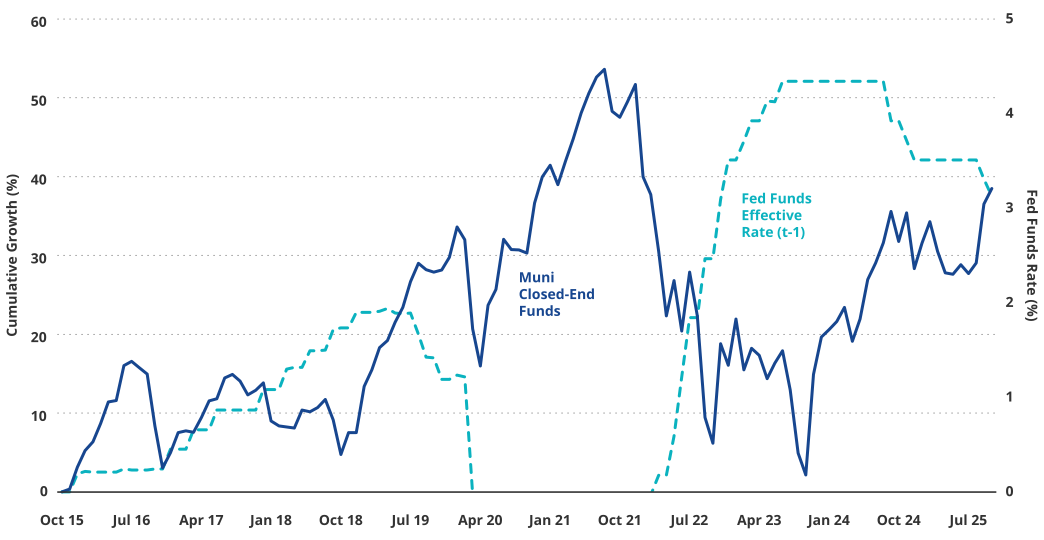
Source: Morningstar. As of 10/31/2025.
Past performance is no guarantee of future results.
XMPT | VanEck CEF Muni Income ETF
2. Cheaper leverage helps CEFs become more efficient
Leverage is a key feature of municipal closed-end funds. In simple terms, managers use leverage to amplify their exposure. Funds borrow at short-term rates and reinvest the proceeds to increase their overall position size. This magnifies both income and performance. It can help boost returns when conditions are favorable but also works in the opposite direction when markets weaken.
Leverage has historically worked well for muni CEFs because the underlying bonds tend to provide stable income and low credit risk. By using leverage, these funds can increase the flow of tax-exempt income and deliver higher yields than unleveraged municipal strategies.
The challenge comes when borrowing costs rise. As short-term rates move higher, the cost of maintaining leverage increases and the spread between what a fund earns and what it pays to finance its holdings narrows. For example, if a fund earns 6% on its portfolio and borrows at 4%, its spread is 2%. If borrowing costs rise to 5%, that spread shrinks to 1%, which can reduce the income available to distribute.
When rates fall, the opposite occurs. Borrowing costs decline, the spread widens, and more of the fund’s earnings flow through to shareholders. Using the same example, if borrowing costs drop from 3% to 1%, that spread increases from 2% to 3%, improving distributable income without any change in holdings. In that environment, leverage works in favor of income generation and overall performance.
Lower leverage costs can directly translate into higher net income, making the same portfolio more efficient and allowing more of its earnings to flow through to investors.
| Unlevered Fund No Borrowing Costs |
Levered Fund Low Borrowing Costs |
Levered Fund High Borrowing Costs |
|
| Net Assets | $100 | $100 | $100 |
| Leverage | $0 | $50 | $50 |
| Total Managed Assets | $100 | $150 | $150 |
| Leverage Ratio | 0% | 33% | 33% |
| Return (before cost) | +5.0% | +7.5% | +7.5% |
| Borrowing Cost (as percentage of Net Assets) |
0% | 1% | 3% |
| Total Return (after cost) |
+5.0% | +6.5% | +4.5% |
Source: Internal. Used for illustrative purposes only.
Recommended subscription
3. New opportunities from record muni issuance
Municipal bond issuance has been running at record levels in 2025. With borrowing costs expected to move lower, many issuers are refinancing older, higher-rate debt while continuing to issue new bonds for infrastructure and other long-term projects.
During the Fed’s rate hikes in 2022 and 2023, refunding activity fell sharply as higher yields made refinancing uneconomical. Over the past two years, refunding has started to recover toward pre-COVID levels, while new-money issuance has climbed to all-time highs. The chart below highlights both trends, showing how lower borrowing costs are helping bring issuers back to the market.
Municipal Bond Issuance Hitting All-Time Highs

Source: SIFMA, Oct 31, 2025. Estimate based on 2024 issuance numbers.
Past performance is no guarantee of future results.
This activity is a positive sign for the health of the market. Refinancing helps municipalities lock in lower long-term costs, which can strengthen their credit quality. At the same time, an active new-issue calendar expands the opportunity set for managers running the CEFs inside XMPT. A steady flow of new bonds allows these managers to rotate into more attractive structures or higher coupons, supporting both income and diversification.
Putting it together
XMPT's structure is built to capture the benefits of a falling-rate environment. Lower rates ease leverage costs, strengthen underlying muni valuations, and keep the market well supplied with new opportunities. Together, these factors can enhance both income potential and total return.
In addition, XMPT's income is largely exempt from federal taxes. On a tax-equivalent basis, its yield remains among the highest in the muni ETF universe.
If the Fed continues cutting rates, the backdrop for leveraged municipal income looks increasingly favorable. XMPT provides a straightforward, cost-efficient and liquid way to access the opportunity.
To receive more Municipal Bonds insights, sign up in our subscription center.

Important Disclosure
This is not an offer to buy or sell, or a recommendation to buy or sell any of the securities/financial instruments mentioned herein. The information presented does not involve the rendering of personalized investment, financial, legal, or tax advice. Certain statements contained herein may constitute projections, forecasts and other forward looking statements, which do not reflect actual results, are valid as of the date of this communication and subject to change without notice. Information provided by third party sources are believed to be reliable and have not been independently verified for accuracy or completeness and cannot be guaranteed. VanEck does not guarantee the accuracy of third party data. The information herein represents the opinion of the author(s), but not necessarily those of VanEck or its employees.
The Fund's performance, because it is a fund of funds, is dependent on the performance of the underlying funds. The Fund is subject to the risks of the underlying funds' investments, and the Fund's shareholders will indirectly bear the expenses of the underlying funds. In addition, at times certain segments of the market represented by the underlying funds may be out of favor and underperform other segments. The shares of a closed-end fund may trade at a discount or premium to its net asset value ("NAV"). Additionally, the securities of closed-end investment companies in which the Fund will invest may be leveraged. As a result, the Fund may be indirectly exposed to leverage through an investment in such securities. An investment in securities of closed-end investment companies that use leverage may expose the Fund to higher volatility in the market value of such securities and the possibility that the Fund's long-term returns on such securities (and, indirectly, the long-term returns of the Shares) will be diminished. An investment in the Fund may be subject to risks which include, among others, fund of funds, investing in closed-end funds, New York, Texas, market, operational, index tracking, authorized participant concentration, no guarantee of active trading market, trading issues, passive management, fund shares trading, premium/discount and liquidity of fund shares, non-diversification, and index-related concentration risks, all of which may adversely affect the Fund. A portion of the dividends you receive may be subject to the federal alternative minimum tax (AMT). There is no guarantee that Fund's income will be exempt from federal, state or local income taxes, and changes in those tax rates or in alternative minimum tax or in the tax treatment of municipal bonds may make them less attractive as investments and cause them to lose value.
Investing involves substantial risk and high volatility, including possible loss of principal. An investor should consider the investment objective, risks, charges and expenses of the Funds carefully before investing. To obtain a prospectus and summary prospectus, which contain this and other information, call 800.826.2333 or visit vaneck.com. Please read the prospectus and summary prospectus carefully before investing.
© Van Eck Securities Corporation, Distributor, a wholly owned subsidiary of Van Eck Associates Corporation.
Related Funds
Important Disclosure
This is not an offer to buy or sell, or a recommendation to buy or sell any of the securities/financial instruments mentioned herein. The information presented does not involve the rendering of personalized investment, financial, legal, or tax advice. Certain statements contained herein may constitute projections, forecasts and other forward looking statements, which do not reflect actual results, are valid as of the date of this communication and subject to change without notice. Information provided by third party sources are believed to be reliable and have not been independently verified for accuracy or completeness and cannot be guaranteed. VanEck does not guarantee the accuracy of third party data. The information herein represents the opinion of the author(s), but not necessarily those of VanEck or its employees.
The Fund's performance, because it is a fund of funds, is dependent on the performance of the underlying funds. The Fund is subject to the risks of the underlying funds' investments, and the Fund's shareholders will indirectly bear the expenses of the underlying funds. In addition, at times certain segments of the market represented by the underlying funds may be out of favor and underperform other segments. The shares of a closed-end fund may trade at a discount or premium to its net asset value ("NAV"). Additionally, the securities of closed-end investment companies in which the Fund will invest may be leveraged. As a result, the Fund may be indirectly exposed to leverage through an investment in such securities. An investment in securities of closed-end investment companies that use leverage may expose the Fund to higher volatility in the market value of such securities and the possibility that the Fund's long-term returns on such securities (and, indirectly, the long-term returns of the Shares) will be diminished. An investment in the Fund may be subject to risks which include, among others, fund of funds, investing in closed-end funds, New York, Texas, market, operational, index tracking, authorized participant concentration, no guarantee of active trading market, trading issues, passive management, fund shares trading, premium/discount and liquidity of fund shares, non-diversification, and index-related concentration risks, all of which may adversely affect the Fund. A portion of the dividends you receive may be subject to the federal alternative minimum tax (AMT). There is no guarantee that Fund's income will be exempt from federal, state or local income taxes, and changes in those tax rates or in alternative minimum tax or in the tax treatment of municipal bonds may make them less attractive as investments and cause them to lose value.
Investing involves substantial risk and high volatility, including possible loss of principal. An investor should consider the investment objective, risks, charges and expenses of the Funds carefully before investing. To obtain a prospectus and summary prospectus, which contain this and other information, call 800.826.2333 or visit vaneck.com. Please read the prospectus and summary prospectus carefully before investing.
© Van Eck Securities Corporation, Distributor, a wholly owned subsidiary of Van Eck Associates Corporation.