Commodity Strategies Diverge as Roll Yield Takes Over
April 08, 2026
Read Time 6 MIN
Key Takeaways:
- The CMCI Index is built for commodity investing across full market cycles, using maturity diversification to reduce volatility and drawdowns.
- Today’s market is the exception, not the rule, with steep backwardation favoring front-month, energy-heavy indices like the S&P GSCI.
- Contango has been the dominant regime for most of the past two decades, and the CMCI Index's design specifically mitigates that persistent drag.
- PIT adapts dynamically, pursuing near-term opportunities and rotating when conditions shift.
- CMCI and PIT provide complementary strategic and tactical commodity exposure.
A rare and powerful market dynamic is unfolding.
Energy markets have been turned upside down by a historic supply disruption. A conflict-driven shutdown of Gulf oil production, estimated at nearly 9 million barrels per day, has driven crude oil futures into steep backwardation. As of April 7, front-month WTI is trading near $110 per barrel, while prices for delivery in late 2026 slope down toward the mid-$70s. This creates a powerful positive roll yield tailwind.
In Understanding the Components of Commodity Futures Returns, we looked at how spot price movement, collateral yield and roll yield drive commodity returns. We’re seeing that framework in action today, with roll yield now taking center stage.
When futures curves are backwardated, investors rolling expiring contracts sell high and buy low, earning a positive spread. History shows how consequential this can be. During the structurally backwardated energy markets of the 1970s and early 1980s, S&P Goldman Sachs Commodity Index (S&P GSCI) roll yield averaged 4.77% and 2.41% annualized, respectively. In contrast, when energy contango dominated the 2000s, that same figure turned sharply negative, to -8.25%.
The current environment is squarely in the first camp—and it is historically rare.
CMCI: Built for the Long Game
The UBS Constant Maturity Commodity Index (“CMCI Index”), the benchmark behind both the VanEck CMCI Commodity Strategy ETF (CMCI) and CM Commodity Index Fund , was designed with a specific, long-term view: commodity futures markets are in contango most of the time, and when in contango, front-month concentration is the most expensive place for investors to sit.
The Index addresses this by spreading exposure across the futures curve, spreading positions three months to three years. Combined with broader commodity diversification, this approach mitigates the negative roll yield impact that has historically been the biggest drag on commodity returns over time.
The numbers bear this out.
Today’s Roll Yield vs. Long-Term Trends
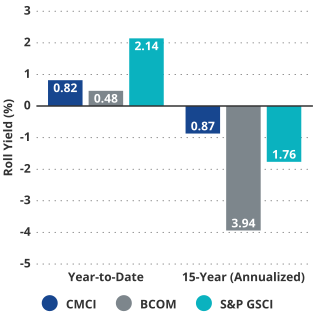
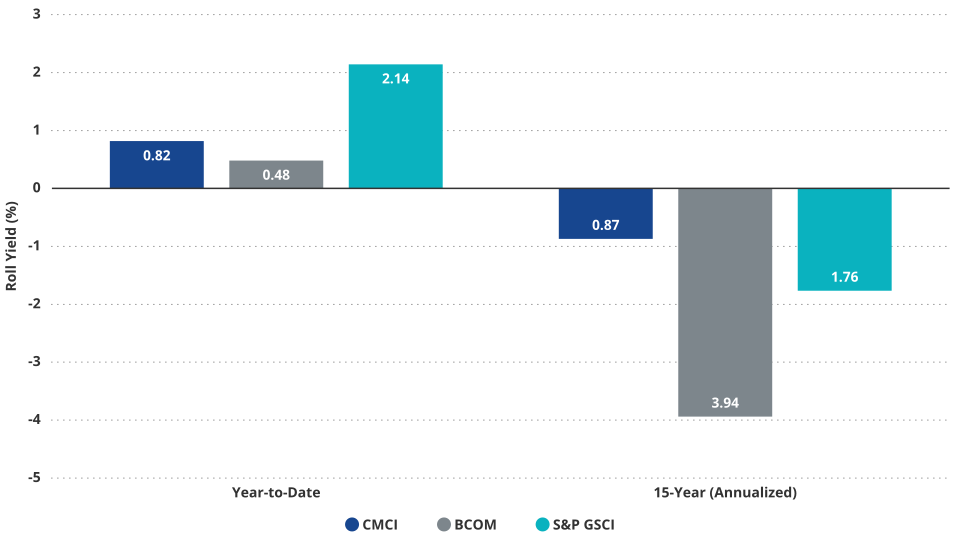
Source: Bloomberg, VanEck. Data as of 3/31/2026. CMCI: UBS Bloomberg Constant Maturity Commodity Index (CMCITR) ; BCOM: Bloomberg Commodity Index; S&P GSCI: S&P Goldman Sachs Commodity Index. Annualized roll yield refers to the annualized return the amount of return generated from the rolling of a short-term futures contract into a longer-term contract and profits from the convergence of the futures price toward a higher spot or cash price. Past performance is no guarantee of future results. Index performance is not representative of fund performance. It is not possible to invest directly in an index. Please see index definitions and other important disclosures at the end of this content. Fund performance current to the most recent month end is available by visiting vaneck.com or by calling 800.826.2333.
Recommended subscription
Why the CMCI Index Is Lagging—And Why That's Expected
The feature that makes this strategy a more resilient long-term holding is precisely what is causing it to lag in the current environment, when near-term backwardation is steep.
Spreading maturity exposure across the curve means the strategy holds some exposure in the longer-dated portion of the energy curve, parts of which is still in contango beyond 2027. At the same time, lower energy concentration relative to the S&P GSCI means it captures less of the sector generating the most positive roll yield today.
Neither of these is a flaw. It is a tradeoff.
This strategy was built to mitigate the persistent headwind of contango, not maximize returns during short-lived periods of extreme backwardation. This design has been right for the vast majority of the past two decades, and will be right again when this supply shock resolves and the curve normalizes.
In short: the CMCI strategy is a strategic all-weather commodity allocation. The S&P GSCI is a high-beta, energy-concentrated tactical instrument that may perform well in environments like today’s, but carries different risks across cycles. Investors who chose the CMCI approach for its volatility management, drawdown characteristics, and roll efficiency made a sound, well-reasoned decision — one that is temporarily in an unfavorable regime, not one that has been invalidated.
The Case for PIT: Tactical Flexibility Across Changing Regimes
For investors seeking to actively participate in environments like the current one, the VanEck Commodity Strategy ETF (PIT) offers a different approach. Unlike passive indices, PIT is not constrained to a fixed position on the curve. It can dynamically allocate across maturities and sectors, which means it can lean into front-month energy exposure when backwardation is steep and reposition as conditions evolve.
In a market where front-month energy backwardation is generating positive roll yield and longer-dated contracts remain in contango, that flexibility matters. An active manager can position explicitly to capture that spread. PIT returned 18.64% in March 2026 alone and 36.61% in Q1 2026, its strongest quarter since inception. That performance reflects the tactical advantage of being unconstrained, with the ability to lean into front-month energy exposure today and rotate as fundamentals evolve.
PIT Cumulative Returns Reflect Tactical Flexibility
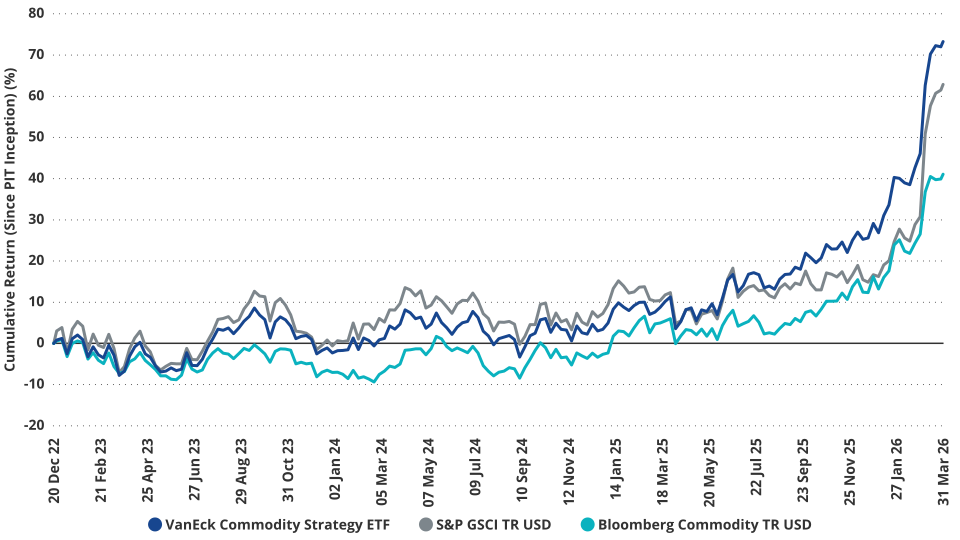
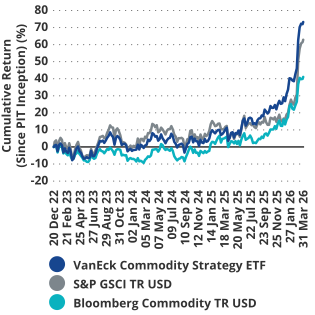
Source: Morningstar, VanEck. Data as of March 31, 2026. Inception date of PIT is 12/20/2022. Past performance is no guarantee of future results. Index performance is not representative of fund performance. It is not possible to invest directly in an index. Please see index definitions and other important disclosures at the end of this content. Fund performance current to the most recent month end is available by visiting vaneck.com or by calling 800.826.2333.
Average Annual Total Returns as of 3/31/2026 (%)
| 1 Mo | YTD | 1 Yr | 3 Yr | Life (12/20/2022) | |
| PIT (NAV) | 18.64 | 36.61 | 54.19 | 21.32 | 18.22 |
| PIT (Market Price) | 18.54 | 37.04 | 54.31 | 21.48 | 18.31 |
| Bloomberg Commodity Index | 11.50 | 24.41 | 32.29 | 13.88 | 11.07 |
Returns less than one year are not annualized.
PIT Gross Expense Ratio: 0.55%
The performance data quoted represents past performance. Past performance is not a guarantee of future results. Investment return and principal value of an investment will fluctuate so that an investor's shares, when redeemed, may be worth more or less than their original cost. Performance may be lower or higher than performance data quoted. Please call 800.826.2333 or visit vaneck.com for performance current to the most recent month end.
Two Different Paths for Commodity Investing
The current environment is a reminder that commodity investing involves not only what you own in different regimes, but also how you own it.
Roll yield can dominate outcomes depending on the shape of the futures curve, and different strategies are built to harness or mitigate that effect in varying ways.
- VanEck CMCI Commodity Strategy ETF (CMCI) and CM Commodity Index Fund are designed to deliver a smoother long-term experience across typical market conditions.
- VanEck Commodity Strategy ETF (PIT) provides the flexibility to adapt across regimes, seeking the strongest opportunities wherever they emerge.
These are complementary, not competing, approaches. Understanding how they differ and when those differences matter are essential to making informed allocation decisions in commodities today.
Explore Investment Ideas
To receive more Natural Resources insights, sign up in our subscription center.

IMPORTANT DISCLOSURES
This is not an offer to buy or sell, or a recommendation to buy or sell any of the securities, financial instruments or digital assets mentioned herein. The information presented does not involve the rendering of personalized investment, financial, legal, tax advice, or any call to action. Certain statements contained herein may constitute projections, forecasts and other forward-looking statements, which do not reflect actual results, are for illustrative purposes only, are valid as of the date of this communication, and are subject to change without notice. Actual future performance of any assets or industries mentioned are unknown. Information provided by third party sources are believed to be reliable and have not been independently verified for accuracy or completeness and cannot be guaranteed. VanEck does not guarantee the accuracy of third-party data. The information herein represents the opinion of the author(s), but not necessarily those of VanEck or its other employees.
All indices are unmanaged and include the reinvestment of all dividends, but do not reflect the payment of transaction costs, advisory fees or expenses that are associated with an investment in the Fund. An index’s performance is not illustrative of the Fund’s performance. Indices are not securities in which investments can be made. Past performance is no guarantee of future results.
The UBS Bloomberg Constant Maturity Commodity Index (CMCITR) is a total return rules-based composite benchmark index diversified across 29 commodity components from within five sectors, specifically energy, precious metals, industrial metals, agricultural and livestock.
Bloomberg Commodity Index (BCOM) provides broad-based exposure to commodities, and no single commodity or commodity sector dominates the index. Rather than being driven by micro-economic events affecting one commodity market or sector, the diversified commodity exposure of BCOM potentially reduces volatility in comparison with non-diversified commodity investments.
S&P Goldman Sachs Commodity Index (S&P GSCI) is composite index of commodity sector returns, representing an unleveraged, long-only investment in commodity futures.
UBS AG AND ITS AFFILIATES (“UBS”) DO NOT SPONSOR, ENDORSE, SELL, OR PROMOTE CM COMMODITY INDEX FUND (THE “PRODUCT”). A DECISION TO INVEST IN THE PRODUCT SHOULD NOT BE MADE IN RELIANCE ON ANY OF THE STATEMENTS SET FORTH IN THIS WEBSITE. PROSPECTIVE INVESTORS ARE ADVISED TO MAKE AN INVESTMENT IN THE PRODUCT ONLY AFTER CAREFULLY CONSIDERING THE RISKS ASSOCIATED WITH INVESTING IN THE PRODUCT, AS DETAILED IN THE PROSPECTUS THAT IS PREPARED BY OR ON BEHALF OF VANECK (“LICENSEE”), THE ISSUER OF THE PRODUCT. UBS HAS LICENSED CERTAIN UBS MARKS AND OTHER DATA TO LICENSEE FOR USE IN CONNECTION WITH THE PRODUCT AND THE BRANDING OF THE PRODUCT, BUT UBS IS NOT INVOLVED IN THE CALCULATION OF THE PRODUCT, THE CONSTRUCTION OF THE PRODUCT’S METHODOLOGY OR THE CREATION OF THE PRODUCT, NOR IS UBS INVOLVED IN THE SALE OR OFFERING OF THE PRODUCT, AND UBS DOES NOT MAKE ANY REPRESENTATIONS OR WARRANTIES WITH RESPECT TO THE PRODUCT AND DISCLAIMS ANY LIABILITY FOR ANY INACCURACY, ERROR OR DELAY IN, OR OMISSION OF THE DATA.
Investments in commodities can be very volatile and direct investment in these markets can be very risky, especially for inexperienced investors.
VanEck CM Commodity Index Fund: You can lose money by investing in the Fund. Any investment in the Fund should be part of an overall investment program, not a complete program. Commodities are assets that have tangible properties, such as oil, metals, and agriculture. Commodities and commodity-linked derivatives may be affected by overall market movements and other factors that affect the value of a particular industry or commodity, such as weather, disease, embargoes or political or regulatory developments. The value of a commodity-linked derivative is generally based on price movements of a commodity, a commodity futures contract, a commodity index or other economic variables based on the commodity markets. Derivatives use leverage, which may exaggerate a loss. An investment in the Fund may be subject to risks which include, but are not limited to, risks related to active management, commodities and commodity-linked derivatives, commodity regulatory, credit, derivatives counterparty, derivatives, government-related bond, index tracking, industry concentration, investments in money market funds, interest rate, LIBOR replacement, market, operational, and subsidiary investment risk, all of which may adversely affect the Fund. The use of commodity-linked derivatives such as swaps, commodity-linked structured notes and futures entails substantial risks, including risk of loss of a significant portion of their principal value, lack of a secondary market, increased volatility, correlation, liquidity, interest-rate, valuation and tax risks. Gains and losses from speculative positions in derivatives may be much greater than the derivative’s cost. At any time, the risk of loss of any individual security held by the Fund could be significantly higher than 50% of the security’s value. Investment in commodity markets may not be suitable for all investors. The Fund’s investment in commodity-linked derivative instruments may subject the Fund to greater volatility than investment in traditional securities.
VanEck CMCI Commodity Strategy ETF: An investment in the Fund may be subject to risks which include, among others, risks related to investing in the agricultural commodity sector, commodities and commodity-linked instruments, commodities and commodity-linked instruments tax, derivatives counterparty, energy commodity sector, metals commodity sector, U.S. treasury bills, Subsidiary investment, commodity regulatory and tax risks with respect to investments in the Subsidiary, gap, cash transactions, credit, debt securities, interest rate, derivatives, commodity index tracking, repurchase agreements, regulatory, market, operational, authorized participant concentration, new fund, no guarantee of active trading market, trading issues, fund shares trading, premium/discount risk and liquidity of fund shares, non-diversified, and commodity index-related concentration risks, all of which may adversely affect the Fund. The use of commodity-linked derivatives such as swaps, commodity-linked structured notes and futures entails substantial risks, including risk of loss of a significant portion of their principal value, lack of a secondary market, increased volatility, correlation, liquidity, interest-rate, valuation and tax risks. Investment in commodity markets may not be suitable for all investors. The Fund’s investment in commodity-linked derivative instruments may subject the Fund to greater volatility than investment in traditional securities. The level of derivatives counterparty risk may be heightened due to the Fund currently only having a single counterparty available with which to enter into swap contracts on the Index.
VanEck Commodity Strategy ETF: An investment in the Fund may be subject to risks which include, among others, risks related to investing in agricultural commodity sector, commodities and commodity-linked instruments and tax, futures contract, energy commodity sector, metals commodity sector, U.S. Treasury Bills, subsidiary investment, commodity regulatory, subsidiary tax, gap, cash transactions, liquidity, high portfolio turnover, active management, credit, interest rate, derivatives, counterparty, pooled investment vehicle, repurchase agreements, regulatory, affiliated fund, market, operational, authorized participant concentration, no guarantee of active trading market, trading issues, fund shares trading, premium/discount, liquidity of fund shares, concentration, municipal securities, money market funds, securitized/asset-backed securities and sovereign bond risks, all of which may adversely affect the Fund.
Investing involves substantial risk and high volatility, including possible loss of principal. An investor should consider the investment objective, risks, charges and expenses of a Fund carefully before investing. To obtain a prospectus and summary prospectus, which contain this and other information, call 800.826.2333 or visit vaneck.com. Please read the prospectus and summary prospectus carefully before investing.
© 2026 Van Eck Securities Corporation, Distributor, a wholly-owned subsidiary of Van Eck Associates Corporation.
Related Funds
IMPORTANT DISCLOSURES
This is not an offer to buy or sell, or a recommendation to buy or sell any of the securities, financial instruments or digital assets mentioned herein. The information presented does not involve the rendering of personalized investment, financial, legal, tax advice, or any call to action. Certain statements contained herein may constitute projections, forecasts and other forward-looking statements, which do not reflect actual results, are for illustrative purposes only, are valid as of the date of this communication, and are subject to change without notice. Actual future performance of any assets or industries mentioned are unknown. Information provided by third party sources are believed to be reliable and have not been independently verified for accuracy or completeness and cannot be guaranteed. VanEck does not guarantee the accuracy of third-party data. The information herein represents the opinion of the author(s), but not necessarily those of VanEck or its other employees.
All indices are unmanaged and include the reinvestment of all dividends, but do not reflect the payment of transaction costs, advisory fees or expenses that are associated with an investment in the Fund. An index’s performance is not illustrative of the Fund’s performance. Indices are not securities in which investments can be made. Past performance is no guarantee of future results.
The UBS Bloomberg Constant Maturity Commodity Index (CMCITR) is a total return rules-based composite benchmark index diversified across 29 commodity components from within five sectors, specifically energy, precious metals, industrial metals, agricultural and livestock.
Bloomberg Commodity Index (BCOM) provides broad-based exposure to commodities, and no single commodity or commodity sector dominates the index. Rather than being driven by micro-economic events affecting one commodity market or sector, the diversified commodity exposure of BCOM potentially reduces volatility in comparison with non-diversified commodity investments.
S&P Goldman Sachs Commodity Index (S&P GSCI) is composite index of commodity sector returns, representing an unleveraged, long-only investment in commodity futures.
UBS AG AND ITS AFFILIATES (“UBS”) DO NOT SPONSOR, ENDORSE, SELL, OR PROMOTE CM COMMODITY INDEX FUND (THE “PRODUCT”). A DECISION TO INVEST IN THE PRODUCT SHOULD NOT BE MADE IN RELIANCE ON ANY OF THE STATEMENTS SET FORTH IN THIS WEBSITE. PROSPECTIVE INVESTORS ARE ADVISED TO MAKE AN INVESTMENT IN THE PRODUCT ONLY AFTER CAREFULLY CONSIDERING THE RISKS ASSOCIATED WITH INVESTING IN THE PRODUCT, AS DETAILED IN THE PROSPECTUS THAT IS PREPARED BY OR ON BEHALF OF VANECK (“LICENSEE”), THE ISSUER OF THE PRODUCT. UBS HAS LICENSED CERTAIN UBS MARKS AND OTHER DATA TO LICENSEE FOR USE IN CONNECTION WITH THE PRODUCT AND THE BRANDING OF THE PRODUCT, BUT UBS IS NOT INVOLVED IN THE CALCULATION OF THE PRODUCT, THE CONSTRUCTION OF THE PRODUCT’S METHODOLOGY OR THE CREATION OF THE PRODUCT, NOR IS UBS INVOLVED IN THE SALE OR OFFERING OF THE PRODUCT, AND UBS DOES NOT MAKE ANY REPRESENTATIONS OR WARRANTIES WITH RESPECT TO THE PRODUCT AND DISCLAIMS ANY LIABILITY FOR ANY INACCURACY, ERROR OR DELAY IN, OR OMISSION OF THE DATA.
Investments in commodities can be very volatile and direct investment in these markets can be very risky, especially for inexperienced investors.
VanEck CM Commodity Index Fund: You can lose money by investing in the Fund. Any investment in the Fund should be part of an overall investment program, not a complete program. Commodities are assets that have tangible properties, such as oil, metals, and agriculture. Commodities and commodity-linked derivatives may be affected by overall market movements and other factors that affect the value of a particular industry or commodity, such as weather, disease, embargoes or political or regulatory developments. The value of a commodity-linked derivative is generally based on price movements of a commodity, a commodity futures contract, a commodity index or other economic variables based on the commodity markets. Derivatives use leverage, which may exaggerate a loss. An investment in the Fund may be subject to risks which include, but are not limited to, risks related to active management, commodities and commodity-linked derivatives, commodity regulatory, credit, derivatives counterparty, derivatives, government-related bond, index tracking, industry concentration, investments in money market funds, interest rate, LIBOR replacement, market, operational, and subsidiary investment risk, all of which may adversely affect the Fund. The use of commodity-linked derivatives such as swaps, commodity-linked structured notes and futures entails substantial risks, including risk of loss of a significant portion of their principal value, lack of a secondary market, increased volatility, correlation, liquidity, interest-rate, valuation and tax risks. Gains and losses from speculative positions in derivatives may be much greater than the derivative’s cost. At any time, the risk of loss of any individual security held by the Fund could be significantly higher than 50% of the security’s value. Investment in commodity markets may not be suitable for all investors. The Fund’s investment in commodity-linked derivative instruments may subject the Fund to greater volatility than investment in traditional securities.
VanEck CMCI Commodity Strategy ETF: An investment in the Fund may be subject to risks which include, among others, risks related to investing in the agricultural commodity sector, commodities and commodity-linked instruments, commodities and commodity-linked instruments tax, derivatives counterparty, energy commodity sector, metals commodity sector, U.S. treasury bills, Subsidiary investment, commodity regulatory and tax risks with respect to investments in the Subsidiary, gap, cash transactions, credit, debt securities, interest rate, derivatives, commodity index tracking, repurchase agreements, regulatory, market, operational, authorized participant concentration, new fund, no guarantee of active trading market, trading issues, fund shares trading, premium/discount risk and liquidity of fund shares, non-diversified, and commodity index-related concentration risks, all of which may adversely affect the Fund. The use of commodity-linked derivatives such as swaps, commodity-linked structured notes and futures entails substantial risks, including risk of loss of a significant portion of their principal value, lack of a secondary market, increased volatility, correlation, liquidity, interest-rate, valuation and tax risks. Investment in commodity markets may not be suitable for all investors. The Fund’s investment in commodity-linked derivative instruments may subject the Fund to greater volatility than investment in traditional securities. The level of derivatives counterparty risk may be heightened due to the Fund currently only having a single counterparty available with which to enter into swap contracts on the Index.
VanEck Commodity Strategy ETF: An investment in the Fund may be subject to risks which include, among others, risks related to investing in agricultural commodity sector, commodities and commodity-linked instruments and tax, futures contract, energy commodity sector, metals commodity sector, U.S. Treasury Bills, subsidiary investment, commodity regulatory, subsidiary tax, gap, cash transactions, liquidity, high portfolio turnover, active management, credit, interest rate, derivatives, counterparty, pooled investment vehicle, repurchase agreements, regulatory, affiliated fund, market, operational, authorized participant concentration, no guarantee of active trading market, trading issues, fund shares trading, premium/discount, liquidity of fund shares, concentration, municipal securities, money market funds, securitized/asset-backed securities and sovereign bond risks, all of which may adversely affect the Fund.
Investing involves substantial risk and high volatility, including possible loss of principal. An investor should consider the investment objective, risks, charges and expenses of a Fund carefully before investing. To obtain a prospectus and summary prospectus, which contain this and other information, call 800.826.2333 or visit vaneck.com. Please read the prospectus and summary prospectus carefully before investing.
© 2026 Van Eck Securities Corporation, Distributor, a wholly-owned subsidiary of Van Eck Associates Corporation.