The Power Divide: China, U.S. and the Future of the Grid
December 02, 2025
Read Time 9 MIN
Key Takeaways:
- China keeps power prices steady while U.S. costs rise with fuel, policy, and investment.
- China coordinates its grid, whereas the U.S. lets markets compete for control.
- China powers production, and the U.S. fuels consumption and comfort.
- Electricity is more than infrastructure and now embodies digital intelligence, strategy and sovereignty.
Two Differing Blueprints for the Global Power Grid
Every second, half of the electricity running through the world’s grids originates from two countries: China and the U.S. China’s State Grid Corporation now transmits more electrons each day than all of Europe combined.
Scale, however, hides a deeper asymmetry. The U.S. still consumes roughly twice as much electricity per person as China. China’s grid powers production, steel, solar panels, batteries, and machinery exported to the world. America’s grid powers consumption, homes, data centers, transport, and comfort.
China and the U.S. Produce Half the World’s Electricity

Source: IEA, VanEck.
Electricity Consumption Per Person in U.S. Twice as High as China’s

Source: IEA, VanEck.
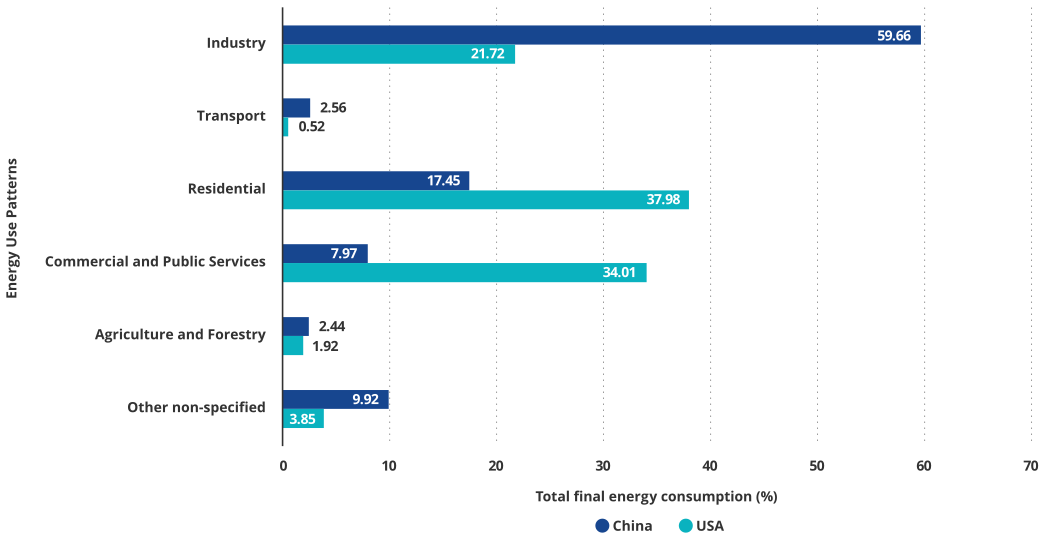
Energy-use structures underline that contrast. In 2023, industry absorbed nearly 60 percent of China’s final energy consumption, while in the U.S., commercial and residential accounted for more than 70 percent.
China Electrifies Production; the U.S. Electrifies Consumption
Source: IEA, VanEck.
These differences are structural. China’s grid serves factories, an instrument of industrial growth. America’s powers lifestyles, energy treated as a market commodity. How a nation uses electricity reveals not just its economy, but its ambitions.
Philosophies of Power: China Monetizes Control, America Monetizes Volatility
Electricity does not just power economies. It reveals how they think. The way a nation builds, owns, and governs its grid is an X-ray of its political DNA. China’s grid is an instrument of the state; America’s is a marketplace.
From Beijing to the provinces, China plans and delivers electricity through a single vertical chain. In the U.S., a patchwork of markets and commissions argues and adapts.
In China, energy planning runs through the National Development and Reform Commission (NDRC) and the National Energy Administration (NEA) to provincial execution. The NDRC sets investment and pricing frameworks and approves key policies; the NEA oversees dispatch, supervises implementation, and manages the energy transition. The State Grid Corporation of China (SGCC) controls five northern and central regions covering more than 80 percent of the population. One of its key tasks is to build and operate ultra-high-voltage transmission lines that carry power from resource rich western and northern areas to the major load centers in the east and south. The China Southern Power Grid (CSG) oversees the southern manufacturing belt, and the Inner Mongolia Power Group, a regional subsidiary of State Grid, manages the western Inner Mongolia network. Together they form the world’s largest coordinated electricity system.
Generation is dominated by six state-owned giants, China Energy Investment, State Power Investment, Huaneng, Datang, Huadian, and Three Gorges, which build and operate plants to meet national quotas. Overlap is deliberate: redundancy guarantees supply. The outcome is speed, scale, and predictability.
China’s Regulatory Framework

Source: China’s Power System (Top Owners), BloombergNEF.
The U.S. operates through a decentralized web of regulators, markets, and utilities rather than a single national system. The Federal Energy Regulatory Commission (FERC) oversees interstate transmission and wholesale power markets, while fifty state commissions regulate retail prices and distribution utilities. Regional transmission organizations such as PJM, MISO, and CAISO coordinate generation and grid operations across multiple states but own no assets. ERCOT in Texas runs largely on its own, reflecting the state’s long-standing preference for competition and independence from federal oversight.
Ownership is equally diverse. Investor-owned utilities such as NextEra, Duke, and Southern Company coexist with public power agencies and rural cooperatives. Independent producers including Vistra, Constellation, and NRG compete in deregulated wholesale markets. This combination of private capital and public oversight encourages innovation and efficiency but often at the expense of coordination.
U.S.’s Regulatory Framework

Source: Regulatory Regime USA, BloombergNEF.
In China, money flows through state banks to meet industrial and employment goals. In the U.S., it moves through markets, directed by investors seeking profit. China grows through coordination, while America advances through competition. One builds certainty; the other builds choice.
The Scale of Power in Two Growth Stories
Electricity generation tells a story of scale and direction. Since 2005, China’s power output has expanded nearly fivefold, growing at a compound annual rate of about 8 percent. The U.S., already a mature system, has grown by less than 1 percent a year. In 2005, America generated roughly twice as much electricity as China; today, the positions have reversed. China now produces more than twice as much power as the U.S.
China’s Capacity Expanded Nearly Fivefold While U.S. Growth Flat

Source: Bloomberg, VanEck. Power Generation, China and the U.S. (2005–2024).
The composition of that growth is equally revealing. China’s system has diversified without slowing. Coal remains the backbone, but new capacity in wind, solar, hydro, and nuclear has added more than six trillion kilowatt-hours since 2005. The result is a power system that is both immense and varied, built for industry, expanding through renewables, and guided by state design.
China: Coal Dominates, But Renewables and Nuclear Power Expand Rapidly

China Power Generation by Source, (2005 vs 2024).
The U.S. system has evolved more than it has expanded. Natural gas replaced coal as the dominant source, while renewables, particularly wind and solar, grew rapidly from a low base. Yet total generation has barely increased. The American grid has become cleaner and more efficient, but not larger, a reflection of modest demand growth and rising efficiency rather than industrial expansion.
U.S.: Gas Replaces Coal, While Renewables Rise from a Small Base
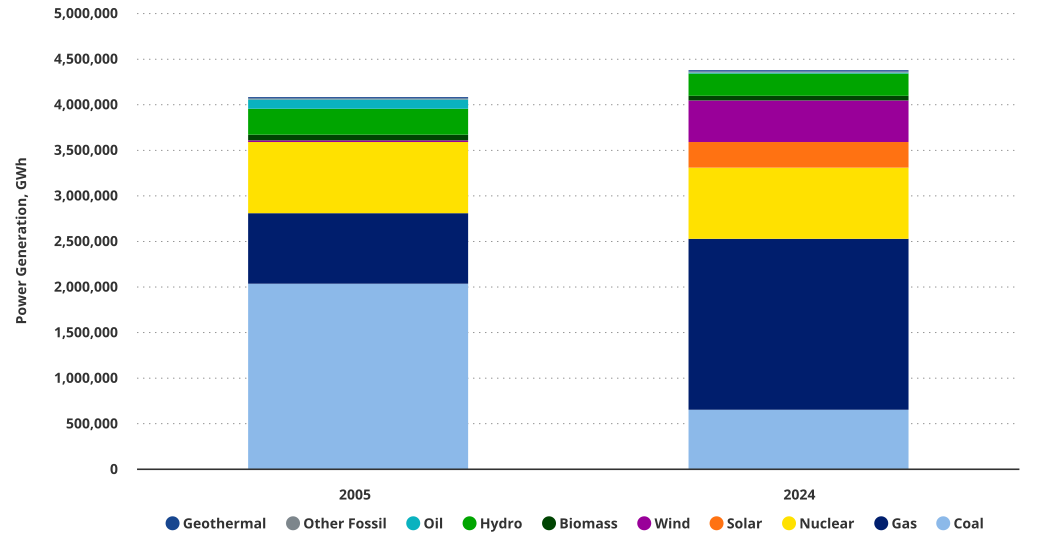
Figure 8. U.S. Power Generation by Source, (2005 vs 2024).
Recommended subscription
The data highlight the core difference between the two models. China’s growth is physical, driven by construction and scale. America’s growth is compositional, driven by substitution and efficiency. One builds new capacity; the other optimizes the old.
When Electricity Pricing Reflects Policy
Chinese electricity costs about half the U.S. level and fluctuates far less. The difference is structural. China finances and regulates power as infrastructure; America prices it as a market commodity.
In China, the National Development and Reform Commission (NDRC) sets benchmark tariffs and allows prices to move within a ±20 percent band, giving limited flexibility while preserving stability for households and factories. When fuel costs rise, state utilities often absorb part of the increase rather than pass it to consumers. Centralized procurement and low-cost domestic engineering keep capital recovery per kilowatt hour modest. Prices vary by region but remain tightly managed: eastern coastal provinces, Hainan, Guangdong, Jiangsu, Zhejiang, Shanghai, and Beijing, typically record tariffs 20–30 percent above the national average, reflecting higher demand and denser load centers.
Market reforms are widening the space for competition but within state boundaries. In 2023, power-trading centers handled nearly 5,700 terawatt hours, equal to approximately 60 percent of national consumption, up from less than 17 percent in 2016. Most trading remains within provinces, though inter-provincial exchanges are expanding as Beijing builds toward a unified national power market by 2030. Even as trading grows, the state anchors prices. Financing, fuel, and infrastructure remain publicly controlled, and most generation is funded by low-cost state credit. The result is a guided market, competitive in allocation, not in price. Stability outweighs transparency, and affordability outranks return.
Across the Pacific, America follows the opposite creed. It prices electricity as a market, not a mandate. Every cost, fuel, finance, or failure, flows straight to the consumer. Volatility is the price of freedom. The Federal Energy Regulatory Commission (FERC) oversees interstate transmission and wholesale pricing, while fifty state commissions regulate retail tariffs and distribution. Power markets are coordinated by regional transmission organizations such as PJM, MISO, and CAISO, which balance generation across states but own no assets. ERCOT in Texas runs largely on its own, reflecting the state’s preference for independence and competition.
This fragmentation defines the U.S. grid. Eastern coastal states, Maine, New York, New Jersey, and Massachusetts, record regional averages about 40–60 percent above the national level, while California and Hawaii stand as extremes, with some of the highest electricity costs in the U.S. The U.S. system passes costs through instantly. When gas prices or capacity payments rise, utilities adjust tariffs through riders (automatic cost pass-through clauses) and surcharges. Market-based dispatch and private ownership encourage efficiency and innovation, but they also amplify price swings.
The Great Price Divide: China Anchors, America Accelerates
Residential
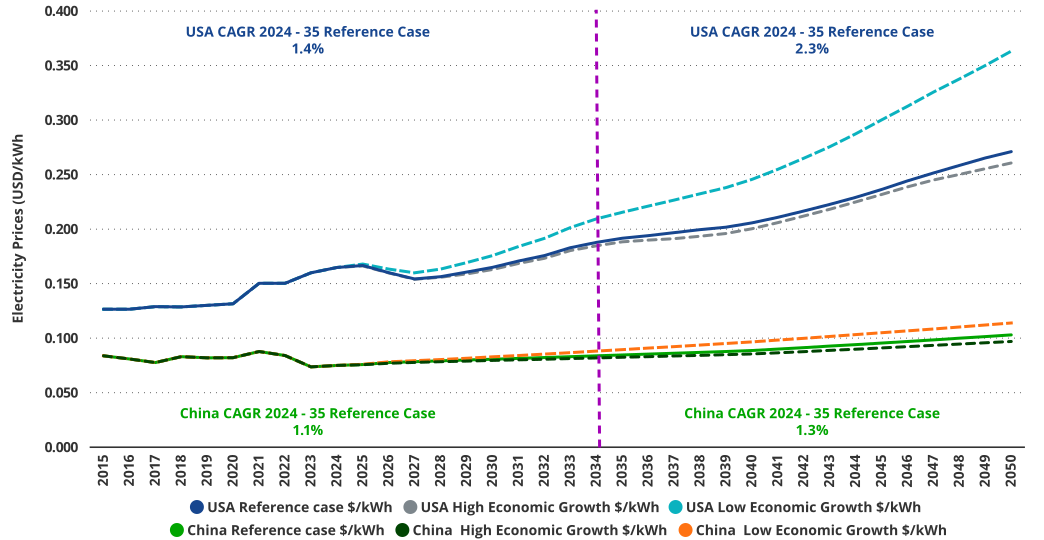
Projected Electricity Prices 2024–2050, Residential Users. Source: U.S. EIA, IEA, CET, VanEck. For illustrative purposes only.
Commercial
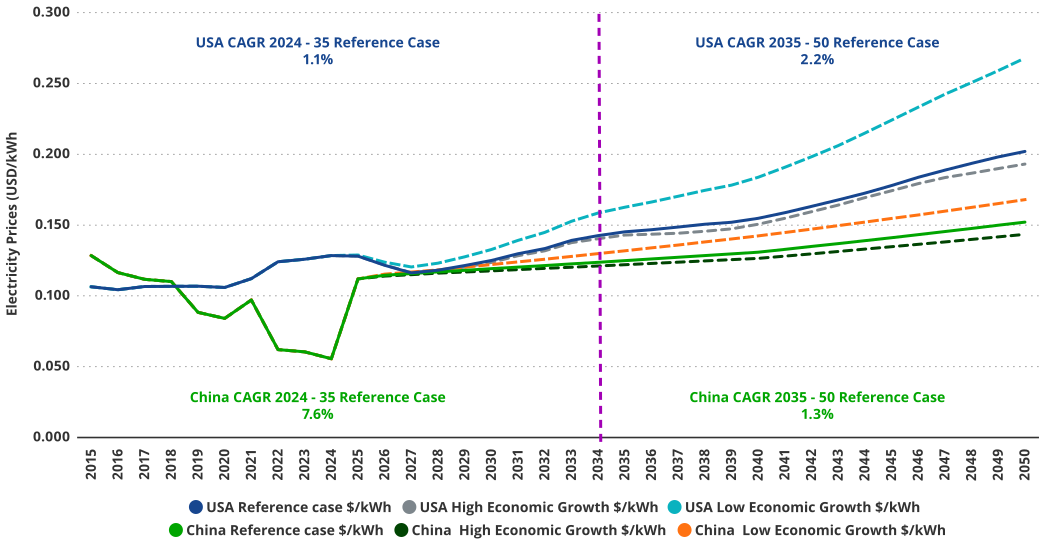
Projected Electricity Prices 2024–2050, Commercial Users. Source: U.S. EIA, IEA, CET, VanEck. For illustrative purposes only.
Model Assumptions. Projections combine U.S. data from the EIA reference and side-case scenarios with the VanEck proprietary China Power Model, a continuously updated, data-driven framework that tests multiple growth trajectories rather than a single forecast. The model simulates the interaction of four structural drivers, fuel costs, electricity demand, renewable share, and carbon or regulatory costs, each calibrated through observed elasticities. The reference case assumes steady demand growth and balanced policy; the high and low cases bracket outcomes shaped by faster digitalization and efficiency gains or by weaker construction and slower industrial recovery. Over time, the model captures the system’s structural decoupling from fossil fuel prices as renewables expand and policy coordination deepens.
The two systems could not be more different. China regulates electricity to shield its economy from volatility; the U.S. prices it to expose its economy to efficiency. One builds certainty, the other choice. Both succeed on their own terms, one through control, the other through competition. Yet both now face the same frontier: as the grid becomes intelligent and demand more digital, the line between command and competition is beginning to blur.
The Age of Electric Sovereignty Is the Next Frontier
In the decade ahead, three forces—state, market, and cloud—will converge into an intelligent power economy, where algorithms, not administrators, balance the flow of energy across nations.
China will embed digital intelligence within its hierarchy, and the U.S. will unleash it through competition. Both are racing toward the same horizon: a self-governing grid that manages itself in real time.
The world’s largest technology firms are already building that future. Their data centers are no longer passive consumers of power but active governors of it, buying, storing, and trading electricity like capital. Energy is becoming liquidity, moving instantly across networks and borders.
The nation-state will endure, but it will now share the stage with digital empires that command both computation and current. China’s strength lies in abundance and control; America’s in innovation and capital. Yet both face a new kind of rival: the corporations that command the cloud.
Electricity is no longer infrastructure. It is digital intelligence, strategy, and sovereignty combined. The next superpower may not be a country at all, but whoever masters the current that powers both machines and minds.
To receive more Natural Resources insights, sign up in our subscription center.

IMPORTANT DISCLOSURES
Please note that VanEck may offer investments products that invest in the asset class(es) or industries included herein.
This is not an offer to buy or sell, or a recommendation to buy or sell any of the securities, financial instruments or digital assets mentioned herein. The information presented does not involve the rendering of personalized investment, financial, legal, tax advice, or any call to action. Certain statements contained herein may constitute projections, forecasts and other forward-looking statements, which do not reflect actual results, are for illustrative purposes only, are valid as of the date of this communication, and are subject to change without notice. Actual future performance of any assets or industries mentioned is unknown. Information provided by third party sources are believed to be reliable and have not been independently verified for accuracy or completeness and cannot be guaranteed. VanEck does not guarantee the accuracy of third-party data. The information herein represents the opinion of the author(s), but not necessarily those of VanEck or its other employees.
For other important disclosures please read more.
All investing is subject to risk, including the possible loss of the money you invest. As with any investment strategy, there is no guarantee that investment objectives will be met and investors may lose money. Diversification does not ensure a profit or protect against a loss in a declining market. Past performance is no guarantee of future results.
© 2026 Van Eck Associates Corporation.
Related Funds
IMPORTANT DISCLOSURES
Please note that VanEck may offer investments products that invest in the asset class(es) or industries included herein.
This is not an offer to buy or sell, or a recommendation to buy or sell any of the securities, financial instruments or digital assets mentioned herein. The information presented does not involve the rendering of personalized investment, financial, legal, tax advice, or any call to action. Certain statements contained herein may constitute projections, forecasts and other forward-looking statements, which do not reflect actual results, are for illustrative purposes only, are valid as of the date of this communication, and are subject to change without notice. Actual future performance of any assets or industries mentioned is unknown. Information provided by third party sources are believed to be reliable and have not been independently verified for accuracy or completeness and cannot be guaranteed. VanEck does not guarantee the accuracy of third-party data. The information herein represents the opinion of the author(s), but not necessarily those of VanEck or its other employees.
For other important disclosures please read more.
All investing is subject to risk, including the possible loss of the money you invest. As with any investment strategy, there is no guarantee that investment objectives will be met and investors may lose money. Diversification does not ensure a profit or protect against a loss in a declining market. Past performance is no guarantee of future results.
© 2026 Van Eck Associates Corporation.