How Private Markets Reshape Growth Exposure
June 10, 2026
Read Time 4 MIN
Key Takeaways:
- More value creation is occurring while companies remain private.
- Venture-backed companies are reaching larger scale before IPO.
- Unicorn valuations continue climbing as private capital expands.
- M&A remains the dominant VC exit pathway, limiting public market access to innovation.
- Advisors may increasingly evaluate how portfolios access long-term innovation exposure.
For decades, public equity markets provided investors with relatively early access to many of the world’s fastest-growing companies. Today, the relationship between innovation and public markets is changing.
As companies remain private longer, they are increasingly reaching larger operating scale, attracting greater amounts of private capital and generating meaningful portions of their value appreciation before ever pursuing a public listing.
This evolution may have important implications for how investors think about innovation exposure and portfolio construction.
Companies Are Reaching Greater Scale Before IPO
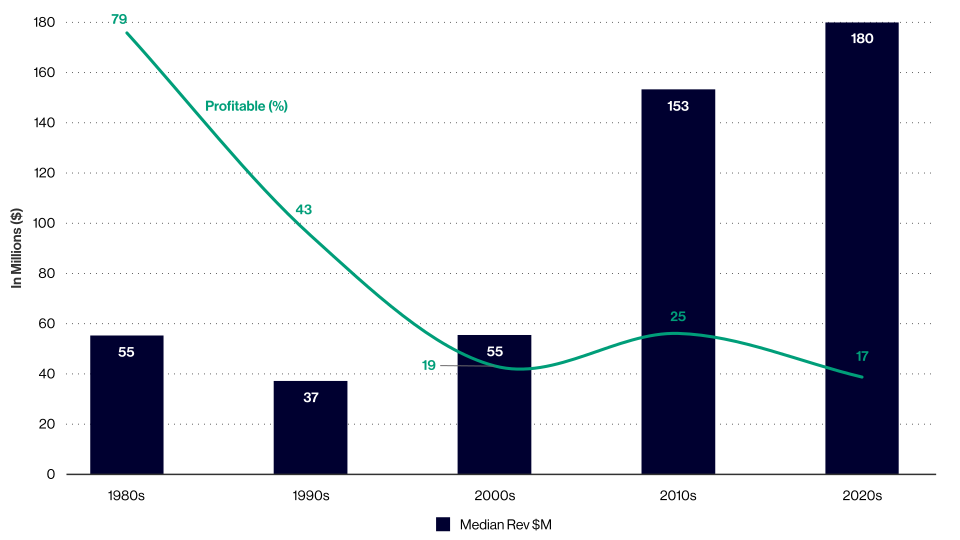
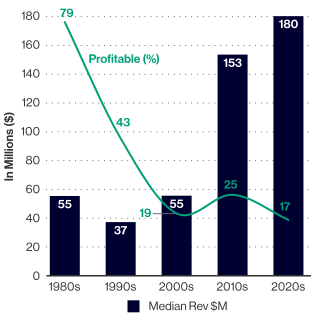
As illustrated in the chart below, the revenue scale and profitability figures have changed dramatically over the past several decades for VC-backed technology IPOs. The revenue scale has surged when comparing a median figure of $55 million back in the 1980s to $180 million more recently. In parallel, we have seen profitability figures contract significantly over this period as innovation-driven companies continue investing more heavily into growth and disruption with less focus on profitability.
VC-Backed Tech IPOs: Revenue Traction & Profitability by Decade
Source: Jay R. Ritter, Director – The IPO Initiative; University of Florida. March 17, 2026.
Rather than accessing public markets earlier in their lifecycle, many companies now remain private while continuing to expand revenue, market share and operating scale. This trend has accelerated alongside the rise of AI and other capital-intensive technologies, where companies often require substantial private funding to support infrastructure, compute capacity and long-term growth initiatives before reaching public markets.
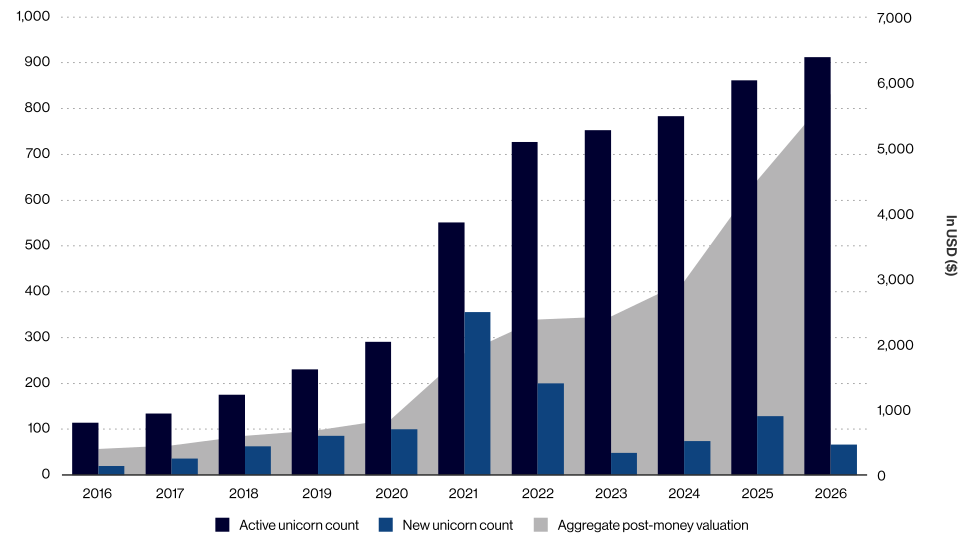
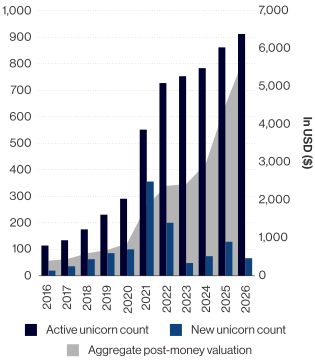
The following chart shows a surge in private companies valued over $1B, or “unicorns”, which is driven by a combination of larger operating metrics and increased valuation multiples as demand for private innovation continues to climb, particularly in AI-related sectors. Just looking at the current number of active unicorns, this cohort represents more than $6T in aggregate market capitalization.
U.S. Unicorn Count and Aggregate Post-Money Valuation ($B)
Source: Q1 2026 Pitchbook-NVCA Venture Monitor.
Recommended subscription
More Value Creation Is Happening Outside Public Markets
We continue seeing larger exits through M&A and IPOs as these technology companies scale, which implies that more value appreciation is happening while companies are private. However, fewer companies are pursuing exits as the staying private for longer trend continues playing out while macro factors further complicate exit activity, leading to private company market capitalizations in the hundreds of billions, and now even trillions. This means more alpha is being generated outside public markets than ever before, which increases the importance and demand for financial advisors and investors to expand their portfolio construction in search of private market access points.
Share of U.S. VC Exit Activity (IPO and M&A) Count by Deal Size ($M)
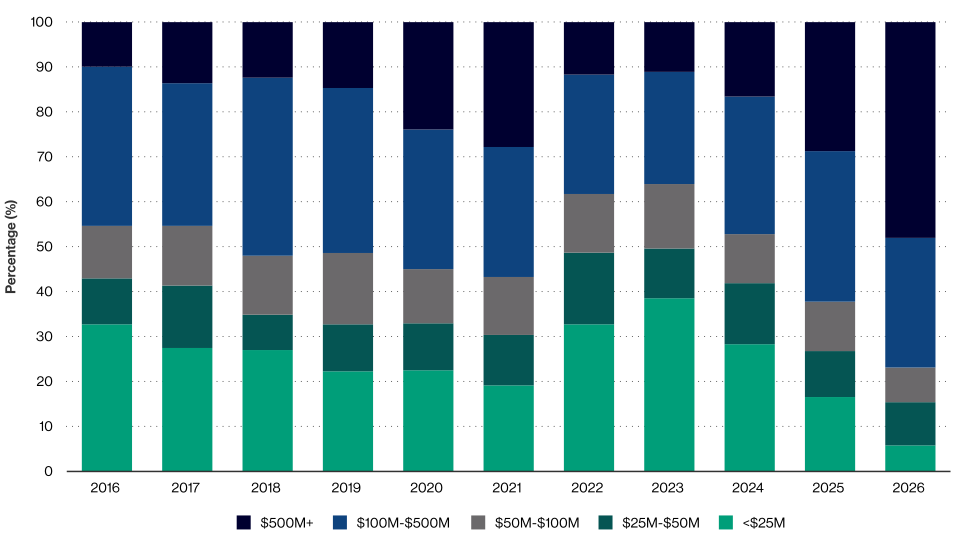
Source: Q1 2026 Pitchbook-NVCA Venture Monitor.
Importantly, M&A historically represents the vast majority of exits for VC-backed companies, thereby further limiting the amount of innovation-oriented companies available for public investors.
Share of U.S. VC Exit Count by Type
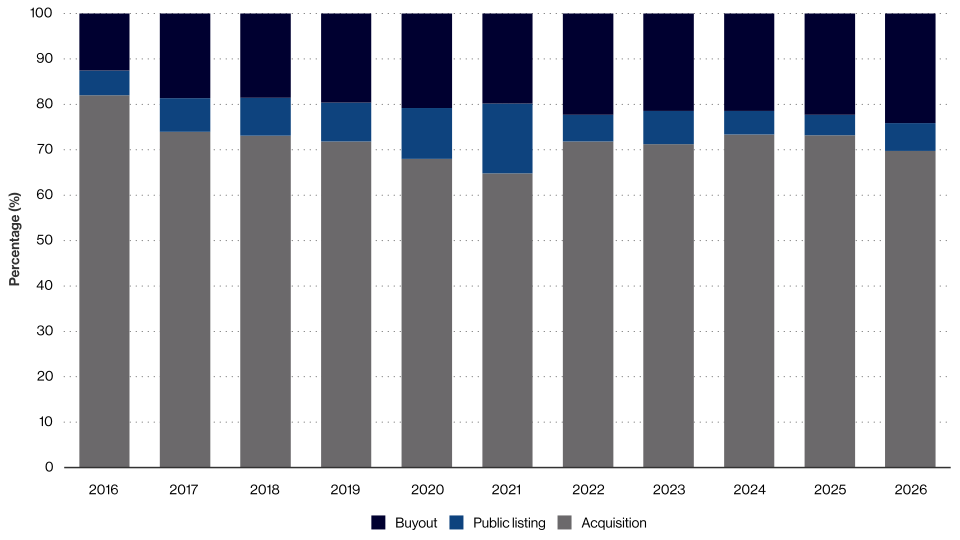
Source: Q1 2026 Pitchbook-NVCA Venture Monitor.
Implications for Investors on Accessing Innovation
Public markets continue serving essential roles in liquidity, governance and scalability, but they may no longer capture the entire innovation economy. As private markets continue expanding and institutionalizing, investors and financial advisors may increasingly evaluate how portfolios access long-term innovation opportunities across both public and private market ecosystems.
The question is no longer whether meaningful innovation is occurring outside public markets. Increasingly, the question is how investors thoughtfully navigate a capital markets environment where a growing share of innovation-driven growth may remain private for longer periods of time.
To receive more Private Markets insights, sign up in our subscription center.

DISCLOSURES
Definitions:
Unicorn: A privately held startup company with a valuation of $1 billion or more.
Venture capital (VC): A form of private equity financing in which investors provide capital to early-stage or high-growth companies in exchange for an ownership stake.
Alpha: A measure of investment return in excess of a benchmark index, used to evaluate how much value an active manager has added on a risk-adjusted basis.
M&A (Mergers & Acquisitions): Corporate transactions in which two companies combine (merger) or one company purchases another (acquisition), representing one of the primary exit pathways for venture-backed companies alongside an IPO.
Unicorn valuations/aggregate post-money valuation: The combined estimated value of all unicorn companies following their most recent funding rounds.
Exit pathway: The means by which investors in a private company realize returns on their investment.
This is not an offer to buy or sell, or a recommendation to buy or sell any of the securities, financial instruments or digital assets mentioned herein. The information presented does not involve the rendering of personalized investment, financial, legal, tax advice, or any call to action. Certain statements contained herein may constitute projections, forecasts and other forward-looking statements, which do not reflect actual results, are for illustrative purposes only, are valid as of the date of this communication, and are subject to change without notice. Actual future performance of any assets or industries mentioned are unknown. Information provided by third party sources are believed to be reliable and have not been independently verified for accuracy or completeness and cannot be guaranteed. VanEck does not guarantee the accuracy of third party data. The information herein represents the opinion of the author(s), but not necessarily those of VanEck or its other employees.
All investing is subject to risk, including the possible loss of the money you invest. As with any investment strategy, there is no guarantee that investment objectives will be met and investors may lose money. Diversification does not ensure a profit or protect against a loss in a declining market. Past performance is no guarantee of future results.
Private markets investments, including venture capital, are speculative, illiquid and involve a high degree of risk. They are generally available only to qualified purchasers or accredited investors and are not suitable for all investors. Private market investments are not publicly traded and may have limited or no liquidity; investors may not be able to sell or transfer their interests and should be prepared to hold any such investment for an indefinite period of time. There is no guarantee that any private company will pursue or complete an initial public offering (IPO), be acquired, or otherwise provide a return of capital. Past performance of private markets or venture capital as an asset class is not indicative of future results.
DISCLOSURES
Definitions:
Unicorn: A privately held startup company with a valuation of $1 billion or more.
Venture capital (VC): A form of private equity financing in which investors provide capital to early-stage or high-growth companies in exchange for an ownership stake.
Alpha: A measure of investment return in excess of a benchmark index, used to evaluate how much value an active manager has added on a risk-adjusted basis.
M&A (Mergers & Acquisitions): Corporate transactions in which two companies combine (merger) or one company purchases another (acquisition), representing one of the primary exit pathways for venture-backed companies alongside an IPO.
Unicorn valuations/aggregate post-money valuation: The combined estimated value of all unicorn companies following their most recent funding rounds.
Exit pathway: The means by which investors in a private company realize returns on their investment.
This is not an offer to buy or sell, or a recommendation to buy or sell any of the securities, financial instruments or digital assets mentioned herein. The information presented does not involve the rendering of personalized investment, financial, legal, tax advice, or any call to action. Certain statements contained herein may constitute projections, forecasts and other forward-looking statements, which do not reflect actual results, are for illustrative purposes only, are valid as of the date of this communication, and are subject to change without notice. Actual future performance of any assets or industries mentioned are unknown. Information provided by third party sources are believed to be reliable and have not been independently verified for accuracy or completeness and cannot be guaranteed. VanEck does not guarantee the accuracy of third party data. The information herein represents the opinion of the author(s), but not necessarily those of VanEck or its other employees.
All investing is subject to risk, including the possible loss of the money you invest. As with any investment strategy, there is no guarantee that investment objectives will be met and investors may lose money. Diversification does not ensure a profit or protect against a loss in a declining market. Past performance is no guarantee of future results.
Private markets investments, including venture capital, are speculative, illiquid and involve a high degree of risk. They are generally available only to qualified purchasers or accredited investors and are not suitable for all investors. Private market investments are not publicly traded and may have limited or no liquidity; investors may not be able to sell or transfer their interests and should be prepared to hold any such investment for an indefinite period of time. There is no guarantee that any private company will pursue or complete an initial public offering (IPO), be acquired, or otherwise provide a return of capital. Past performance of private markets or venture capital as an asset class is not indicative of future results.