Liquidity Still Matters as Private Market Access Expands
June 24, 2026
Read Time 4 MIN
Key Takeaways:
- Evergreen and semi-liquid structures are expanding access to private markets.
- Underlying private assets remain structurally illiquid despite periodic liquidity features.
- Slower IPO and M&A activity can extend liquidity timelines and impact distributions.
- Secondary markets are becoming increasingly important liquidity solutions.
- Investors should carefully align private market exposure with liquidity needs and portfolio objectives.
As private markets continue to expand, demand for greater access from wealth management and retail channels have accelerated in recent years. Historically, many private market strategies were largely limited to institutional investors and ultra-high-net-worth individuals.
A wider range of investors today have access as asset managers launch different types of fund structures with features designed to expand access, including by broadening eligibility, lowering minimum investments, improving subscription and tax administration, and incorporating partial liquidity.
The most frequently used structures are interval and tender offer funds (sometimes referred to as semi-liquid evergreen funds), which are closed-end funds under the Investment Company Act of 1940. According to XA Investments, the interval and tender offer fund market reached a new high of 308 funds with $233 billion in net assets as of December 31, 2025, a $61 billion increase from 2024.
Expanding Access Does Not Eliminate Illiquidity
While demand for these alternative investment structures is expected to continue, it is vital for financial advisors and investors to understand that (i) the underlying assets in areas like venture capital (VC) and broader private equity are structurally illiquid, and (ii) a longer-term holding period of at least 3-5 years should be expected to properly benefit from these types of strategies.
These investment strategies are not designed for shorter-term investment horizons, even if the underlying fund structures allow for some level of periodic liquidity.
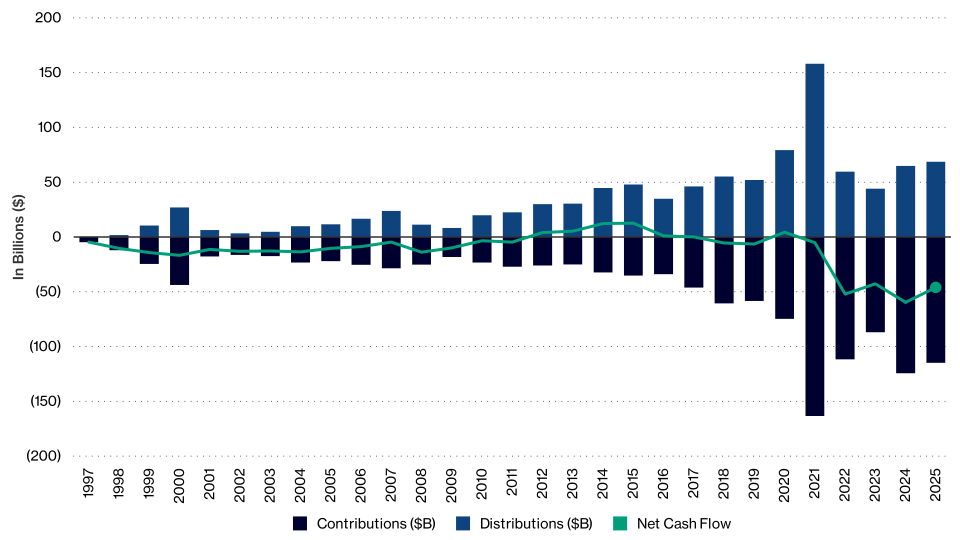
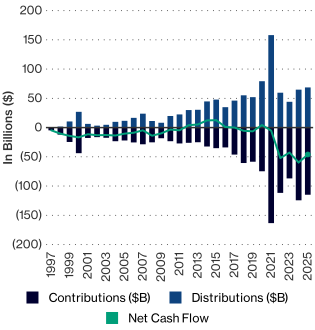
Compressed exit activity has created net cash flow challenges for the venture ecosystem in recent years as the ratio of capital distributions to contributions remains at multi-decade lows, as illustrated in the following chart. An investor seeking liquidity in this type of environment may experience significant discounts to the fair market value of their positions.
U.S. VC Cash Flows ($B)
Source: Q1 2026 Pitchbook-NVCA Venture Monitor.
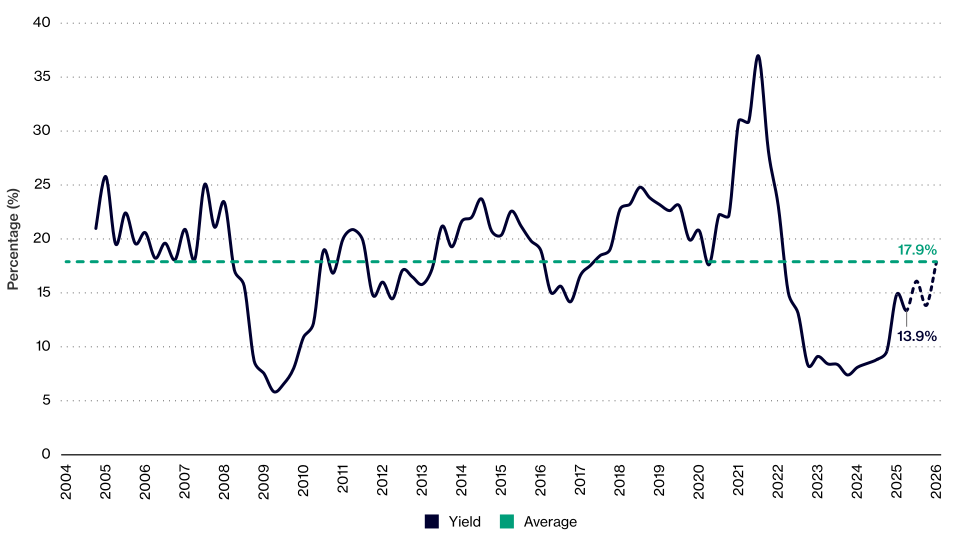
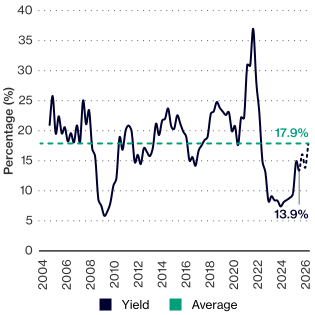
However, the ratio of distributions to net asset value (NAV) has come off recent lows and is showing signs of improvement as exit activity picks up, which is a positive development for the ecosystem. Despite ongoing geopolitical and macro uncertainty, we believe there is a strong set up for both M&A and IPO activity to accelerate through 2026 and potentially set new records.
U.S. VC 12-month Distribution Yield as a Share of NAV
Source: Q1 2026 Pitchbook-NVCA Venture Monitor.
Despite these recent improvements to exit activity, secondary transaction volume is reaching record levels as General Partners (GPs) of funds, Limited Partners (LPs) of funds and underlying portfolio companies (including founders, employees, etc.) have greater demand for liquidity solutions. Fortunately, the continued institutionalization of private markets and maturation of secondaries now provides the ability for these various constituents to achieve liquidity through various transaction structures. We anticipate secondary activity to continue accelerating for the foreseeable future.
Secondary Transaction Volume ($B)
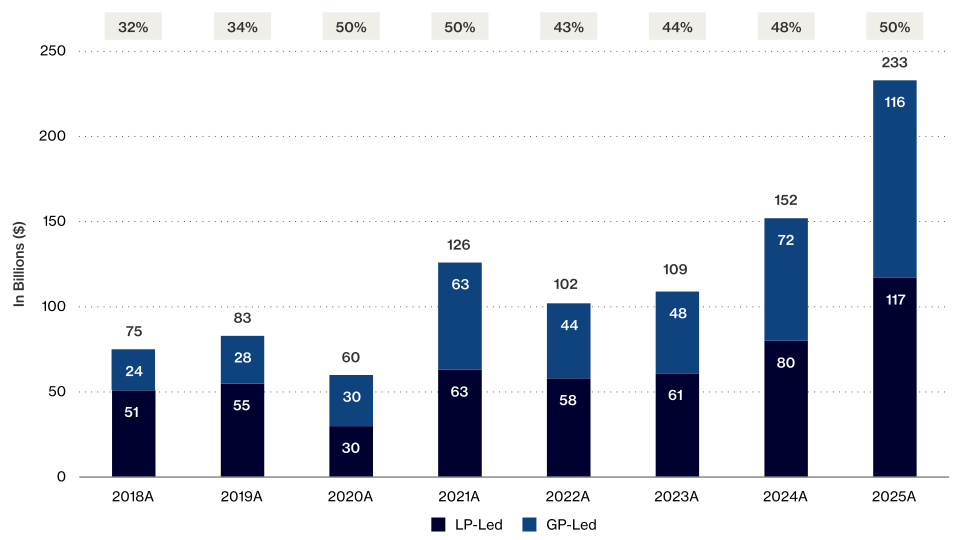
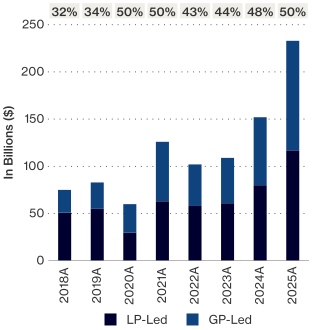
Source: Lazard 1H 2026 Secondary Market Report.
Recommended subscription
Private Markets Are Becoming Core Portfolio Considerations
The growth of private markets reflects a significant structural change across global capital markets, particularly in the U.S. The line between private and public markets has blurred, while strategies such as VC are likely to continue serving as the key drivers of innovation and disruption outside listed markets.
The question is no longer whether investors should allocate capital to private markets, but rather how to effectively construct a portfolio that incorporates long-duration private assets while addressing the investors’ objectives and needs.
To receive more Private Markets insights, sign up in our subscription center.

DISCLOSURES
Definitions:
Venture capital (VC): A form of private equity financing in which investors provide capital to early-stage or high-growth companies in exchange for an ownership stake
Sovereign wealth funds: State-owned investment vehicles that manage a country's national savings or reserve assets with the goal of generating long-term returns.
M&A (Mergers & Acquisitions): Corporate transactions in which two companies combine (merger) or one company purchases another (acquisition), representing one of the primary exit pathways for venture-backed companies alongside an IPO.
Alpha: A measure of investment return in excess of a benchmark index, used to evaluate how much value an active manager has added on a risk-adjusted basis.
Interval fund: A type of closed-end investment fund that offers investors periodic opportunities to redeem shares at net asset value, subject to limitations and fund-specific terms.
Tender offer fund: A type of closed-end investment fund that provides liquidity through periodic repurchase offers, allowing investors to tender a portion of their shares back to the fund.
Evergreen fund: An investment fund structure with no fixed termination date that continuously raises capital and makes investments while providing limited liquidity opportunities to investors.
Secondary market: A market in which existing interests in private funds or private companies are bought and sold between investors rather than issued directly by the underlying company or fund.
General Partner (GP): The investment manager responsible for sourcing, evaluating and managing investments on behalf of a private fund.
Limited Partner (LP): An investor in a private fund who provides capital but does not participate in the day-to-day management of the fund.
This is not an offer to buy or sell, or a recommendation to buy or sell any of the securities, financial instruments or digital assets mentioned herein. The information presented does not involve the rendering of personalized investment, financial, legal, tax advice, or any call to action. Certain statements contained herein may constitute projections, forecasts and other forward-looking statements, which do not reflect actual results, are for illustrative purposes only, are valid as of the date of this communication, and are subject to change without notice. Actual future performance of any assets or industries mentioned are unknown. Information provided by third party sources are believed to be reliable and have not been independently verified for accuracy or completeness and cannot be guaranteed. VanEck does not guarantee the accuracy of third party data. The information herein represents the opinion of the author(s), but not necessarily those of VanEck or its other employees.
All investing is subject to risk, including the possible loss of the money you invest. As with any investment strategy, there is no guarantee that investment objectives will be met and investors may lose money. Diversification does not ensure a profit or protect against a loss in a declining market. Past performance is no guarantee of future results.
Private markets investments, including venture capital, are speculative, illiquid and involve a high degree of risk. They are generally available only to qualified purchasers or accredited investors and are not suitable for all investors. Private market investments are not publicly traded and may have limited or no liquidity; investors may not be able to sell or transfer their interests and should be prepared to hold any such investment for an indefinite period of time. There is no guarantee that any private company will pursue or complete an initial public offering (IPO), be acquired, or otherwise provide a return of capital. Past performance of private markets or venture capital as an asset class is not indicative of future results.
DISCLOSURES
Definitions:
Venture capital (VC): A form of private equity financing in which investors provide capital to early-stage or high-growth companies in exchange for an ownership stake
Sovereign wealth funds: State-owned investment vehicles that manage a country's national savings or reserve assets with the goal of generating long-term returns.
M&A (Mergers & Acquisitions): Corporate transactions in which two companies combine (merger) or one company purchases another (acquisition), representing one of the primary exit pathways for venture-backed companies alongside an IPO.
Alpha: A measure of investment return in excess of a benchmark index, used to evaluate how much value an active manager has added on a risk-adjusted basis.
Interval fund: A type of closed-end investment fund that offers investors periodic opportunities to redeem shares at net asset value, subject to limitations and fund-specific terms.
Tender offer fund: A type of closed-end investment fund that provides liquidity through periodic repurchase offers, allowing investors to tender a portion of their shares back to the fund.
Evergreen fund: An investment fund structure with no fixed termination date that continuously raises capital and makes investments while providing limited liquidity opportunities to investors.
Secondary market: A market in which existing interests in private funds or private companies are bought and sold between investors rather than issued directly by the underlying company or fund.
General Partner (GP): The investment manager responsible for sourcing, evaluating and managing investments on behalf of a private fund.
Limited Partner (LP): An investor in a private fund who provides capital but does not participate in the day-to-day management of the fund.
This is not an offer to buy or sell, or a recommendation to buy or sell any of the securities, financial instruments or digital assets mentioned herein. The information presented does not involve the rendering of personalized investment, financial, legal, tax advice, or any call to action. Certain statements contained herein may constitute projections, forecasts and other forward-looking statements, which do not reflect actual results, are for illustrative purposes only, are valid as of the date of this communication, and are subject to change without notice. Actual future performance of any assets or industries mentioned are unknown. Information provided by third party sources are believed to be reliable and have not been independently verified for accuracy or completeness and cannot be guaranteed. VanEck does not guarantee the accuracy of third party data. The information herein represents the opinion of the author(s), but not necessarily those of VanEck or its other employees.
All investing is subject to risk, including the possible loss of the money you invest. As with any investment strategy, there is no guarantee that investment objectives will be met and investors may lose money. Diversification does not ensure a profit or protect against a loss in a declining market. Past performance is no guarantee of future results.
Private markets investments, including venture capital, are speculative, illiquid and involve a high degree of risk. They are generally available only to qualified purchasers or accredited investors and are not suitable for all investors. Private market investments are not publicly traded and may have limited or no liquidity; investors may not be able to sell or transfer their interests and should be prepared to hold any such investment for an indefinite period of time. There is no guarantee that any private company will pursue or complete an initial public offering (IPO), be acquired, or otherwise provide a return of capital. Past performance of private markets or venture capital as an asset class is not indicative of future results.