Companies Are Staying Private Longer: Why It Matters
May 28, 2026
Read Time 5 MIN
Key Takeaways:
- Companies are remaining private significantly longer.
- Public markets may no longer capture the full innovation cycle.
- AI and abundant private capital are accelerating the trend.
- Investors may be accessing companies later in their growth lifecycle.
- Advisors may increasingly need to rethink innovation exposure.
For decades, public markets represented the primary access point to innovation-driven growth. Investors could participate in the expansion of transformational businesses relatively early in their lifecycle through publicly listed equities. Today, however, many of the world’s fastest-growing companies are staying private significantly longer, allowing a larger share of value creation to occur outside traditional equity indices.
While wealthy industrialist families including the Morgans, Rockefellers, Vanderbilts and Whitneys invested in private companies dating back to the late 19th and early 20th centuries, modern venture capital (VC) can be traced to the period immediately following World War II, with the founding of the American Research and Development Corporation (ARDC). ARDC is considered by many to be the first VC firm in the U.S. Structured as a closed-end fund under the Investment Company Act of 1940, ARDC introduced a permanent capital base funded by wealthy families, university endowments, insurers and investment trusts.
The original purpose of venture capital was to finance the commercialization of innovative, high-risk technologies and emerging companies. In addition to the potential for profit generation, VC was meant to act as a catalyst for job stimulation and political stability. Not surprisingly, VC has played a significant role in funding the technologies behind major industrial and technological revolutions. That influence may be felt more than ever as artificial intelligence (AI) impacts the entire innovation economy, including areas like space, defense, security, semiconductors, manufacturing, energy, finance and healthcare.
Today, there are roughly several thousand active VC firms globally with more than 1,000 in the U.S. and hundreds of billions in annual deal activity. As VC has become more institutionalized, it has also expanded as a category with sub-segments representing different stages of company development, including pre-seed, seed, early-stage, late-stage and growth. This institutionalization notably signals the maturing of an asset class that has attracted record levels of capital as we observe an evolution across public and private markets.
Furthermore, there has been a significant structural shift between public and private markets over the past several decades as private companies continue staying private for longer. As evidenced in the chart below, VC-backed technology companies went from staying private for ~5 years before going public back in the 1980s to ~12 years today, with 2022 and 2024 hitting a peak of 14 years.
VC-Backed Tech IPOs: Volume & Median Age by Decade
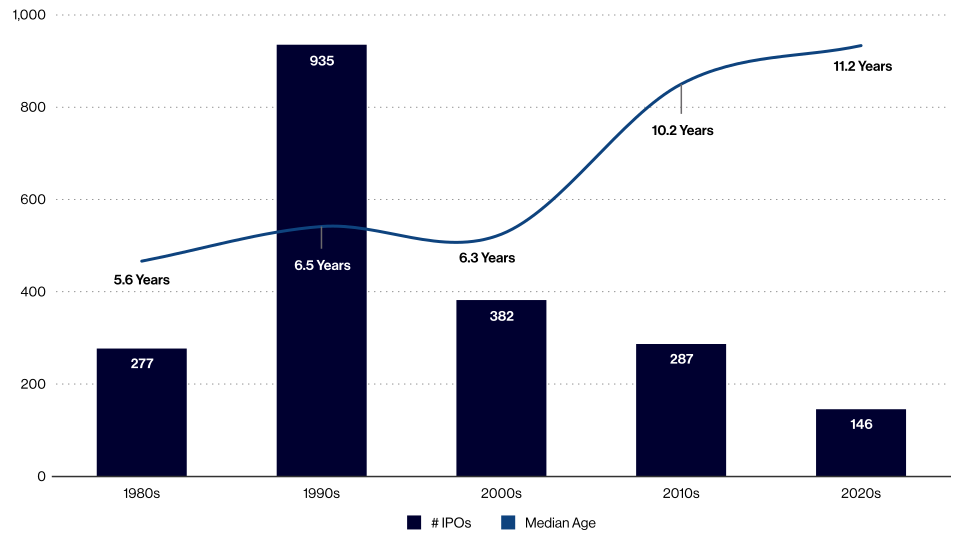
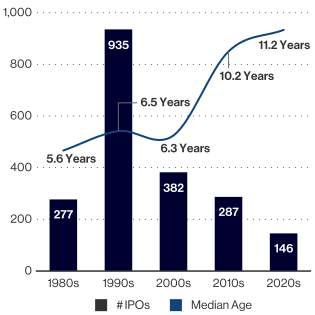
Source: Jay R. Ritter, Director – The IPO Initiative; University of Florida. March 17, 2026.
This data raises two critical questions: why are companies staying private for longer, and what does this mean for investors?
Recommended subscription
Why Companies Are Staying Private Longer
Several factors contribute to “why”, but to oversimplify, the three most meaningful drivers are regulatory, administrative and capital formation.
- Regulatory
- Section 12(g) of the Securities Exchange Act of 1934: Foundational rule that forced companies to register with the SEC and file public disclosures if they had more than 500 shareholders and $10 million in assets. This may imply that many companies were forced to go public sooner than they would have chosen otherwise.
- Sarbanes-Oxley (SOX): Enacted in 2002, SOX significantly increased the cost and burden for companies’ securities to trade on listed exchanges. Due to the associated costs being relatively fixed regardless of company size, this disproportionately impacted small to mid-sized companies.
- The JOBS Act (2012): Interpreted by many as a watershed moment, the biggest impact was revising the shareholder of record threshold up to 2,000 shareholders (or up to 500 non-accredited investors) excluding employees that receive shares via compensation. This change extended the runway for companies to operate privately.
- SEC’s Regulation D Amendments (2013): SEC lifted the longstanding ban on general solicitation under Rule 506(c) for private placements, unlocking access for private companies to target a larger pool of capital.
- Administrative
- Administrative, reporting and compliance requirements for publicly traded companies can be overwhelming and prohibitive for less established companies focused on disruptive growth.
- Publicly traded companies are exposed to daily idiosyncratic market volatility as well as the need to publish and meet quarterly operating guidance, which can impact a management team’s ability to achieve long-term objectives.
- Staying private can be less daunting, more constructive and provide greater operational flexibility.
- Capital formation
- Fueled by the regulatory and administrative shifts noted above, the amount of capital made available to private companies has surged over the past couple of decades.
- As companies stay private longer, they often generate higher operating metrics and market capitalizations, attracting interest from new types of investors as the inherent risk-return profiles change. For example, late-stage VC and growth-equity investors are more likely to step in once a technology company has de-risked its business model and demonstrated certain levels of revenue, growth and potentially even profitability. The same can be true for sovereign wealth and crossover funds.
- New pools of capital provide a combination of liquidity and fresh capital to further support companies staying private for longer.
What This Means for Investors
The growth of private markets represents one of the most significant structural changes across modern capital markets. Companies are remaining private longer, scaling to larger operating and valuation milestones before pursuing IPOs and increasingly generating meaningful portions of their value appreciation outside traditional public equity markets.
As a result, public market investors may be accessing companies later in their growth lifecycle than in previous decades. The continued expansion of AI and other innovation-driven industries may further reinforce the importance of private capital in financing long-duration growth opportunities.
Public markets continue serving essential roles in liquidity, governance and scalability. However, they may no longer fully capture the entire innovation economy. For investors, the conversation is increasingly shifting from whether innovation is occurring outside public markets to how portfolios thoughtfully evaluate exposure across both public and private market ecosystems.
To receive more Private Markets insights, sign up in our subscription center.

IMPORTANT DISCLOSURES
Definitions:
Venture capital (VC): A form of private equity financing in which investors provide capital to early-stage or high-growth companies in exchange for an ownership stake.
ARDC: American Research and Development Corporation, widely considered the first institutional venture capital firm in the U.S.
Pre-seed, seed, early-stage, late-stage, growth (VC stages): Refers to the sequential phases of private company development that correspond to different types of venture capital investment.
Section 12(g): A provision of the Securities Exchange Act of 1934 that requires companies exceeding certain shareholder and asset thresholds to register with the SEC and comply with public reporting obligations.
Sarbanes-Oxley (SOX): Federal legislation enacted in 2002 that significantly increased the compliance costs and reporting requirements for publicly traded companies.
JOBS Act: The Jumpstart Our Business Startups Act of 2012, which raised the shareholder threshold triggering SEC registration requirements and extended the runway for companies to remain private.
Regulation D (Reg D): A set of SEC rules that allow companies to raise capital through private placements without registering the offering as a public securities transaction.
Crossover funds: Investment funds that participate in both private and public equity markets, often investing in late-stage private companies shortly before a public offering.
Sovereign wealth funds: State-owned investment vehicles that manage a country's national savings or reserve assets with the goal of generating long-term returns.
M&A (Mergers & Acquisitions): Corporate transactions in which two companies combine (merger) or one company purchases another (acquisition), representing one of the primary exit pathways for venture-backed companies alongside an IPO.
Alpha: A measure of investment return in excess of a benchmark index, used to evaluate how much value an active manager has added on a risk-adjusted basis.
This is not an offer to buy or sell, or a recommendation to buy or sell any of the securities, financial instruments or digital assets mentioned herein. The information presented does not involve the rendering of personalized investment, financial, legal, tax advice, or any call to action. Certain statements contained herein may constitute projections, forecasts and other forward-looking statements, which do not reflect actual results, are for illustrative purposes only, are valid as of the date of this communication, and are subject to change without notice. Actual future performance of any assets or industries mentioned are unknown. Information provided by third party sources are believed to be reliable and have not been independently verified for accuracy or completeness and cannot be guaranteed. VanEck does not guarantee the accuracy of third party data. The information herein represents the opinion of the author(s), but not necessarily those of VanEck or its other employees.
All investing is subject to risk, including the possible loss of the money you invest. As with any investment strategy, there is no guarantee that investment objectives will be met and investors may lose money. Diversification does not ensure a profit or protect against a loss in a declining market. Past performance is no guarantee of future results.
Private markets investments, including venture capital, are speculative, illiquid and involve a high degree of risk. They are generally available only to qualified purchasers or accredited investors and are not suitable for all investors. Private market investments are not publicly traded and may have limited or no liquidity; investors may not be able to sell or transfer their interests and should be prepared to hold any such investment for an indefinite period of time. There is no guarantee that any private company will pursue or complete an initial public offering (IPO), be acquired, or otherwise provide a return of capital. Past performance of private markets or venture capital as an asset class is not indicative of future results.
IMPORTANT DISCLOSURES
Definitions:
Venture capital (VC): A form of private equity financing in which investors provide capital to early-stage or high-growth companies in exchange for an ownership stake.
ARDC: American Research and Development Corporation, widely considered the first institutional venture capital firm in the U.S.
Pre-seed, seed, early-stage, late-stage, growth (VC stages): Refers to the sequential phases of private company development that correspond to different types of venture capital investment.
Section 12(g): A provision of the Securities Exchange Act of 1934 that requires companies exceeding certain shareholder and asset thresholds to register with the SEC and comply with public reporting obligations.
Sarbanes-Oxley (SOX): Federal legislation enacted in 2002 that significantly increased the compliance costs and reporting requirements for publicly traded companies.
JOBS Act: The Jumpstart Our Business Startups Act of 2012, which raised the shareholder threshold triggering SEC registration requirements and extended the runway for companies to remain private.
Regulation D (Reg D): A set of SEC rules that allow companies to raise capital through private placements without registering the offering as a public securities transaction.
Crossover funds: Investment funds that participate in both private and public equity markets, often investing in late-stage private companies shortly before a public offering.
Sovereign wealth funds: State-owned investment vehicles that manage a country's national savings or reserve assets with the goal of generating long-term returns.
M&A (Mergers & Acquisitions): Corporate transactions in which two companies combine (merger) or one company purchases another (acquisition), representing one of the primary exit pathways for venture-backed companies alongside an IPO.
Alpha: A measure of investment return in excess of a benchmark index, used to evaluate how much value an active manager has added on a risk-adjusted basis.
This is not an offer to buy or sell, or a recommendation to buy or sell any of the securities, financial instruments or digital assets mentioned herein. The information presented does not involve the rendering of personalized investment, financial, legal, tax advice, or any call to action. Certain statements contained herein may constitute projections, forecasts and other forward-looking statements, which do not reflect actual results, are for illustrative purposes only, are valid as of the date of this communication, and are subject to change without notice. Actual future performance of any assets or industries mentioned are unknown. Information provided by third party sources are believed to be reliable and have not been independently verified for accuracy or completeness and cannot be guaranteed. VanEck does not guarantee the accuracy of third party data. The information herein represents the opinion of the author(s), but not necessarily those of VanEck or its other employees.
All investing is subject to risk, including the possible loss of the money you invest. As with any investment strategy, there is no guarantee that investment objectives will be met and investors may lose money. Diversification does not ensure a profit or protect against a loss in a declining market. Past performance is no guarantee of future results.
Private markets investments, including venture capital, are speculative, illiquid and involve a high degree of risk. They are generally available only to qualified purchasers or accredited investors and are not suitable for all investors. Private market investments are not publicly traded and may have limited or no liquidity; investors may not be able to sell or transfer their interests and should be prepared to hold any such investment for an indefinite period of time. There is no guarantee that any private company will pursue or complete an initial public offering (IPO), be acquired, or otherwise provide a return of capital. Past performance of private markets or venture capital as an asset class is not indicative of future results.