How AI Is Reshaping Drug Discovery and Healthcare Investing
February 06, 2026
Read Time 5 MIN
Key Takeaways:
- AI boosts efficiency in early, high-failure R&D, improving success rates and capital efficiency across biotech and pharma.
- Biotech uses AI for breakthrough discovery, while large pharma scales it to strengthen pipelines and manage patent risk.
- VanEck’s BBH and PPH ETFs provide complementary exposure to AI-driven innovation across healthcare.
How Is AI Changing Drug Discovery and What Does It Mean for Investors?
AI is reshaping drug discovery by improving efficiency in the earliest and most failure-prone stages of development, with implications for both biotech innovators and large pharmaceutical companies.
Drug discovery has traditionally been slow, expensive, and uncertain. Artificial intelligence is now being deployed to improve how potential drugs are identified, designed, and evaluated, long before clinical trials begin. As the Economist recently highlighted in the article An AI revolution in drugmaking is under way, this shift is already altering the economics of research and development across healthcare.
What Problems Is AI Solving in Drug Development?
AI helps address inefficiencies in early-stage drug discovery, where most failures occur and costs are hardest to control.
Historically, companies have relied on trial-and-error approaches that require screening vast numbers of compounds with low success rates. AI tools are now being used to narrow the field earlier and more intelligently.
Key ways AI is being applied in drug development include:
- Identifying biological targets using large-scale genomic and proteomic data
- Designing molecules digitally rather than relying solely on lab-based experimentation
- Predicting safety or efficacy issues before candidates enter costly trial phases
By improving decision-making earlier in the process, AI may help reduce wasted R&D spending while increasing the number of viable drug candidates.
Where Is AI Adoption Happening Across Healthcare?
AI is being adopted across both biotech and pharmaceutical companies, but in different ways.
| Segment | How AI Is Used | Investment Implication |
| Biotechnology | AI-driven platforms for novel target discovery and early-stage innovation | Exposure to potential breakthroughs and licensing opportunities |
| Pharmaceuticals | AI applied across large pipelines to improve R&D efficiency and pipeline durability | Support for long-term revenue stability and capital discipline |
Smaller biotech firms often lead innovation, while large pharma companies benefit from scale, data depth, and diversified pipelines.
Does AI Reduce Risk in Drug Discovery?
AI does not eliminate risk, but it may improve the odds of bringing a drug to market.
Drug development remains complex, highly regulated, and uncertain. However, even modest improvements in hit rates or development timelines can be meaningful in an industry where returns depend on a small number of successful drugs.
For investors, the key takeaway is not faster blockbuster creation, but better capital efficiency over time.
Why Is AI-Driven Healthcare Innovation Especially Important Now?
AI adoption in the healthcare space coincides with a major wave of pharmaceutical patent expirations.
Large, liquid pharma companies have the scale, clinical expertise, and global reach to participate meaningfully in the next generation of therapeutic innovation, including the expansion of peptide-based medicines. AI assisted drug discovery may also help these firms refresh pipelines more efficiently at a time when the industry is preparing for notable patent expirations.
Patent Expiration Risk for Total Worldwide Drug RX Revenues 2025-2030
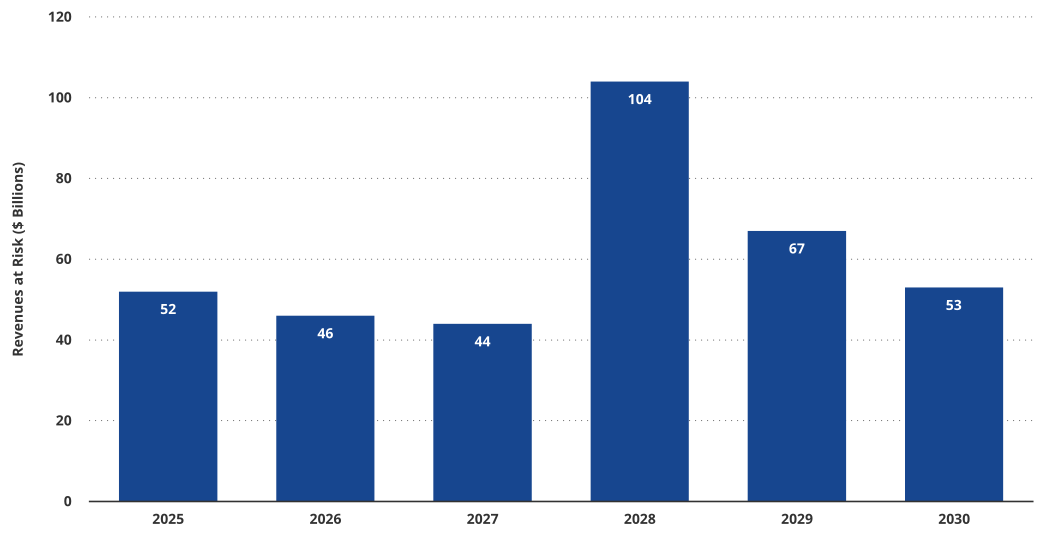
Source: Worldwide; Evaluate (EvaluatePharma), as of May 2025 Past performance is no guarantee of future results.
If AI improves efficiency in the critical “0 to 1” phase, it may help established pharma companies refresh pipelines more consistently and respond more effectively to patent turnover.
Related content: Why Are Investors Re-Evaluating Large Pharmaceutical Companies?
How Is the AI-Enabled Healthcare Market Expected to Grow?
The market for AI-enabled drug discovery is expected to grow rapidly over the next decade as adoption expands across research, development, and clinical applications.
According to industry estimates, spending on AI tools in drug discovery is projected to accelerate meaningfully through 2032 as pharmaceutical and biotech companies increasingly embed AI into core R&D workflows. This growth reflects rising confidence that AI can improve productivity in early-stage research, where costs are high and failure rates are steep.
Forecasted Market Growth for Global AI Drug Discovery (2023-2032)
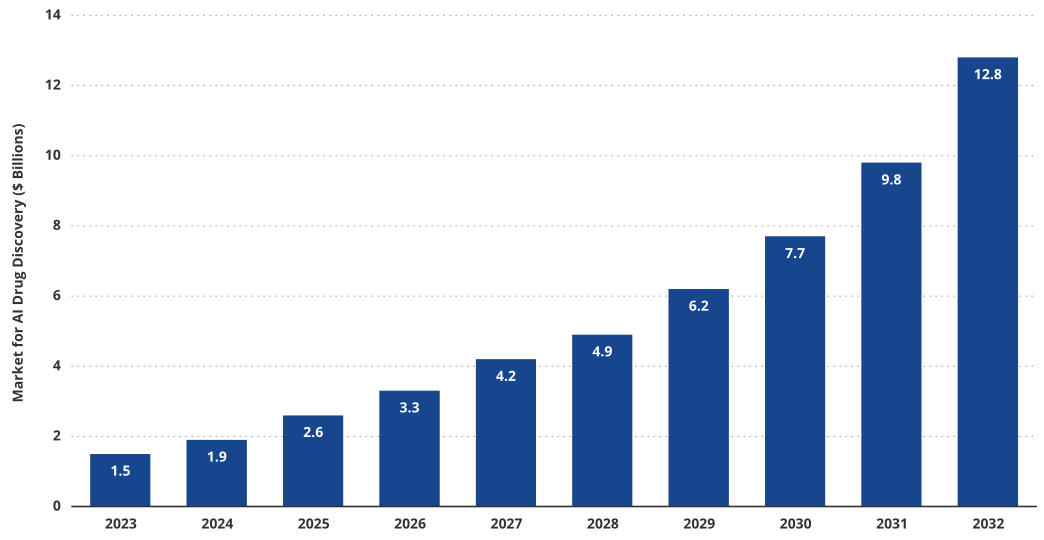
Source: Market.us, as of October 2023. Past performance is no guarantee of future results. Not intended as a forecast or prediction of future results.
Recommended subscription
This growth underscores why AI is increasingly viewed as a structural shift rather than a niche tool within healthcare R&D.
How Can Investors Access These AI-Driven Healthcare Trends?
Investors can gain targeted exposure through biotech and pharmaceutical ETFs designed to capture different parts of the innovation cycle.
The VanEck Biotech ETF (BBH) offers access to the innovation side of AI-driven drug development:
- Focuses on leading biotechnology companies
- Provides exposure to firms at the forefront of drug discovery and innovation
- Includes companies actively using AI-enabled research platforms
The VanEck Pharmaceutical ETF (PPH) is designed to capture established global drugmakers with scale, diversified revenue streams, and proven commercialization capabilities:
- Highly liquid companies: Tracks the largest most liquid pharmaceutical companies
- Industry leaders: Favors established industry leaders with meaningful scale
- Global scope: Provides exposure to U.S. and international equities for global industry representation
The Bottom Line: Why AI Matters for Healthcare Investors
AI is not transforming drug discovery overnight, but it is steadily reshaping how innovation is pursued.
By improving efficiency at the earliest stages of development, AI may help:
- Increase the productivity of R&D spending
- Support pipeline replenishment amid patent expirations
- Strengthen the long-term outlook for both biotech innovators and pharmaceutical leaders
Explore Investment Ideas
To receive more Thematic Investing insights, sign up in our subscription center.

IMPORTANT DISCLOSURES
This is not an offer to buy or sell, or a recommendation to buy or sell any of the securities, financial instruments or digital assets mentioned herein. The information presented does not involve the rendering of personalized investment, financial, legal, tax advice, or any call to action. Certain statements contained herein may constitute projections, forecasts and other forward-looking statements, which do not reflect actual results, are for illustrative purposes only, are valid as of the date of this communication, and are subject to change without notice. Actual future performance of any assets or industries mentioned are unknown. Information provided by third party sources are believed to be reliable and have not been independently verified for accuracy or completeness and cannot be guaranteed. VanEck does not guarantee the accuracy of third party data. The information herein represents the opinion of the author(s), but not necessarily those of VanEck or its other employees.
The principal risks of investing in VanEck ETFs and mutual funds include, but are not limited to, sector, market, economic, political, foreign currency, world event, index tracking, active management, social media analytics, derivatives, blockchain, commodities and non-diversification risks, as well as fluctuations in net asset value and the risks associated with investing in less developed capital markets. VanEck ETFs may also be subject to authorized participant concentration, no guarantee of active trading market, trading issues, passive management, fund shares trading, premium/discount risk and liquidity of fund shares risks. VanEck ETFs or mutual funds may loan their securities, which may subject them to additional credit and counterparty risk. ETFs or mutual funds that invest in high-yield securities are subject to subject to risks associated with investing in high-yield securities; which include a greater risk of loss of income and principal than funds holding higher-rated securities; concentration risk; credit risk; hedging risk; interest rate risk; and short sale risk. ETFs or mutual funds that invest in companies with small capitalizations are subject to elevated risks, which include, among others, greater volatility, lower trading volume and less liquidity than larger companies. Please see the prospectus of each Fund for more complete information regarding each Fund’s specific risks.MVIS® US Listed Pharmaceutical 25 Index (MVPPHTR) - tracks the overall performance of companies involved in pharmaceuticals, including pharmaceutical research and development as well a production, marketing and sales of pharmaceuticals. MVIS US Listed Pharmaceutical 25 Index is the exclusive property of MarketVector Indexes GmbH (a wholly owned subsidiary of Van Eck Securities Corporation), which has contracted with Solactive AG to maintain and calculate the Index. Solactive AG uses its best efforts to ensure that the Index is calculated correctly. Irrespective of its obligations towards MarketVector Indexes GmbH, Solactive AG has no obligation to point out errors in the Index to third parties. The VanEck Pharmaceutical ETF is not sponsored, endorsed, sold or promoted by MarketVector Indexes GmbH and MarketVector Indexes GmbH makes no representation regarding the advisability of investing in the Fund.
Investing involves substantial risk and high volatility, including possible loss of principal. An investor should consider the investment objective, risks, charges and expenses of a Fund carefully before investing. To obtain a prospectus and summary prospectus, which contain this and other information, call 800.826.2333 or visit vaneck.com. Please read the prospectus and summary prospectus carefully before investing.
© Van Eck Securities Corporation, Distributor, a wholly owned subsidiary of Van Eck Associates Corporation.
666 Third Avenue | New York, NY 10017
© 2026 VanEck. VanEck®, VanEck Access the opportunities®, and the stylized VanEck design®are trademarks of Van Eck Associates Corporation.
Related Funds
IMPORTANT DISCLOSURES
This is not an offer to buy or sell, or a recommendation to buy or sell any of the securities, financial instruments or digital assets mentioned herein. The information presented does not involve the rendering of personalized investment, financial, legal, tax advice, or any call to action. Certain statements contained herein may constitute projections, forecasts and other forward-looking statements, which do not reflect actual results, are for illustrative purposes only, are valid as of the date of this communication, and are subject to change without notice. Actual future performance of any assets or industries mentioned are unknown. Information provided by third party sources are believed to be reliable and have not been independently verified for accuracy or completeness and cannot be guaranteed. VanEck does not guarantee the accuracy of third party data. The information herein represents the opinion of the author(s), but not necessarily those of VanEck or its other employees.
The principal risks of investing in VanEck ETFs and mutual funds include, but are not limited to, sector, market, economic, political, foreign currency, world event, index tracking, active management, social media analytics, derivatives, blockchain, commodities and non-diversification risks, as well as fluctuations in net asset value and the risks associated with investing in less developed capital markets. VanEck ETFs may also be subject to authorized participant concentration, no guarantee of active trading market, trading issues, passive management, fund shares trading, premium/discount risk and liquidity of fund shares risks. VanEck ETFs or mutual funds may loan their securities, which may subject them to additional credit and counterparty risk. ETFs or mutual funds that invest in high-yield securities are subject to subject to risks associated with investing in high-yield securities; which include a greater risk of loss of income and principal than funds holding higher-rated securities; concentration risk; credit risk; hedging risk; interest rate risk; and short sale risk. ETFs or mutual funds that invest in companies with small capitalizations are subject to elevated risks, which include, among others, greater volatility, lower trading volume and less liquidity than larger companies. Please see the prospectus of each Fund for more complete information regarding each Fund’s specific risks.MVIS® US Listed Pharmaceutical 25 Index (MVPPHTR) - tracks the overall performance of companies involved in pharmaceuticals, including pharmaceutical research and development as well a production, marketing and sales of pharmaceuticals. MVIS US Listed Pharmaceutical 25 Index is the exclusive property of MarketVector Indexes GmbH (a wholly owned subsidiary of Van Eck Securities Corporation), which has contracted with Solactive AG to maintain and calculate the Index. Solactive AG uses its best efforts to ensure that the Index is calculated correctly. Irrespective of its obligations towards MarketVector Indexes GmbH, Solactive AG has no obligation to point out errors in the Index to third parties. The VanEck Pharmaceutical ETF is not sponsored, endorsed, sold or promoted by MarketVector Indexes GmbH and MarketVector Indexes GmbH makes no representation regarding the advisability of investing in the Fund.
Investing involves substantial risk and high volatility, including possible loss of principal. An investor should consider the investment objective, risks, charges and expenses of a Fund carefully before investing. To obtain a prospectus and summary prospectus, which contain this and other information, call 800.826.2333 or visit vaneck.com. Please read the prospectus and summary prospectus carefully before investing.
© Van Eck Securities Corporation, Distributor, a wholly owned subsidiary of Van Eck Associates Corporation.
666 Third Avenue | New York, NY 10017
© 2026 VanEck. VanEck®, VanEck Access the opportunities®, and the stylized VanEck design®are trademarks of Van Eck Associates Corporation.