How Do You Invest in the AI Value Chain?
August 11, 2026
Read Time 7 MIN
Key Takeaways:
- The AI trade spans four layers: building chips, powering data centers, housing infrastructure, and applying AI.
- SMH and SMHX offer core semiconductor exposure as the foundation of the AI economy.
- NLR captures nuclear power's growing role as the preferred baseload energy source for AI data centers.
- RACK covers the full data center supply chain in one ETF, from cooling to grid modernization.
- IBOT and WARP target companies applying AI through robotics, automation, and defense technology.
How Do You Invest in the AI Value Chain?
Say “the AI trade” and most investors picture the same short list of chip designers. That instinct isn’t wrong, but it stops short of the full opportunity. AI has become an industrial buildout reaching into power grids, mining, real estate, and the factory floor. McKinsey estimates AI-related data center capital spending could reach $5.2 trillion globally by 2030, and as much as $7.9 trillion if demand accelerates (McKinsey & Company, April 2025). That spending ripples outward, link by link, through a value chain: someone has to build the chips, power the machines that run them, house it all in infrastructure, and apply AI in their own products. Each link is a distinct way to express the same conviction, and VanEck offers a targeted exchange-traded fund(s) (ETFs) for each.
The AI value chain, mapped to VanEck ETFs
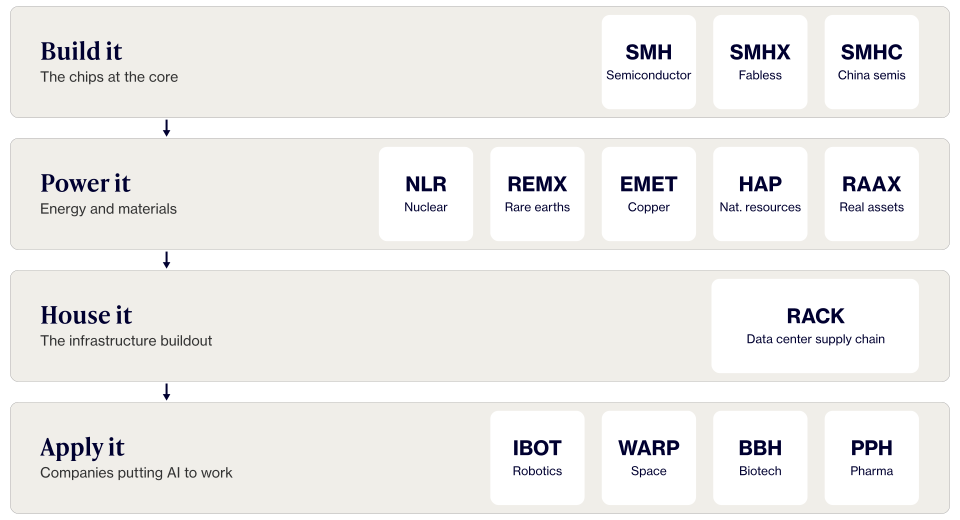
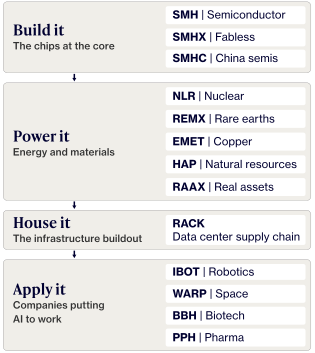
For illustrative purposes only; not a recommendation to buy or sell any security.
Step 1, Build It: The Chips at the Core
Every layer of the AI economy rests on silicon, which is why most investors begin here. The VanEck Semiconductor ETF (SMH) is the anchor, tracking the largest U.S.-listed chip companies across design, manufacturing, and equipment. For a more focused angle, the VanEck Fabless Semiconductor ETF (SMHX) concentrates on the asset-light designers that architect chips without owning the foundries.
The numbers behind this link are striking. Gartner reports that AI processors generated more than $200 billion in revenue in 2025, nearly a third of all semiconductor sales, and projects AI chips will exceed half the total market by 2029 (Gartner, January 2026). Semiconductors are the “picks and shovels” of AI, among the purest investable exposure to its success.
For a geographic angle, the VanEck China Semiconductor ETF (SMHC) offers pure-play exposure to China’s domestic chip industry with no overlap with the U.S.-listed names. Its case is as much geopolitical as financial: China has made chip self-sufficiency a national priority, and U.S. export controls have accelerated rather than slowed the build-out, with roughly $98 billion committed across three phases of its National IC Fund. As a new single-country fund it carries higher risk and suits a specialized satellite role.
Gartner, January 2026
Step 2, Power It: The Energy and Materials Behind the Buildout
Chips run on electricity, and a great deal of it. As data centers multiply, the binding constraint on AI is shifting from compute to power. U.S. data center power demand is set to rise from roughly 50 gigawatts in 2024 to about 134 gigawatts by 2030, nearly tripling (451 Research / S&P Global, September 2025); McKinsey sees data centers climbing from under 4% of U.S. power demand in 2023 to nearly 12% by 2030 (McKinsey & Company, 2024). Renewables alone can’t guarantee round-the-clock supply, which has put nuclear back at the center of the conversation. The VanEck Uranium and Nuclear ETF (NLR) spans the full nuclear value chain, from uranium mining to reactors to utilities, the reliable, zero-carbon baseload power AI infrastructure needs. Hyperscalers have announced roughly 30 gigawatts of nuclear deals in two years (S&P Global, June 2026), from Microsoft’s Three Mile Island restart to commitments from Meta and Amazon.
451 Research/S&P Global projects
U.S. data center power demand is set to nearly triple by 2030
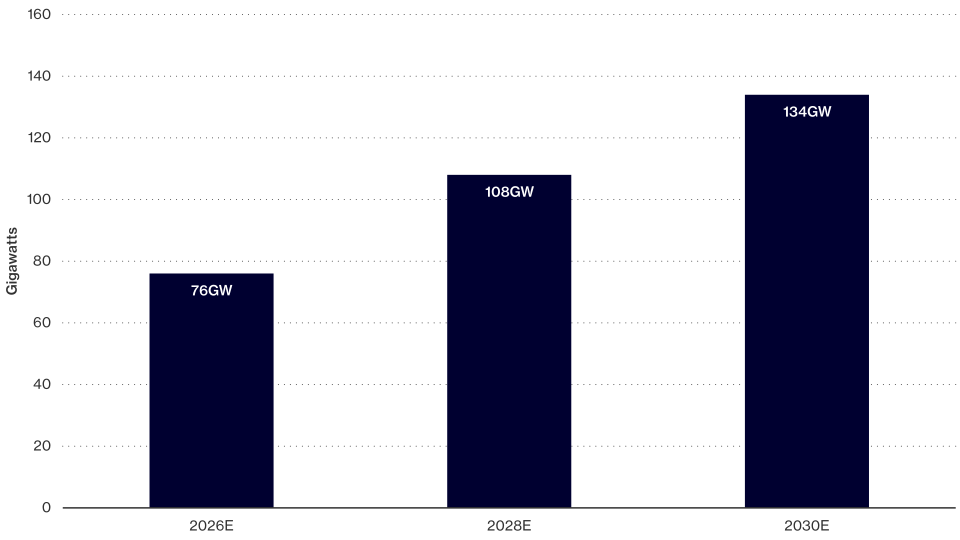
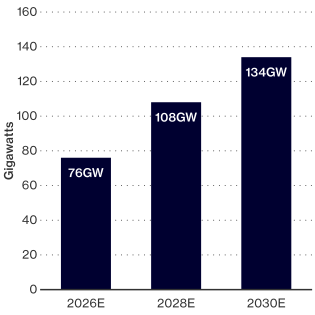
Utility power to hyperscale, leased, and crypto data centers, in gigawatts. Source: S&P Global / 451 Research (Oct 14, 2025)
Electric Power Research Institute (EPRI) / U.S. Department of Energy, 2026
Building all this also takes raw materials. The VanEck Rare Earth and Strategic Metals ETF (REMX) holds producers of the metals essential to AI hardware and defense, while the VanEck Copper and Electrification ETF (EMET) captures copper’s central role in electrification. The power story is bigger than AI alone, with demand also rising across electric transport and heavy industry, so the case doesn’t rest on AI living up to every projection.
For the broadest version of this materials angle, two funds reach wider still: the VanEck Natural Resources ETF (HAP), spanning global producers across energy, metals, agriculture, and renewables, and the VanEck Real Assets ETF (RAAX), which allocates dynamically across commodities, natural-resource equities, gold, REITs, and infrastructure. These sit slightly apart from the pure-play funds above: the AI link is real but diffuse, since the buildout is only one of several forces lifting demand for physical inputs. They’re best understood not as AI funds but as diversified commodity and real-asset exposure that stands to benefit if it keeps pulling.
Step 3, House It: The Infrastructure Buildout
Between the chips and the power sits the physical buildout itself: data centers, cooling systems, networking gear, and grid equipment, where the bottlenecks are most acute. The VanEck Data Center Supply Chain ETF (RACK), launched in 2026, is built for this link, requiring companies to derive at least half their revenue from AI infrastructure and data center development across four areas: semiconductors and quantum; nuclear and power; memory, servers, and equipment; and cooling, storage, and grid modernization. For an investor who believes in the buildout but doesn’t want to pick the winning bottleneck, RACK packages the whole physical supply chain into one diversified vehicle.
Recommended subscription
CreditSights; company filings, 2026
Step 4, Apply It: The Companies Putting AI to Work
At the far end of the chain are the companies that don’t build or power AI, but use it. The clearest example is robotics: the VanEck Robotics ETF (IBOT) tracks robotics, automation, and autonomous systems, where AI is the intelligence behind the machine. The VanEck Space ETF (WARP) reaches into the space, defense, and advanced-technology economy, fields increasingly defined by AI-driven autonomy.
AI’s reach extends into healthcare through the VanEck Biotech ETF (BBH) and VanEck Pharmaceutical ETF (PPH), which hold companies using AI to speed drug discovery and diagnostics. In honesty, these are healthcare funds first, so they round out the applied-AI end of the chain rather than serve as core AI exposure.
Putting the Chain Together
The point isn’t to pick one link and ignore the rest, but to combine them. A common approach is core-and-satellite: the semiconductor funds (SMH, SMHX) as the core, the power and materials funds (NLR, REMX, EMET) as thematic satellites, RACK as a diversified infrastructure holding, and the applied-AI funds (IBOT, WARP, BBH, PPH) as tilts. Because RACK already spans semiconductors, power, and infrastructure, size it deliberately alongside the single-theme funds. For those who’d rather not assemble the pieces, the VanEck Technology TruSector ETF (TRUT) is an actively managed, single-ticker way to own the broad technology complex beneath much of the AI story.
How to Invest in the AI Trade
The AI trade is far wider than the chips that started it. Following the value chain, build it, power it, house it, apply it, reveals a sequence of distinct, investable links, each with a targeted VanEck ETF behind it. Some investors will want just the core; others the chain end to end. Either way the model is the same: AI is an industrial buildout, with more than one place to put capital to work. To explore any of the funds mentioned here, visit the individual fund pages at vaneck.com.
Sources: Data center capital-spending scenarios from McKinsey & Company, “The cost of compute: A $7 trillion race to scale data centers” (April 2025). AI-processor revenue figures from Gartner, Inc. (January 2026). Data center share of U.S. power demand from McKinsey & Company (2024). U.S. data center grid-power demand from 451 Research / S&P Global Market Intelligence, Datacenter Services & Infrastructure Market Monitor & Forecast (September 2025); 2024 figure approximate. Nuclear-deal figures from S&P Global Market Intelligence (June 2026). Hyperscaler capex figures from CreditSights and company filings (2026). China equipment-spending and National integrated circuit (IC) Fund figures from SEMI (2026) and public reporting. Fund strategy descriptions for HAP and RAAX from VanEck fund documentation (2026). All market-size, energy, and capacity figures are projections and estimates, not guarantees.
To receive more Thematic Investing insights, sign up in our subscription center.

Important Disclosures
This is not an offer to buy or sell, or a recommendation to buy or sell any of the securities, financial instruments or digital assets mentioned herein. The information presented does not involve the rendering of personalized investment, financial, legal, tax advice, or any call to action. Certain statements contained herein may constitute projections, forecasts and other forward-looking statements, which do not reflect actual results, are for illustrative purposes only, are valid as of the date of this communication, and are subject to change without notice. Actual future performance of any assets or industries mentioned are unknown. Information provided by third party sources are believed to be reliable and have not been independently verified for accuracy or completeness and cannot be guaranteed. VanEck does not guarantee the accuracy of third party data. The information herein represents the opinion of the author(s), but not necessarily those of VanEck or its other employees.
Fund holdings will vary and are subject to change. For a complete list of holdings, please visit each respective Fund's page.
The principal risks of investing in VanEck ETFs include sector, industry and thematic concentration, market, economic, political, foreign currency, foreign securities, emerging market issuer, depositary receipt, world event, index tracking, passive management, active management, derivatives, commodities and non-diversification risks, as well as fluctuations in net asset value and the risks associated with investing in less developed capital markets. As exchange-traded funds, the Funds are also subject to authorized participant concentration, absence of an active trading market, trading, premium/discount and liquidity of fund shares risks; recently organized Funds are also subject to new fund risk. ETFs with Chinese issuer exposure are further subject to A-Shares, Stock Connect, People’s Republic of China (PRC) tax, currency devaluation, government intervention, expropriation and trade limitation risks; ETFs that invest in real estate investment trusts (REITs) or allocate to other exchange-traded products are additionally subject to real estate, fund of funds, subsidiary investment, commodity regulatory, subsidiary tax, interest rate, credit, high portfolio turnover and gap risks. ETFs that invest in companies with small and medium capitalizations are subject to elevated risks, which include, among others, greater volatility, lower trading volume and less liquidity than larger companies. Please see the prospectus of each Fund for more complete information regarding each Fund’s specific risks.
Investing involves substantial risk and high volatility, including possible loss of principal. An investor should consider the investment objective, risks, charges and expenses of the Fund carefully before investing. To obtain a prospectus and summary prospectus, which contains this and other information, call 800.826.2333 or visit vaneck.com/etfs. Please read the prospectus and summary prospectus carefully before investing.
© Van Eck Securities Corporation, Distributor, a wholly owned subsidiary of Van Eck Associates Corporation.
Related Funds
Important Disclosures
This is not an offer to buy or sell, or a recommendation to buy or sell any of the securities, financial instruments or digital assets mentioned herein. The information presented does not involve the rendering of personalized investment, financial, legal, tax advice, or any call to action. Certain statements contained herein may constitute projections, forecasts and other forward-looking statements, which do not reflect actual results, are for illustrative purposes only, are valid as of the date of this communication, and are subject to change without notice. Actual future performance of any assets or industries mentioned are unknown. Information provided by third party sources are believed to be reliable and have not been independently verified for accuracy or completeness and cannot be guaranteed. VanEck does not guarantee the accuracy of third party data. The information herein represents the opinion of the author(s), but not necessarily those of VanEck or its other employees.
Fund holdings will vary and are subject to change. For a complete list of holdings, please visit each respective Fund's page.
The principal risks of investing in VanEck ETFs include sector, industry and thematic concentration, market, economic, political, foreign currency, foreign securities, emerging market issuer, depositary receipt, world event, index tracking, passive management, active management, derivatives, commodities and non-diversification risks, as well as fluctuations in net asset value and the risks associated with investing in less developed capital markets. As exchange-traded funds, the Funds are also subject to authorized participant concentration, absence of an active trading market, trading, premium/discount and liquidity of fund shares risks; recently organized Funds are also subject to new fund risk. ETFs with Chinese issuer exposure are further subject to A-Shares, Stock Connect, People’s Republic of China (PRC) tax, currency devaluation, government intervention, expropriation and trade limitation risks; ETFs that invest in real estate investment trusts (REITs) or allocate to other exchange-traded products are additionally subject to real estate, fund of funds, subsidiary investment, commodity regulatory, subsidiary tax, interest rate, credit, high portfolio turnover and gap risks. ETFs that invest in companies with small and medium capitalizations are subject to elevated risks, which include, among others, greater volatility, lower trading volume and less liquidity than larger companies. Please see the prospectus of each Fund for more complete information regarding each Fund’s specific risks.
Investing involves substantial risk and high volatility, including possible loss of principal. An investor should consider the investment objective, risks, charges and expenses of the Fund carefully before investing. To obtain a prospectus and summary prospectus, which contains this and other information, call 800.826.2333 or visit vaneck.com/etfs. Please read the prospectus and summary prospectus carefully before investing.
© Van Eck Securities Corporation, Distributor, a wholly owned subsidiary of Van Eck Associates Corporation.