Is AI a Bubble? The Dot-Com Bubble vs. Today’s AI Revolution
October 15, 2025
Read Time 7 MIN
Key Takeaways:
- Today’s AI surge is built on real profits and infrastructure, not speculation.
- Semiconductor demand spans GPUs, memory, and design tools, driving sustained growth.
- SMH and SMHX offer investors exposure to both AI hardware build-out and chip design innovation.
The Rise of AI Companies
Artificial intelligence is driving one of the most significant infrastructure build-outs in modern history. Unlike the dot-com boom of the late 1990s, today’s AI expansion is being led by profitable global companies deploying existing cash flow. Additionally, OpenAI’s partnerships with NVIDIA, AMD, Intel, and Oracle highlight how critical computing power has become as AI moves from experimentation to commercial applications. While outcomes remain uncertain, the current environment suggests that semiconductors may continue to play a central role in this evolving technological era. For investors, VanEck’s Semiconductor ETF (SMH) and VanEck’s Fabless Semiconductor ETF (SMHX) offer two distinct ways to access the ecosystem behind this compute build-out.
Artificial intelligence has become what Morningstar calls a “generational demand driver” across the semiconductor value chain. Demand is rising not just for GPUs but also for the networking, memory, and design software that support them, underscoring how pervasive this build-out has become.
AI “Bubble” vs. Dot-Com Bubble Breakdown
The late 1990s were defined by startups chasing growth with limited revenue and easy access to capital. Today’s AI expansion looks very different. The world’s largest technology companies are reinvesting substantial free cash flow into physical infrastructure because they view AI as essential to their long-term competitiveness.
Amazon anticipates approximately $100 billion in capital expenditures for 2025, with a significant portion allocated to cloud and AI. Microsoft plans to invest about $80 billion, Alphabet has raised its target to $85 billion, and Meta anticipates investing between $66 billion and $72 billion. These are balance-sheet decisions, not speculative ventures.
Hyperscaler Planned Spend Through 2025
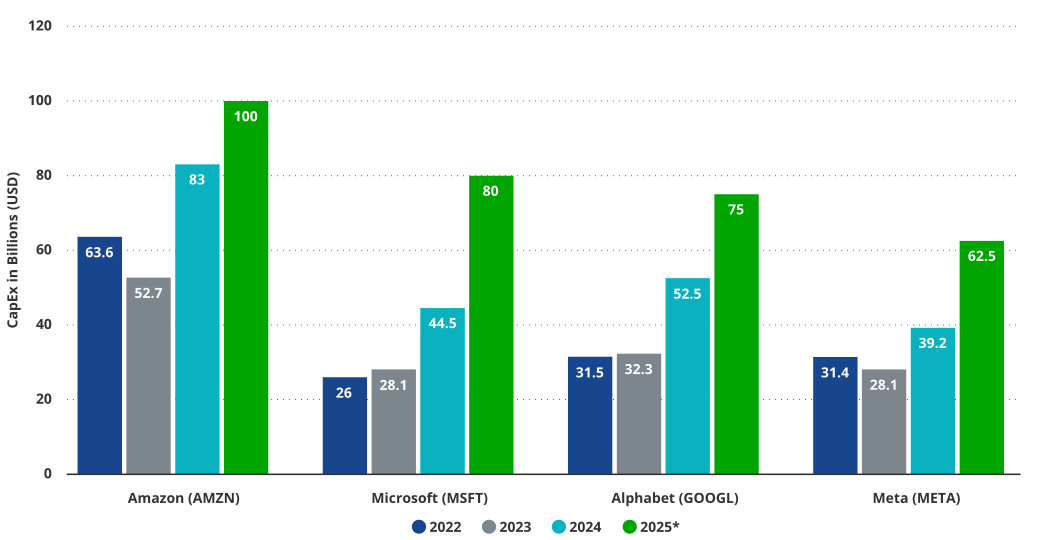
* Company’s anticipated capital expenditures for 2025.
Source: Amazon, Microsoft, Alphabet, Meta as of 2025. Not intended as a recommendation to buy or sell any securities referenced herein. For illustrative purposes only. Past performance is no guarantee of future results.
Industry data show that semiconductor firms reinvest roughly 60% of their distributable capital in R&D and capacity expansion, a level that has doubled over the past eight years, with an annualized growth rate of nearly 10%. That suggests today’s capex is being fueled mostly by profits and innovation, not by speculative financing.
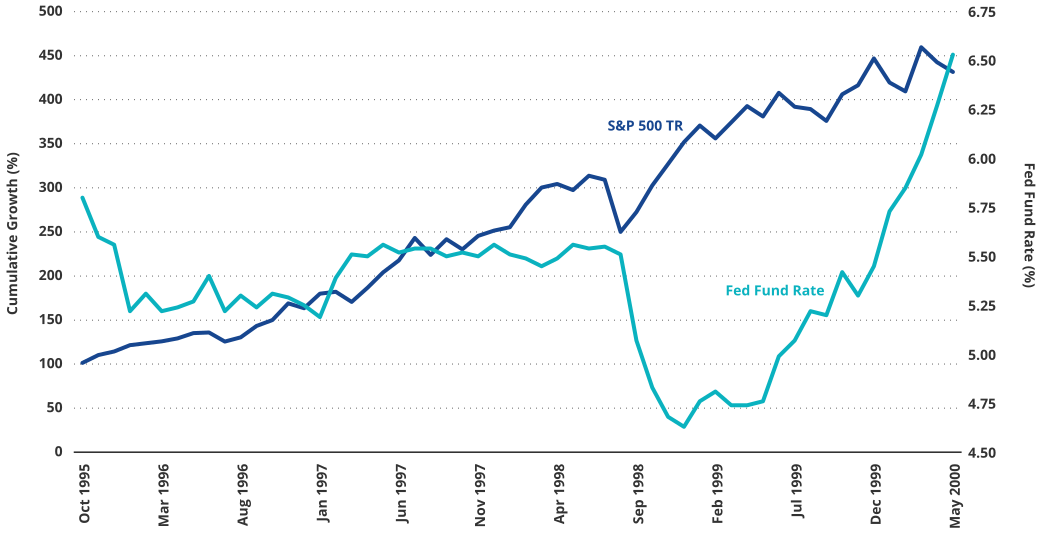
The macro backdrop is also distinct. In 2000, the Federal Reserve was tightening policy to rein in an overheating economy. As of September 2025, the Fed’s target range is 4.00 to 4.25 percent, reflecting a shift toward easing. While monetary policy could shift again, the present environment is more supportive of long-term capital investment than it was during the dot-com era.
S&P 500 Returns vs. Federal Interest Rates in the Dot-Com Bubble
Source: Morningstar, FRED® as of 10.9.2025. Past performance is no guarantee of future results.
The New Race for AI computing Power
OpenAI sits at the center of the current AI infrastructure race. Its agreements across the semiconductor ecosystem underscore how competitive and strategic access to compute power has become.
With NVIDIA, OpenAI signed a letter of intent to deploy at least 10 gigawatts of systems beginning in 2026. NVIDIA has indicated plans to invest up to $100 billion in OpenAI as that deployment progresses. OpenAI also reached a definitive agreement with AMD to purchase 6 gigawatts of hardware over several years, including a warrant for up to 160 million AMD shares tied to deployment milestones.
Beyond GPUs, OpenAI is expanding its compute footprint through Oracle Cloud Infrastructure alongside Microsoft’s Azure. Oracle’s participation includes the development of new multi-gigawatt “Stargate” data center campuses across the United States. Meanwhile, NVIDIA and Intel have partnered to address ongoing packaging bottlenecks, with Intel expected to assist in advanced packaging and assembly.
AI Circular Deals
| Partnership | Announced / Updated | Scope / Capacity | Timing | Strategic Rationale |
| OpenAI ↔ NVIDIA | Sep-25 | LOI for ≥10 GW of NVIDIA systems; up to $100B investment | 3rd Qtr. 2026 start | Secures GPU supply and deepens alignment |
| OpenAI ↔ AMD | Oct-25 | 6 GW GPU deal; warrant for up to 160M AMD shares | 3rd Qtr 2026 start | Adds second source and supply diversity |
| OpenAI ↔ Oracle (w/ Microsoft) | 2025 | Azure AI extended to OCI; five “Stargate” sites (~10 GW) | 2025–2027 | Expands compute footprint and redundancy |
| NVIDIA ↔ Intel | 2025 | Collaboration on advanced packaging; $5B NVDA investment | 2025 onward | Eases packaging bottlenecks at TSMC |
Not intended as a recommendation to buy or sell any securities referenced herein. For illustrative purposes only. Past performance is no guarantee of future results.
Recommended subscription
Forecasts from the U.S. Department of Energy and McKinsey indicate that cloud and hyperscaler capital spending could exceed $450 billion by 2027, up from roughly $150 billion in 2023. Those figures illustrate the sheer scale of infrastructure investment now underway to support AI demand.
The Bottlenecks Ahead
Despite this wave of spending, capacity remains limited in key areas. TSMC’s advanced packaging process, for example, is expected to reach around 75,000 wafers per month in 2025, yet that may still fall short of global demand. The supply of high-bandwidth memory (HBM) is also tight, as SK Hynix, Samsung, and Micron work to improve yields on the latest HBM3E technology.
According to data from Gartner, HBM represented roughly 17–20% of DRAM (Dynamic Random Access Memory) demand in 2024 and could reach nearly 50% by 2029, with suppliers expected to more than double capacity in 2025. Advanced packaging is also emerging as a key enabler of AI performance, expected to grow around 8% annually this decade as chip designers adopt chiplet and 3D stacking techniques.
Power and cooling constraints present another challenge. The development of multi-gigawatt data center campuses depends on local grid expansion, permitting, and environmental planning—factors that can delay or cap the pace of deployment.
From Build-Out to Scale-Out
For investors, these developments highlight two complementary parts of the semiconductor landscape.
SMH represents the companies responsible for building the physical backbone of AI. It tracks the MVIS US Listed Semiconductor 25 Index, which is composed of large, liquid semiconductor and equipment companies that generate at least half of their revenue from the industry. These are the companies that produce the chips, tools, and systems that enable the world’s compute expansion.
SMHX captures the fabless innovators driving AI’s scale-out. It tracks the MarketVector US Listed Fabless Semiconductor Index, which includes chip designers creating architectures and connectivity solutions aimed at improving efficiency and overcoming memory and power constraints.
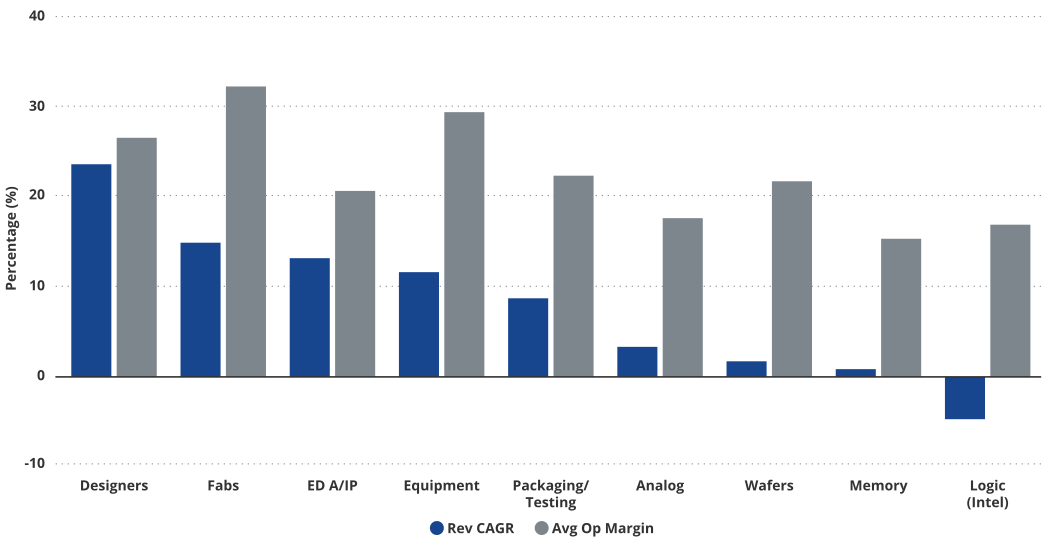
Beyond manufacturing, design-led innovation remains critical. Fabless chip designers, EDA software firms, and IP licensors have delivered some of the strongest growth and margin expansion in recent years—a dynamic that directly connects to SMHX’s focus on the fabless, innovation-driven segment of the market.
Designers Have Best Growth; Designers, TSMC, Equipment Have Great Margins
Historical revenue CAGR and average operating margins from 2018 to 2014.
Source: Morningstar as of 2025. Not intended as a recommendation to buy or sell any securities referenced herein. For illustrative purposes only. Past performance is no guarantee of future results.
Together, these two funds provide diversified exposure across the semiconductor value chain. SMH reflects the structural build-out of manufacturing and infrastructure, while SMHX focuses on the design-side innovation that helps AI systems run faster and more efficiently.
Bubble or Structural Transformation in Motion?
Every major technological shift begins with years of foundational investment. Railroads, electrification, and the rise of the internet all followed this path, with infrastructure build-outs paving the way for future productivity gains. The current expansion of AI compute infrastructure may represent a similar phase in technological progress.
According to projections from the U.S. Department of Energy and McKinsey, AI-driven data center power demand is compounding at 22% to 33% annually, far outpacing historical energy-use growth. This reflects how the AI revolution extends well beyond semiconductors—it is transforming the physical infrastructure of compute itself.
While no one can predict how this will ultimately unfold, the magnitude and composition of current spending point to a longer-term structural trend rather than short-lived speculation. The semiconductor industry sits at the center of this transformation.
SMH offers a way to participate in the broader infrastructure build-out, while SMHX focuses on enabling designers and innovators to scale AI. Together, they provide diversified access to the companies shaping what may prove to be one of the most important technology transitions of our lifetime.
To receive more Thematic Investing insights, sign up in our subscription center.

Important Disclosure
This is not an offer to buy or sell, or a recommendation to buy or sell any of the securities, financial instruments or digital assets mentioned herein. The information presented does not involve the rendering of personalized investment, financial, legal, tax advice, or any call to action. Certain statements contained herein may constitute projections, forecasts and other forward-looking statements, which do not reflect actual results, are for illustrative purposes only, are valid as of the date of this communication, and are subject to change without notice. Actual future performance of any assets or industries mentioned are unknown. Information provided by third party sources are believed to be reliable and have not been independently verified for accuracy or completeness and cannot be guaranteed. VanEck does not guarantee the accuracy of third party data. The information herein represents the opinion of the author(s), but not necessarily those of VanEck or its other employees.
Index returns are not Fund returns and do not reflect any management fees or brokerage expenses. Past performance is no guarantee of future results. Certain indices may take into account withholding taxes. Investors can not invest directly in the Index. Returns for actual Fund investors may differ from what is shown because of differences in timing, the amount invested and fees and expenses. Index returns assume that dividends have been reinvested.
VanEck Semiconductor ETF (SMH®) seeks to replicate as closely as possible, before fees and expenses, the price and yield performance of the MVIS® US Listed Semiconductor 25 Index (MVSMHTR), which is intended to track the overall performance of companies involved in semiconductor production and equipment.
VanEck® Fabless Semiconductor ETF (the “Fund”) seeks to track as closely as possible, before fees and expenses, the price and yield performance of the MarketVector™ US Listed Fabless Semiconductor Index (the “Fabless Index” or the “Index”), which is intended to track the overall performance of companies involved in semiconductor production and classified as a fabless.
An investment in the Fund may be subject to risks which include, but are not limited to, special risk considerations of investing in Vietnamese issuers, foreign securities, emerging and frontier market issuers, foreign currency, depositary receipts, real estate sector, consumer staples sector, financials sector, basic materials sector, industrials sector, micro-,small- and medium-capitalization companies, cash transactions, equity securities, market, operational, index tracking, authorized participant concentration, no guarantee of active trading market, trading issues, passive management, fund shares trading, premium/discount, liquidity of fund shares, issuer-specific changes, non-diversified and index-related concentration risks, all of which may adversely affect the Fund. Emerging and frontier market issuers and foreign securities may be subject to securities markets, political and economic, investment and repatriation restrictions, different rules and regulations, less publicly available financial information, foreign currency and exchange rates, operational and settlement, and corporate and securities laws risks. Micro-, small- and medium-capitalization companies may be subject to elevated risks.
Investing involves substantial risk and high volatility, including possible loss of principal. An investor should consider the investment objective, risks, charges and expenses of the Fund carefully before investing. To obtain a prospectus and summary prospectus, which contains this and other information, call 800.826.2333 or visit vaneck.com/etfs. Please read the prospectus and summary prospectus carefully before investing.
© Van Eck Securities Corporation, Distributor, a wholly owned subsidiary of Van Eck Associates Corporation.
666 Third Avenue | New York, NY 10017
Related Funds
Important Disclosure
This is not an offer to buy or sell, or a recommendation to buy or sell any of the securities, financial instruments or digital assets mentioned herein. The information presented does not involve the rendering of personalized investment, financial, legal, tax advice, or any call to action. Certain statements contained herein may constitute projections, forecasts and other forward-looking statements, which do not reflect actual results, are for illustrative purposes only, are valid as of the date of this communication, and are subject to change without notice. Actual future performance of any assets or industries mentioned are unknown. Information provided by third party sources are believed to be reliable and have not been independently verified for accuracy or completeness and cannot be guaranteed. VanEck does not guarantee the accuracy of third party data. The information herein represents the opinion of the author(s), but not necessarily those of VanEck or its other employees.
Index returns are not Fund returns and do not reflect any management fees or brokerage expenses. Past performance is no guarantee of future results. Certain indices may take into account withholding taxes. Investors can not invest directly in the Index. Returns for actual Fund investors may differ from what is shown because of differences in timing, the amount invested and fees and expenses. Index returns assume that dividends have been reinvested.
VanEck Semiconductor ETF (SMH®) seeks to replicate as closely as possible, before fees and expenses, the price and yield performance of the MVIS® US Listed Semiconductor 25 Index (MVSMHTR), which is intended to track the overall performance of companies involved in semiconductor production and equipment.
VanEck® Fabless Semiconductor ETF (the “Fund”) seeks to track as closely as possible, before fees and expenses, the price and yield performance of the MarketVector™ US Listed Fabless Semiconductor Index (the “Fabless Index” or the “Index”), which is intended to track the overall performance of companies involved in semiconductor production and classified as a fabless.
An investment in the Fund may be subject to risks which include, but are not limited to, special risk considerations of investing in Vietnamese issuers, foreign securities, emerging and frontier market issuers, foreign currency, depositary receipts, real estate sector, consumer staples sector, financials sector, basic materials sector, industrials sector, micro-,small- and medium-capitalization companies, cash transactions, equity securities, market, operational, index tracking, authorized participant concentration, no guarantee of active trading market, trading issues, passive management, fund shares trading, premium/discount, liquidity of fund shares, issuer-specific changes, non-diversified and index-related concentration risks, all of which may adversely affect the Fund. Emerging and frontier market issuers and foreign securities may be subject to securities markets, political and economic, investment and repatriation restrictions, different rules and regulations, less publicly available financial information, foreign currency and exchange rates, operational and settlement, and corporate and securities laws risks. Micro-, small- and medium-capitalization companies may be subject to elevated risks.
Investing involves substantial risk and high volatility, including possible loss of principal. An investor should consider the investment objective, risks, charges and expenses of the Fund carefully before investing. To obtain a prospectus and summary prospectus, which contains this and other information, call 800.826.2333 or visit vaneck.com/etfs. Please read the prospectus and summary prospectus carefully before investing.
© Van Eck Securities Corporation, Distributor, a wholly owned subsidiary of Van Eck Associates Corporation.
666 Third Avenue | New York, NY 10017