Private Market Access Without the Hassle
August 01, 2025
Read Time 4 MIN
Key Takeaways
- Private market growth has quadrupled in the last ten years as investors look beyond traditional markets in search of high income. Private credit with a focus on direct lending to middle market companies underserved by traditional banks is leading this trend.
- Historically, investors have faced obstacles when trying to access the private credit space, but ETFs such as BIZD and GPZ can offer convenient exposure without the hassle allowing retail investors access to the space.
- The VanEck BDC ETF BIZD, offers liquid access to middle‑market private credit, letting retail investors tap into higher‑yield income opportunities without the typical complexity, lock‑ups, or direct lending arrangements.
- The VanEck Alternative Asset Manager ETF GPZ provides exposure to leading public alternative asset managers, allowing investors access to the growth of firms that structure and manage private market capital across equity, credit, infrastructure, and real estate.
Private markets are growing rapidly. Just ten years ago, they represented around $4 trillion in assets. Today that number has grown to about $15 trillion and industry estimates maintain that pace of growth into the next decade.1 This expansion reflects a major shift in how investors are seeking returns, as many look beyond traditional public markets in search of better income, diversification, and long-term growth.
But while private markets offer attractive opportunities, they are not always easy to access. High investment minimums, long lockup periods, and complex structures often stand in the way. However, at VanEck we have aimed to change that with ETF offerings that provide simple and liquid exposure to two important parts of the private market landscape.
Private Credit Exposure Made Simple
One of the fastest growing corners of private markets is private credit, particularly direct lending to middle market companies. These firms often fall outside the scope of traditional bank lending but still require capital for growth, acquisitions, and operational improvements. Historically, investors have faced various obstacles when trying to access this space directly, from minimum investment requirements to complex fund structures with limited transparency and liquidity.
VanEck’s BDC Income ETF (BIZD) offers simple and efficient access to this market by investing in a portfolio of publicly traded business development companies (BDCs). BDCs are specialized investment companies that provide loans directly to middle market businesses. By investing in BDCs, BIZD delivers diversified exposure to the underlying loan portfolios of these development companies, but with daily liquidity, transparency, and ease of access typically associated with ETFs. This diversified approach also helps reduce the impact of performance differences among individual BDCs, which can vary based on their asset mix, sector exposure, financing terms, and management quality.
BIZD | VanEck BDC Income ETF
One of the primary benefits of private credit is its income potential, and BIZD offers investors a way to tap into that. Loans originated by BDCs often carry higher yields than traditional fixed income investments, helping enhance portfolio income generation.
BDCs Offer High Income Potential | As of June 30, 2025

Source: FactSet. BDCs represented by MVIS US Business Development Companies Index; U.S. HY Bonds represented by ICE BofAML US High Yield Index; REITs represented by FTSE NAREIT Equity REITs Index; Utilities represented by Standard & Poor’s 500 Utilities Index; U.S. Stocks represented by Standard & Poor’s 500 Index; U.S. IG Bonds represented by Bloomberg Barclays Capital US Aggregate Bond Index; U.S. 10 Yr Treasury represented by ICE BofAML Current 10-Year US Treasury Index.
Most BDC loans are also floating rate, allowing them to adjust with interest rate movements and remain attractive in a higher-for-longer rate environment. This floating rate structure also provides diversification benefits when paired with traditional core bond holdings, which typically have fixed coupons and greater duration risk.
Overall, BIZD serves as an effective tool for investors looking to participate in the income opportunities associated with private credit without the barriers to entry of traditional direct private credit investments.
Investing in the Firms Powering Private Markets
Another way to tap into the growth of private markets is by investing in the companies that operate and manage the funds behind it. These are alternative asset managers, firms that oversee capital across private credit, private equity, real estate, infrastructure, and venture capital. As the organizations sourcing deals, structuring loans, and allocating private capital, they are positioned to benefit directly from the increasing demand for private market solutions.
Recommended subscription
While alternative asset managers have been around for a while, the role these firms play in the market is evolving. As demand for private credit and other private market strategies grows, these companies are expanding their business models. Many are reaching beyond institutional capital and into wealth management and retirement channels, broadening their investor base and solidifying their importance in today’s investment landscape. With access to long-term capital and resilient fee structures, they are well positioned to benefit from the continued shift toward private markets.
To help investors access this opportunity, VanEck introduced the Alternative Asset Manager ETF (GPZ), designed to offer access to the public equities of leading private asset managers like Blackstone, KKR and others. Through these firms, GPZ captures a broad spectrum of alternative asset management businesses, providing exposure to the growth taking place across the various private market categories.
Asset Exposure of Underlying Management Firm AUM | As of June 30, 2025
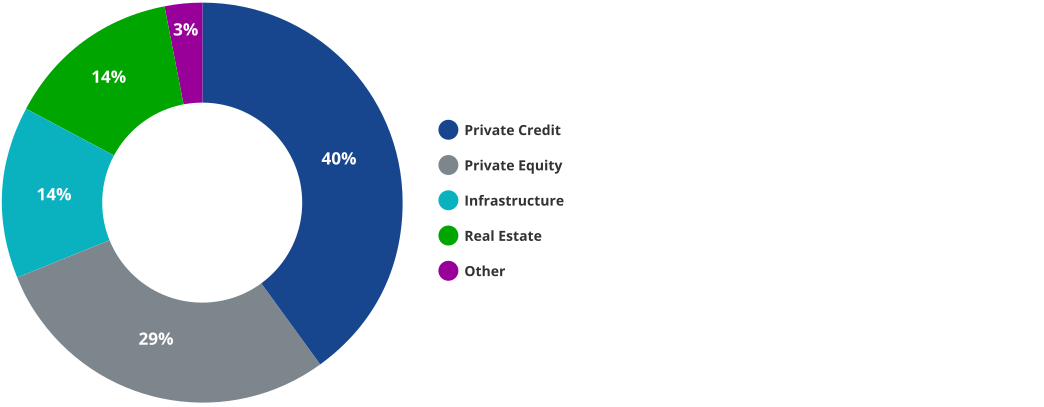
Source: Individual company filings and reports. Alternative management firm asset exposure is based on an aggregate weighted average calculation of constituents in the MarketVector Alternative Asset Managers Index.
GPZ | VanEck Alternative Asset Manager ETF
With GPZ, investors can efficiently invest in the equity of firms driving growth across the private market ecosystem, gaining diversified exposure in a single, convenient ETF.
Exposure Made Practical
The appeal of private market investments has traditionally come with significant hurdles and complexity. BIZD and GPZ address these challenges, offering investors straightforward access to two distinct yet complementary areas of the alternative investment universe: middle market private credit and the asset managers leading the industry.
In an era where private markets are increasingly becoming part of investor portfolios, VanEck’s BIZD and GPZ ETFs present investors with access to the opportunity and benefits of these markets without the traditional hassles.
To receive more Thematic Investing insights, sign up in our subscription center.

Important Disclosures
1 Source: Preqin; Partners Group. Past or projected data does not guarantee future results and is for illustrative purposes only.
MVIS US Business Development Companies Index is a rules-based index intended to track the overall performance of Business Development Companies (BDC).
Standard & Poor’s 500 Index, calculated with dividends reinvested, consists of 500 widely held common stocks covering the industrial, utility, financial and transportation sectors.
FTSE NAREIT Equity REITs Index is a broad-based, free-float adjusted market capitalization weighted index consisting of equity real estate investment trusts.
Standard & Poor’s 500 Utilities Index comprises those companies included in the S&P 500 that are classified as members of the GICS® utilities sector.
ICE BofAML US High Yield Index tracks the performance of U.S. dollar-denominated below investment grade corporate debt publically issued in the U.S. domestic market. Qualifying securities must have a below investment grade rating.
Bloomberg Barclays Capital US Aggregate Bond Index is a broad-based benchmark that measures the investment grade, U.S. dollar-denominated, fixed-rate taxable bond market, including Treasuries, government-related and corporate securities, mortgage-backed securities, asset-backed securities, commercial mortgage-backed securities.
ICE BofAML Current 10-Year US Treasury Index is a one-security index comprised of the most recently issued 10-year U.S. Treasury bond. To qualify for the inclusion, the 10-year bond must be auctioned on or before the third business day before the last business day of the month.
This is not an offer to buy or sell, or a recommendation to buy or sell any of the securities/financial instruments mentioned herein. The information presented does not involve the rendering of personalized investment, financial, legal, or tax advice. Certain statements contained herein may constitute projections, forecasts and other forward looking statements, which do not reflect actual results, are valid as of the date of this communication and subject to change without notice. Information provided by third party sources are believed to be reliable and have not been independently verified for accuracy or completeness and cannot be guaranteed. VanEck does not guarantee the accuracy of third party data. The information herein represents the opinion of the author(s), but not necessarily those of VanEck or its employees.
An investment in VanEck Alternative Asset Manager ETF may be subject to risks which include, among others, risks related to investing in alternative asset managers, issuer-specific changes, financials sector, equity securities, small-, medium and large-capitalization companies, depositary receipts, special risk considerations of investing in Canadian and European issuers, foreign securities, foreign currency, market, operational, index tracking, authorized participant concentration, new fund, no guarantee of active trading market, trading issues, passive management, fund shares trading, premium/discount, liquidity of fund shares, non-diversified and index-related concentration risks, all of which may adversely affect the Fund. Investing in listed alternative asset managers may be speculative and involve substantial risks, including leverage, liquidity, significant volatility, operational complexity, valuation, limited public information, and the risk of borrower default or bankruptcy. Small, medium and large-capitalization companies may be subject to elevated risks.
Business Development Companies (BDCs) generally invest in less mature U.S. private companies or thinly traded U.S. public companies which involve greater risk than well-established publicly-traded companies. While the BDCs that comprise the Index are expected to generate income in the form of dividends, certain BDCs during certain periods of time may not generate such income. Twill indirectly bear its proportionate share of any management fees and other operating expenses incurred by the BDCs and of any performance-based or incentive fees payable by the BDCs in which it invests, in addition to the expenses paid by the Fund. A BDC’s incentive fee may be very high, vary from year to year and be payable even if the value of the BDC’s portfolio declines in a given time period. Incentive fees may create an incentive for a BDC’s manager to make investments that are risky or more speculative than would be the case in the absence of such compensation arrangements, and may also encourage the BDC’s manager to use leverage to increase the return on the BDC’s investments. The use of leverage by BDCs magnifies gains and losses on amounts invested and increases the risks associated with investing in BDCs. A BDC may make investments with a larger amount of risk of volatility and loss of principal than other investment options and may also be highly speculative and aggressive. The Fund and its affiliates may not own in excess of 25% of a BDC's outstanding voting securities which may limit the Fund's ability to fully replicate its index. An investment in the Fund may be subject to risks which include, among others, investing in BDCs, investment restrictions, financial sector, small- and medium-capitalization companies, equity securities, derivatives, derivatives counterparty, liquidity risk related to swap agreements, floating rate risk for BDCs, market, operational, regulatory, index tracking, authorized participant concentration, no guarantee of active trading market, trading issues, passive management, fund shares trading, premium/discount and liquidity of fund shares, issuer-specific changes, and index-related concentration risks, all of which may adversely affect the fund. Small- and medium-capitalization companies may be subject to elevated risks.
MarketVector Alternative Asset Managers Index is the exclusive property of MarketVector Indexes GmbH (a wholly owned subsidiary of Van Eck Securities Corporation), which has contracted with Solactive AG to maintain and calculate the Index. Solactive AG uses its best efforts to ensure that the Index is calculated correctly. Irrespective of its obligations towards MarketVector Indexes GmbH, Solactive AG has no obligation to point out errors in the Index to third parties. The VanEck Alternative Asset Manager ETF is not sponsored, endorsed, sold or promoted by MarketVector Indexes GmbH and MarketVector Indexes GmbH makes no representation regarding the advisability of investing in the Fund.
Investing involves substantial risk and high volatility, including possible loss of principal. An investor should consider a Fund's investment objective, risks, charges and expenses carefully before investing. To obtain a prospectus and summary prospectus for VanEck Funds and VanEck ETFs, which contain this and other information, call 800.826.2333 or visit vaneck.com. Please read the prospectus and summary prospectus for VanEck Funds and VanEck ETFs carefully before investing.
© Van Eck Securities Corporation, Distributor, a wholly owned subsidiary of Van Eck Associates Corporation.
Related Funds
Important Disclosures
1 Source: Preqin; Partners Group. Past or projected data does not guarantee future results and is for illustrative purposes only.
MVIS US Business Development Companies Index is a rules-based index intended to track the overall performance of Business Development Companies (BDC).
Standard & Poor’s 500 Index, calculated with dividends reinvested, consists of 500 widely held common stocks covering the industrial, utility, financial and transportation sectors.
FTSE NAREIT Equity REITs Index is a broad-based, free-float adjusted market capitalization weighted index consisting of equity real estate investment trusts.
Standard & Poor’s 500 Utilities Index comprises those companies included in the S&P 500 that are classified as members of the GICS® utilities sector.
ICE BofAML US High Yield Index tracks the performance of U.S. dollar-denominated below investment grade corporate debt publically issued in the U.S. domestic market. Qualifying securities must have a below investment grade rating.
Bloomberg Barclays Capital US Aggregate Bond Index is a broad-based benchmark that measures the investment grade, U.S. dollar-denominated, fixed-rate taxable bond market, including Treasuries, government-related and corporate securities, mortgage-backed securities, asset-backed securities, commercial mortgage-backed securities.
ICE BofAML Current 10-Year US Treasury Index is a one-security index comprised of the most recently issued 10-year U.S. Treasury bond. To qualify for the inclusion, the 10-year bond must be auctioned on or before the third business day before the last business day of the month.
This is not an offer to buy or sell, or a recommendation to buy or sell any of the securities/financial instruments mentioned herein. The information presented does not involve the rendering of personalized investment, financial, legal, or tax advice. Certain statements contained herein may constitute projections, forecasts and other forward looking statements, which do not reflect actual results, are valid as of the date of this communication and subject to change without notice. Information provided by third party sources are believed to be reliable and have not been independently verified for accuracy or completeness and cannot be guaranteed. VanEck does not guarantee the accuracy of third party data. The information herein represents the opinion of the author(s), but not necessarily those of VanEck or its employees.
An investment in VanEck Alternative Asset Manager ETF may be subject to risks which include, among others, risks related to investing in alternative asset managers, issuer-specific changes, financials sector, equity securities, small-, medium and large-capitalization companies, depositary receipts, special risk considerations of investing in Canadian and European issuers, foreign securities, foreign currency, market, operational, index tracking, authorized participant concentration, new fund, no guarantee of active trading market, trading issues, passive management, fund shares trading, premium/discount, liquidity of fund shares, non-diversified and index-related concentration risks, all of which may adversely affect the Fund. Investing in listed alternative asset managers may be speculative and involve substantial risks, including leverage, liquidity, significant volatility, operational complexity, valuation, limited public information, and the risk of borrower default or bankruptcy. Small, medium and large-capitalization companies may be subject to elevated risks.
Business Development Companies (BDCs) generally invest in less mature U.S. private companies or thinly traded U.S. public companies which involve greater risk than well-established publicly-traded companies. While the BDCs that comprise the Index are expected to generate income in the form of dividends, certain BDCs during certain periods of time may not generate such income. Twill indirectly bear its proportionate share of any management fees and other operating expenses incurred by the BDCs and of any performance-based or incentive fees payable by the BDCs in which it invests, in addition to the expenses paid by the Fund. A BDC’s incentive fee may be very high, vary from year to year and be payable even if the value of the BDC’s portfolio declines in a given time period. Incentive fees may create an incentive for a BDC’s manager to make investments that are risky or more speculative than would be the case in the absence of such compensation arrangements, and may also encourage the BDC’s manager to use leverage to increase the return on the BDC’s investments. The use of leverage by BDCs magnifies gains and losses on amounts invested and increases the risks associated with investing in BDCs. A BDC may make investments with a larger amount of risk of volatility and loss of principal than other investment options and may also be highly speculative and aggressive. The Fund and its affiliates may not own in excess of 25% of a BDC's outstanding voting securities which may limit the Fund's ability to fully replicate its index. An investment in the Fund may be subject to risks which include, among others, investing in BDCs, investment restrictions, financial sector, small- and medium-capitalization companies, equity securities, derivatives, derivatives counterparty, liquidity risk related to swap agreements, floating rate risk for BDCs, market, operational, regulatory, index tracking, authorized participant concentration, no guarantee of active trading market, trading issues, passive management, fund shares trading, premium/discount and liquidity of fund shares, issuer-specific changes, and index-related concentration risks, all of which may adversely affect the fund. Small- and medium-capitalization companies may be subject to elevated risks.
MarketVector Alternative Asset Managers Index is the exclusive property of MarketVector Indexes GmbH (a wholly owned subsidiary of Van Eck Securities Corporation), which has contracted with Solactive AG to maintain and calculate the Index. Solactive AG uses its best efforts to ensure that the Index is calculated correctly. Irrespective of its obligations towards MarketVector Indexes GmbH, Solactive AG has no obligation to point out errors in the Index to third parties. The VanEck Alternative Asset Manager ETF is not sponsored, endorsed, sold or promoted by MarketVector Indexes GmbH and MarketVector Indexes GmbH makes no representation regarding the advisability of investing in the Fund.
Investing involves substantial risk and high volatility, including possible loss of principal. An investor should consider a Fund's investment objective, risks, charges and expenses carefully before investing. To obtain a prospectus and summary prospectus for VanEck Funds and VanEck ETFs, which contain this and other information, call 800.826.2333 or visit vaneck.com. Please read the prospectus and summary prospectus for VanEck Funds and VanEck ETFs carefully before investing.
© Van Eck Securities Corporation, Distributor, a wholly owned subsidiary of Van Eck Associates Corporation.