Gold Price & Investment Outlook: 2026 & Beyond
February 27, 2026
Read Time 10+ MIN
Key Takeaways:
- Gold’s bull market remains intact despite volatility, with record highs driven by global uncertainty.
- Inflation, de-dollarization and central bank demand are structurally supporting gold prices.
- Gold and gold equities offer diversification, crisis resilience and long-term upside potential.
The information, valuation scenarios and price targets presented on gold in this blog are not intended as financial advice, a recommendation to buy or sell gold, or any call to action. There may be risks or other factors not accounted for in these scenarios that may impede the performance of gold; its actual future performance is unknown, and may differ significantly from any valuation scenarios or projections/forecasts herein. Any projections, forecasts or forward-looking statements included herein are the results of a simulation based on our research, are valid as of the date of this communication and subject to change without notice, and are for illustrative purposes only. Please conduct your own research and draw your own conclusions.
Gold is one of the most vital metals in the world and a unique asset, with the ability to enhance portfolio diversification, act as store of value, and hedge against systemic risk. VanEck has long been considered a leader in gold-related investments and has been managing gold funds since 1968, including the nation's first open-ended gold equity mutual fund.
As we look to the future of gold investment, understanding the evolving dynamics and fundamentals of this precious metal is crucial. This article will provide a recap of the current state of gold investing, some of VanEck's gold market predictions, and the Firm's general outlook for the metal in the coming years.
Recent Trends in Gold Investing
In 2024 and 2025, gold prices soared to successive record highs, and 2026 has continued the trend with even greater momentum. Gold has surged above $5,000 per ounce, having reached an intraday high of $5,595 on January 29, 2026, before pulling back. It has been the best-performing major asset class over the past two years, nearly doubling the returns of the S&P 500 over the trailing 12 months.
This surge has been driven, in part, by robust central bank demand, including from emerging markets such as China, India, and Turkey. Gold prices are significantly influenced by global economic conditions, including inflation rates and geopolitical tensions.
More recently, gold has benefited from deteriorating macroeconomic conditions, including geopolitical uncertainty globally, tariff and sanctions policy volatility, and growing questions about U.S. dollar reserve status—all of which are driving demand for alternatives to the dollar. As the chart below shows, foreign central banks now hold more gold than U.S. Treasuries.
Value of Gold vs. U.S. Treasuries Held at Foreign Central Banks
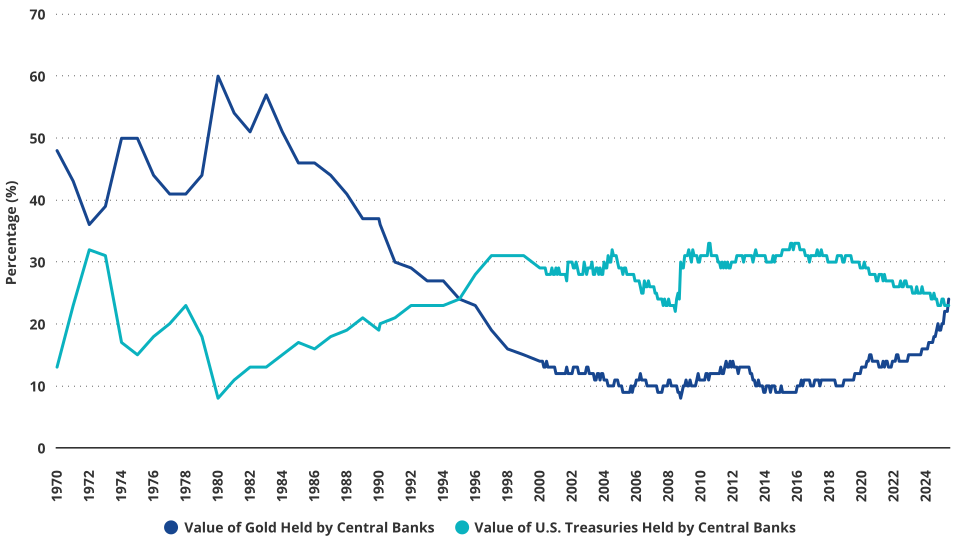
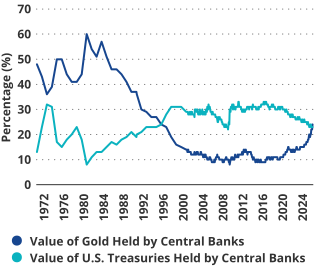
Source: Visual Capitalist. Data as of December 2025. Past performance is no guarantee of future results.
However, despite the new highs gold made in 2026, its price movements have been extremely volatile. While the long-term outlook for gold remains bright, investors in gold should expect periods of volatility. Looking at the current gold environment through the lens of the two previous major bull markets provides helpful context: the 1976–1980 cycle (which produced roughly 500% cumulative returns) and the 2001–2011 cycle (roughly 600% cumulative returns). The current cycle, which began in 2022, has generated approximately 200% so far. Importantly, both prior bull markets experienced five corrections of 10% or more along the way. The recent pullback represents the second such correction in this cycle and falls well within historical norms.
Historically, gold has reacted to various global events such as financial crises and shifts in monetary policy. The current trend mirrors past periods where gold strengthened amid global uncertainties, suggesting a recurring pattern of investor behavior during times of economic and geopolitical uncertainty.
Historical Lookback of Gold Prices
For centuries, gold has served as a form of exchange, a safe haven investment (in times of financial market turmoil) as well as a hedge against severe inflation. As an investment, gold helps enhance portfolio diversification, acts as store of value, and offers a hedge against systemic risk. In addition, gold has outperformed traditional asset classes over the last 25 years.
Historical Gold Outperformance Since 2000
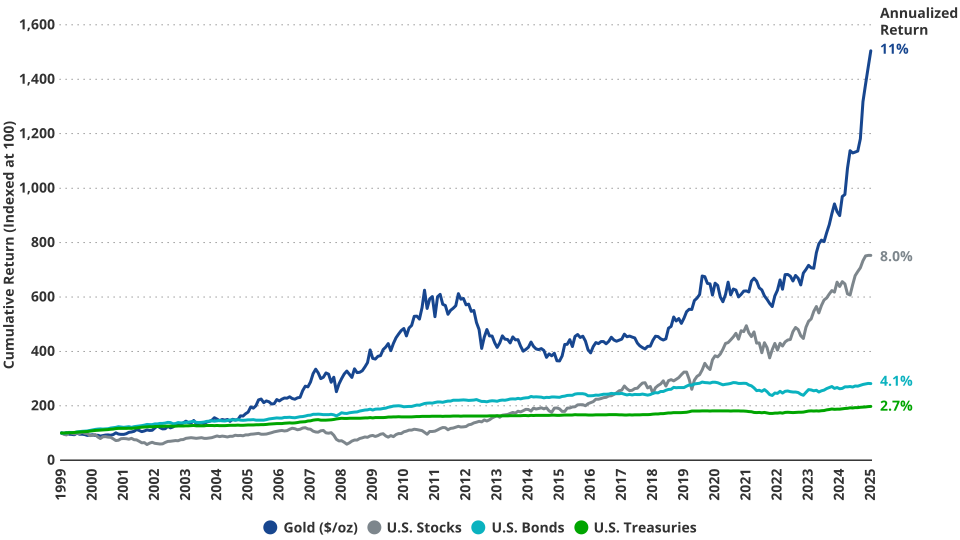
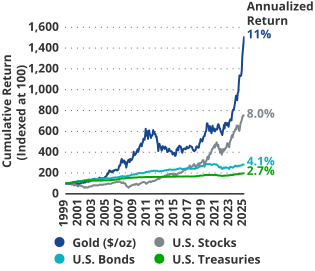
Source: FactSet, VanEck. Data as of December 2025. U.S. Stocks represented by S&P® 500 Index; U.S.Bonds represented by Bloomberg Barclays U.S. Aggregate Bond Index; Gold ($/oz) represented by LBMA PM Gold Price; U.S. Treasuries represented by the Bloomberg Barclays U.S. 1-3 Year Treasury Bond Index. Past performance is no guarantee of future results. Index performance is not illustrative of product performance. It is not possible to invest directly in an index.
Key Factors Affecting Gold Prices
Understanding the macroeconomic, geopolitical, and technological factors that influence the price of gold is crucial for investors seeking to navigate the complexities of the market. The impact of interest rates and global economic policies collectively shape the investment landscape of gold.
Macroeconomic Factors Affecting Gold Prices
Gold prices are significantly influenced by macroeconomic factors, particularly interest rates and monetary policy. Typically, when interest rates are low, the opportunity cost of holding non-yielding assets like gold decreases, making gold more attractive to investors. Conversely, higher interest rates can strengthen the dollar and make yield-bearing assets more appealing, often leading to a decline in gold prices. However, current trends deviate from this norm due to sustained inflationary pressures and de-dollarization, which has helped sustain strong investment demand for gold.
The recent nomination of Kevin Warsh as the next Fed Chair introduced fresh volatility into the gold market, with gold initially falling 9% on the announcement before stabilizing. Markets are now pricing in the possibility of multiple rate cuts in 2026, which should provide a supportive backdrop for gold going forward.
Looking forward, continued inflationary pressures and geopolitical risks are likely to further bolster gold's appeal as a hedge against market volatility.
Geopolitical Influences
Historical data shows that gold prices often increase during times of geopolitical unrest or instability, as investors seek stability. This sensitivity to global political dynamics contributes to gold's status as a "safe haven" asset.
In the current market environment, gold and gold stocks should ultimately benefit from the heightened level of risk across the global economy and global financial system. With U.S. exceptionalism increasingly in question, the potential for a weaker dollar should continue to drive de-dollarization, which also benefits gold. Rising geopolitical tensions involving Venezuela, Iran, and Greenland, combined with persistent U.S. tariff and sanctions threats, have added further fuel to gold's rally. In general, the unpredictability of economic policies and heightened market volatility should boost gold's appeal as the preferred safe-haven asset during times of global uncertainty. This should support a continued shift in investor sentiment towards gold and related equities.
Gold Investing Outlook and Why Gold Could Go Higher in 2026
Here we explore what these developments could mean for gold prices in 2026 and beyond, examining both short-term forecasts and longer-term projections based on current and emerging market influences.
Short-term Forecast: 2026 Gold Predictions
Gold had a phenomenal—if very volatile—start to 2026. The move above $5,000 on January 26 appeared to unleash a wave of speculative buying, pushing gold to an intraday high of $5,595 by January 29. That kind of price action made a pullback almost inevitable, and gold ended January at $4,894, still up over 13% for the month.
January's price action is a reminder of both gold's uncontested role as a safe haven and the increased volatility that comes with trading at record levels. In our view, these sharp swings should not distract or deter gold investors. Gold's longer-term outlook remains supported by the same forces that drove it in 2025: central banks and investors seeking protection, diversification, and de-dollarization in their reserves and portfolios. Rising geopolitical risks and trade tensions, inflation concerns, a potentially weaker dollar, and the risk of a meaningful correction in stretched equity markets should all continue to support gold in 2026. However, investors may want to hold gold for the long term but be prepared for near-term pullbacks given its significantly strong run.
By Historical Standards, We View Gold’s Bull Market Is in Its Infancy
Gold - Cumulative Total Return
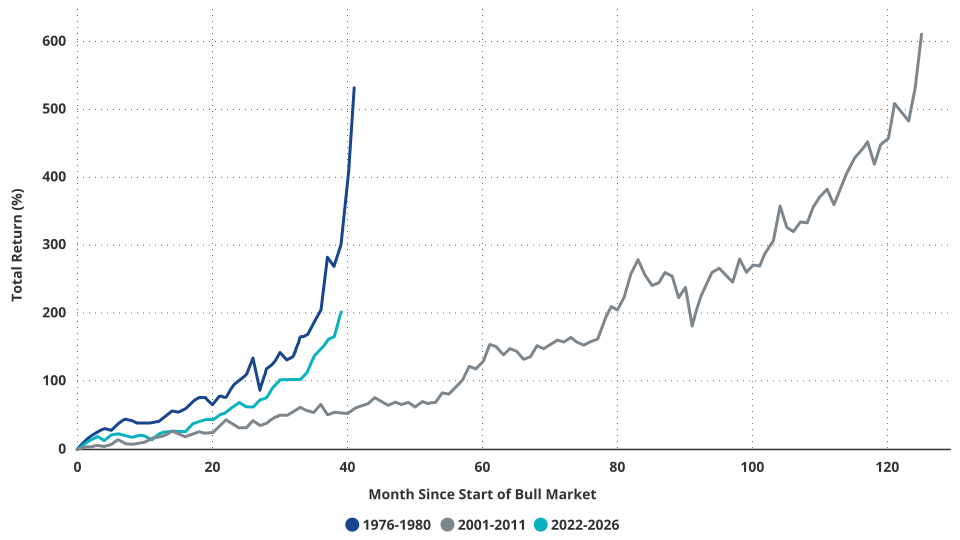
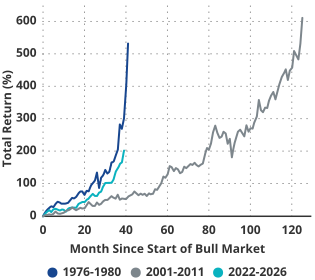
Source: VanEck, Bloomberg. Data as of January 2026. Past performance is no guarantee of future results.
Side Note: For Miners, It's About More Than Just the Gold Price
A rising gold price environment has historically been accompanied by strong performance by gold equities. The sector outperformers must also demonstrate that they are fundamentally positioned and have a sound strategy that will translate higher gold prices into improved cash flow and higher returns, which will deliver growth. Organic growth does not come easy in the gold sector. Finding new gold deposits, or defining/expanding existing ones, is a difficult, lengthy, and capital-intensive process. Most senior and mid-tier companies struggle to simply replace their annual production. To significantly expand their depleting reserve and resource base, companies generally must acquire other companies or assets. All things equal, the more advanced a project is, the higher its valuation and the faster the company can deliver growth.
Gold equities remain in catch-up mode. The MarketVector Global Gold Miners Index have delivered strong gains but still underperformed the metal. This dynamic reflects a feature of the past decade: gold mining equities have been consistently valued using gold price assumptions that lag the spot price. However, we are seeing a notable shift. Equity and commodity analysts are increasingly publishing gold price forecasts that not only point to higher prices in 2026 but assume sustained or elevated price levels through 2028–2029. This should translate into stronger consensus expectations for valuations, earnings, and cash flows across the sector and help support a long-overdue re-rating of gold mining equities. Gold miners are generating record cash flows, with robust margins even at lower gold prices, enabling increased shareholder returns and accelerating investment in the sector's long-term growth pipeline.
Gold stocks' leverage to the gold price, combined with their attractive valuations relative to the broader equity markets, and their low correlation with most other asset classes, should lead to a re-rating of the sector as investors look for a safer place to rotate capital to and as they look to diversify their portfolios.
5 Year Forecast: Gold Price Forecast for 2027–2031
Gold was built for the shifting trends currently unfolding in the global economy: inflation, war, uncertainty and growing financial instability. As the chart below illustrates, gold has dominated every major asset class across over the past five years. Over the past year, gold has delivered an annualized return of roughly 65%—nearly four times the return of U.S. stocks and more than eight times that of U.S. bonds. Over two and three years, gold's annualized returns of approximately 45% and 33%, respectively, have roughly doubled those of U.S. equities. Even over the full five-year period, gold's annualized return of approximately 18% has outpaced stocks, bonds, and commodities alike. As these trends continue to play out over the next five years and reshape the global economic order, we believe gold has the potential to continue to trade at elevated levels, with further upside as structural demand drivers intensify.
Annualized Total Return
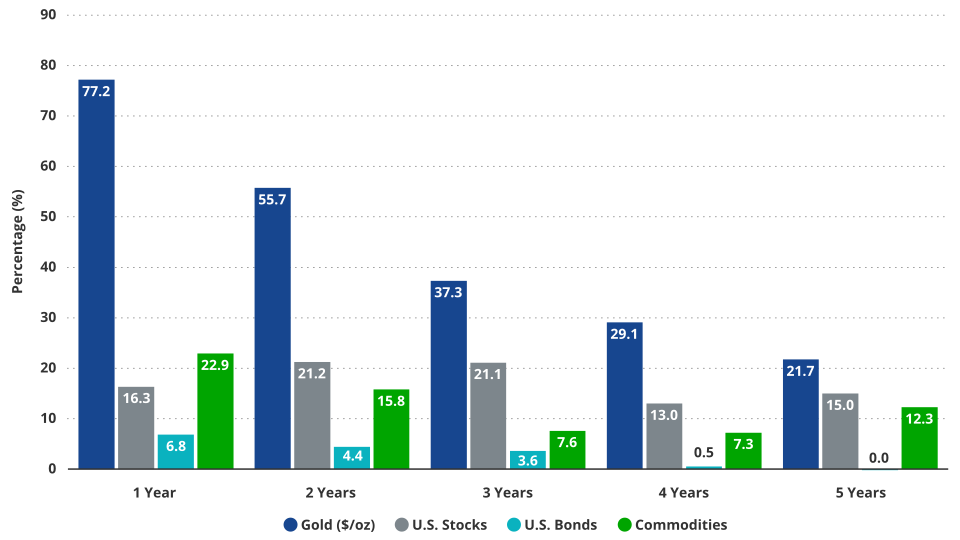
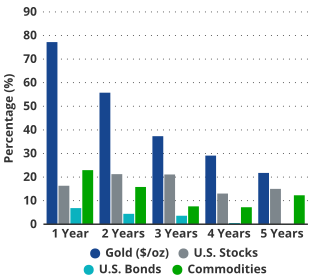
Source: VanEck, Bloomberg. Data as of December 2025. For illustrative purposes only. Past performance is no guarantee of future results. “Gold” is represented by the spot price of gold. “U.S. Stocks” represented by the S&P 500 Index. “U.S. Bonds” represented by the Bloomberg U.S. Aggregate Bond index. “Commodities” represented by the Bloomberg Commodity Index. Index performance is not illustrative of product performance. It is not possible to invest directly in an index.
Long-term Gold Forecast: 2031 & Beyond
The following analysis is a theoretical balance-sheet exercise and is not intended as an expected price level. For illustrative purposes only.
Longer term, investors should expect gold to continue to act as a hedge against broader market volatility and uncertainty. Since 2008, gold has outperformed U.S. stocks and Treasuries during the most notable of market crises. This reflects gold's role as a hedge against financial risks and safe haven amid uncertainty.
Our Emerging Markets Bond team recently published a thought-provoking analysis examining what would happen if the U.S. dollar were to lose its reserve status. Using balance-sheet math—dividing central bank money liabilities by gold reserves and weighting by FX turnover—they calculate that the price of gold equalizing central bank M0 liabilities would be approximately $39,000 per ounce. Under a broader M2 framework, the implied price reaches approximately $184,000 per ounce. VanEck's view remains that the dollar will not lose its reserve status outright but will gradually share it with other currencies, including gold. Still, the analysis illustrates how dramatically gold could be repriced in a scenario where confidence in the dollar meaningfully erodes, and underscores the structural case for gold in a world where de-dollarization is an accelerating trend.
Conclusion: Investing in Gold Is a Cornerstone of a Diversified Portfolio
Gold continues to be an indispensable asset in the global financial landscape, demonstrating remarkable resilience and adaptability amidst fluctuating macroeconomic conditions and geopolitical tensions. From 2024 through early 2026, gold prices have surged to new highs, driven by a mix of geopolitical uncertainty, record investment demand, and substantial buying from emerging market central banks. This trend underscores gold's enduring role as a safe haven during times of economic uncertainty and its appeal as a hedge against systemic risks and inflation.
Looking ahead, the investment outlook for gold remains positive, with expectations of continued strength in the market. Factors such as ongoing geopolitical risks, trade policy uncertainty and sustained inflationary pressures are likely to further enhance gold's attractiveness. Additionally, technological advancements in mining and shifts in consumer demand in industries like electronics and jewelry will continue to influence gold production and prices.
For investors, the strategic implications are clear: we believe gold should be considered a vital component of a diversified investment portfolio, not only for its traditional benefits but also for its potential to deliver significant returns in a complex global economic environment. The insights provided here aim to equip investors with the knowledge to navigate the evolving gold market, ensuring informed decision-making for both short-term opportunities and long-term investment strategies.
VanEck has provided investors access to gold, one of the most vital metals in the world, for over 50 years with both actively and passively managed solutions.
To receive more Gold Investing insights, sign up in our subscription center.


IMPORTANT DISCLOSURES
This content is intended for educational purposes only. Please note that the availability of the products mentioned may vary by country, and it is recommended to check with your local stock exchange.
This is not an offer to buy or sell, or a recommendation to buy or sell any of the securities, financial instruments or digital assets mentioned herein. The information presented does not involve the rendering of personalized investment, financial, legal, tax advice, or any call to action. Certain statements contained herein may constitute projections, forecasts and other forward-looking statements, which do not reflect actual results, are for illustrative purposes only, are valid as of the date of this communication, and are subject to change without notice. Actual future performance of any assets or industries mentioned are unknown. Information provided by third party sources are believed to be reliable and have not been independently verified for accuracy or completeness and cannot be guaranteed. VanEck does not guarantee the accuracy of third party data. The information herein represents the opinion of the author(s), but not necessarily those of VanEck or its other employees.
This is not an offer to buy or sell, or a recommendation to buy or sell any of the securities, financial instruments or digital assets mentioned herein. The information presented does not involve the rendering of personalized investment, financial, legal, tax advice, or any call to action. Certain statements contained herein may constitute projections, forecasts and other forward-looking statements, which do not reflect actual results, are for illustrative purposes only, are valid as of the date of this communication, and are subject to change without notice. Actual future performance of any assets or industries mentioned are unknown. Information provided by third party sources are believed to be reliable and have not been independently verified for accuracy or completeness and cannot be guaranteed. VanEck does not guarantee the accuracy of third party data. The information herein represents the opinion of the speaker(s), but not necessarily those of VanEck or its other employees.
Gold investments are subject to the risks associated with concentrating its assets in the gold industry, which can be significantly affected by international economic, monetary and political developments. Investments in gold may decline in value due to developments specific to the gold industry. Foreign gold security investments involve risks related to adverse political and economic developments unique to a country or a region, currency fluctuations or controls, and the possibility of arbitrary action by foreign governments, or political, economic or social instability. Gold investments are subject to risks associated with investments in U.S. and non-U.S. issuers, commodities and commodity-linked derivatives, commodities and commodity-linked derivatives tax, gold-mining industry, derivatives, emerging market securities, foreign currency transactions, foreign securities, other investment companies, management, market, non-diversification, operational, regulatory, small- and medium-capitalization companies and subsidiary risks.
The information, valuation scenarios and price targets presented on gold in this blog are not intended as financial advice, a recommendation to buy or sell gold, or any call to action. There may be risks or other factors not accounted for in these scenarios that may impede the performance of gold; its actual future performance is unknown, and may differ significantly from any valuation scenarios or projections/forecasts herein. Any projections, forecasts or forward-looking statements included herein are the results of a simulation based on our research, are valid as of the date of this communication and subject to change without notice, and are for illustrative purposes only. Please conduct your own research and draw your own conclusions.
Past performance is not an indication, or guarantee, of future results. Hypothetical or model performance results have certain inherent limitations. Unlike an actual performance record, simulated results do not represent actual trading, and accordingly, may have undercompensated or overcompensated for the impact, if any, of certain market factors such as market disruptions and lack of liquidity. In addition, hypothetical trading does not involve financial risk and no hypothetical trading record can completely account for the impact of financial risk in actual trading (for example, the ability to adhere to a particular trading program in spite of trading losses). Hypothetical or model performance is designed with benefit of hindsight.
Please see the prospectus of each Fund for more complete information regarding each Fund’s specific risks.
No part of this material may be reproduced in any form, or referred to in any other publication, without express written permission of VanEck.
All investing is subject to risk, including the possible loss of the money you invest. As with any investment strategy, there is no guarantee that investment objectives will be met and investors may lose money. Diversification does not ensure a profit or protect against a loss in a declining market. Past performance is no guarantee of future results.
© Van Eck Associates Corporation.
666 Third Avenue | New York, NY 10017
© 2026 VanEck. VanEck®, VanEck Access the opportunities®, and the stylized VanEck design® are trademarks of Van Eck Associates Corporation.
IMPORTANT DISCLOSURES
This content is intended for educational purposes only. Please note that the availability of the products mentioned may vary by country, and it is recommended to check with your local stock exchange.
This is not an offer to buy or sell, or a recommendation to buy or sell any of the securities, financial instruments or digital assets mentioned herein. The information presented does not involve the rendering of personalized investment, financial, legal, tax advice, or any call to action. Certain statements contained herein may constitute projections, forecasts and other forward-looking statements, which do not reflect actual results, are for illustrative purposes only, are valid as of the date of this communication, and are subject to change without notice. Actual future performance of any assets or industries mentioned are unknown. Information provided by third party sources are believed to be reliable and have not been independently verified for accuracy or completeness and cannot be guaranteed. VanEck does not guarantee the accuracy of third party data. The information herein represents the opinion of the author(s), but not necessarily those of VanEck or its other employees.
This is not an offer to buy or sell, or a recommendation to buy or sell any of the securities, financial instruments or digital assets mentioned herein. The information presented does not involve the rendering of personalized investment, financial, legal, tax advice, or any call to action. Certain statements contained herein may constitute projections, forecasts and other forward-looking statements, which do not reflect actual results, are for illustrative purposes only, are valid as of the date of this communication, and are subject to change without notice. Actual future performance of any assets or industries mentioned are unknown. Information provided by third party sources are believed to be reliable and have not been independently verified for accuracy or completeness and cannot be guaranteed. VanEck does not guarantee the accuracy of third party data. The information herein represents the opinion of the speaker(s), but not necessarily those of VanEck or its other employees.
Gold investments are subject to the risks associated with concentrating its assets in the gold industry, which can be significantly affected by international economic, monetary and political developments. Investments in gold may decline in value due to developments specific to the gold industry. Foreign gold security investments involve risks related to adverse political and economic developments unique to a country or a region, currency fluctuations or controls, and the possibility of arbitrary action by foreign governments, or political, economic or social instability. Gold investments are subject to risks associated with investments in U.S. and non-U.S. issuers, commodities and commodity-linked derivatives, commodities and commodity-linked derivatives tax, gold-mining industry, derivatives, emerging market securities, foreign currency transactions, foreign securities, other investment companies, management, market, non-diversification, operational, regulatory, small- and medium-capitalization companies and subsidiary risks.
The information, valuation scenarios and price targets presented on gold in this blog are not intended as financial advice, a recommendation to buy or sell gold, or any call to action. There may be risks or other factors not accounted for in these scenarios that may impede the performance of gold; its actual future performance is unknown, and may differ significantly from any valuation scenarios or projections/forecasts herein. Any projections, forecasts or forward-looking statements included herein are the results of a simulation based on our research, are valid as of the date of this communication and subject to change without notice, and are for illustrative purposes only. Please conduct your own research and draw your own conclusions.
Past performance is not an indication, or guarantee, of future results. Hypothetical or model performance results have certain inherent limitations. Unlike an actual performance record, simulated results do not represent actual trading, and accordingly, may have undercompensated or overcompensated for the impact, if any, of certain market factors such as market disruptions and lack of liquidity. In addition, hypothetical trading does not involve financial risk and no hypothetical trading record can completely account for the impact of financial risk in actual trading (for example, the ability to adhere to a particular trading program in spite of trading losses). Hypothetical or model performance is designed with benefit of hindsight.
Please see the prospectus of each Fund for more complete information regarding each Fund’s specific risks.
No part of this material may be reproduced in any form, or referred to in any other publication, without express written permission of VanEck.
All investing is subject to risk, including the possible loss of the money you invest. As with any investment strategy, there is no guarantee that investment objectives will be met and investors may lose money. Diversification does not ensure a profit or protect against a loss in a declining market. Past performance is no guarantee of future results.
© Van Eck Associates Corporation.
666 Third Avenue | New York, NY 10017
© 2026 VanEck. VanEck®, VanEck Access the opportunities®, and the stylized VanEck design® are trademarks of Van Eck Associates Corporation.