Gold Bull Market Endures Early 2026 Volatility
February 10, 2026
Read Time 4 MIN
Monthly gold market and economic insights from Imaru Casanova, Portfolio Manager, featuring her unique views on mining and gold’s portfolio benefits.
Key Takeaways:
- Gold’s January spike and drop highlight volatility, but the bull market thesis remains intact.
- 2025 demand hit records as ETFs surged and central banks remained strong buyers.
- Miners are catching up as higher long-term gold forecasts support re-rating potential.
Gold Bull Market Endures Early 2026 Volatility
Gold’s Volatile Start to 2026
Gold had a phenomenal, albeit very volatile, start to the year. Rising geopolitical tensions around the world, in particular, developments involving Venezuela, Iran and Greenland, combined with persistent U.S. tariff and sanctions threats, pushed gold above $5,000 per ounce on January 26. Breaking through that psychological level appeared to unleash a wave of speculative buying. By January 29, gold was trading at an intraday high of $5,595 per ounce, nearly $1,300 higher than at the end of 2025.
That kind of price action made a pullback almost inevitable, and markets quickly found a catalyst in the nomination of Kevin Warsh as the next Fed Chair on January 30. Gold fell 9% on the day. Warsh was initially seen as a more hawkish choice, supportive of the U.S. dollar and generally negative for gold, signaling potentially less accommodative monetary policy ahead. That said, after the initial reaction, the implied probability of Fed rate cuts ticked up slightly, possibly reflecting Warsh’s comments suggesting alignment with President Trump’s preference for lower rates. Gold closed January 30 at $4,894.23 per ounce, ending the month up $574.86, or 13.31%.
Chart 1: 3-Month Gold Price
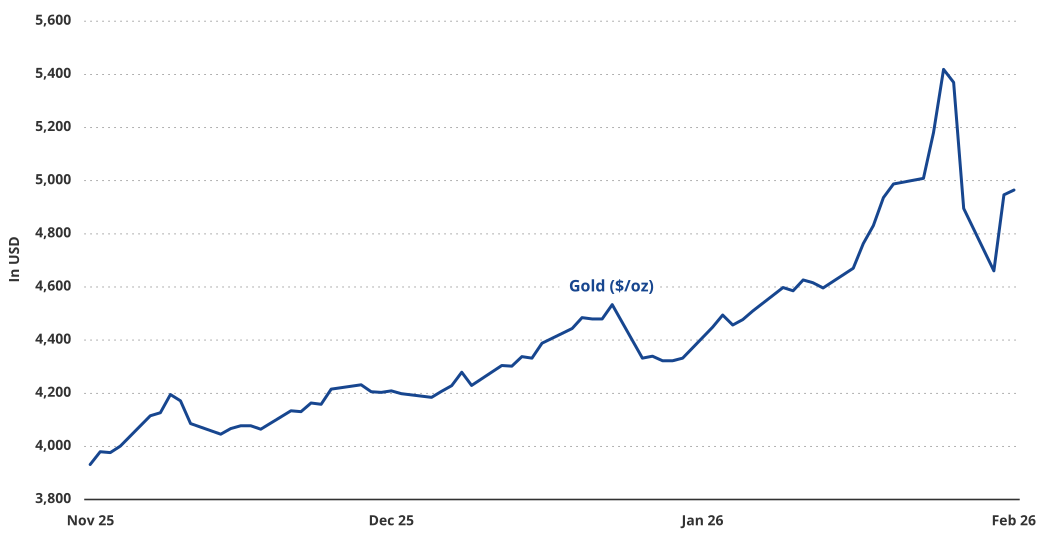
Source: FactSet. Data as of January 4, 2026.
Key Gold Price Drivers Remain in Place
January’s price action is a reminder of both gold’s uncontested role as a safe haven and U.S. dollar alternative, and the increased volatility that comes with trading at record levels. In our view, these sharp swings should not distract or deter gold investors. Gold's longer-term outlook remains supported by the same forces that drove it in 2025: central banks and investors seeking protection, diversification and de-dollarization in their reserves and portfolios. Rising geopolitical risks and trade tensions, inflation concerns, a potentially weaker dollar and the risk of a meaningful correction in stretched equity markets should all continue to support gold in 2026. While new highs are likely to be followed by pullbacks and periods of range-bound trading, we believe this gold bull market still has several years to run.
The World Gold Council published its 2025 Gold Demand Trends: Total gold demand in 2025 exceeded 5,000 tonnes for the first time, a value of $555 billion which represented a 45% increase year-on-year. Stronger investment flows fueled overall demand growth, with global gold bullion ETF holdings rising by 801 tonnes the second-largest annual increase on record, while bar and coin demand accelerated to a 12-year high. Central banks purchased 863 tonnes of gold. Although official sector buying eased in 2025, from the recent pace of around 1,000 tonnes annually, it remains historically high and broadly diversified across regions.
Gold Equities Still in Catch-up Mode
Gold equity markets had little time to absorb the sharp rise in gold prices during the first month of 2026. The MarketVector Global Gold Miners Index delivered a strong gain of 10.91% over the month but still underperformed the metal itself. This dynamic highlights a feature of the sector over the past decade: gold mining equities have been consistently valued using gold price assumptions that lag the spot price.
In recent years, as markets begin to gain confidence that higher gold prices are sustainable and adjust valuation assumptions accordingly, the gold price itself often continues to move higher, leaving equities in a persistent catch-up mode. This year, however, we are seeing a notable shift. Equity and commodity analysts are increasingly publishing gold price forecasts that not only point to higher prices in 2026 but also assume sustained or elevated price levels through 2028–2029. This should translate into stronger consensus expectations for valuations, earnings and cash flows across the sector and help support a long-overdue re-rating of gold mining equities.
Outlook for Gold Mining Companies
Looking ahead, most gold mining companies will report their Q4 2025 and full-year results, along with 2026 guidance, in February. While outcomes will likely vary based on company-specific factors, particularly with respect to cost increases expected in 2026, we expect a clear and consistent message to emerge. Even at lower gold prices, gold miners are generating record cash flows with robust margins, enabling increased shareholder returns and accelerating investment in the sector’s long-term growth pipeline.
To receive more Gold Investing insights, sign up in our subscription center.

Important Disclosures
All company, sector, and sub-industry weightings as of January 31, 2026, unless otherwise noted.
Please note that VanEck may offer investment products that invest in the asset class(es) or industries included in this communication.
This is not an offer to buy or sell, or a solicitation of any offer to buy or sell any of the securities mentioned herein. The information presented does not involve the rendering of personalized investment, financial, legal, or tax advice. Certain statements contained herein may constitute projections, forecasts and other forward-looking statements, which do not reflect actual results.
Please note that the information herein represents the opinion of the author, but not necessarily those of VanEck, and this opinion may change at any time and from time to time. Non-VanEck proprietary information contained herein has been obtained from sources believed to be reliable but not guaranteed. Not intended to be a forecast of future events, a guarantee of future results or investment advice. Historical performance is not indicative of future results. Current data may differ from data quoted. Any graphs shown herein are for illustrative purposes only. No part of this material may be reproduced in any form, or referred to in any other publication, without express written permission of VanEck.
Diversification does not assure a profit or protect against loss.
Nothing in this content should be considered a solicitation to buy or an offer to sell shares of any investment in any jurisdiction where the offer or solicitation would be unlawful under the securities laws of such jurisdiction, nor is it intended as investment, tax, financial, or legal advice. Investors should seek such professional advice for their particular situation and jurisdiction.
MarketVector Global Gold Miners Index (MVGDXTR) tracks the overall performance of companies involved in the gold mining industry. NYSE Arca Gold Miners Index (GDMNTR) is a modified market capitalization-weighted index comprised of publicly traded companies involved primarily in the mining for gold.
Any indices listed are unmanaged indices and include the reinvestment of all dividends, but do not reflect the payment of transaction costs, advisory fees or expenses that are associated with an investment in a Fund. Certain indices may take into account withholding taxes. An index’s performance is not illustrative of a Fund’s performance. Indices are not securities in which investments can be made.
Investments in commodities can be very volatile and direct investment in these markets can be very risky, especially for inexperienced investors.
Gold investments are subject to the risks associated with concentrating its assets in the gold industry, which can be significantly affected by international economic, monetary and political developments. Investments in gold may decline in value due to developments specific to the gold industry. Foreign gold security investments involve risks related to adverse political and economic developments unique to a country or a region, currency fluctuations or controls, and the possibility of arbitrary action by foreign governments, or political, economic or social instability. Gold investments are subject to risks associated with investments in U.S. and non-U.S. issuers, commodities and commodity-linked derivatives, commodities and commodity-linked derivatives tax, gold-mining industry, derivatives, emerging market securities, foreign currency transactions, foreign securities, other investment companies, management, market, non-diversification, operational, regulatory, small- and medium-capitalization companies and subsidiary risks.
All investing is subject to risk, including the possible loss of the money you invest. As with any investment strategy, there is no guarantee that investment objectives will be met and investors may lose money. Diversification does not ensure a profit or protect against a loss in a declining market. Past performance is no guarantee of future performance.
© Van Eck Associates Corporation
666 Third Avenue | New York, NY 10017
Important Disclosures
All company, sector, and sub-industry weightings as of January 31, 2026, unless otherwise noted.
Please note that VanEck may offer investment products that invest in the asset class(es) or industries included in this communication.
This is not an offer to buy or sell, or a solicitation of any offer to buy or sell any of the securities mentioned herein. The information presented does not involve the rendering of personalized investment, financial, legal, or tax advice. Certain statements contained herein may constitute projections, forecasts and other forward-looking statements, which do not reflect actual results.
Please note that the information herein represents the opinion of the author, but not necessarily those of VanEck, and this opinion may change at any time and from time to time. Non-VanEck proprietary information contained herein has been obtained from sources believed to be reliable but not guaranteed. Not intended to be a forecast of future events, a guarantee of future results or investment advice. Historical performance is not indicative of future results. Current data may differ from data quoted. Any graphs shown herein are for illustrative purposes only. No part of this material may be reproduced in any form, or referred to in any other publication, without express written permission of VanEck.
Diversification does not assure a profit or protect against loss.
Nothing in this content should be considered a solicitation to buy or an offer to sell shares of any investment in any jurisdiction where the offer or solicitation would be unlawful under the securities laws of such jurisdiction, nor is it intended as investment, tax, financial, or legal advice. Investors should seek such professional advice for their particular situation and jurisdiction.
MarketVector Global Gold Miners Index (MVGDXTR) tracks the overall performance of companies involved in the gold mining industry. NYSE Arca Gold Miners Index (GDMNTR) is a modified market capitalization-weighted index comprised of publicly traded companies involved primarily in the mining for gold.
Any indices listed are unmanaged indices and include the reinvestment of all dividends, but do not reflect the payment of transaction costs, advisory fees or expenses that are associated with an investment in a Fund. Certain indices may take into account withholding taxes. An index’s performance is not illustrative of a Fund’s performance. Indices are not securities in which investments can be made.
Investments in commodities can be very volatile and direct investment in these markets can be very risky, especially for inexperienced investors.
Gold investments are subject to the risks associated with concentrating its assets in the gold industry, which can be significantly affected by international economic, monetary and political developments. Investments in gold may decline in value due to developments specific to the gold industry. Foreign gold security investments involve risks related to adverse political and economic developments unique to a country or a region, currency fluctuations or controls, and the possibility of arbitrary action by foreign governments, or political, economic or social instability. Gold investments are subject to risks associated with investments in U.S. and non-U.S. issuers, commodities and commodity-linked derivatives, commodities and commodity-linked derivatives tax, gold-mining industry, derivatives, emerging market securities, foreign currency transactions, foreign securities, other investment companies, management, market, non-diversification, operational, regulatory, small- and medium-capitalization companies and subsidiary risks.
All investing is subject to risk, including the possible loss of the money you invest. As with any investment strategy, there is no guarantee that investment objectives will be met and investors may lose money. Diversification does not ensure a profit or protect against a loss in a declining market. Past performance is no guarantee of future performance.
© Van Eck Associates Corporation
666 Third Avenue | New York, NY 10017