November Market Recap: AI Adoption Surges & Tight Liquidity Creates Opportunity
December 09, 2025
Read Time 6 MIN
Key Takeaways
- Liquidity stress tightened markets, with Bitcoin leading risk-asset weakness as the earliest barometer.
- AI signals shifted from infrastructure build-out toward real enterprise adoption.
- Real assets outperformed as late-cycle macro meets early-cycle technology demand.
AI Adoption Surges & Tight Liquidity Creates Opportunity
The views expressed are for illustrative purposes only, subject to change without notice, do not constitute investment advice or recommendations, and are those of the author(s) and not necessarily those of VanEck or its other employees. Past performance is no guarantee of future results.
November showed how fast sentiment can flip when liquidity gets scarce. As we’ve come to expect, as funding costs rose and repo markets showed, the most sensitive assets were the first to get hit. Bitcoin dropped nearly 30% from its October high before stabilizing. High-growth tech stocks corrected about 10%. Timing told the real story: Bitcoin began rolling over on October 6, while the tech sector’s meaningful leg down didn’t begin until October 29. That three-week lead is why we treat Bitcoin as the market’s earliest liquidity barometer: when the plumbing begins to clog, it leaks first.
We used the sell-off to add.
Bitcoin: A Signal For Tech Stocks
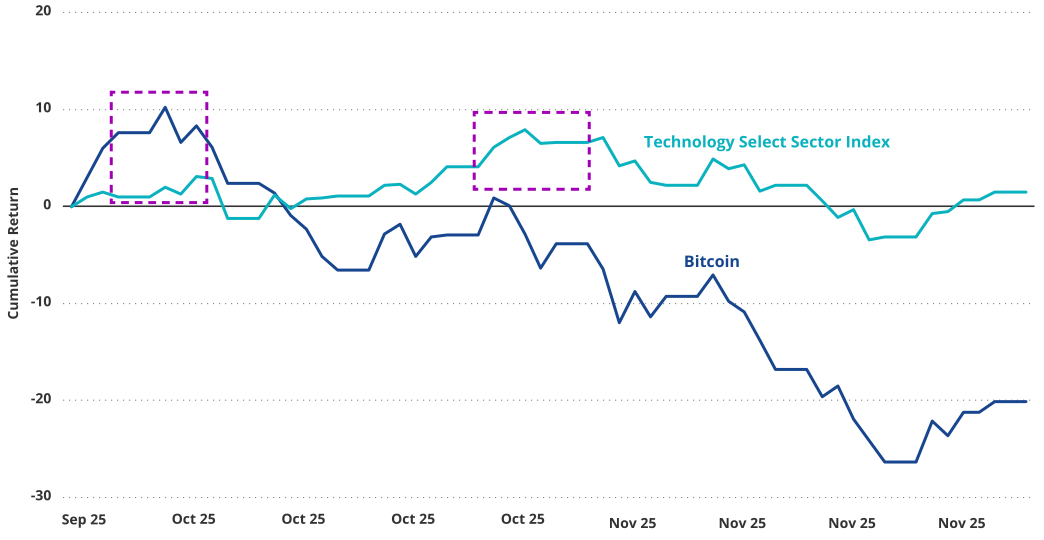
Source: Bloomberg, as of 11/30/2025. Past performance is no guarantee of future results.
On November 21, as Bitcoin touched its low, our models flagged a clear mean-reversion setup: the decline was too sharp relative to its own history and too disconnected from the rest of the portfolio. We increased exposure when fear was peaking. That’s exactly what the process is designed to do.
Alongside the liquidity dynamics, November provided steady, incremental signals pointing toward a shift in the AI cycle from Phase 1 (infrastructure) into Phase 2 (adoption).
The Framework
- Phase 1: Chips, data centers, power: the build-out
- Phase 2: AI embedded in actual products and workflows: real revenue
- Phase 3: Automation and robotics at scale: labor transformation Two verifiable developments stood out:
- Cisco raised full-year guidance on continued AI-driven networking demand.
- CrowdStrike lifted its outlook after sustained enterprise take-up of its AI-native security platform.
These are not explosive moves, but they are consistent with the transition from experimentation to deployment. A recent Economist article highlighted just how wide the gap remains between “we have an AI subscription” and “AI is embedded in production workflows.”
That gap is the hallmark of the productivity J-curve: friction today, bigger payoff later. We remain positioned for the latter.

Source: The Economist, as of 2025.
Late-Cycle Backdrop, Early-Cycle Technology
The tension is obvious: an early-cycle technology boom is running head-first into a late-cycle economy.
Circular AI revenue, onshoring costs, tariffs, geopolitical friction, a shrinking middle class, and political gridlock that shows no sign of ending. The root cause is simple: the system is working for some, not most. That divergence showed up at the ballot box on November 4, with economic worries driving record turnout in the NYC mayoral race — where Zohran Mamdani won on a platform of rent freezes and affordability — and Democratic sweeps in Virginia and New Jersey, as voters punished the status quo for persistent inflation and job stagnation.
AI will drive productivity and growth. But first it will displace knowledge workers. Later, when robotics scale, the impact spreads vastly wider. Public debt in that environment becomes an even larger problem.
Real Asset Backbone Behind AI Adoption
There is another story developing beneath the surface: old-world assets are quietly building the new world. A diversified basket of real-asset companies, aka the businesses powering infrastructure, energy, industrial metals, transportation, and manufacturing, is outperforming the Nasdaq 100 Index year-to-date.
Real Assets: The Bull Market Nobody Is Paying Attention To
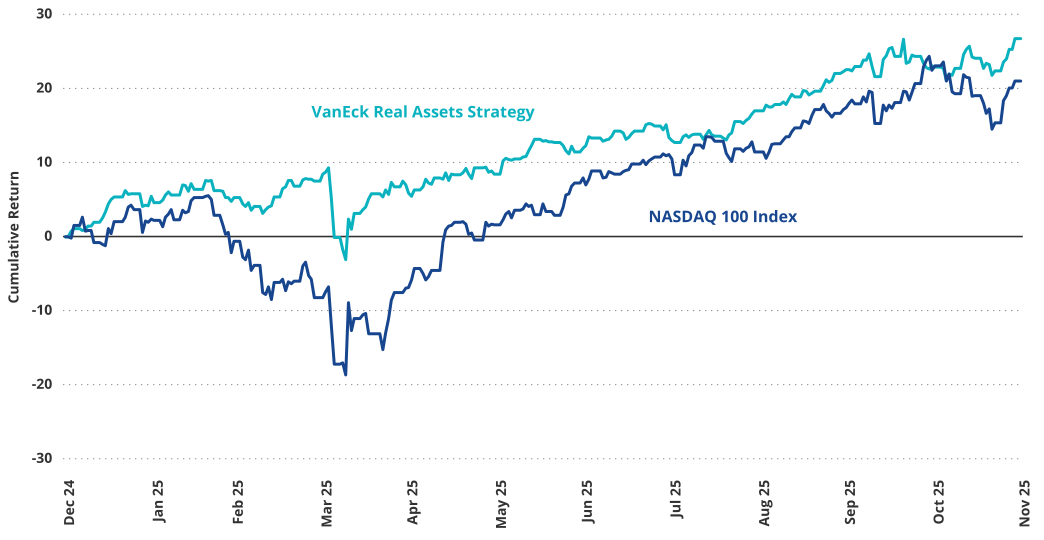
Source: FactSet, as of 11/30/2025. Past performance is no guarantee of future results.
The next decade of AI, automation, and reshoring simply cannot happen without this backbone. Data centers need power. Robotics need materials. Supply chains need redundancy. Innovation needs infrastructure. And the bill for all of it is being financed through monetary dilution and persistent fiscal deficits. This is why we continue to own real assets for upside participation — and gold to protect against the debasement that ultimately pays for the next wave of growth.
Debt and Liquidity: Stress, Not Panic
Roughly $9.2 trillion in U.S. Treasuries mature in 2025; a large but manageable rolling refinancing task. During the post-COVID period, the Treasury shifted issuance toward short-term bills, doubling T-Bills’ share of the Treasuries market from ~12% in 2015 to ~22% by 2025. The move has effectively served as a form of yield-curve control by flooding the front end and compressing long-term rates.
The trade-off is more frequent rollovers and greater sensitivity to liquidity swings.
Bills Make Up More Than 20% of Treasuries Market
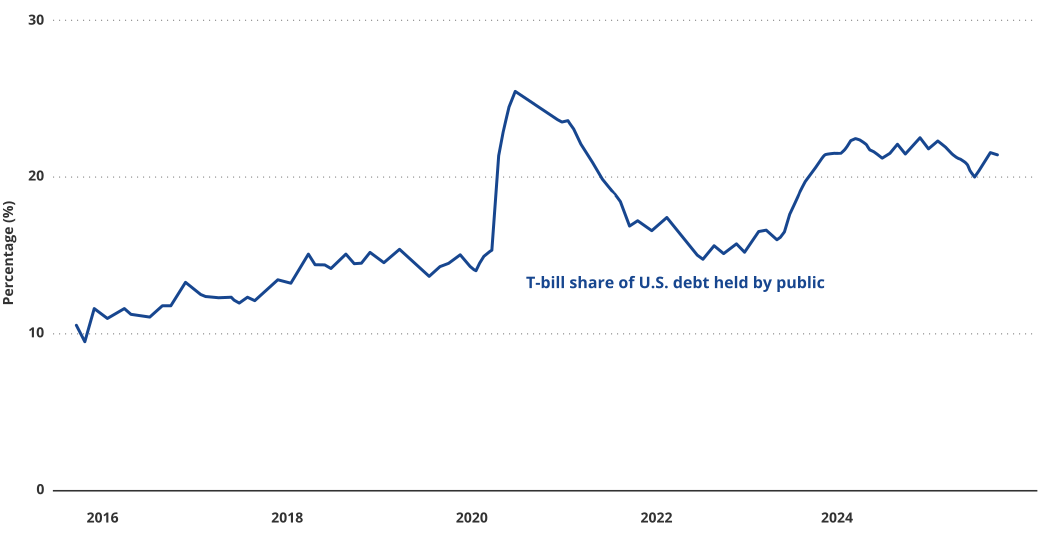
Source: Bloomberg, as of 2025.
The Treasury General Account (TGA) adds another important layer to the picture. The Treasury built up a sizable cash balance, funded predominantly through bill issuance, which drained a significant amount of reserves from the banking system over the course of the year.
That tightening became most visible in the repo markets. Toward the end of November, funding pressures surfaced: repo rates climbed, SOFR briefly moved above the Fed’s target range, and strains appeared in parts of the financial plumbing.
In response, the Federal Reserve brought its Treasury QT runoff to an earlier end than many had anticipated and made clear it was paying close attention to funding conditions. It wasn’t a crisis—just a sharp reminder that liquidity still matters, and the most sensitive parts of the money markets feel it first.
How We Handled November
- Increased Bitcoin when sellers panicked
- Remained positioned in companies delivering measurable AI adoption
- Continued to benefit from reshoring and real-asset exposure
- Gold worked again: up over 5% in the month, now above $4,200 after starting last December below $2,600
The Bottom Line
There’s no going back.
We are in a new regime: governments will debase currency to service yesterday’s debt and fund tomorrow’s ambitions. At the same time, extreme innovation, led by AI, is rewriting productivity, profitability, and power.
We believe the winning portfolio owns both sides of that equation:
- Assets that potentially protect and profit from debasement (Bitcoin, gold, real assets)
- Companies and themes that may capture the capex surge and the productivity explosion
Diversification across these forces is no longer optional. It is the new foundation for generating returns in a world that is changing fast.
Macro themes we’re watching:
Debt
Fiscal excess is fueling innovation and instability.
AI’s Three Phases
Builders spend, Adopters save, Automators replace.
De-Dollarization
Stores of value to hedge against deficits, debt, and geopolitics.
Today’s predominant macro forces are driving the key themes and exposures in VanEck’s models, including the core allocation of the VanEck Wealth Builder Plus Portfolios. The allocations below are representative of the Moderate Portfolio.
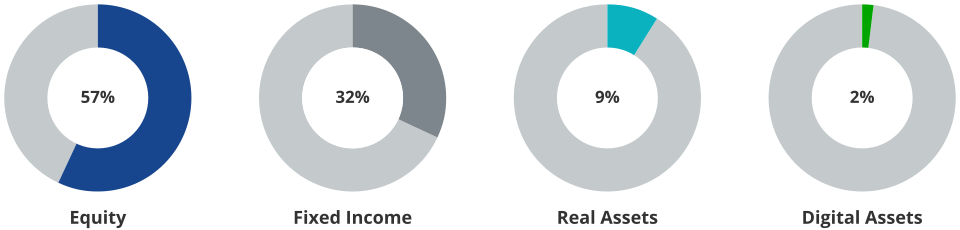
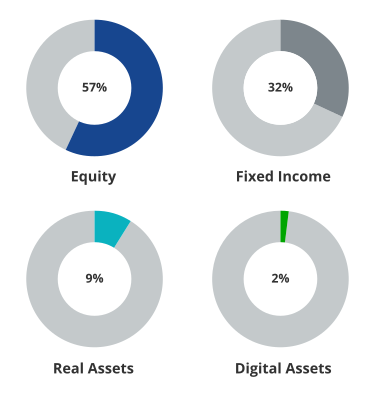
Source: VanEck, 11/30/2025. Not intended as a recommendation to buy or sell any securities or digital assets, or as investment or any call to action.
Source: VanEck, FactSet. As of 11/30/2025. For illustrative purposes only. Not intended as an offer or recommendation to buy or sell any securities referenced herein. Strategy allocations will vary. Holdings exclude cash.
Recommended subscription
Standardized Performance
| Inception Date | 1M | 3M | YTD | 1Y | 3Y | 5Y | Since Inception | |
| Wealth Builder Plus Conservative Strategy | 7/1/2024 | |||||||
| Net | 0.28 | 3.23 | 10.39 | 8.06 | -- | -- | 9.71 | |
| Gross | 0.28 | 3.23 | 10.39 | 8.06 | -- | -- | 9.71 | |
| 20% ACWI/80% ICE Broad Market Index | 0.48 | 3.02 | 9.94 | 7.99 | -- | -- | 8.86 | |
| Wealth Builder Plus Moderate Strategy | 7/1/2024 | |||||||
| Net | -0.06 | 4.83 | 15.28 | 11.95 | -- | -- | 14.57 | |
| Gross | -0.06 | 4.83 | 15.28 | 11.95 | -- | -- | 14.57 | |
| 60% ACWI/40% ICE Broad Market Index | 0.19 | 4.34 | 14.79 | 12.37 | -- | -- | 13.16 | |
| Wealth Builder Plus Aggressive Strategy | 7/1/2024 | |||||||
| Net | -0.22 | 5.76 | 18.02 | 14.22 | -- | -- | 17.17 | |
| Gross | -0.22 | 5.76 | 18.02 | 14.22 | -- | -- | 17.17 | |
| 80% ACWI/20% ICE Broad Market Index | 0.04 | 4.99 | 17.16 | 14.49 | -- | -- | 15.23 | |
| Thematic Disruption Strategy | 12/24/2021 | |||||||
| Net | -5.16 | 6.96 | 23.33 | 23.62 | 20.17 | -- | 6.14 | |
| Gross | -5.15 | 6.98 | 23.45 | 23.74 | 20.47 | -- | 6.46 | |
| MSCI ACWI IMI Growth Index | -1.36 | 7.27 | 21.85 | 21.59 | 22.92 | -- | 9.20 | |
| Real Assets Strategy | 8/16/2017 | |||||||
| Net | 3.20 | 9.21 | 28.52 | 22.01 | 14.55 | 15.39 | 8.08 | |
| Gross | 3.20 | 9.21 | 28.52 | 22.01 | 14.76 | 15.75 | 8.49 | |
| Bloomberg Commodity Index | 3.20 | 8.47 | 16.15 | 17.33 | 3.21 | 11.79 | 6.24 | |
| Select Opportunities Strategy | 12/20/2024 | |||||||
| Net | -2.54 | 9.08 | 26.79 | -- | -- | -- | 25.65 | |
| Gross | -2.54 | 9.08 | 26.79 | -- | -- | -- | 25.65 | |
| MSCI ACWI Index | -0.01 | 5.93 | 21.07 | -- | -- | -- | 21.39 | |
| Dynamic High Income Strategy | 9/30/2021 | |||||||
| Net | 1.05 | 1.00 | 7.14 | 4.71 | 7.63 | -- | 3.18 | |
| Gross | 1.05 | 1.00 | 7.14 | 4.71 | 7.69 | -- | 3.25 | |
| ICE BofA Global HY Corp. & Sov. Index | 0.49 | 1.74 | 10.69 | 10.03 | 11.26 | -- | 3.94 |
Source: VanEck. As of 11/30/2025. Returns greater than 1 year are annualized. The performance data quoted represents past performance. Past performance is not a guarantee of future results. Performance may be lower or higher than performance data quoted. Performance figures presented herein are preliminary and may differ slightly from final performance figures. Fees paid represent acquired fund fees of the underlying funds held by the Strategies. Please contact us at [email protected] for additional information.
To receive more Model Portfolio insights, sign up in our subscription center.


Important Disclosures
This is not an offer to buy or sell, or a recommendation to buy or sell any of the securities, financial instruments or digital assets mentioned herein. The information presented does not involve the rendering of personalized investment, financial, legal, tax advice, or any call to action. Certain statements contained herein may constitute projections, forecasts and other forward-looking statements, which do not reflect actual results, are for illustrative purposes only, are valid as of the date of this communication, and are subject to change without notice. Actual future performance of any assets or industries mentioned are unknown. Information provided by third party sources are believed to be reliable and have not been independently verified for accuracy or completeness and cannot be guaranteed. VanEck does not guarantee the accuracy of third party data. The information herein represents the opinion of the author(s), but not necessarily those of VanEck or its other employees.
The models are not mutual funds or other types of securities and will not be registered with the Securities and Exchange Commission as investment companies under the Investment Company Act of 1940, as amended, and no units or shares of the models will be registered under the Securities Act of 1933, as amended, nor will they be registered with any state securities regulator. Accordingly, the models are not subject to compliance with the requirements of such acts.
An investment in the Strategies may be subject to risks including small- and medium-capitalization companies, emerging market issuers, foreign securities and currency, equity securities, derivatives, blockchain, social media analytics, non-diversification, sector and market conditions, economic, political, regulatory and world events, index tracking, cash transactions, operational issues, authorized participant concentration, absence of an active trading market, trading issues, passive management, fund share trading, premium/discount and liquidity risks, issuer-specific changes, and index-related concentration, any of which may adversely affect the Strategies. Emerging market issuers and foreign securities may face market, political, economic, investment and repatriation restrictions; differing rules and disclosure; currency and exchange-rate risks; operational and settlement challenges; and distinct corporate and securities laws. Small- and medium-capitalization companies may present elevated risks. Derivatives may involve costs and risks, including liquidity, interest rate, and the possibility that positions cannot be closed when most advantageous.
Digital asset investments are subject to significant risk and may not be suitable for all investors. Digital asset prices are highly volatile, and the value of digital assets, can rise or fall dramatically and quickly. If their value goes down, there’s no guarantee that it will rise again. As a result, there is a significant risk of loss of your entire principal investment.
The portfolio holdings presented represent securities held as of the period indicated and may not be representative of current or future investments. Such data may vary for each client in the strategy due to, but not limited to, asset size, market conditions, client guidelines and the diversity of portfolio holdings. Portfolio holdings are subject to change without notice and are being provided for illustrative purposes only. Nothing contained herein should be construed as (i) an offer to buy any security or (ii) a recommendation as to the advisability of investing in, purchasing or selling any security. This material is being provided for illustrative purposes only. Past performance is no guarantee of future results.
All investing is subject to risk, including the possible loss of the money you invest. As with any investment strategy, there is no guarantee that investment objectives will be met and investors may lose money. Diversification does not ensure a profit or protect against a loss in a declining market. Past performance is no guarantee of future results.
GIPS Disclosures
Van Eck Associates Corporation (“VanEck”) is an independent investment adviser registered under the Investment Advisers Act of 1940. VanEck, which commenced operations 1985 (predecessor company in 1955), provides investment advisory services to registered investment companies, other pooled investment vehicles, separate institutional clients, and private investment accounts.
VanEck claims compliance with the Global Investment Performance Standards (GIPS®) and has prepared and presented this report in compliance with the GIPS standards. VanEck has been independently verified for the periods January 1, 2006 through June 30, 2025.
The verification reports are available upon request. A firm that claims compliance with the GIPS standards must establish policies and procedures for complying with all the applicable requirements of the GIPS standards. Verification provides assurance on whether the firm’s policies and procedures related to composite and pooled fund maintenance, as well as the calculation, presentation, and distribution of performance, have been designed in compliance with the GIPS standards and have been implemented on a firm-wide basis. Verification does not provide assurance on the accuracy of any specific performance report. The Wealth Builder Moderate (Proprietary) composite’s inception date is July 1, 2024 and the creation date is July 1, 2024. GIPS® is a registered trademark of CFA Institute. CFA Institute does not endorse or promote this organization, nor does it warrant the accuracy or quality of the content contained herein.
Wealth Builder Plus Moderate (Proprietary) is a diversified, risk-balanced portfolio of U.S. listed ETFs that gains exposure to key asset classes. These include, U.S., developed international and emerging market equities, U.S. investment grade, high yield and emerging market debt, and commodity futures, gold bullion and natural resource equities. Additionally, the strategy may gain exposure, through U.S. listed ETFs, to more differentiated assets, such as digital assets and high yield alternatives. The strategy will re-balance periodically to maintain diversification and its overall risk profile. The Wealth Builder Plus Moderate (Proprietary) risk level is moderate. 100% of composite assets are proprietary.
60% ACWI 40% US Broad Market Index (6040MOD) is a blended index of 60 % MSCI ACWI and 40% ICE BofA US Broad Market Index. MSCI All Country World Index (MXWD) is a free float-adjusted market capitalization index designed to measure the combined equity market performance of developed and emerging markets countries. ICE BofA US Broad Market Index (US00) tracks the performance of US dollar denominated investment grade debt publicly issued and settled in the US domestic market, including US Treasury, quasi-government, corporate, securitized and collateralized securities.
Wealth Builder Plus Conservative (Proprietary) is a diversified, risk-balanced portfolio of U.S. listed ETFs that gains exposure to key asset classes. These include, U.S., developed international and emerging market equities, U.S. investment grade, high yield and emerging market debt, and commodity futures, gold bullion and natural resource equities. Additionally, the strategy may gain exposure, through U.S. listed ETFs, to more differentiated assets, such as digital assets and high yield alternatives. The strategy will re-balance periodically to maintain diversification and its overall risk profile. The Wealth Builder Plus Conservative (Proprietary) risk level is conservative. 100% of composite assets are proprietary.
20% ACWI 80% US Broad Market Index (2080CON) is a blended index of 20 % MSCI ACWI and 80% ICE BofA US Broad Market Index. MSCI All Country World Index (MXWD) is a free float-adjusted market capitalization index designed to measure the combined equity market performance of developed and emerging markets countries. ICE BofA US Broad Market Index (US00) tracks the performance of US dollar denominated investment grade debt publicly issued and settled in the US domestic market, including US Treasury, quasi-government, corporate, securitized and collateralized securities.
Wealth Builder Plus Aggressive (Proprietary) is a diversified, risk-balanced portfolio of U.S. listed ETFs that gains exposure to key asset classes. These include, U.S., developed international and emerging market equities, U.S. investment grade, high yield and emerging market debt, and commodity futures, gold bullion and natural resource equities. Additionally, the strategy may gain exposure, through U.S. listed ETFs, to more differentiated assets, such as digital assets and high yield alternatives. The strategy will re-balance periodically to maintain diversification and its overall risk profile. The Wealth Builder Plus Aggressive (Proprietary) risk level is aggressive. 100% of composite assets are proprietary.
80% ACWI 20% US Broad Market Index (8020AGG) is a blended index of 80 % MSCI ACWI and 20% ICE BofA US Broad Market Index. MSCI All Country World Index (MXWD) is a free float-adjusted market capitalization index designed to measure the combined equity market performance of developed and emerging markets countries. ICE BofA US Broad Market Index (US00) tracks the performance of US dollar denominated investment grade debt publicly issued and settled in the US domestic market, including US Treasury, quasi-government, corporate, securitized and collateralized securities.
The Thematic Disruption Strategy (Proprietary) composite is focused on disruptive, innovative and forward thinking themes across a wide array of industries, including technology, finance, healthcare, energy and retail. This strategy is adaptive and take advantage of economic opportunities as a result of novel and transformative discoveries. The portfolio construction process will simultaneously allow for overweighting the most financially lucrative innovations and managing risk vis a vis the correlations and volatilities of the ETFs in the investible universe. The Strategy utilizes the Russell 1000 Growth Total Return Index as a performance benchmark. 100% of composite assets are proprietary.
The MSCI ACWI IMI Growth Index is designed to capture large, mid, and small-cap securities exhibiting overall growth style characteristics across both Developed Markets (DM) and Emerging Markets (EM) countries. The growth investment style characteristics for index construction are defined using five variables: long-term forward earnings per share (EPS) growth rate, short-term forward EPS growth rate, current internal growth rate, long-term historical EPS growth trend, and long-term historical sales per share growth trend.
Real Assets (Proprietary) seeks long-term total return. In pursuing long-term total return, the composite seeks to maximize real returns while seeking to reduce downside risk during sustained market declines by allocating primarily to exchange-traded products that provides exposure to real assets, which include commodities, real estate, natural resources, and infrastructure. The composite seeks to reduce downside risk by using a rules based approach to determine when to allocate a portion or all of the composite’s assets to cash and cash equivalents. 100% of composite assets are proprietary.
Bloomberg Commodity Index (BCOMTR) (the “index”) and comprises exchange-traded future contracts on more than 20 commodities which are weighted to account for economic significance and market liquidity.
VanEck Dynamic High Income Composite seeks to provide high current income with consideration for capital appreciation. The Strategy utilizes The ICE BofA Global High Yield Corporate & Sovereign Index as a performance benchmark. Prior to December 1, 2022, 100% of composite assets were proprietary.
The ICE BofA Global High Yield Corporate & Sovereign Index (HG00) tracks the performance of the below investment grade global debt markets denominated in the major developed market currencies.
The S&P 500 Index is a product of S&P Dow Jones Indices LLC and/or its affiliates and has been licensed for use by Van Eck Associates Corporation. Copyright © 2024 S&P Dow Jones Indices LLC, a division of S&P Global, Inc., and/or its affiliates. All rights reserved.
Redistribution or reproduction in whole or in part are prohibited without written permission of S&P Dow Jones Indices LLC. For more information on any of S&P Dow Jones Indices LLC’s indices please visit https://www.spglobal.com/spdji/en/. S&P® is a registered trademark of S&P Global and Dow Jones® is a registered trademark of Dow Jones Trademark Holdings LLC. Neither S&P Dow Jones Indices LLC, Dow Jones Trademark Holdings LLC, their affiliates nor their third party licensors make any representation or warranty, express or implied,
as to the ability of any index to accurately represent the asset class or market sector that it purports to represent and neither S&P Dow Jones Indices LLC, Dow Jones Trademark Holdings LLC, their affiliates nor their third party licensors shall have any liability for any errors, omissions, or interruptions of any index or the data included therein.
The S&P 500® Index consists of 500 widely held common stocks covering industrial, utility, financial and transportation sector; as an Index, it is unmanaged and is not a security in which investments can be made.
The Nasdaq-100 Index tracks the performance of the 100 largest non-financial companies listed on the Nasdaq Stock Market, emphasizing innovation and growth, particularly in tech, and is capitalization-weighted.
The Bloomberg Aggregate Bond Index is a broad benchmark for the investment-grade, fixed-rate taxable bond market, including Treasuries, corporate, mortgage-backed, asset-backed, and government-related securities. It is a market capitalization-weighted index used by investors, bond traders, mutual funds, and ETFs to measure the performance of the U.S. dollar-denominated investment-grade bond market.
The composite returns represent the total returns of all fully discretionary portfolios within the strategies’ mandate. The returns of the portfolio are time-weighted, based on trade date accounting. VanEck’s policy is to accrue interest income and recognize dividend income and short dividend expense as reported on ex-dividend date. Interest income is recognized when received. Interest, dividends, and capital gains accrued on foreign securities are reported net of non-reclaimable foreign withholding taxes. Portfolio valuations are based on market values and expressed in US Dollars.
Composite returns are shown gross and net of management fees while including the reinvestment of all income. Brokerage and transaction expenses such as exchange, duty, and commission fees are deducted from trade amounts to determine net transaction costs/proceeds which are reflected in both gross and net returns. Net of fee performance is calculated by deducting actual management fees and in some instances, performance based fees charged to each account.
The composite returns represent past performance and are not reliable indicators of future results which may vary. The composite and comparative index returns can be found on the following page. Additional information regarding policies for valuing investments, calculating performance and preparing GIPS Reports are all available upon request.
Van Eck Associates Corporation (the “Adviser”) has agreed to waive fees and/or pay Fund expenses to the extent necessary to prevent the operating expenses of the Fund (excluding acquired fund fees and expenses, trading expenses, taxes and extraordinary expenses). The expense limitation is expected to continue until the Fund’s Board of Trustees acts to discontinue all or a portion of such expense limitation. A complete list of composite and limited distribution pooled fund descriptions and list of broad distribution pooled funds is available upon request.
Total Firm AUM include all discretionary and non-discretionary assets under management of VanEck, including all fee-paying accounts and accounts managed outside the Firm (e.g. by sub-advisers) where VanEck has allocation and selection authority. Firm proprietary accounts are included in the definition of firm assets. The three-year annualized standard deviation, gross of fees, found on the following page, measures the variability of the composite and the benchmark returns over the preceding 36 month period.
The significant cash flow policy has been suspended for this composite since its inception.
© Van Eck Associates Corporation.
Intelligently-designed exposure across asset classes for diversified portfolios
Important Disclosures
This is not an offer to buy or sell, or a recommendation to buy or sell any of the securities, financial instruments or digital assets mentioned herein. The information presented does not involve the rendering of personalized investment, financial, legal, tax advice, or any call to action. Certain statements contained herein may constitute projections, forecasts and other forward-looking statements, which do not reflect actual results, are for illustrative purposes only, are valid as of the date of this communication, and are subject to change without notice. Actual future performance of any assets or industries mentioned are unknown. Information provided by third party sources are believed to be reliable and have not been independently verified for accuracy or completeness and cannot be guaranteed. VanEck does not guarantee the accuracy of third party data. The information herein represents the opinion of the author(s), but not necessarily those of VanEck or its other employees.
The models are not mutual funds or other types of securities and will not be registered with the Securities and Exchange Commission as investment companies under the Investment Company Act of 1940, as amended, and no units or shares of the models will be registered under the Securities Act of 1933, as amended, nor will they be registered with any state securities regulator. Accordingly, the models are not subject to compliance with the requirements of such acts.
An investment in the Strategies may be subject to risks including small- and medium-capitalization companies, emerging market issuers, foreign securities and currency, equity securities, derivatives, blockchain, social media analytics, non-diversification, sector and market conditions, economic, political, regulatory and world events, index tracking, cash transactions, operational issues, authorized participant concentration, absence of an active trading market, trading issues, passive management, fund share trading, premium/discount and liquidity risks, issuer-specific changes, and index-related concentration, any of which may adversely affect the Strategies. Emerging market issuers and foreign securities may face market, political, economic, investment and repatriation restrictions; differing rules and disclosure; currency and exchange-rate risks; operational and settlement challenges; and distinct corporate and securities laws. Small- and medium-capitalization companies may present elevated risks. Derivatives may involve costs and risks, including liquidity, interest rate, and the possibility that positions cannot be closed when most advantageous.
Digital asset investments are subject to significant risk and may not be suitable for all investors. Digital asset prices are highly volatile, and the value of digital assets, can rise or fall dramatically and quickly. If their value goes down, there’s no guarantee that it will rise again. As a result, there is a significant risk of loss of your entire principal investment.
The portfolio holdings presented represent securities held as of the period indicated and may not be representative of current or future investments. Such data may vary for each client in the strategy due to, but not limited to, asset size, market conditions, client guidelines and the diversity of portfolio holdings. Portfolio holdings are subject to change without notice and are being provided for illustrative purposes only. Nothing contained herein should be construed as (i) an offer to buy any security or (ii) a recommendation as to the advisability of investing in, purchasing or selling any security. This material is being provided for illustrative purposes only. Past performance is no guarantee of future results.
All investing is subject to risk, including the possible loss of the money you invest. As with any investment strategy, there is no guarantee that investment objectives will be met and investors may lose money. Diversification does not ensure a profit or protect against a loss in a declining market. Past performance is no guarantee of future results.
GIPS Disclosures
Van Eck Associates Corporation (“VanEck”) is an independent investment adviser registered under the Investment Advisers Act of 1940. VanEck, which commenced operations 1985 (predecessor company in 1955), provides investment advisory services to registered investment companies, other pooled investment vehicles, separate institutional clients, and private investment accounts.
VanEck claims compliance with the Global Investment Performance Standards (GIPS®) and has prepared and presented this report in compliance with the GIPS standards. VanEck has been independently verified for the periods January 1, 2006 through June 30, 2025.
The verification reports are available upon request. A firm that claims compliance with the GIPS standards must establish policies and procedures for complying with all the applicable requirements of the GIPS standards. Verification provides assurance on whether the firm’s policies and procedures related to composite and pooled fund maintenance, as well as the calculation, presentation, and distribution of performance, have been designed in compliance with the GIPS standards and have been implemented on a firm-wide basis. Verification does not provide assurance on the accuracy of any specific performance report. The Wealth Builder Moderate (Proprietary) composite’s inception date is July 1, 2024 and the creation date is July 1, 2024. GIPS® is a registered trademark of CFA Institute. CFA Institute does not endorse or promote this organization, nor does it warrant the accuracy or quality of the content contained herein.
Wealth Builder Plus Moderate (Proprietary) is a diversified, risk-balanced portfolio of U.S. listed ETFs that gains exposure to key asset classes. These include, U.S., developed international and emerging market equities, U.S. investment grade, high yield and emerging market debt, and commodity futures, gold bullion and natural resource equities. Additionally, the strategy may gain exposure, through U.S. listed ETFs, to more differentiated assets, such as digital assets and high yield alternatives. The strategy will re-balance periodically to maintain diversification and its overall risk profile. The Wealth Builder Plus Moderate (Proprietary) risk level is moderate. 100% of composite assets are proprietary.
60% ACWI 40% US Broad Market Index (6040MOD) is a blended index of 60 % MSCI ACWI and 40% ICE BofA US Broad Market Index. MSCI All Country World Index (MXWD) is a free float-adjusted market capitalization index designed to measure the combined equity market performance of developed and emerging markets countries. ICE BofA US Broad Market Index (US00) tracks the performance of US dollar denominated investment grade debt publicly issued and settled in the US domestic market, including US Treasury, quasi-government, corporate, securitized and collateralized securities.
Wealth Builder Plus Conservative (Proprietary) is a diversified, risk-balanced portfolio of U.S. listed ETFs that gains exposure to key asset classes. These include, U.S., developed international and emerging market equities, U.S. investment grade, high yield and emerging market debt, and commodity futures, gold bullion and natural resource equities. Additionally, the strategy may gain exposure, through U.S. listed ETFs, to more differentiated assets, such as digital assets and high yield alternatives. The strategy will re-balance periodically to maintain diversification and its overall risk profile. The Wealth Builder Plus Conservative (Proprietary) risk level is conservative. 100% of composite assets are proprietary.
20% ACWI 80% US Broad Market Index (2080CON) is a blended index of 20 % MSCI ACWI and 80% ICE BofA US Broad Market Index. MSCI All Country World Index (MXWD) is a free float-adjusted market capitalization index designed to measure the combined equity market performance of developed and emerging markets countries. ICE BofA US Broad Market Index (US00) tracks the performance of US dollar denominated investment grade debt publicly issued and settled in the US domestic market, including US Treasury, quasi-government, corporate, securitized and collateralized securities.
Wealth Builder Plus Aggressive (Proprietary) is a diversified, risk-balanced portfolio of U.S. listed ETFs that gains exposure to key asset classes. These include, U.S., developed international and emerging market equities, U.S. investment grade, high yield and emerging market debt, and commodity futures, gold bullion and natural resource equities. Additionally, the strategy may gain exposure, through U.S. listed ETFs, to more differentiated assets, such as digital assets and high yield alternatives. The strategy will re-balance periodically to maintain diversification and its overall risk profile. The Wealth Builder Plus Aggressive (Proprietary) risk level is aggressive. 100% of composite assets are proprietary.
80% ACWI 20% US Broad Market Index (8020AGG) is a blended index of 80 % MSCI ACWI and 20% ICE BofA US Broad Market Index. MSCI All Country World Index (MXWD) is a free float-adjusted market capitalization index designed to measure the combined equity market performance of developed and emerging markets countries. ICE BofA US Broad Market Index (US00) tracks the performance of US dollar denominated investment grade debt publicly issued and settled in the US domestic market, including US Treasury, quasi-government, corporate, securitized and collateralized securities.
The Thematic Disruption Strategy (Proprietary) composite is focused on disruptive, innovative and forward thinking themes across a wide array of industries, including technology, finance, healthcare, energy and retail. This strategy is adaptive and take advantage of economic opportunities as a result of novel and transformative discoveries. The portfolio construction process will simultaneously allow for overweighting the most financially lucrative innovations and managing risk vis a vis the correlations and volatilities of the ETFs in the investible universe. The Strategy utilizes the Russell 1000 Growth Total Return Index as a performance benchmark. 100% of composite assets are proprietary.
The MSCI ACWI IMI Growth Index is designed to capture large, mid, and small-cap securities exhibiting overall growth style characteristics across both Developed Markets (DM) and Emerging Markets (EM) countries. The growth investment style characteristics for index construction are defined using five variables: long-term forward earnings per share (EPS) growth rate, short-term forward EPS growth rate, current internal growth rate, long-term historical EPS growth trend, and long-term historical sales per share growth trend.
Real Assets (Proprietary) seeks long-term total return. In pursuing long-term total return, the composite seeks to maximize real returns while seeking to reduce downside risk during sustained market declines by allocating primarily to exchange-traded products that provides exposure to real assets, which include commodities, real estate, natural resources, and infrastructure. The composite seeks to reduce downside risk by using a rules based approach to determine when to allocate a portion or all of the composite’s assets to cash and cash equivalents. 100% of composite assets are proprietary.
Bloomberg Commodity Index (BCOMTR) (the “index”) and comprises exchange-traded future contracts on more than 20 commodities which are weighted to account for economic significance and market liquidity.
VanEck Dynamic High Income Composite seeks to provide high current income with consideration for capital appreciation. The Strategy utilizes The ICE BofA Global High Yield Corporate & Sovereign Index as a performance benchmark. Prior to December 1, 2022, 100% of composite assets were proprietary.
The ICE BofA Global High Yield Corporate & Sovereign Index (HG00) tracks the performance of the below investment grade global debt markets denominated in the major developed market currencies.
The S&P 500 Index is a product of S&P Dow Jones Indices LLC and/or its affiliates and has been licensed for use by Van Eck Associates Corporation. Copyright © 2024 S&P Dow Jones Indices LLC, a division of S&P Global, Inc., and/or its affiliates. All rights reserved.
Redistribution or reproduction in whole or in part are prohibited without written permission of S&P Dow Jones Indices LLC. For more information on any of S&P Dow Jones Indices LLC’s indices please visit https://www.spglobal.com/spdji/en/. S&P® is a registered trademark of S&P Global and Dow Jones® is a registered trademark of Dow Jones Trademark Holdings LLC. Neither S&P Dow Jones Indices LLC, Dow Jones Trademark Holdings LLC, their affiliates nor their third party licensors make any representation or warranty, express or implied,
as to the ability of any index to accurately represent the asset class or market sector that it purports to represent and neither S&P Dow Jones Indices LLC, Dow Jones Trademark Holdings LLC, their affiliates nor their third party licensors shall have any liability for any errors, omissions, or interruptions of any index or the data included therein.
The S&P 500® Index consists of 500 widely held common stocks covering industrial, utility, financial and transportation sector; as an Index, it is unmanaged and is not a security in which investments can be made.
The Nasdaq-100 Index tracks the performance of the 100 largest non-financial companies listed on the Nasdaq Stock Market, emphasizing innovation and growth, particularly in tech, and is capitalization-weighted.
The Bloomberg Aggregate Bond Index is a broad benchmark for the investment-grade, fixed-rate taxable bond market, including Treasuries, corporate, mortgage-backed, asset-backed, and government-related securities. It is a market capitalization-weighted index used by investors, bond traders, mutual funds, and ETFs to measure the performance of the U.S. dollar-denominated investment-grade bond market.
The composite returns represent the total returns of all fully discretionary portfolios within the strategies’ mandate. The returns of the portfolio are time-weighted, based on trade date accounting. VanEck’s policy is to accrue interest income and recognize dividend income and short dividend expense as reported on ex-dividend date. Interest income is recognized when received. Interest, dividends, and capital gains accrued on foreign securities are reported net of non-reclaimable foreign withholding taxes. Portfolio valuations are based on market values and expressed in US Dollars.
Composite returns are shown gross and net of management fees while including the reinvestment of all income. Brokerage and transaction expenses such as exchange, duty, and commission fees are deducted from trade amounts to determine net transaction costs/proceeds which are reflected in both gross and net returns. Net of fee performance is calculated by deducting actual management fees and in some instances, performance based fees charged to each account.
The composite returns represent past performance and are not reliable indicators of future results which may vary. The composite and comparative index returns can be found on the following page. Additional information regarding policies for valuing investments, calculating performance and preparing GIPS Reports are all available upon request.
Van Eck Associates Corporation (the “Adviser”) has agreed to waive fees and/or pay Fund expenses to the extent necessary to prevent the operating expenses of the Fund (excluding acquired fund fees and expenses, trading expenses, taxes and extraordinary expenses). The expense limitation is expected to continue until the Fund’s Board of Trustees acts to discontinue all or a portion of such expense limitation. A complete list of composite and limited distribution pooled fund descriptions and list of broad distribution pooled funds is available upon request.
Total Firm AUM include all discretionary and non-discretionary assets under management of VanEck, including all fee-paying accounts and accounts managed outside the Firm (e.g. by sub-advisers) where VanEck has allocation and selection authority. Firm proprietary accounts are included in the definition of firm assets. The three-year annualized standard deviation, gross of fees, found on the following page, measures the variability of the composite and the benchmark returns over the preceding 36 month period.
The significant cash flow policy has been suspended for this composite since its inception.
© Van Eck Associates Corporation.