The Investment Case for Bitcoin
Read Time 8 MIN
Please note that VanEck has exposure to bitcoin.
Investments in digital assets are subject to significant risk and are not suitable for all investors. The value of digital assets is highly volatile, and it is possible to lose your entire principal investment. Past performance is no guarantee of future results.
Key takeaways:
- Scarcity by design: Bitcoin’s hard cap of 21 million coins and periodic halvings reduce new supply over time, distinguishing it from fiat currencies and supporting its potential long-term store-of-value thesis.
- Adoption accelerates across institutions and ETPs: U.S. spot bitcoin ETPs now hold over 1.2 million BTC, while corporations, governments, and institutional allocators continue to increase their exposure.
- Portfolio diversifier with outsized long-term returns: A small bitcoin allocation has historically improved cumulative returns in a 60/40 portfolio, and bitcoin has been the top-performing asset class in 9 of the past 12 years, though investors should be prepared for significant volatility.
The investment case for bitcoin is built on four key elements:
- Limited supply: Bitcoin has a maximum supply of 21 million coins. This scarcity means its price may rise over time as adoption grows.
- Increasing adoption: Bitcoin continues to gain traction among individuals, corporations, and institutions. The spot bitcoin ETF wrapper has also expanded access for investors who prefer traditional market infrastructure.
- Potential inflation hedge: Bitcoin's fixed supply schedule means it is not subject to discretionary monetary expansion, which may support its use as a possible long-term store of value.
- Diversification benefits: Bitcoin's returns have historically shown a low-to-moderate correlation with traditional asset classes over longer horizons, though correlations can rise during periods of market stress.
However, unlike gold, bitcoin is:
- Divisible
- Transparent
Bitcoin's Limited Supply Creates Scarcity and May Increase Its Value Over Time
There will only ever be 21 million bitcoin. This supply cap is built into the protocol and is one of bitcoin's defining characteristics. Bitcoin also has periodic "halvings," which reduce the block subsidy paid to miners by 50% roughly every four years. Over time, this reduces the rate at which new bitcoin is introduced until the maximum supply is reached (estimated around the year 2140).
The fourth halving occurred in April 2024, reducing the block subsidy to 3.125 BTC. Historically, bitcoin has often performed strongly in the months surrounding halvings, but the timing and magnitude of post-halving moves have varied meaningfully across cycles. After reaching new highs in late 2025, bitcoin has also experienced a notable drawdown into early 2026, underscoring that halving-related supply dynamics do not eliminate volatility.
Bitcoin Halvings are Typically Associated with Strong Returns
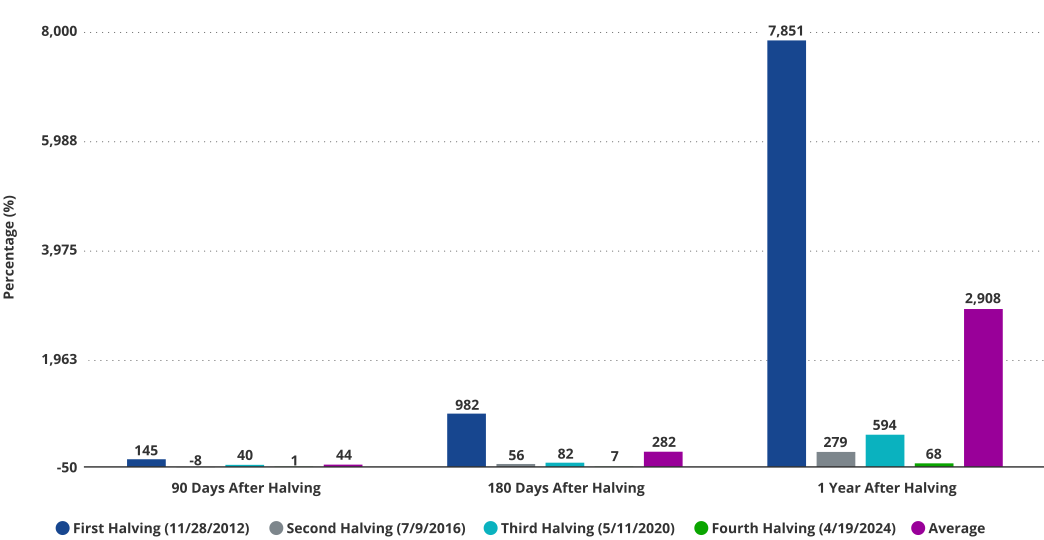
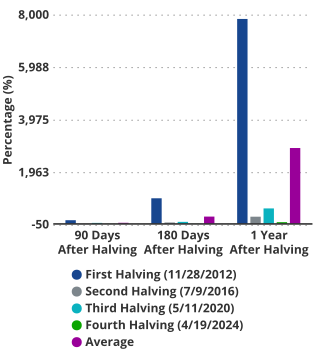
Source: Bloomberg; VanEck research as of 12/31/2025. Past performance is not indicative of future results. Not intended as a recommendation to buy or sell any securities named herein.
These halvings reduce the new supply of bitcoin over time. In addition, bitcoin's finite supply makes it distinct from fiat currencies, whose supply can expand based on policy choices. Periods of rapid monetary expansion and persistent inflation have renewed investor interest in assets perceived as scarce. In that context, bitcoin's fixed issuance schedule may support the thesis that it can possibly function as a long-term store of value and an alternative to gold for certain investors.
As of February 13, 2026, bitcoin is trading around $68,747 per coin (based on daily close data). This is approximately 45% below its October 2025 peak near $125,173.
Bitcoin Adoption Continues
In its early years, bitcoin was used primarily by technologists and early adopters. Acquiring it was cumbersome, use cases were limited, and few merchants accepted it as payment. That has changed. Over the past several years, adoption has grown substantially as infrastructure around custody, trading, and payments has matured, and more merchants and businesses now accept bitcoin.
The development of user-friendly wallets, exchanges, and marketplaces has reduced technical barriers. At the same time, institutional participation has expanded: hedge funds, asset managers, and other allocators increasingly evaluate bitcoin as a potential store of value and portfolio diversifier.
One of the most notable developments in adoption has been the growth of U.S. spot bitcoin ETFs. As of February 13, 2026, U.S. spot bitcoin ETPs collectively hold 1,268,383 BTC (approximately $87.2B in market value), representing about 6.04% of bitcoin's maximum supply. (Source: Bitbo, February 13, 2026.)
Beyond ETPs, bitcoin is also held by corporations and governments. Treasury trackers collectively report millions of bitcoin held by public companies, private entities, and sovereign holders (for example, Bitbo's treasuries tracker reports roughly 3,767,992 BTC held by tracked entities).
Bitcoin Holdings in Publicly Traded, Private Companies, ETPs, and Countries
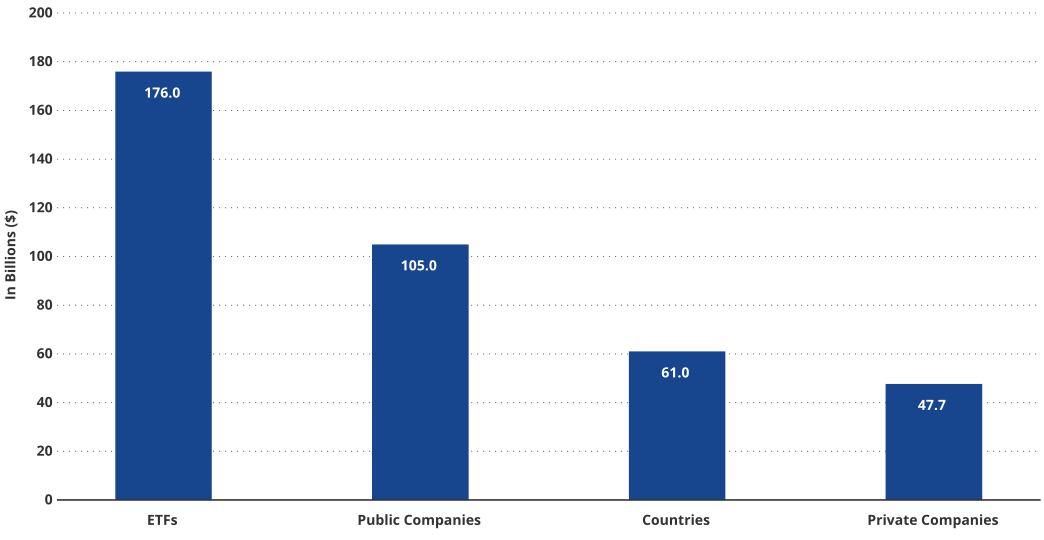
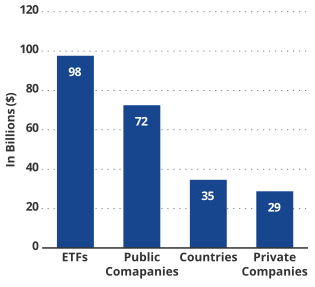
Source: Buybitcoinworldwide as of 02/17/2026. Past performance is not a guarantee of future results. Not intended as a recommendation to buy or sell any securities named herein.
Layer 2 solutions may be the next step in boosting adoption by enabling faster and lower-cost transactions while retaining bitcoin's security model. Built on top of the bitcoin blockchain, the Lightning Network has pushed the boundaries of bitcoin's payments capability through lower fees and faster settlement for small transactions. Other technologies, such as the RGB protocol, aim to enable more complex digital assets and smart-contract-like functionality on top of bitcoin while minimizing changes to the base layer.
Potential Hedge Against Inflation
The rapid expansion in global money supply over the past several years has heightened inflation concerns and renewed interest in assets perceived as scarce. Bitcoin's supply schedule is transparent and cannot be altered without broad network consensus, a feature that distinguishes it from fiat currencies. For some investors, this fixed issuance schedule supports the thesis that bitcoin may serve as a hedge against inflation over long time horizons.
That said, bitcoin's price can still be influenced by liquidity conditions, investor risk appetite, and broader market cycles. Investors considering bitcoin as an inflation hedge should be prepared for periods when bitcoin does not behave like a near-term hedge, even if the long-term scarcity thesis remains intact.
The Role of Bitcoin in a Diversified Portfolio
Beyond its standalone merits, bitcoin may enhance risk-return profiles in diversified portfolios. As shown below, even a small allocation has historically improved cumulative returns for a traditional 60/40 portfolio (equities/bonds) while only modestly increasing overall volatility. That said, outcomes depend on entry points and holding periods, and bitcoin’s volatility can materially increase drawdowns at higher allocations.
Small Bitcoin Exposure Enhances Results
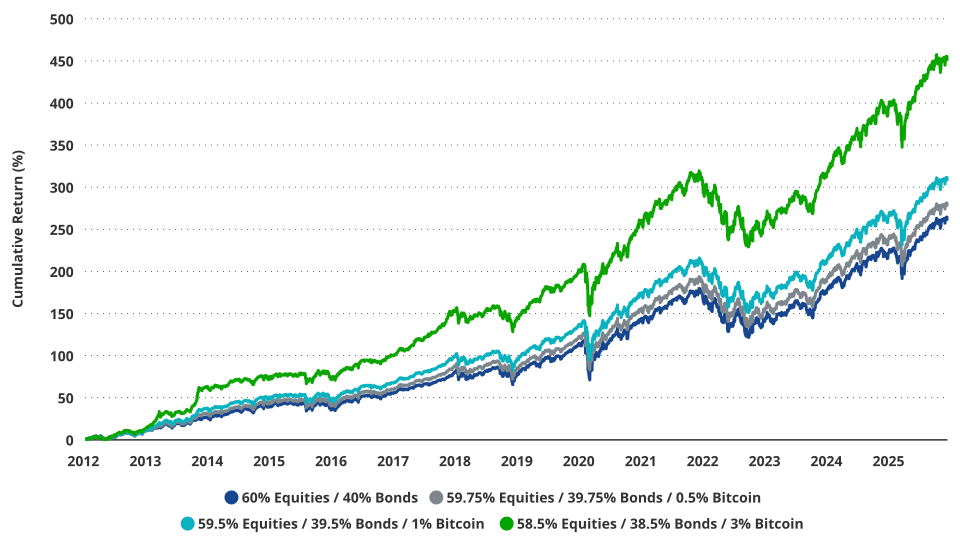
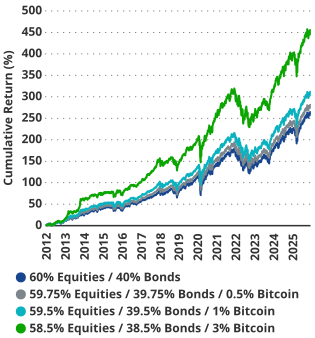
Source: Morningstar; VanEck research as of 12/31/2025. Equities are represented by the S&P 500 Index, Bonds are represented by the Bloomberg Barclays US Aggregate Index, Bitcoin is represented by the MarketVector Bitcoin Index. Past performance is no guarantee of future results. Not intended as a recommendation to buy or sell any securities mentioned herein, to adopt any investment strategy, or as any call to action. Index performance is not representative of fund performance. It is not possible to invest directly in an index. Please see important disclosures at the end of this commentary regarding hypothetical performance.
| 1 year Return |
3 year Return |
5 year Return |
Since Inception Return (Annualized) |
Since Inception Std Dev |
Since Inception Max Drawdown |
Since Inception Sharpe Ratio |
|
| 60% Equities / 40% Bonds | 11.62 | 12.75 | 9.62 | 9.45 | 12.21 | -21.54 | 0.96 |
| 59.75% Equities / 39.75% Bonds / 0.5% Bitcoin | 11.62 | 12.66 | 9.60 | 9.85 | 10.49 | -20.35 | 1.03 |
| 59.5% Equities / 39.5% Bonds / 1% Bitcoin | 11.92 | 13.00 | 9.93 | 10.49 | 10.54 | -20.58 | 1.11 |
| 58.5% Equities / 38.5% Bonds / 3% Bitcoin | 13.14 | 14.35 | 11.27 | 13.03 | 10.99 | -21.53 | 1.37 |
Source: Morningstar; VanEck research as of 12/31/2025. Past performance is no guarantee of future results. Not intended as a recommendation to buy or sell any securities mentioned herein, to adopt any investment strategy, or as any call to action. Index performance is not representative of fund performance. It is not possible to invest directly in an index.
Bitcoin's History of Robust Performance
Despite its well-known volatility, bitcoin has delivered outsized long-term returns relative to many traditional asset classes. Those returns, however, have not been linear; large drawdowns are a recurring feature of bitcoin’s market cycles. The 2025–2026 drawdown is a reminder that investors should size positions appropriately and maintain a time horizon aligned with the asset’s risk profile.
Below are bitcoin's historical returns for various holding periods (based on daily close prices as of February 13, 2026; nearest available look-back dates were used when needed). (Source: Bloomberg)
- 1 year: -28.66%
- 3 years: +217.57%
- 5 years: +44.19%
- 7 years: +1809.10%
- 10 years: +17894.50%
These figures underscore bitcoin's long-term growth potential, while also highlighting the importance of risk management through position sizing, rebalancing discipline, and a willingness to tolerate volatility.
Bitcoin Has Been the Best Performing Asset Class in 9 Out of the Past 12 Years

Source: Morningstar; VanEck research as of 12/31/2025. Bitcoin is represented by MarketVector Bitcoin PR USD; US Equities are represented by the S&P 500 TR USD; Gold is represented by the S&P GSCI Gold Spot; Emerging Markets is represented by Fidelity Emerging Markets TR; Real Estate is represented by the NASDAQ Global Real Estate TR USD; US Bonds are represented by Bloomberg US Aggregate Bond USD; Treasuries are represented by the Bloomberg Aggregate Bond Treasury TR USD; Commodities are represented by the Bloomberg Commodity TR USD. Past performance is no guarantee of future results.
How Might Bitcoin Shine Brighter Than Gold?
Bitcoin and gold both derive appeal from scarcity, but bitcoin offers distinct advantages that may make it more practical in a digital economy.
Divisible: Gold can only be divided into smaller units up to a point, which can make smaller transactions cumbersome. Bitcoin is divisible to eight decimal places (the smallest unit is a Satoshi), making it easier to use for small-value payments and precise allocations.
Transparent: Bitcoin transactions are recorded on a public blockchain, allowing users to verify supply and track transfers on-chain. This transparency makes bitcoin difficult to counterfeit and provides a level of auditability that physical commodities generally cannot match.
Gold has served as a store of value for centuries, and both assets may be considered as hedges against currency debasement and macro uncertainty. With its divisibility and on-chain transparency, bitcoin may continue to compete with gold for a share of “store of value” allocations among retail and institutional investors alike.
To receive more Digital Assets insights, sign up in our subscription center.


IMPORTANT DISCLOSURES
Definitions
Bitcoin (BTC) is a decentralized digital currency, without a central bank or single administrator, that can be sent from user to user on the peer-to-peer Bitcoin network without the need for intermediaries.
RGB is a client-side validated state and a smart contracts system operating on Layer 2 and 3 of the Bitcoin ecosystem.
Lightning Network: A Layer 2 payment protocol layered on top of Bitcoin.
Index Definitions
Index returns assume reinvestment of all income and do not reflect any management fees or brokerage expenses associated with fund returns. Returns for actual fund investors may differ from what is shown because of differences in timing, the amount invested and fees and expenses. You cannot invest directly in an index.
S&P® 500 Index: is a float-adjusted, market-cap-weighted index of 500 leading U.S. companies from across all market sectors.
Bloomberg Barclays U.S. Aggregate Bond TR Index: is a broad-based benchmark that measures the investment grade, U.S. dollar-denominated, fixed-rate taxable bond market. The index includes Treasuries, government-related and corporate securities, MBS (agency fixed-rate and hybrid ARM pass-throughs), ABS and CMBS (agency and non-agency).
Bloomberg Barclays EM Local Currency Government TR Index: is a flagship index that measures the performance of local currency Emerging Markets (EM) debt. Classification as an EM is rules-based and reviewed annually using World Bank income group, International Monetary Fund (IMF) country classification and additional considerations such as market size and investability.
MSCI US REIT Index: is a free float-adjusted market capitalization index that is comprised of equity REITs and represents about 99% of the US REIT universe and securities are classified in the Equity REITs Industry (under the Real Estate sector) according to the Global Industry Classification Standard (GICS®). It however excludes Mortgage REIT and selected Specialized REITs.
S&P GSCI Gold Index: is a sub-index of the S&P GSCI, provides investors with reliable and publicly available benchmark tracking the COMEX gold future. The index is designed to be tradable, readily accessible to market participants, and cost efficient to implement.
Brent Crude Oil Spot Price Index: is one of the major benchmarks used in pricing oil, alongside WTI Crude Oil Spot Price.
MarketVector Bitcoin Benchmark Rate: is designed to be a robust price for Bitcoin in USD, based on one hour median weighted prices.
Fidelity Emerging Markets Index: represents the performance of the MSCI Emerging Market. The index is a market capitalization-weighted index that is designed to measure the investable equity market performance for global investors in emerging markets.
Nasdaq Global Real Estate Index: is a float adjusted market capitalization-weighted index which includes securities in the Nasdaq Global Market Index that are classified in the Real Estate Supersector according to Industry Classification Benchmark (ICB).
Bloomberg Commodity Index: tracks prices of futures contracts on physical commodities on the commodity markets.
All S&P indices listed are products of S&P Dow Jones Indices LLC and/or its affiliates and has been licensed for use by Van Eck Associates Corporation. Copyright © 2024 S&P Dow Jones Indices LLC, a division of S&P Global, Inc., and/or its affiliates. All rights reserved. Redistribution or reproduction in whole or in part are prohibited without written permission of S&P Dow Jones Indices LLC. For more information on any of S&P Dow Jones Indices LLC’s indices please visit https://www.spglobal.com/spdji/en/. S&P® is a registered trademark of S&P Global and Dow Jones® is a registered trademark of Dow Jones Trademark Holdings LLC. Neither S&P Dow Jones Indices LLC, Dow Jones Trademark Holdings LLC, their affiliates nor their third party licensors make any representation or warranty, express or implied, as to the ability of any index to accurately represent the asset class or market sector that it purports to represent and neither S&P Dow Jones Indices LLC, Dow Jones Trademark Holdings LLC, their affiliates nor their third party licensors shall have any liability for any errors, omissions, or interruptions of any index or the data included therein.
Please note that VanEck may offer investments products that invest in the asset class(es) or industries included herein.
This is not an offer to buy or sell, or a solicitation of any offer to buy or sell any of the securities, financial instruments or digital assets mentioned herein. The information presented does not involve the rendering of personalized investment, financial, legal, or tax advice. Certain statements contained herein may constitute projections, forecasts and other forward looking statements, which do not reflect actual results. Information provided by third-party sources are believed to be reliable and have not been independently verified for accuracy or completeness and cannot be guaranteed. Any opinions, projections, forecasts, and forward-looking statements presented herein are valid as of the date of this communication and are subject to change without notice. The information herein represents the opinion of the author(s), but not necessarily those of VanEck or its employees.
There are inherent risks with fixed income investing. These risks may include interest rate, call, credit, market, inflation, government policy, liquidity, or junk bond. When interest rates rise, bond prices fall. This risk is heightened with investments in longer duration fixed-income securities and during periods when prevailing interest rates are low or negative.
Emerging Market securities are subject to greater risks than U.S. domestic investments. These additional risks may include exchange rate fluctuations and exchange controls; less publicly available information; more volatile or less liquid securities markets; and the possibility of arbitrary action by foreign governments, or political, economic or social instability.
Gold investments are subject to the risks associated with concentrating its assets in the gold industry, which can be significantly affected by international economic, monetary, political developments and other risks specific to the gold industry. Foreign and emerging market gold security investments may entail heightened risks, such as adverse political and economic developments unique to a country or a region, currency fluctuations or controls, and the possibility of arbitrary action by foreign governments, or political, economic or social instability.
Hard assets investments are subject to risks associated with real estate, precious metals, natural resources and commodities and events related to these industries, foreign investments, illiquidity, credit, interest rate fluctuations, inflation, leverage, and non-diversification.
Investments in digital assets and Web3 companies are highly speculative and involve a high degree of risk. These risks include, but are not limited to: the technology is new and many of its uses may be untested; intense competition; slow adoption rates and the potential for product obsolescence; volatility and limited liquidity, including but not limited to, inability to liquidate a position; loss or destruction of key(s) to access accounts or the blockchain; reliance on digital wallets; reliance on unregulated markets and exchanges; reliance on the internet; cybersecurity risks; and the lack of regulation and the potential for new laws and regulation that may be difficult to predict. Moreover, the extent to which Web3 companies or digital assets utilize blockchain technology may vary, and it is possible that even widespread adoption of blockchain technology may not result in a material increase in the value of such companies or digital assets.
Digital asset prices are highly volatile, and the value of digital assets, and Web3 companies, can rise or fall dramatically and quickly. If their value goes down, there’s no guarantee that it will rise again. As a result, there is a significant risk of loss of your entire principal investment.
Digital assets are not generally backed or supported by any government or central bank and are not covered by FDIC or SIPC insurance. Accounts at digital asset custodians and exchanges are not protected by SPIC and are not FDIC insured. Furthermore, markets and exchanges for digital assets are not regulated with the same controls or customer protections available in traditional equity, option, futures, or foreign exchange investing.
Digital assets include, but are not limited to, cryptocurrencies, tokens, NFTs, assets stored or created using blockchain technology, and other Web3products.
Web3 companies include but are not limited to, companies that involve the development, innovation, and/or utilization of blockchain, digital assets, or crypto technologies.
All investing is subject to risk, including the possible loss of the money you invest. As with any investment strategy, there is no guarantee that investment objectives will be met and investors may lose money. Diversification does not ensure a profit or protect against a loss in a declining market. Past performance is no guarantee of future performance.
© Van Eck Associates Corporation.
IMPORTANT DISCLOSURES
Definitions
Bitcoin (BTC) is a decentralized digital currency, without a central bank or single administrator, that can be sent from user to user on the peer-to-peer Bitcoin network without the need for intermediaries.
RGB is a client-side validated state and a smart contracts system operating on Layer 2 and 3 of the Bitcoin ecosystem.
Lightning Network: A Layer 2 payment protocol layered on top of Bitcoin.
Index Definitions
Index returns assume reinvestment of all income and do not reflect any management fees or brokerage expenses associated with fund returns. Returns for actual fund investors may differ from what is shown because of differences in timing, the amount invested and fees and expenses. You cannot invest directly in an index.
S&P® 500 Index: is a float-adjusted, market-cap-weighted index of 500 leading U.S. companies from across all market sectors.
Bloomberg Barclays U.S. Aggregate Bond TR Index: is a broad-based benchmark that measures the investment grade, U.S. dollar-denominated, fixed-rate taxable bond market. The index includes Treasuries, government-related and corporate securities, MBS (agency fixed-rate and hybrid ARM pass-throughs), ABS and CMBS (agency and non-agency).
Bloomberg Barclays EM Local Currency Government TR Index: is a flagship index that measures the performance of local currency Emerging Markets (EM) debt. Classification as an EM is rules-based and reviewed annually using World Bank income group, International Monetary Fund (IMF) country classification and additional considerations such as market size and investability.
MSCI US REIT Index: is a free float-adjusted market capitalization index that is comprised of equity REITs and represents about 99% of the US REIT universe and securities are classified in the Equity REITs Industry (under the Real Estate sector) according to the Global Industry Classification Standard (GICS®). It however excludes Mortgage REIT and selected Specialized REITs.
S&P GSCI Gold Index: is a sub-index of the S&P GSCI, provides investors with reliable and publicly available benchmark tracking the COMEX gold future. The index is designed to be tradable, readily accessible to market participants, and cost efficient to implement.
Brent Crude Oil Spot Price Index: is one of the major benchmarks used in pricing oil, alongside WTI Crude Oil Spot Price.
MarketVector Bitcoin Benchmark Rate: is designed to be a robust price for Bitcoin in USD, based on one hour median weighted prices.
Fidelity Emerging Markets Index: represents the performance of the MSCI Emerging Market. The index is a market capitalization-weighted index that is designed to measure the investable equity market performance for global investors in emerging markets.
Nasdaq Global Real Estate Index: is a float adjusted market capitalization-weighted index which includes securities in the Nasdaq Global Market Index that are classified in the Real Estate Supersector according to Industry Classification Benchmark (ICB).
Bloomberg Commodity Index: tracks prices of futures contracts on physical commodities on the commodity markets.
All S&P indices listed are products of S&P Dow Jones Indices LLC and/or its affiliates and has been licensed for use by Van Eck Associates Corporation. Copyright © 2024 S&P Dow Jones Indices LLC, a division of S&P Global, Inc., and/or its affiliates. All rights reserved. Redistribution or reproduction in whole or in part are prohibited without written permission of S&P Dow Jones Indices LLC. For more information on any of S&P Dow Jones Indices LLC’s indices please visit https://www.spglobal.com/spdji/en/. S&P® is a registered trademark of S&P Global and Dow Jones® is a registered trademark of Dow Jones Trademark Holdings LLC. Neither S&P Dow Jones Indices LLC, Dow Jones Trademark Holdings LLC, their affiliates nor their third party licensors make any representation or warranty, express or implied, as to the ability of any index to accurately represent the asset class or market sector that it purports to represent and neither S&P Dow Jones Indices LLC, Dow Jones Trademark Holdings LLC, their affiliates nor their third party licensors shall have any liability for any errors, omissions, or interruptions of any index or the data included therein.
Please note that VanEck may offer investments products that invest in the asset class(es) or industries included herein.
This is not an offer to buy or sell, or a solicitation of any offer to buy or sell any of the securities, financial instruments or digital assets mentioned herein. The information presented does not involve the rendering of personalized investment, financial, legal, or tax advice. Certain statements contained herein may constitute projections, forecasts and other forward looking statements, which do not reflect actual results. Information provided by third-party sources are believed to be reliable and have not been independently verified for accuracy or completeness and cannot be guaranteed. Any opinions, projections, forecasts, and forward-looking statements presented herein are valid as of the date of this communication and are subject to change without notice. The information herein represents the opinion of the author(s), but not necessarily those of VanEck or its employees.
There are inherent risks with fixed income investing. These risks may include interest rate, call, credit, market, inflation, government policy, liquidity, or junk bond. When interest rates rise, bond prices fall. This risk is heightened with investments in longer duration fixed-income securities and during periods when prevailing interest rates are low or negative.
Emerging Market securities are subject to greater risks than U.S. domestic investments. These additional risks may include exchange rate fluctuations and exchange controls; less publicly available information; more volatile or less liquid securities markets; and the possibility of arbitrary action by foreign governments, or political, economic or social instability.
Gold investments are subject to the risks associated with concentrating its assets in the gold industry, which can be significantly affected by international economic, monetary, political developments and other risks specific to the gold industry. Foreign and emerging market gold security investments may entail heightened risks, such as adverse political and economic developments unique to a country or a region, currency fluctuations or controls, and the possibility of arbitrary action by foreign governments, or political, economic or social instability.
Hard assets investments are subject to risks associated with real estate, precious metals, natural resources and commodities and events related to these industries, foreign investments, illiquidity, credit, interest rate fluctuations, inflation, leverage, and non-diversification.
Investments in digital assets and Web3 companies are highly speculative and involve a high degree of risk. These risks include, but are not limited to: the technology is new and many of its uses may be untested; intense competition; slow adoption rates and the potential for product obsolescence; volatility and limited liquidity, including but not limited to, inability to liquidate a position; loss or destruction of key(s) to access accounts or the blockchain; reliance on digital wallets; reliance on unregulated markets and exchanges; reliance on the internet; cybersecurity risks; and the lack of regulation and the potential for new laws and regulation that may be difficult to predict. Moreover, the extent to which Web3 companies or digital assets utilize blockchain technology may vary, and it is possible that even widespread adoption of blockchain technology may not result in a material increase in the value of such companies or digital assets.
Digital asset prices are highly volatile, and the value of digital assets, and Web3 companies, can rise or fall dramatically and quickly. If their value goes down, there’s no guarantee that it will rise again. As a result, there is a significant risk of loss of your entire principal investment.
Digital assets are not generally backed or supported by any government or central bank and are not covered by FDIC or SIPC insurance. Accounts at digital asset custodians and exchanges are not protected by SPIC and are not FDIC insured. Furthermore, markets and exchanges for digital assets are not regulated with the same controls or customer protections available in traditional equity, option, futures, or foreign exchange investing.
Digital assets include, but are not limited to, cryptocurrencies, tokens, NFTs, assets stored or created using blockchain technology, and other Web3products.
Web3 companies include but are not limited to, companies that involve the development, innovation, and/or utilization of blockchain, digital assets, or crypto technologies.
All investing is subject to risk, including the possible loss of the money you invest. As with any investment strategy, there is no guarantee that investment objectives will be met and investors may lose money. Diversification does not ensure a profit or protect against a loss in a declining market. Past performance is no guarantee of future performance.
© Van Eck Associates Corporation.