Inside Active Management: How We Invest in the Crypto Economy
November 06, 2025
Read Time 4 MIN
Key Takeaways:
- Discipline turns volatility into opportunity by grounding crypto investing in research, not speculation.
- Conviction builds when company fundamentals and onchain activity confirm the same trend.
- Active positioning across market cycles helps capture innovation while protecting against excess.
Active Management Starts with Discipline
In our previous post, we explored why active management matters in crypto, how adaptability helps investors navigate powerful cycles and shifting opportunities. But adaptability alone isn’t enough. True active management comes from discipline: applying structured research, judgment, and balance to every decision.
In the onchain economy, this means blending traditional financial analysis with blockchain-specific insights, knowing how to assess, adjust, and remain composed when conditions change.
1. Building the Investable Universe
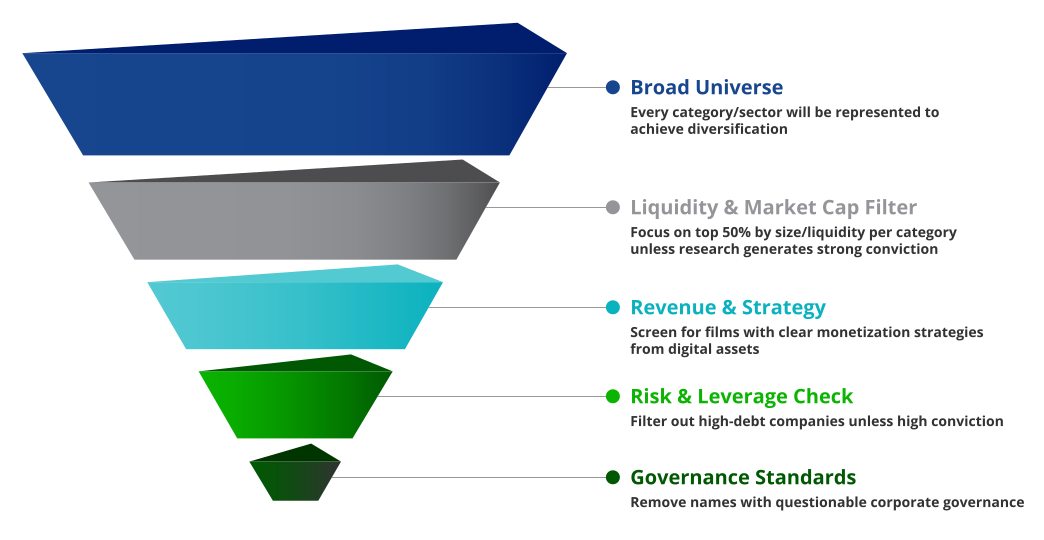
Every active strategy begins with defining the opportunity set. In digital assets, that means identifying publicly traded companies meaningfully exposed to Bitcoin and the broader adoption of digital assets. This wide universe includes companies across every GICS sector, predominantly spanning fintech, e-commerce, energy infrastructure, and AI computing.
From thousands of global equities, we narrow the universe through three filters:
- Relevance: Companies must derive real revenue or strategic value from blockchain or digital assets.
- Scale and Strength: We focus on listed equities with meaningful size, liquidity, and sound balance sheets.
- Governance: Transparency and prudent financial management are essential; excessive leverage or weak oversight is screened out early.
This disciplined foundation identifies companies built for endurance from data-center operators powering AI workloads to fintechs integrating blockchain payments.
2. Combining Fundamental and Onchain Research
Traditional equity analysis still matters because cash flow growth, profitability, and competitive advantage form the backbone of long-term success. But active research goes further.
If research is like coaching a college football team, it’s about evaluating the play calls, execution, and game management, not just looking at the final score. A single flashy win doesn’t make a championship team, and one bad quarter doesn’t define a season. The same applies to digital asset companies. We care about consistency, execution, and how they perform under pressure.
Onchain metrics like transaction volumes or network fees provide real-time visibility into blockchain activity. Macro indicators like global liquidity, dollar strength, or policy shifts help us understand the playing field. And fundamental research reveals whether a company has a sustainable game plan.
Just as a coach desires to build a team with a solid run game, disciplined defense, and a quarterback who protects the football, we favor companies with reliable revenue, manageable leverage, and leadership we can trust. Those are the teams that may not always dominate the highlight reel but are most poised to endure and come away victorious.
When fundamentals, onchain data, and macro context align, conviction builds. When they diverge, it’s time to reassess the playbook.
3. Positioning Across Market Cycles
Crypto markets remain cyclical, with volatility often centered around Bitcoin’s halving cycle. For active managers, the goal isn’t to predict each turn but to position intelligently through them.
Bitcoin Returns Across Expansion and Contraction Cycles Over the Last 10 Calendar Years (%)

Source: Morningstar, as of December 2024. Chart shows cumulative percentage returns for Bitcoin from January 2015 and does not reflect spot price levels. Expansion: periods beginning at a market trough and continuing until the next 10% decline. Expansions encompass recovery through the prior peak or a new all-time high. Contraction: periods beginning at a market peak and continuing through the subsequent trough that includes a decline of 10% or more. References to Bitcoin market cycles are based on historical data and are provided for illustrative purposes only. Past performance is no guarantee of future results. Please see important disclosures at the end of the presentation.
Recommended subscription
Just as great coaches adjust the game plan depending on their opponent, active managers adapt exposure based on where we are in the market cycle.
- In expansion phases, exposure tilts toward higher-beta areas—miners and exchanges that thrive on liquidity and optimism.
- In downturns, companies with diversified revenue and durable balance sheets, such as semiconductor or infrastructure firms may get added exposure.
It’s about sticking to the game plan, protecting against turnovers, keeping it manageable on third down, and taking your shot when the opportunity arises. The process generally underweights leverage, avoiding companies or instruments reliant on borrowed exposure. That discipline helps reduce the impact of speculative excess that often defines crypto bull markets.
4. Continuous Monitoring and Risk Management
Markets, like seasons, shift quickly. Constant evaluation ensures the strategy stays disciplined even as conditions change.
Teams track earnings, governance, and onchain data alongside macro signals that influence sentiment. The goal is to spot subtle cracks before they widen, such as rising leverage, slowing network activity, or liquidity stress.
Sentiment indicators such as futures funding rates and Relative Unrealized Profit help identify overheated or oversold markets, offering cues to adjust before volatility spikes. When red flags emerge, exposure can be trimmed or exited, an option passive strategies lack. Meanwhile, new entrants are continuously assessed as innovation reshapes the opportunity set.

5. From Research to Real-World Impact
The payoff of this process is clarity. Decisions rest on measurable fundamentals and data-backed conviction, not momentum or hype. Active management provides a framework to participate in one of the most dynamic corners of global markets while maintaining a balance between opportunity and risk.
Much like a team that plays a complete game, successful active management means not being one-dimensional or careless with the football. It’s about preparation, adaptability, and execution across every phase of the market, putting investors in a position to win over the long run.
Lasting Advantage Comes from Discipline
Active management in the onchain economy is ultimately about discipline: integrating research, real-time data, and risk awareness to navigate an evolving market.
For investors seeking a structured, research-driven approach, VanEck’s Onchain Economy ETF (NODE) applies active management to companies leading the digital asset transition.
NODE | VanEck Onchain Economy ETF
To receive more Digital Assets insights, sign up in our subscription center.


Important Disclosures
The Fund may invest nearly all of its net assets in either Digital Transformation Companies and/or Digital Asset Instruments.The Fund does not invest in digital assets or commodities directly.
An investment in the Fund involves a substantial degree of risk and is not suitable for all investors. Investors in the Fund should be willing to accept a high degree of volatility in the price of the Fund’s Shares and the possibility of significant losses. An investment in the Fund is not a deposit with a bank and is not insured or guaranteed by the Federal Deposit Insurance Corporation or any other government agency. Therefore, you should consider carefully various risks before investing in the Fund, each of which could significantly and adversely affect the value of an investment in the Fund.
An investment in the Fund may be subject to risks which include, among others, risks related to investing in digital transformation companies, digital asset instruments, commodities and commodity-linked instruments, subsidiary investment, commodity regulatory (with respect to investments in the subsidiary), tax (with respect to investments in the subsidiary), gap, liquidity, derivatives, new fund, regulatory, non-diversified, small- and medium-capitalization companies, foreign securities, emerging market issuers, market, operational, active management, authorized participant concentration, no guarantee of active trading market, trading issues, fund shares trading, premium/discount risk and liquidity of fund shares, industry concentration, cash transactions, underlying investment vehicle, and affiliated investment vehicle risks, all of which may adversely affect the fund. Emerging market issuers and foreign securities may be subject to securities markets, political and economic, investment and repatriation restrictions, different rules and regulations, less publicly available financial information, foreign currency and exchange rates, operational and settlement, and corporate and securities laws risks. Small- and medium-capitalization companies may be subject to elevated risks.
Digital asset instruments may be subject to risks associated with investing in digital asset exchange-traded products (“ETPs”), which include the historical extreme volatility of the digital asset and cryptocurrency market, as well as less regulation and thus fewer investor protections, as these ETPs are not investment companies registered under the Investment Company Act of 1940 (“1940 Act”) or commodity pools for the purposes of the Commodity Exchange Act (“CEA”).
The technology relating to digital assets, including blockchain, is new and developing and the risks associated with digital assets may not fully emerge until the technology is widely used. Digital asset technologies are used by companies to optimize their business practices, whether by using the technology within their business or operating business lines involved in the operation of the technology. The cryptographic keys necessary to transact a digital asset may be subject to theft, loss, or destruction, which could adversely affect a company’s business or operations if it were dependent on the digital asset. There may be risks posed by the lack of regulation for digital assets and any future regulatory developments could affect the viability and expansion of the use of digital assets.
Commodities and commodity-linked instruments may be subject to further risks, including tax and futures contracts risk. This risk may be adversely affected by “negative roll yields” in “contango” markets. The Fund will “roll” out of one futures contract as the expiration date approaches and into another futures contract with a later expiration date. The “rolling” feature creates the potential for a significant negative effect on the Fund’s performance that is independent of the performance of the spot prices of the underlying commodity. The “spot price” of a commodity is the price of that commodity for immediate delivery, as opposed to a futures price, which represents the price for delivery on a specified date in the future. The Fund would be expected to experience negative roll yield if the futures prices tend to be greater than the spot price. A market where futures prices are generally greater than spot prices is referred to as a “contango” market. Therefore, if the futures market for a given commodity is in contango, then the value of a futures contract on that commodity would tend to decline over time (assuming the spot price remains unchanged), because the higher futures price would fall as it converges to the lower spot price by expiration. Extended period of contango may cause significant and sustained losses. Additionally, because of the frequency with which the Fund may roll futures contracts, the impact of contango on Fund performance may be greater than it would have been if the Fund rolled futures contracts less frequently.
Investing involves substantial risk and high volatility, including possible loss of principal. An investor should consider the investment objective, risks, charges and expenses of the Fund carefully before investing. To obtain a prospectus and summary prospectus, which contains this and other information, call 800.826.2333 or visit vaneck.com. Please read the prospectus and summary prospectus carefully before investing.
© Van Eck Securities Corporation, Distributor, a wholly-owned subsidiary of Van Eck Associates Corporation.
Related Funds
Important Disclosures
The Fund may invest nearly all of its net assets in either Digital Transformation Companies and/or Digital Asset Instruments.The Fund does not invest in digital assets or commodities directly.
An investment in the Fund involves a substantial degree of risk and is not suitable for all investors. Investors in the Fund should be willing to accept a high degree of volatility in the price of the Fund’s Shares and the possibility of significant losses. An investment in the Fund is not a deposit with a bank and is not insured or guaranteed by the Federal Deposit Insurance Corporation or any other government agency. Therefore, you should consider carefully various risks before investing in the Fund, each of which could significantly and adversely affect the value of an investment in the Fund.
An investment in the Fund may be subject to risks which include, among others, risks related to investing in digital transformation companies, digital asset instruments, commodities and commodity-linked instruments, subsidiary investment, commodity regulatory (with respect to investments in the subsidiary), tax (with respect to investments in the subsidiary), gap, liquidity, derivatives, new fund, regulatory, non-diversified, small- and medium-capitalization companies, foreign securities, emerging market issuers, market, operational, active management, authorized participant concentration, no guarantee of active trading market, trading issues, fund shares trading, premium/discount risk and liquidity of fund shares, industry concentration, cash transactions, underlying investment vehicle, and affiliated investment vehicle risks, all of which may adversely affect the fund. Emerging market issuers and foreign securities may be subject to securities markets, political and economic, investment and repatriation restrictions, different rules and regulations, less publicly available financial information, foreign currency and exchange rates, operational and settlement, and corporate and securities laws risks. Small- and medium-capitalization companies may be subject to elevated risks.
Digital asset instruments may be subject to risks associated with investing in digital asset exchange-traded products (“ETPs”), which include the historical extreme volatility of the digital asset and cryptocurrency market, as well as less regulation and thus fewer investor protections, as these ETPs are not investment companies registered under the Investment Company Act of 1940 (“1940 Act”) or commodity pools for the purposes of the Commodity Exchange Act (“CEA”).
The technology relating to digital assets, including blockchain, is new and developing and the risks associated with digital assets may not fully emerge until the technology is widely used. Digital asset technologies are used by companies to optimize their business practices, whether by using the technology within their business or operating business lines involved in the operation of the technology. The cryptographic keys necessary to transact a digital asset may be subject to theft, loss, or destruction, which could adversely affect a company’s business or operations if it were dependent on the digital asset. There may be risks posed by the lack of regulation for digital assets and any future regulatory developments could affect the viability and expansion of the use of digital assets.
Commodities and commodity-linked instruments may be subject to further risks, including tax and futures contracts risk. This risk may be adversely affected by “negative roll yields” in “contango” markets. The Fund will “roll” out of one futures contract as the expiration date approaches and into another futures contract with a later expiration date. The “rolling” feature creates the potential for a significant negative effect on the Fund’s performance that is independent of the performance of the spot prices of the underlying commodity. The “spot price” of a commodity is the price of that commodity for immediate delivery, as opposed to a futures price, which represents the price for delivery on a specified date in the future. The Fund would be expected to experience negative roll yield if the futures prices tend to be greater than the spot price. A market where futures prices are generally greater than spot prices is referred to as a “contango” market. Therefore, if the futures market for a given commodity is in contango, then the value of a futures contract on that commodity would tend to decline over time (assuming the spot price remains unchanged), because the higher futures price would fall as it converges to the lower spot price by expiration. Extended period of contango may cause significant and sustained losses. Additionally, because of the frequency with which the Fund may roll futures contracts, the impact of contango on Fund performance may be greater than it would have been if the Fund rolled futures contracts less frequently.
Investing involves substantial risk and high volatility, including possible loss of principal. An investor should consider the investment objective, risks, charges and expenses of the Fund carefully before investing. To obtain a prospectus and summary prospectus, which contains this and other information, call 800.826.2333 or visit vaneck.com. Please read the prospectus and summary prospectus carefully before investing.
© Van Eck Securities Corporation, Distributor, a wholly-owned subsidiary of Van Eck Associates Corporation.