Investing in Digital Assets Without Full Crypto Exposure
February 25, 2026
Read Time 5 MIN
Key Takeaways:
- Advisors seek digital asset exposure but want to manage volatility and downside risk.
- Adoption is shifting to real-world infrastructure, finance and computing use cases.
- NODE provides diversified equity exposure to the onchain economy in an ETF structure.
This material is for informational purposes only and is not a recommendation to buy or sell any security. Fund holdings are subject to change. Investments in digital assets are subject to significant risk and are not suitable for all investors. The value of digital assets is highly volatile, and it is possible to lose your entire principal investment.
Advisors Want Exposure, But Not Excess Risk
Many financial advisors recognize the long-term potential of digital assets. At the same time, they face practical constraints.
Sharp drawdowns, client discomfort, and unfamiliar risk profiles make “all-in” crypto exposure a challenging fit for most portfolios. For many advisors, the real question isn’t whether to gain exposure, but how to do so responsibly.
That distinction matters.
Digital Asset Adoption Is Moving into the Real Economy
Digital assets are no longer confined to trading activity or token prices. Increasingly, blockchain technology is showing up in real-world economic functions, powering infrastructure, improving financial processes, and supporting data-intensive computing.
In many cases, this adoption is being led not by cryptocurrencies themselves, but by public companies with tangible assets, revenues, and governance structures. That shift opens the door to a more familiar way of accessing the opportunity.
Digital Asset Adoption in Today’s Real World
Companies are already using digital asset infrastructure in practical, revenue-generating ways.
Some firms are building data centers specifically designed for high-density computing, with the power and cooling required to support AI and blockchain workloads. One clear example is Applied Digital. Applied Digital ($APLD) develops data centers built to handle the power and cooling demands of high-density computing, supporting both blockchain networks and AI workloads. It shows how digital asset exposure can come from owning critical infrastructure, rather than relying solely on cryptocurrency prices.
Others are adapting existing digital asset infrastructure to create more stable, contracted revenue streams. A different example comes from Core Scientific ($CORZ). The company has entered into long-term hosting agreements that bring its contracted high-performance computing (HPC) capacity to roughly 590 megawatts across multiple data center sites. At that scale, 590 megawatts are enough power to support multiple hyperscale data centers running around the clock. This shift shows how digital asset infrastructure can move beyond mining and toward predictable, usage-based revenue supported by long-term contracts.
Core Scientific Data Centers and AI Factories Across Seven States
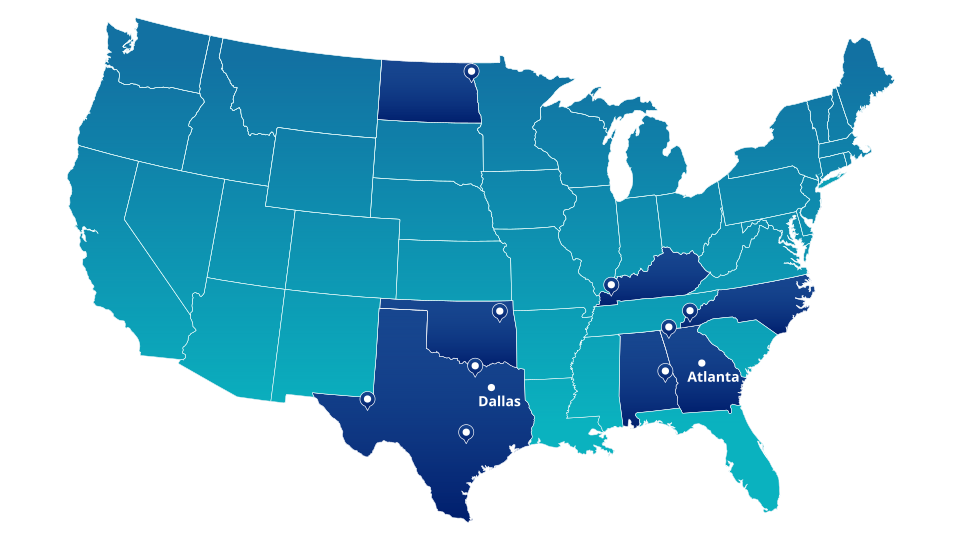

Source: Core Scientific as of 2.11.26.
In financial services, blockchain is being used to reduce costs rather than create speculation. Figure Technology Solutions ($FIGR) uses blockchain as the system of record for home equity lending, allowing loans to be funded in as few as five days rather than weeks. By relying on automated valuation models instead of manual appraisals and reconciliation, Figure reduces or eliminates appraisal fees, avoids annual line fees, and removes early closure penalties. Together, these changes show how blockchain can materially lower costs and speed up settlement in traditional lending while improving customer experience.
Taken together, these examples highlight a common theme: digital assets are increasingly about infrastructure and efficiency, not just price movements. But that does not mean all forms of digital asset exposure are equally easy to use in client portfolios.
Why Pure Crypto Exposure Can Be Hard to Use
Despite these developments, direct crypto exposure remains difficult for many advisors to incorporate.
Rapid drawdowns can be challenging to explain to clients. Leverage and speculative behavior can amplify downside risk. And token-based investments often don’t align neatly with traditional portfolio construction frameworks.
This caution isn’t resistance to innovation. It’s prudent risk management.
How NODE Approaches Digital Assets Differently
The VanEck Onchain Economy ETF NODE is built around the idea that participation does not require full exposure.
Rather than focusing primarily on tokens, NODE emphasizes equity exposure to the onchain economy, investing in companies that build, operate, and benefit from digital asset infrastructure. The portfolio spans areas such as data centers, energy, fintech, and selectively chosen digital asset instruments.
The strategy is actively managed with explicit awareness of volatility, seeking to participate in long-term adoption while avoiding unnecessary concentration and leverage.
In simple terms, NODE is designed to engage with the theme, without taking on the full volatility profile of pure crypto exposure.
A Different Way to Participate in the Onchain Economy
Structure matters, especially when introducing emerging investment themes.
NODE offers exposure through a familiar ETF wrapper, with holdings in publicly traded companies that often have multiple drivers of performance beyond digital asset prices alone. This diversified approach can help smooth outcomes over time and make the story easier for clients to understand.
The goal isn’t to eliminate volatility, but to manage it thoughtfully.
Recommended subscription
A Practical Role for Digital Assets in Portfolios
For many advisors, NODE can serve as:
- A measured entry point into digital asset exposure
- A complement to existing crypto allocations
- A satellite position tied to long-term digital transformation
This flexibility allows advisors to scale exposure as conviction and client comfort evolve.
The Future of Digital Assets
Digital asset adoption is becoming more economic and less speculative as it spreads across infrastructure, finance, and computing.
Advisors no longer have to choose between participating in this shift and maintaining disciplined risk management. NODE is designed to help bridge that gap, offering access to digital asset leaders with an active approach that balances growth and stability as market conditions change.
NODE | VanEck Onchain Economy ETF
To receive more Digital Assets insights, sign up in our subscription center.


IMPORTANT DISCLOSURES
This is not an offer to buy or sell, or a recommendation to buy or sell any of the securities, financial instruments or digital assets mentioned herein. The information presented does not involve the rendering of personalized investment, financial, legal, tax advice, or any call to action. Certain statements contained herein may constitute projections, forecasts and other forward-looking statements, which do not reflect actual results, are for illustrative purposes only, are valid as of the date of this communication, and are subject to change without notice. Actual future performance of any assets or industries mentioned are unknown. Information provided by third party sources are believed to be reliable and have not been independently verified for accuracy or completeness and cannot be guaranteed. VanEck does not guarantee the accuracy of third party data. The information herein represents the opinion of the author(s), but not necessarily those of VanEck or its other employees.
Index performance is not representative of fund performance. It is not possible to invest directly in an index.
VanEck Onchain Economy ETF (“NODE”)
The Fund may invest nearly all of its net assets in either Digital Transformation Companies and/or Digital Asset Instruments. The Fund does not invest in digital assets or commodities directly.
An investment in the Fund involves a substantial degree of risk and is not suitable for all investors.Investors in the Fund should be willing to accept a high degree of volatility in the price of the Fund’s Shares and the possibility of significant losses. An investment in the Fund is not a deposit with a bank and is not insured or guaranteed by the Federal Deposit Insurance Corporation or any other government agency. Therefore, you should consider carefully various risks before investing in the Fund, each of which could significantly and adversely affect the value of an investment in the Fund.
An investment in the Fund may be subject to risks which include, among others, risks related to investing in digital transformation companies, digital asset instruments, commodities and commodity-linked instruments, subsidiary investment, commodity regulatory (with respect to investments in the subsidiary), tax (with respect to investments in the subsidiary), gap, liquidity, derivatives, new fund, regulatory, non-diversified, small- and medium-capitalization companies, foreign securities, emerging market issuers, market, operational, active management, authorized participant concentration, no guarantee of active trading market, trading issues, fund shares trading, premium/discount risk and liquidity of fund shares, industry concentration, cash transactions, underlying investment vehicle, and affiliated investment vehicle risks, all of which may adversely affect the fund. Emerging market issuers and foreign securities may be subject to securities markets, political and economic, investment and repatriation restrictions, different rules and regulations, less publicly available financial information, foreign currency and exchange rates, operational and settlement, and corporate and securities laws risks. Small- and medium-capitalization companies may be subject to elevated risks.
Digital asset instruments may be subject to risks associated with investing in digital asset exchange-traded products (“ETPs”), which include the historical extreme volatility of the digital asset and cryptocurrency market, as well as less regulation and thus fewer investor protections, as these ETPs are not investment companies registered under the Investment Company Act of 1940 (“1940 Act”) or commodity pools for the purposes of the Commodity Exchange Act (“CEA”).
The technology relating to digital assets, including blockchain, is new and developing and the risks associated with digital assets may not fully emerge until the technology is widely used. Digital asset technologies are used by companies to optimize their business practices, whether by using the technology within their business or operating business lines involved in the operation of the technology. The cryptographic keys necessary to transact a digital asset may be subject to theft, loss, or destruction, which could adversely affect a company’s business or operations if it were dependent on the digital asset. There may be risks posed by the lack of regulation for digital assets and any future regulatory developments could affect the viability and expansion of the use of digital assets.
Investing involves substantial risk and high volatility, including possible loss of principal. An investor should consider the investment objective, risks, charges and expenses of a Fund carefully before investing. To obtain a prospectus and summary prospectus, which contain this and other information, call 800.826.2333 or visit vaneck.com. Please read the prospectus and summary prospectus carefully before investing. © Van Eck Securities Corporation, Distributor, a wholly-owned subsidiary of Van Eck Associates Corporation
Related Funds
IMPORTANT DISCLOSURES
This is not an offer to buy or sell, or a recommendation to buy or sell any of the securities, financial instruments or digital assets mentioned herein. The information presented does not involve the rendering of personalized investment, financial, legal, tax advice, or any call to action. Certain statements contained herein may constitute projections, forecasts and other forward-looking statements, which do not reflect actual results, are for illustrative purposes only, are valid as of the date of this communication, and are subject to change without notice. Actual future performance of any assets or industries mentioned are unknown. Information provided by third party sources are believed to be reliable and have not been independently verified for accuracy or completeness and cannot be guaranteed. VanEck does not guarantee the accuracy of third party data. The information herein represents the opinion of the author(s), but not necessarily those of VanEck or its other employees.
Index performance is not representative of fund performance. It is not possible to invest directly in an index.
VanEck Onchain Economy ETF (“NODE”)
The Fund may invest nearly all of its net assets in either Digital Transformation Companies and/or Digital Asset Instruments. The Fund does not invest in digital assets or commodities directly.
An investment in the Fund involves a substantial degree of risk and is not suitable for all investors.Investors in the Fund should be willing to accept a high degree of volatility in the price of the Fund’s Shares and the possibility of significant losses. An investment in the Fund is not a deposit with a bank and is not insured or guaranteed by the Federal Deposit Insurance Corporation or any other government agency. Therefore, you should consider carefully various risks before investing in the Fund, each of which could significantly and adversely affect the value of an investment in the Fund.
An investment in the Fund may be subject to risks which include, among others, risks related to investing in digital transformation companies, digital asset instruments, commodities and commodity-linked instruments, subsidiary investment, commodity regulatory (with respect to investments in the subsidiary), tax (with respect to investments in the subsidiary), gap, liquidity, derivatives, new fund, regulatory, non-diversified, small- and medium-capitalization companies, foreign securities, emerging market issuers, market, operational, active management, authorized participant concentration, no guarantee of active trading market, trading issues, fund shares trading, premium/discount risk and liquidity of fund shares, industry concentration, cash transactions, underlying investment vehicle, and affiliated investment vehicle risks, all of which may adversely affect the fund. Emerging market issuers and foreign securities may be subject to securities markets, political and economic, investment and repatriation restrictions, different rules and regulations, less publicly available financial information, foreign currency and exchange rates, operational and settlement, and corporate and securities laws risks. Small- and medium-capitalization companies may be subject to elevated risks.
Digital asset instruments may be subject to risks associated with investing in digital asset exchange-traded products (“ETPs”), which include the historical extreme volatility of the digital asset and cryptocurrency market, as well as less regulation and thus fewer investor protections, as these ETPs are not investment companies registered under the Investment Company Act of 1940 (“1940 Act”) or commodity pools for the purposes of the Commodity Exchange Act (“CEA”).
The technology relating to digital assets, including blockchain, is new and developing and the risks associated with digital assets may not fully emerge until the technology is widely used. Digital asset technologies are used by companies to optimize their business practices, whether by using the technology within their business or operating business lines involved in the operation of the technology. The cryptographic keys necessary to transact a digital asset may be subject to theft, loss, or destruction, which could adversely affect a company’s business or operations if it were dependent on the digital asset. There may be risks posed by the lack of regulation for digital assets and any future regulatory developments could affect the viability and expansion of the use of digital assets.
Investing involves substantial risk and high volatility, including possible loss of principal. An investor should consider the investment objective, risks, charges and expenses of a Fund carefully before investing. To obtain a prospectus and summary prospectus, which contain this and other information, call 800.826.2333 or visit vaneck.com. Please read the prospectus and summary prospectus carefully before investing. © Van Eck Securities Corporation, Distributor, a wholly-owned subsidiary of Van Eck Associates Corporation