Softer Growth – Blessing in Disguise?
December 21, 2022
Read Time 2 MIN
Market Rates Expectations
The market stepped up its expectations for the implied policy rate in Japan (to “mighty” 0.3% in one year or so), but the outlook for many emerging markets (EM) is decidedly less hawkish. The Czech National Bank kept its policy rate on hold once again – as expected – and the market sees room for about 80bps of rate cuts next year on the back of on-going disinflation (to mid-single digits in H2-2023) and a significant growth slowdown (from 2.4% in 2022 to zero next year). Colombia’s inflation risks are more persistent – this fact was reflected in yesterday’s central bank minutes – but the economy is slowing, and this might pave the way for smaller rate hikes in H1-2023 (with some potential for easing in H2, if disinflation allows). The market also started to price in a small H2-2023 rate cut in India – even though the central bank minutes cautioned against excessive optimism on the disinflation front.
Milder Recession
Softer growth – both on a country level and global – can pose policy challenges for those EMs where inflation is the farthest from the target. The latest data flow, however, suggests that the slowdown might be less dramatic than previously feared. South Korea reported a small pickup in its 20-day exports, while the Conference Board Consumer Confidence Index in the U.S. surprised meaningfully to the upside. Germany’s IFO survey was also slightly better than expected. And, of course, we are eagerly awaiting China’s domestic activity gauges for December to see whether the reflation narrative is working. The share of negative 2023 growth revisions reached 83% in the past three months (Bloomberg’s consensus pool of 101 countries) – but are we at the bottom of the “growth negativity” trend?
External Balances in EM
One potential silver lining in a slower growth environment is that it can lead to better current account outcomes. Naturally, this does not apply to all EMs, but the market might appreciate smaller current account deficits in Central Europe (expected 4% of GDP in Poland and 7% of GDP in Hungary in 2022) and Colombia (5.8% of GDP in 2022) – because the respective fiscal gaps are also wide, translating into additional bond issuance. We also keep an eye on Brazil – the country’s basic balance (current account + foreign direct investments) is very healthy now (see chart below), but incoming administration’s spending plans can boost domestic consumption (and, potentially, demand for imports), whereas stalling reforms can discourage capital inflows (including direct). Stay tuned!
Chart at a Glance: Brazil’s External Balance Is Healthy but Will It Last?
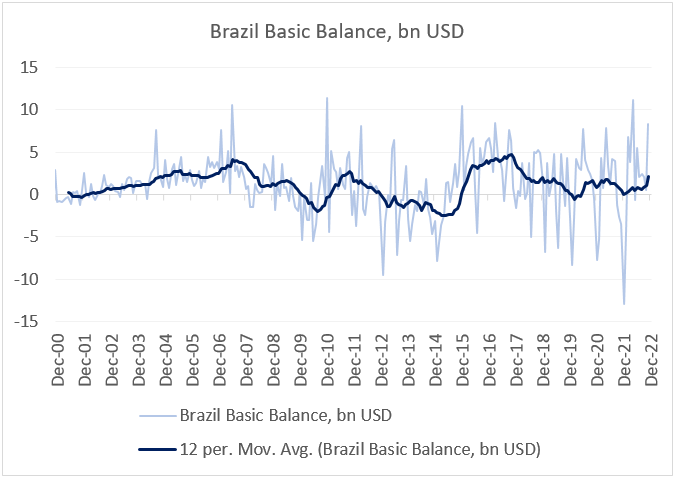
Source: Bloomberg LP.
