Stagflation Or Not… Yet?
June 01, 2022
Read Time 2 MIN
The stagflation narrative was on full display in EMEA, but the picture in other EM regions is mixed - Brazil’s stagflation “escape velocity” looks more and more convincing these days.
EMEA Persistent Stagflation Drumbeat
Emerging Markets (EM) activity gauges come in all shapes and forms these days – some agreeing with the stagflation narrative, and some saying “maybe not”. The stagflationary signal is currently the most persistent in EMEA. Turkey’s PMI (Purchasing Managers Index) stayed in contraction zone in May (49.2), with annual headline inflation surging to 70%. Poland’s inflation accelerated to nearly 14% year-on-year, but the manufacturing PMI unexpectedly dropped from healthy 52.4 into contraction zone (48.5 – see chart below). Hungary’s PMI managed to stay above 50.0, but it moderated much more than expected – against the backdrop of rapidly rising prices (9.5% year-on-year in May). Trends like these pose additional policy challenges for authorities – the Hungarian central bank decided to slow the pace of rate hikes, and the government’s 2023 fiscal plans are now gaining in importance (especially for bond investors).
EM Asia – Much More Than Stagflation
EM Asia is also attracting a lot of attention – as a latecomer to the EM hiking cycle – but the regional dynamics are mixed. Very solid PMIs in India (54.6) and the Philippines (54.1) show that domestic demand is strong, and the central banks were absolutely right to raise policy rates in order to bring inflation back to target. By contrast, China’s Caixin PMI (a higher representation of private firms vs. the official PMI) was not only contractionary but also weaker than expected. China’s continuing reliance on the supply-side stimulus is likely to keep inflation pressures under control in the foreseeable future (=no stagflation in sight). Malaysia’s combo of barely-expansionary PMI and 2.3% annual inflation also does not look very stagflationary – and it also tells us that the central bank can easily afford to take a pause after the surprising liftoff in May. Thailand’s PMI was stable and decent (51.9) – but would this be enough to force the central bank shift to gears and hike on June 8? An upside inflation surprise later this week can be a catalyst.
Brazil - Stronger Growth/Lower Inflation Pattern Emerging
Finally, a nice rise in Brazil’s PMI (54.2) gives more credence to the latest growth upgrades – it also makes a dent in Brazil’s stagflation storyline. Yes, headline inflation is still “double-digit” high, but the consensus believes it had peaked in April, and this should allow the central bank to end its very aggressive tightening cycle in the next several months. Stay tuned!
Chart at a Glance: “Warsaw, We Have A Problem”, A Stagflation Problem
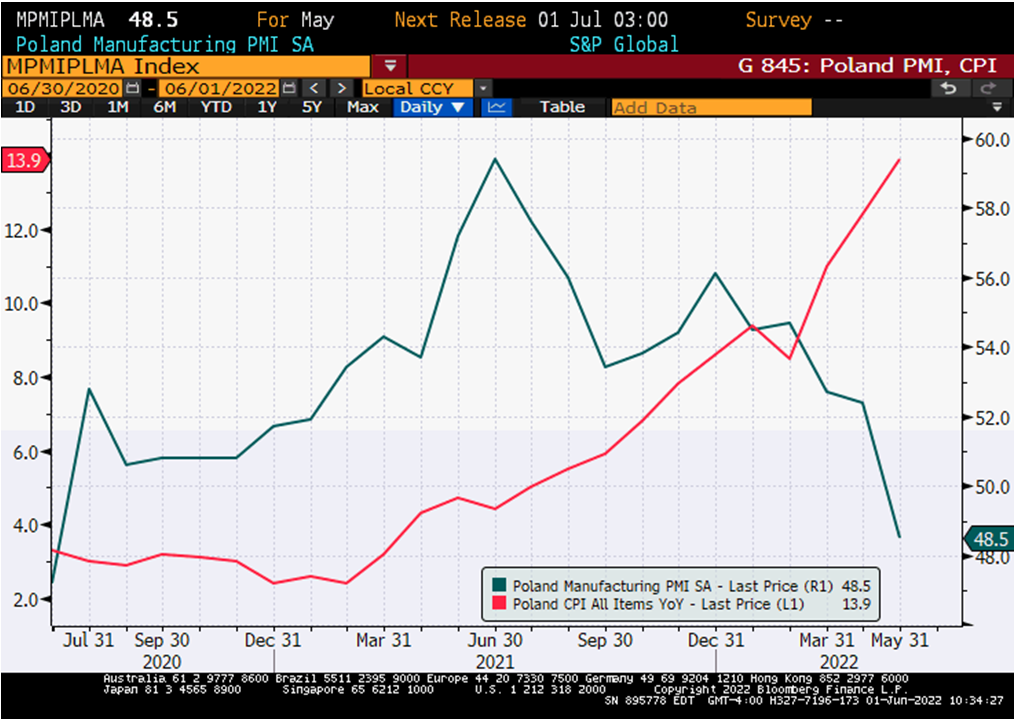
Source: Bloomberg LP

PMI – Purchasing Managers’ Index: economic indicators derived from monthly surveys of private sector companies. A reading above 50 indicates expansion, and a reading below 50 indicates contraction; ISM – Institute for Supply Management PMI: ISM releases an index based on more than 400 purchasing and supply managers surveys; both in the manufacturing and non-manufacturing industries; CPI – Consumer Price Index: an index of the variation in prices paid by typical consumers for retail goods and other items; PPI – Producer Price Index: a family of indexes that measures the average change in selling prices received by domestic producers of goods and services over time; PCE inflation – Personal Consumption Expenditures Price Index: one measure of U.S. inflation, tracking the change in prices of goods and services purchased by consumers throughout the economy; MSCI – Morgan Stanley Capital International: an American provider of equity, fixed income, hedge fund stock market indexes, and equity portfolio analysis tools; VIX – CBOE Volatility Index: an index created by the Chicago Board Options Exchange (CBOE), which shows the market's expectation of 30-day volatility. It is constructed using the implied volatilities on S&P 500 index options.; GBI-EM – JP Morgan’s Government Bond Index – Emerging Markets: comprehensive emerging market debt benchmarks that track local currency bonds issued by Emerging market governments; EMBI – JP Morgan’s Emerging Market Bond Index: JP Morgan's index of dollar-denominated sovereign bonds issued by a selection of emerging market countries; EMBIG - JP Morgan’s Emerging Market Bond Index Global: tracks total returns for traded external debt instruments in emerging markets.
The information presented does not involve the rendering of personalized investment, financial, legal, or tax advice. This is not an offer to buy or sell, or a solicitation of any offer to buy or sell any of the securities mentioned herein. Certain statements contained herein may constitute projections, forecasts and other forward looking statements, which do not reflect actual results. Certain information may be provided by third-party sources and, although believed to be reliable, it has not been independently verified and its accuracy or completeness cannot be guaranteed. Any opinions, projections, forecasts, and forward-looking statements presented herein are valid as the date of this communication and are subject to change. The information herein represents the opinion of the author(s), but not necessarily those of VanEck.
Investing in international markets carries risks such as currency fluctuation, regulatory risks, economic and political instability. Emerging markets involve heightened risks related to the same factors as well as increased volatility, lower trading volume, and less liquidity. Emerging markets can have greater custodial and operational risks, and less developed legal and accounting systems than developed markets.
All investing is subject to risk, including the possible loss of the money you invest. As with any investment strategy, there is no guarantee that investment objectives will be met and investors may lose money. Diversification does not ensure a profit or protect against a loss in a declining market. Past performance is no guarantee of future performance.
PMI – Purchasing Managers’ Index: economic indicators derived from monthly surveys of private sector companies. A reading above 50 indicates expansion, and a reading below 50 indicates contraction; ISM – Institute for Supply Management PMI: ISM releases an index based on more than 400 purchasing and supply managers surveys; both in the manufacturing and non-manufacturing industries; CPI – Consumer Price Index: an index of the variation in prices paid by typical consumers for retail goods and other items; PPI – Producer Price Index: a family of indexes that measures the average change in selling prices received by domestic producers of goods and services over time; PCE inflation – Personal Consumption Expenditures Price Index: one measure of U.S. inflation, tracking the change in prices of goods and services purchased by consumers throughout the economy; MSCI – Morgan Stanley Capital International: an American provider of equity, fixed income, hedge fund stock market indexes, and equity portfolio analysis tools; VIX – CBOE Volatility Index: an index created by the Chicago Board Options Exchange (CBOE), which shows the market's expectation of 30-day volatility. It is constructed using the implied volatilities on S&P 500 index options.; GBI-EM – JP Morgan’s Government Bond Index – Emerging Markets: comprehensive emerging market debt benchmarks that track local currency bonds issued by Emerging market governments; EMBI – JP Morgan’s Emerging Market Bond Index: JP Morgan's index of dollar-denominated sovereign bonds issued by a selection of emerging market countries; EMBIG - JP Morgan’s Emerging Market Bond Index Global: tracks total returns for traded external debt instruments in emerging markets.
The information presented does not involve the rendering of personalized investment, financial, legal, or tax advice. This is not an offer to buy or sell, or a solicitation of any offer to buy or sell any of the securities mentioned herein. Certain statements contained herein may constitute projections, forecasts and other forward looking statements, which do not reflect actual results. Certain information may be provided by third-party sources and, although believed to be reliable, it has not been independently verified and its accuracy or completeness cannot be guaranteed. Any opinions, projections, forecasts, and forward-looking statements presented herein are valid as the date of this communication and are subject to change. The information herein represents the opinion of the author(s), but not necessarily those of VanEck.
Investing in international markets carries risks such as currency fluctuation, regulatory risks, economic and political instability. Emerging markets involve heightened risks related to the same factors as well as increased volatility, lower trading volume, and less liquidity. Emerging markets can have greater custodial and operational risks, and less developed legal and accounting systems than developed markets.
All investing is subject to risk, including the possible loss of the money you invest. As with any investment strategy, there is no guarantee that investment objectives will be met and investors may lose money. Diversification does not ensure a profit or protect against a loss in a declining market. Past performance is no guarantee of future performance.