Q2 2026 Outlook: The Reset Is Your Entry Point
April 13, 2026
Read Time 5 MIN
Key Takeaways:
- Corporate adoption is driving the next phase of AI growth and monetization.
- Semiconductor demand remains strong as AI capex continues.
- Private credit markets are pricing in stress not supported by current fundamentals, creating opportunity.
- Fiscal risks are rising again, reinforcing the need for portfolio hedges like gold.
- India remains a long-term growth opportunity, while bitcoin is mixed near term but constructive long term.

After a volatile start to the year, several areas of the market have reset, creating more attractive opportunities in Q2. While macro conditions remain broadly supportive, the opportunity set is increasingly driven by selectivity rather than broad exposure.
AI Compute and Semiconductor Demand Still Underestimated
The most important development this quarter is a shift in how AI is being monetized.
While early adoption was driven by consumers, the data now clearly shows that corporate America is opening its wallet. Companies are increasingly willing to invest heavily in AI due to the productivity gains it delivers, often completing tasks in minutes that previously took days.
We are seeing this firsthand at VanEck. Our own token usage has scaled to billions per day following enterprise rollouts of ChatGPT and Claude, offering a real-world example of how quickly these tools are being embedded into workflows.

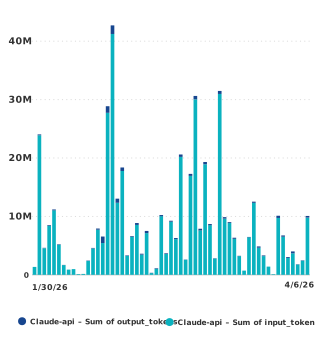
Source: VanEck. Data as of April 2026. Any projections and forward-looking statements herein are for illustrative purposes only, reflect current views as of this date, are subject to change without notice, and are not necessarily those of VanEck or its other employees. Nothing herein should be construed as investment advice, a recommendation, or a call to action. Digital assets involve significant risk and may not be suitable for all investors. Investing involves risk, including possible loss of principal. There is no guarantee any strategy will achieve its objectives, and diversification does not ensure a profit or protect against loss. Historical data only. Past performance is no guarantee of future results.
This combination of rising adoption alongside improving efficiency helps explain why total AI spending continues to grow. Even as costs per unit fall, the number of use cases and users is expanding rapidly.
Despite this, markets remain skeptical that current levels of capital expenditure can continue over the longer term. We believe that skepticism may be misplaced. Companies are unlikely to cut spending on a technology that delivers clear efficiency gains.
As a result, semiconductors remain a high-conviction area, with markets potentially underestimating the durability of AI-driven demand
Private Credit Fear vs. Reality
Private credit continues to dominate headlines, but the underlying data tells a more measured story.
Default rates remain relatively low, and the broader U.S. economy remains resilient. Yet many business development companies (BDCs) are trading at discounts that imply significantly higher levels of stress than current fundamentals would suggest.
This disconnect creates opportunity. Publicly traded BDCs benefit from structural advantages, such as the absence of forced selling, which make them more resilient than many investors assume.
At the same time, the valuation reset has extended to the managers themselves. Firms such as Ares and Blue Owl, which previously traded at elevated multiples, now appear far more reasonably valued relative to their long-term earnings potential.
Hedge Fiscal Uncertainty with Gold
While the fiscal outlook had been improving, new spending proposals have reintroduced uncertainty. Higher deficits could place upward pressure on long-term interest rates, which would have broad implications for financial markets. This is one of the key risks we are monitoring closely.
Gold remains a critical hedge in this environment. Importantly, its long-term drivers extend beyond inflation or short-term geopolitical events. Instead, gold is supported by global wealth growth and a gradual shift away from reliance on the U.S. dollar.
Short-term volatility, such as recent selling tied to energy price shocks, does not change this longer-term trend. We continue to view gold as a strategic allocation, particularly on pullbacks.
More broadly, commodity markets are also being shaped by geopolitical developments. In the near term, shifts in the futures curve into backwardation can create additional return drivers for investors, particularly through positive roll yield. However, these dynamics are cyclical and should be understood as part of a broader allocation strategy.
India Remains Long-Term Opportunity Despite Volatility
India continues to offer compelling long-term growth potential, even after a period of underperformance. Structural reforms, favorable demographics and rapid digital adoption remain intact. At the same time, the market is undergoing a period of adjustment, with traditional business models being disrupted and valuations becoming more attractive.
For long-term investors, this combination of structural growth and improved entry points remains compelling.
Bitcoin Enters a More Complex Cycle
Bitcoin’s traditional four-year cycle appears to have shifted, creating a more nuanced near-term outlook. While past cycles were marked by sharp drawdowns following halving events, recent price behavior suggests a more range-bound environment. This may reflect broader institutional participation and lower volatility.
While the near-term outlook is mixed, the long-term case for adoption remains intact. Current levels may represent a more constructive entry point for investors with a longer horizon.
Where to Allocate Now
Following recent volatility, the investment landscape is offering more targeted opportunities, particularly in areas where fundamentals remain intact despite sentiment weakening and valuations pulling back.
For investors, Q2 is less about broad market direction and more about identifying where resets have created more attractive entry points.
- Lean into AI and semiconductors as enterprise demand continues to drive sustained growth.
- Consider adding exposure to BDCs and private credit managers after recent valuation resets.
- Maintain gold as a portfolio hedge against rising fiscal risks and higher long-term rates.
- Look to India for long-term growth as structural trends remain intact despite volatility.
- Approach Bitcoin opportunistically at current levels with a long-term perspective.
To learn more about how our Asset Allocation Committee is building portfolios in the current environment, watch this webinar replay: A Macro Playbook for Market Volatility and Geopolitical Conflict.
To receive more Investment Outlook insights, sign up in our subscription center.

Important Disclosures
Bitcoin (BTC) is a decentralized digital currency, without a central bank or single administrator, that can be sent from user to user on the peer-to-peer Bitcoin network without the need for intermediaries.
Please note that VanEck may offer investments products that invest in the asset class(es) or industries included herein.
This is not an offer to buy or sell, or a recommendation to buy or sell any of the securities, financial instruments or digital assets mentioned herein. The information presented does not involve the rendering of personalized investment, financial, legal, tax advice, or any call to action. Certain statements contained herein may constitute projections, forecasts and other forward-looking statements, which do not reflect actual results, are for illustrative purposes only, are valid as of the date of this communication, and are subject to change without notice. Actual future performance of any assets or industries mentioned is unknown. Information provided by third party sources are believed to be reliable and have not been independently verified for accuracy or completeness and cannot be guaranteed. VanEck does not guarantee the accuracy of third-party data. The information herein represents the opinion of the author(s), but not necessarily those of VanEck or its other employees.
For other important disclosures please read more.
All investing is subject to risk, including the possible loss of the money you invest. As with any investment strategy, there is no guarantee that investment objectives will be met and investors may lose money. Diversification does not ensure a profit or protect against a loss in a declining market. Past performance is no guarantee of future results.
© Van Eck Associates Corporation.
Important Disclosures
Bitcoin (BTC) is a decentralized digital currency, without a central bank or single administrator, that can be sent from user to user on the peer-to-peer Bitcoin network without the need for intermediaries.
Please note that VanEck may offer investments products that invest in the asset class(es) or industries included herein.
This is not an offer to buy or sell, or a recommendation to buy or sell any of the securities, financial instruments or digital assets mentioned herein. The information presented does not involve the rendering of personalized investment, financial, legal, tax advice, or any call to action. Certain statements contained herein may constitute projections, forecasts and other forward-looking statements, which do not reflect actual results, are for illustrative purposes only, are valid as of the date of this communication, and are subject to change without notice. Actual future performance of any assets or industries mentioned is unknown. Information provided by third party sources are believed to be reliable and have not been independently verified for accuracy or completeness and cannot be guaranteed. VanEck does not guarantee the accuracy of third-party data. The information herein represents the opinion of the author(s), but not necessarily those of VanEck or its other employees.
For other important disclosures please read more.
All investing is subject to risk, including the possible loss of the money you invest. As with any investment strategy, there is no guarantee that investment objectives will be met and investors may lose money. Diversification does not ensure a profit or protect against a loss in a declining market. Past performance is no guarantee of future results.
© Van Eck Associates Corporation.