3 Steps for Active EM Bond Investing
October 17, 2025
Read Time 5 MIN
Emerging markets (EM) bonds have grown into one of the most compelling opportunities in fixed income. With lower debt levels, more independent central banks, and attractive real yields, many EMs are better positioned than developed markets to deliver stability and growth. Yet, EM debt remains under-owned, in part because outcomes can diverge dramatically between countries and currencies. Below, we summarize the investment process for the actively managed VanEck Emerging Markets Bond ETF, which aims to capitalize on these disparities and opportunities across the EM debt spectrum.
A Valuation-Based Investment Process
At the core of our EM bond strategy is a simple principle: buy cheap bonds, not good or bad risks. To do that, step 1 of our investment process builds a radar chart showing each country’s superiority, or inferiority, relative to the global average measured in units of standard deviation across a range of 16 fundamental metrics. These metrics include:
- Standard measures such as general government debt/GDP
- Flow measures such as the current account deficit/GDP
- Structural measures, such as the banking system’s common equity-to-assets ratio
We display these as a radar chart, as shown below. When the country result is inside the global mean result, it is superior to the global mean. Conversely, when the result is outside the global mean, it is inferior to the global average.
Brazil’s Radar Chart Measuring Fundamental Risk

Source: Bloomberg LP. Data as of June 2025. Past performance does not guarantee future results.
Recommended subscription
From there, we then “line up” all the radar charts for the countries and companies in the investable universe. We do this by calculating a z-score (a way of measuring how far a data point is from the average of a dataset) based on each country’s superiority, or inferiority, to the global mean, as measured by the metrics detailed in the chart. We compare these z-scores and bonds with similar yields. You can see the fundamental z-score on the x-axis in the chart below. Those with superior fundamentals are on the left, inferior to the right. We highlight Brazil and see that the real yields (y-axis) of Brazil’s 10-year local-currency bonds are higher than the predicted level (along the dotted line), based on all the other EM 10-year local-currency bonds. They are therefore considered cheap. We conduct this exercise for every tenor of bond. And we conduct it for hard-currency bonds using yield or spread on the y-axis, which you can see in the chart below.
In this chart, you can see that Brazilian hard-currency bonds are expensive. The output of Step 1 in our process is a list of the cheapest bonds in EM, whether local, hard, sovereign, or corporate, based entirely on their deviation from the predicted level. The cheaper they are, the more they are liked and therefore the higher they are on the list. You may notice that Step 1 favors tenors/duration based entirely on cheapness relative to fundamentals, not the investment teams’ top-down opinion on U.S. ‘duration’. If the 20-year Brazilian local currency bond was cheaper relative to the predicted level than the 10-year Brazilian local currency bond, the 20-year bond is higher in the ranking.
Real 10-year Local Currency Valuations and Country Fundamentals Determine which 10-year Local Currency Bonds Pay Real Yields that are Relatively Too High
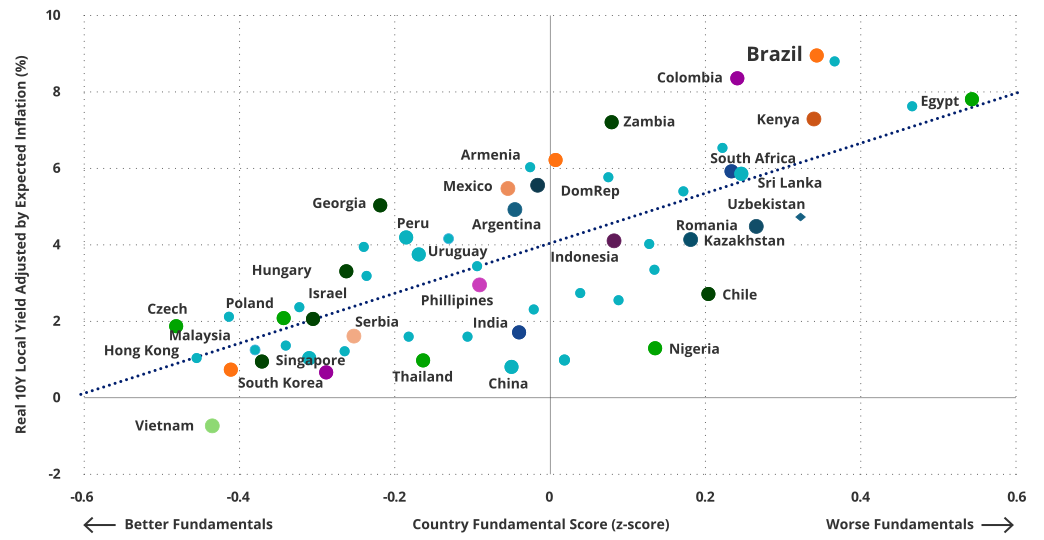
Source: VanEck Research; IMF; World Bank; Moody’s; Bloomberg LP. Data as of June 2025. Past performance is not indicative of future results. Z-score is a statistical measurement that describes a value’s relationship to the mean of a group of values.
EMBX | VanEck Emerging Markets Bond ETF
Sovereign 5-year Bond Valuations and Country Fundamentals Determine which 5-year Hard Currency Sovereign Bonds Pay Yields that Are Relatively Too High

Source: VanEck Research; IMF; World Bank; Moody’s; Bloomberg LP. Data as of June 2025. Past performance is not indicative of future results. Z-score is a statistical measurement that describes a value’s relationship to the mean of a group of values.
The result of Step 1 is a list of the cheapest bonds in EM, without reference to whether they are local currency, hard-currency sovereign, or hard-currency corporate. It is an entirely quantitative process. In EM, however, there are many non-systematic risks, such as politics, elections, index exclusions/inclusions, global trade partnerships and treaties that are not appropriately managed by the quantitative framework in Step 1.
This is why we have Step 2, which may eliminate or impact the ranking of bonds chosen by Step 1. Step 2 of the process involves three ‘tests’:
- Political/policy
- Economic
- Technical A ‘strong fail’ result on any of these removes a bond from the list.
Each test is applied bond-by-bond, so the investment team can fail a 10-year local currency bond from a country but not a 5-year hard-currency bond from the same country. All changes in Step 2 are subjective and documented by the investment team monthly.
Step 3 is portfolio construction. In Step 1, the cheaper a bond is relative to the predicted level, the greater the allocation. If a bond is in the top quartile of cheapness, it gets the maximum allocation of 1.5 times the benchmark weight for that country. If a bond is in the second quartile, the maximum allocation is 1.25 times the benchmark weight for that country and so on, until the portfolio is full. The portfolio is constructed in consideration of risk constraints.
VanEck Emerging Markets Bond Strategy
The VanEck Emerging Markets Bond ETF was one of the first blended emerging markets bond strategies in the market. The Strategy adopts a comprehensive approach, investing across the entire EM bond spectrum to maximize opportunity and manage risk in a complex global environment. Despite global disruptions such as the COVID pandemic, the war in Ukraine and economic troubles in China, the fund has consistently outperformed both global and U.S. bond benchmarks, earning top-quartile rankings from Morningstar over the past five years. This outperformance, both absolute and risk-adjusted, is also evident when compared to the fund’s benchmark, which includes the same EM bonds but without active management. VanEck’s active strategy, which focuses on fundamental value relative to bond risk premia, aims to capitalize on these shifts and avoid troubled issuers, making a compelling case for a diversified, actively managed EM bond allocation.
Use these links to learn more about the investment case for EM bonds, the power of adding EM bonds to a 60/40 portfolio, and the benefits of an actively managed EM approach.
To receive more Emerging Markets Bonds insights, sign up in our subscription center.

IMPORTANT DISCLOSURES
This is not an offer to buy or sell, or a recommendation to buy or sell any of the securities, financial instruments or digital assets mentioned herein. The information presented does not involve the rendering of personalized investment, financial, legal, tax advice, or any call to action. Certain statements contained herein may constitute projections, forecasts and other forward-looking statements, which do not reflect actual results, are for illustrative purposes only, are valid as of the date of this communication, and are subject to change without notice. Actual future performance of any assets or industries mentioned are unknown. Information provided by third party sources are believed to be reliable and have not been independently verified for accuracy or completeness and cannot be guaranteed. VanEck does not guarantee the accuracy of third party data. The information herein represents the opinion of the speaker(s), but not necessarily those of VanEck or its other employees.
An investment in the VanEck Emerging Markets Bond ETF may be subject to risks which include, among others, risks related to active management, credit, credit-linked notes, currency management strategies, derivatives, emerging market issuers, ESG investing, foreign currency, foreign securities, hedging, high portfolio turnover, high yield securities, interest rate, market, non-diversified, operational, restricted securities, investing in other funds, sovereign bond, special risk considerations of investing in African, Asian, and Latin American issuers, authorized participant concentration, no guarantee of active trading market, trading issues, fund shares trading, premium/discount and liquidity of fund shares, and cash transactions risks, all of which may adversely affect the Fund. Emerging market issuers and foreign securities may be subject to securities markets, political and economic, investment and repatriation restrictions, different rules and regulations, less publicly available financial information, foreign currency and exchange rates, operational and settlement, and corporate and securities laws risks.
Investing involves substantial risk and high volatility, including possible loss of principal. An investor should consider the investment objective, risks, charges and expenses of the Funds carefully before investing. To obtain a prospectus and summary prospectus, which contain this and other information, call 800.826.2333 or visit vaneck.com. Please read the prospectus and summary prospectus carefully before investing.
© Van Eck Securities Corporation, Distributor, a wholly owned subsidiary of Van Eck Associates Corporation.
Related Funds
IMPORTANT DISCLOSURES
This is not an offer to buy or sell, or a recommendation to buy or sell any of the securities, financial instruments or digital assets mentioned herein. The information presented does not involve the rendering of personalized investment, financial, legal, tax advice, or any call to action. Certain statements contained herein may constitute projections, forecasts and other forward-looking statements, which do not reflect actual results, are for illustrative purposes only, are valid as of the date of this communication, and are subject to change without notice. Actual future performance of any assets or industries mentioned are unknown. Information provided by third party sources are believed to be reliable and have not been independently verified for accuracy or completeness and cannot be guaranteed. VanEck does not guarantee the accuracy of third party data. The information herein represents the opinion of the speaker(s), but not necessarily those of VanEck or its other employees.
An investment in the VanEck Emerging Markets Bond ETF may be subject to risks which include, among others, risks related to active management, credit, credit-linked notes, currency management strategies, derivatives, emerging market issuers, ESG investing, foreign currency, foreign securities, hedging, high portfolio turnover, high yield securities, interest rate, market, non-diversified, operational, restricted securities, investing in other funds, sovereign bond, special risk considerations of investing in African, Asian, and Latin American issuers, authorized participant concentration, no guarantee of active trading market, trading issues, fund shares trading, premium/discount and liquidity of fund shares, and cash transactions risks, all of which may adversely affect the Fund. Emerging market issuers and foreign securities may be subject to securities markets, political and economic, investment and repatriation restrictions, different rules and regulations, less publicly available financial information, foreign currency and exchange rates, operational and settlement, and corporate and securities laws risks.
Investing involves substantial risk and high volatility, including possible loss of principal. An investor should consider the investment objective, risks, charges and expenses of the Funds carefully before investing. To obtain a prospectus and summary prospectus, which contain this and other information, call 800.826.2333 or visit vaneck.com. Please read the prospectus and summary prospectus carefully before investing.
© Van Eck Securities Corporation, Distributor, a wholly owned subsidiary of Van Eck Associates Corporation.