EM Bonds Shine as DM Bonds Struggle with Fiscal Drift
October 07, 2025
Read Time 8 MIN
Key Takeaways:
- Low-debt EMs with orthodox central banks are benefiting, while high-debt DMs face fiscal and political strains.
- EM governments are popular and disciplined, contrasting with weak and unpopular DM leadership.
- A steadily strengthening CNY is a key, overlooked driver of EM currency resilience.
The VanEck Emerging Markets Bond ETF† was up 1.70% in September, compared to 1.59% for its benchmark, the 50% J.P. Morgan Government Bond Index - Emerging Markets Global Diversified (GBI-EM) and 50% J.P. Morgan Emerging Markets Bond Index (EMBI). Year to date, the ETF is up 15.41%, compared to 13.04% for its benchmark, and 8.12% and 6.96% for the Global Agg and 10-year Treasuries, respectively. Argentina was a big mover this month (and an outperformer for the ETF). We touch on it inside, though we caution that there is a significant global oversupply of opinions on Argentina. Here’s ours: we didn’t like Argentina because policy was way ahead of politics and there was a consensus overweight/bullish view in markets and among cab drivers globally. Then politics arose, bonds puked, and there was a chance of a fairly fast and easy bridge loan from the US (which then happened). So, when it crashed, we got bullish. It’s a trade, we are still in a heavily game-theoretic stage. We remain very bullish on local currency, while somewhat cautious on USD duration especially with low spreads. The ETF has around 55.3% in curated local currency, the rest in mostly higher-yielding USD bonds. Carry is 6.4%, yield to worst (YTW) is 8.1%, and duration is 5.3. The maximum for local is 60% and our bias remains to be close to the maximum.
EMBX | VanEck Emerging Markets Bond ETF
Average Annual Total Returns* (%) (In USD)
| as of 9/30/2025 | MTD | 3MO | YTD | 1 Year | 3 Years | 5 Years | 10 Years | Since Inception |
| VanEck Emerging Markets Bond ETF | 1.70 | 4.40 | 15.41 | 9.72 | 13.39 | 4.87 | 5.27 | 3.39 |
| 50%JPM GBI-EM GD and 50%JPM EMBI GD | 1.59 | 3.78 | 13.04 | 7.98 | 11.80 | 2.33 | 3.92 | 2.48 |
| ICE BofA Gbl Brd Mkt TR USD | 0.78 | 0.75 | 8.12 | 2.36 | 5.24 | -2.00 | 0.93 | 0.66 |
| ICE BofA Current 10-Y US Trsy TR USD | 0.94 | 1.81 | 6.93 | 1.35 | 2.85 | -3.08 | 0.53 | 0.74 |
Source: VanEck. EMBX Expense Ratio: Gross: 0.75% | Net: 0.75%
Van Eck Associates Corporation (the “Adviser”) will pay all expenses of the Fund, except for the fee payment under the investment management agreement, acquired fund fees and expenses, interest expense, offering costs, trading expenses, taxes and extraordinary expenses. Notwithstanding the foregoing, the Adviser has agreed to pay the offering costs until at least May 1, 2027. “Other Expenses” have been restated to reflect current fees.
The performance data quoted represents past performance. Past performance is not a guarantee of future results. Investment return and principal value of an investment will fluctuate so that an investor's shares, when redeemed, may be worth more or less than their original cost. Performance may be lower or higher than performance data quoted. Please call 800.826.2333 or visit http://vaneck.com for performance current to the most recent month ended.
Prior to 10/06/2025, the Fund operated as the VanEck Emerging Markets Bond mutual fund; performance shown before that date is that fund’s NAV performance (Class I, unadjusted for today’s ETF expenses).
The big wheel turning remains “fiscal dominance”, in which low-indebted EMs with inflation-focused central banks win, and high-indebted DMs with arguably co-opted central banks lose. We got reminders of the bad – UK financing worries, a EU that looks not to be seizing the moment to issue mutualized debt when the market wants it, a new PM in France with immediate protests over fiscal policy…sigh. EM gave us more reminders of the good. Mexico’s first budget under newly elected President Sheinbaum met market expectations of orthodoxy. Indonesia re-committed to its fiscal targets after a bout of political turmoil that saw its finance minister leave. (Now, on Indonesia, we must say that we have low confidence in this commitment, but our point is that the government rushed to reassure on orthodoxy; whether they are serious is a separate question.) South Africa is arguably in a goldilocks situation, with its always-excellent monetary policy now complemented by improved fiscal outcomes. China is chugging along smoothly, with the market hopefully realizing that weak growth outcomes will be met with fiscal stimulus (which will be reduced if strong growth outcomes materialize). And we have deepening reform in Ecuador under its IMF program, and surprising positive policy tilts in Zambia, just to mention some of the off-the-beaten-path names.
“Fiscal dominance” also happens to map to social and political risk. A classic outcome is higher inflation, which reduces the real value of debt at the expense of social and political peace, as well as attempts to downplay inflation in nominal GDP narratives. A cursory look at DM headlines tells you we are at this stage. EM politics, on the other hand, are generally characterized by strength, popularity, and economic orthodoxy. Just look at Exhibit 1, which shows government popularity (defined as “approval” and using data sources chosen by Perplexity). We always like to remind investors that it is hard (and getting harder) to find relevant political parties in EMs that can get away with heterodoxy – voters aren’t as susceptible to promises of fiscal profligacy or harnessing central banks to gin up growth. Mexico’s supposedly left-wing government is economically orthodox and generated higher real incomes for Mexicans, for example – that is a typical and arguably growing formula inside EMs. Roughly half of consumption in many of our countries is food and energy, so voters have disciplined politicians over decades.
Exhibit 1 – EMs Have Popular (and Orthodox) Governments, DMs Have Unpopular and Flailing Governments
Government Popularity
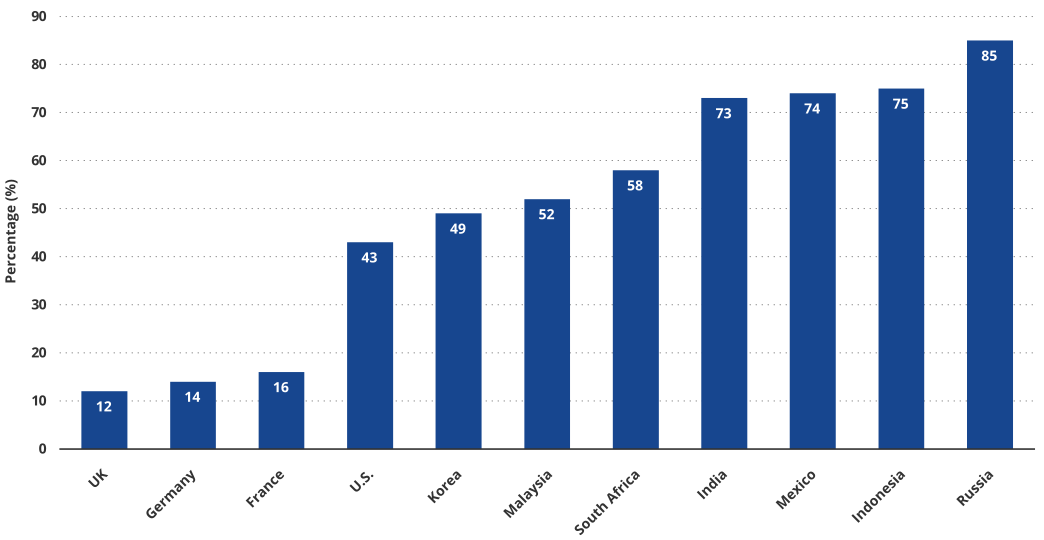
Source: VanEck, Perplexity; data as of September 2025.
If “fiscal dominance” is the big wheel, CNY remains the driving wheel where actual asset-price stuff starts happening…and it keeps strengthening steadily. This remains one of the most important dynamics for all markets and remains incredibly overlooked. EMs trade more with China than with the US, so this is a huge tailwind to EM currencies (see Exhibit 2). And remember the start of the year or even last month? The consensus view was that tariffs would destroy EM currencies. The opposite has happened. We’ve written extensively on this, including our piece “The Curiously Unpopular Case for RMB/CNY Appreciation”. Now, as we said in the piece, CNY itself is not the way to express this view. It will be tightly managed and the appreciation will be like watching paint dry. Lucky for us we can invest in bonds/currencies that are allowed to move more freely, see below for the big names. We should also point out that the ETF has no exposure to India local currency, which performed poorly in 2025, as we see it as broadly “not ready for primetime”. We are also cautious/underweight on Indonesia local, also a loser this year.
Exhibit 2 – EM Currencies Keep Rallying; Every Possible Cause Cited Other Than CNY
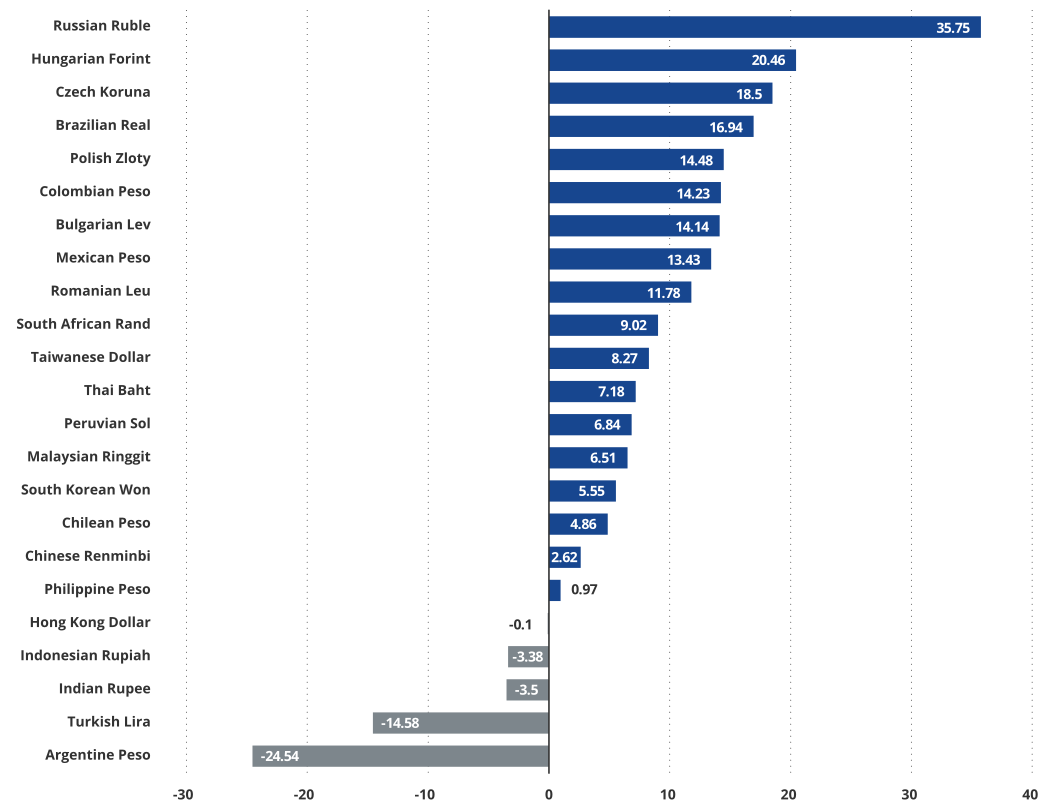
Source: Bloomberg. Data as of September 2025.
Recommended subscription
A look at Argentina. The ratio of the number of opinions on Argentina relative to its importance is astronomical. For decades this has been the case. From cab drivers to heads of state – I’m always getting asked about trivial Argentina and never about Indonesia, Brazil, South Africa, or Nigeria. It’s incredible. Our opinion is actually pretty simple, and we’re also intimating that the world doesn’t need more opinions on Argentina…but here’s ours.
We didn’t like Argentina. Policy was way ahead of politics. Then it blew up in September and bond prices crashed. And, there was a chance of a fairly fast and easy bridge loan from the US. And, the market was consensus overweight, even the cab drivers. So, when it crashed, we got bullish. It’s a trade, we are still in a heavily game-theoretic stage. But, the government can probably get through to midterm elections with protecting reserves and actually buying back short-dated USD debt (which we now own). We’ll see what we think at that next decision node, the midterm elections.
Exposure Types and Significant Changes
The changes to our top positions are summarized below. Our largest positions in September were South Africa, Mexico, Poland, Thailand and Malaysia:
- We increased our local currency exposure in South Africa and Poland. South Africa’s “sleeper” fiscal story is not fully appreciated by the market, but the country’s fiscal performance continues to improve, and the latest move – considering a formal fiscal rule – would be a major structural breakthrough. In terms of our investment process, this has strengthened South Africa’s policy test score. Poland’s fiscal situation looks more concerning, but this is unlikely to affect net bond issuance and slow fiscal consolidation (which in part reflects less inflationary defense spending) is mostly priced in. Poland’s central bank remains credible, and the currency is a proxy for the Europe’s revival theme, which improves the technical test score for the country.
- We also increased our hard currency sovereign exposure in Argentina and the Republic of Congo. The level of political noise in Argentina will remain elevated in the run up to the mid-term elections, but the U.S. decision to provide a large-scale support package (which came after a major selloff) is likely to be a game-changer for the post-election period, strengthening the policy test score for the country. Congo’s multi-billion dollar deal with China to boost oil production had a positive impact on the country’s economic and policy test scores.
- Finally, we increased our local currency exposure in Mexico and Chile. Mexico is a major winner in Trade War 2.0, with supportive domestic backdrop (gradual fiscal consolidation, disinflation, and credible rate cuts being the most relevant for local bonds). The global commodity/copper price backdrop remains beneficial for the Chilean currency, the central bank might deliver another rate cut, and the presidential election outcome is not expected to derail Chile’s orthodox policy framework. In terms of our investment process, this improves the technical and policy test scores for the country.
- We reduced our local currency exposure in Indonesia on the back of the constant flow of negative fiscal news, which reflect the government’s increasingly pro-growth policy stance. An additional structural complication is an attempt to expand the central bank’s mandate. Both factors worsened the country’s policy test score. Further, Indonesia’s economy will be negatively affected by the Grasberg mine incident – it lowered the economic test score for the country.
- We also reduced our local currency exposure and hard currency corporate exposure in Brazil. The latter reflected corporate fraud allegations. Regarding local bonds, we took partial profits after the huge year-to-date rally, which dented the technical test score for the country. We are likely to take it back up.
- Finally, we reduced our local currency exposure in China and hard currency sovereign exposure in Bosnia and Herzegovina. Bosnia and Herzegovina is making structural progress to access the EU funds (Growth Plan for the Western Balkans), but valuations are less attractive now, so we decided to employ the funds in more compelling opportunities. We also took partial profits in China, since the anti-involution policy push is expected to lead to higher domestic prices, and hence, higher local yields, worsening the policy test score for the country.
To receive more Emerging Markets Bonds insights, sign up in our subscription center.

DISCLOSURES
* On October 6th, 2025, the Fund converted from an open‑end mutual fund into an exchange‑traded fund (“ETF”). As part of the conversion, the Fund adopted the accounting and performance history of its predecessor mutual fund (the “Predecessor Fund”). Performance shown for periods prior to October 6th, 2025 reflects the NAV performance of the Predecessor Fund’s institutional share class ("Class I") and not the ETF’s market‑price performance. If the Predecessor Fund had been structured as an ETF, its performance may have differed (for example, due to brokerage commissions, bid‑ask spreads, and premiums/discounts to NAV). Effective October 6th, 2025, the Fund’s total annual operating expenses changed; returns for periods prior to that date reflect the Predecessor Fund’s expenses then in effect.
This is not an offer to buy or sell, or a recommendation to buy or sell any of the securities, financial instruments or digital assets mentioned herein. The information presented does not involve the rendering of personalized investment, financial, legal, tax advice, or any call to action. Certain statements contained herein may constitute projections, forecasts and other forward-looking statements, which do not reflect actual results, are for illustrative purposes only, are valid as of the date of this communication, and are subject to change without notice. Actual future performance of any assets or industries mentioned are unknown. Information provided by third party sources are believed to be reliable and have not been independently verified for accuracy or completeness and cannot be guaranteed. VanEck does not guarantee the accuracy of third party data. The information herein represents the opinion of the author(s), but not necessarily those of VanEck or its other employees.
Duration measures a bond's sensitivity to interest rate changes that reflects the change in a bond's price given a change in yield. This duration measure is appropriate for bonds with embedded options. Carry is the benefit or cost for owning an asset. Yield to worst is a measure of the lowest possible yield that can be received on a bond with an early retirement provision. Averages are market weighted. The yields presented do not represent the performance of the Fund. These statistics do not take into account fees and expenses associated with investments of the Fund.
All indices are unmanaged and include the reinvestment of all dividends, but do not reflect the payment of transaction costs, advisory fees or expenses that are associated with an investment in the Fund. Certain indices may take into account withholding taxes. An index's performance is not illustrative of the Fund's performance. Indices are not securities in which investments can be made.
The Fund's benchmark index (50% GBI-EM/50% EMBI) is a blended index consisting of 50% J.P. Morgan Government Bond Index-Emerging Markets (GBI-EM) Global Diversified and 50% J.P. Morgan Emerging Markets Bond Index (EMBI). The J.P. Morgan GBI-EM Global Diversified tracks local currency bonds issued by Emerging Markets governments. The J.P. Morgan EMBI Global Diversified tracks returns for actively traded external debt instruments in emerging markets, and is also J.P. Morgan's most liquid U.S. dollar emerging markets debt benchmark.
The Bloomberg Global Aggregate Index measures the performance of global investment grade fixed income securities.
The FTSE Treasury Benchmark 10 year measures the return of the 10 year U.S. Treasury.
ICE BofA Global Broad Market Index tracks the performance of investment grade debt publicly issued in the major domestic and eurobond markets, including sovereign, quasi-government, corporate, securitized and collateralized securities. ICE BofA Current 10-Year U.S. Treasury Index is comprised of the most recently issued 10-year U.S. Treasury note.
The MSCI ACWI Index is a global equity benchmark that captures large- and mid-cap stocks across 23 developed and 24 emerging markets, representing approximately 85% of the global investable equity universe.
The S&P 500 Index is a widely recognized U.S. equity benchmark that tracks 500 of the largest publicly traded companies, reflecting the performance of the core U.S. stock market.
Information has been obtained from sources believed to be reliable but J.P. Morgan does not warrant its completeness or accuracy. The Index is used with permission. The index may not be copied, used or distributed without J.P. Morgan's written approval. Copyright 2025, J.P. Morgan Chase & Co. All rights reserved.
An investment in the VanEck Emerging Markets Bond ETF may be subject to risks which include, among others, risks related to active management, credit, credit-linked notes, currency management strategies, derivatives, emerging market issuers, ESG investing, foreign currency, foreign securities, hedging, high portfolio turnover, high yield securities, interest rate, market, non-diversified, operational, restricted securities, investing in other funds, sovereign bond, special risk considerations of investing in African, Asian, and Latin American issuers, authorized participant concentration, no guarantee of active trading market, trading issues, fund shares trading, premium/discount and liquidity of fund shares, and cash transactions risks, all of which may adversely affect the Fund. Emerging market issuers and foreign securities may be subject to securities markets, political and economic, investment and repatriation restrictions, different rules and regulations, less publicly available financial information, foreign currency and exchange rates, operational and settlement, and corporate and securities laws risks. Investing involves substantial risk and high volatility, including possible loss of principal. An investor should consider the investment objective, risks, charges and expenses of a Fund carefully before investing. To obtain a prospectus and summary prospectus, which contain this and other information, call 800.826.2333 or visit vaneck.com. Please read the prospectus and summary prospectus carefully before investing.
© 2025 Van Eck Securities Corporation, Distributor, a wholly-owned subsidiary of Van Eck Associates Corporation.
Related Funds
DISCLOSURES
* On October 6th, 2025, the Fund converted from an open‑end mutual fund into an exchange‑traded fund (“ETF”). As part of the conversion, the Fund adopted the accounting and performance history of its predecessor mutual fund (the “Predecessor Fund”). Performance shown for periods prior to October 6th, 2025 reflects the NAV performance of the Predecessor Fund’s institutional share class ("Class I") and not the ETF’s market‑price performance. If the Predecessor Fund had been structured as an ETF, its performance may have differed (for example, due to brokerage commissions, bid‑ask spreads, and premiums/discounts to NAV). Effective October 6th, 2025, the Fund’s total annual operating expenses changed; returns for periods prior to that date reflect the Predecessor Fund’s expenses then in effect.
This is not an offer to buy or sell, or a recommendation to buy or sell any of the securities, financial instruments or digital assets mentioned herein. The information presented does not involve the rendering of personalized investment, financial, legal, tax advice, or any call to action. Certain statements contained herein may constitute projections, forecasts and other forward-looking statements, which do not reflect actual results, are for illustrative purposes only, are valid as of the date of this communication, and are subject to change without notice. Actual future performance of any assets or industries mentioned are unknown. Information provided by third party sources are believed to be reliable and have not been independently verified for accuracy or completeness and cannot be guaranteed. VanEck does not guarantee the accuracy of third party data. The information herein represents the opinion of the author(s), but not necessarily those of VanEck or its other employees.
Duration measures a bond's sensitivity to interest rate changes that reflects the change in a bond's price given a change in yield. This duration measure is appropriate for bonds with embedded options. Carry is the benefit or cost for owning an asset. Yield to worst is a measure of the lowest possible yield that can be received on a bond with an early retirement provision. Averages are market weighted. The yields presented do not represent the performance of the Fund. These statistics do not take into account fees and expenses associated with investments of the Fund.
All indices are unmanaged and include the reinvestment of all dividends, but do not reflect the payment of transaction costs, advisory fees or expenses that are associated with an investment in the Fund. Certain indices may take into account withholding taxes. An index's performance is not illustrative of the Fund's performance. Indices are not securities in which investments can be made.
The Fund's benchmark index (50% GBI-EM/50% EMBI) is a blended index consisting of 50% J.P. Morgan Government Bond Index-Emerging Markets (GBI-EM) Global Diversified and 50% J.P. Morgan Emerging Markets Bond Index (EMBI). The J.P. Morgan GBI-EM Global Diversified tracks local currency bonds issued by Emerging Markets governments. The J.P. Morgan EMBI Global Diversified tracks returns for actively traded external debt instruments in emerging markets, and is also J.P. Morgan's most liquid U.S. dollar emerging markets debt benchmark.
The Bloomberg Global Aggregate Index measures the performance of global investment grade fixed income securities.
The FTSE Treasury Benchmark 10 year measures the return of the 10 year U.S. Treasury.
ICE BofA Global Broad Market Index tracks the performance of investment grade debt publicly issued in the major domestic and eurobond markets, including sovereign, quasi-government, corporate, securitized and collateralized securities. ICE BofA Current 10-Year U.S. Treasury Index is comprised of the most recently issued 10-year U.S. Treasury note.
The MSCI ACWI Index is a global equity benchmark that captures large- and mid-cap stocks across 23 developed and 24 emerging markets, representing approximately 85% of the global investable equity universe.
The S&P 500 Index is a widely recognized U.S. equity benchmark that tracks 500 of the largest publicly traded companies, reflecting the performance of the core U.S. stock market.
Information has been obtained from sources believed to be reliable but J.P. Morgan does not warrant its completeness or accuracy. The Index is used with permission. The index may not be copied, used or distributed without J.P. Morgan's written approval. Copyright 2025, J.P. Morgan Chase & Co. All rights reserved.
An investment in the VanEck Emerging Markets Bond ETF may be subject to risks which include, among others, risks related to active management, credit, credit-linked notes, currency management strategies, derivatives, emerging market issuers, ESG investing, foreign currency, foreign securities, hedging, high portfolio turnover, high yield securities, interest rate, market, non-diversified, operational, restricted securities, investing in other funds, sovereign bond, special risk considerations of investing in African, Asian, and Latin American issuers, authorized participant concentration, no guarantee of active trading market, trading issues, fund shares trading, premium/discount and liquidity of fund shares, and cash transactions risks, all of which may adversely affect the Fund. Emerging market issuers and foreign securities may be subject to securities markets, political and economic, investment and repatriation restrictions, different rules and regulations, less publicly available financial information, foreign currency and exchange rates, operational and settlement, and corporate and securities laws risks. Investing involves substantial risk and high volatility, including possible loss of principal. An investor should consider the investment objective, risks, charges and expenses of a Fund carefully before investing. To obtain a prospectus and summary prospectus, which contain this and other information, call 800.826.2333 or visit vaneck.com. Please read the prospectus and summary prospectus carefully before investing.
© 2025 Van Eck Securities Corporation, Distributor, a wholly-owned subsidiary of Van Eck Associates Corporation.