Unlocking Growth: The Power of Emerging Markets Debt
October 09, 2025
Read Time 5 MIN
The Overlooked Benefits of EM Debt
Many fixed income portfolios do not include an allocation to emerging markets (EM) bonds. Over the past 25 years, EM governments have gone from being in deficit to running up surpluses, while developed markets (DM) governments have been accruing deficits. This change has resulted in a shift in the origin of bond crises since the turn of the millennium. Fixed income portfolios have yet to reflect this new reality. We believe EM bonds are the future of fixed income.
Emerging Markets Exhibit Stronger Fundamentals Than Developed Markets
EMs generally have lower levels of government and/or total economy debt. This allows central banks independence to focus solely on inflation and not be constrained by concerns about undermining government financing. As they are independent, EM central banks can maintain high real policy rates that keep market rates attractive to those of DM countries. Further, we think DMs are generally facing headwinds from geopolitical developments, while many EMs are experiencing tailwinds from geopolitical developments.
The chart below shows EM central government debt levels, which are lower than those in DM. This is the result of decades of fiscal prudence and central bank independence, particularly in Asia, put in place after the 1997 Asia Crisis. It is also worth noting that EMs have lower total economy (i.e. private) debt than DMs. An important point is that the way in which governments treat private debt in their economies might also differ between key EM and DM. Since the GFC, DM central banks have taken risky assets onto their balance sheet, including high yield (HY) ETFs, as was the case with the U.S. This can stabilize markets, but the moral hazard is that it creates market distortions. Contrast this with China’s recent property crisis, in which policymakers avoided taking these entities onto their balance sheet.
In comparing the U.S. and China’s approaches, it is orthodox policy not to guarantee corporate risks, however much short-term pain this entails. That’s the key point, EM, such as China, have shown great caution over debt levels, which protects their economies.
EM Government Debt Is Lower than DM
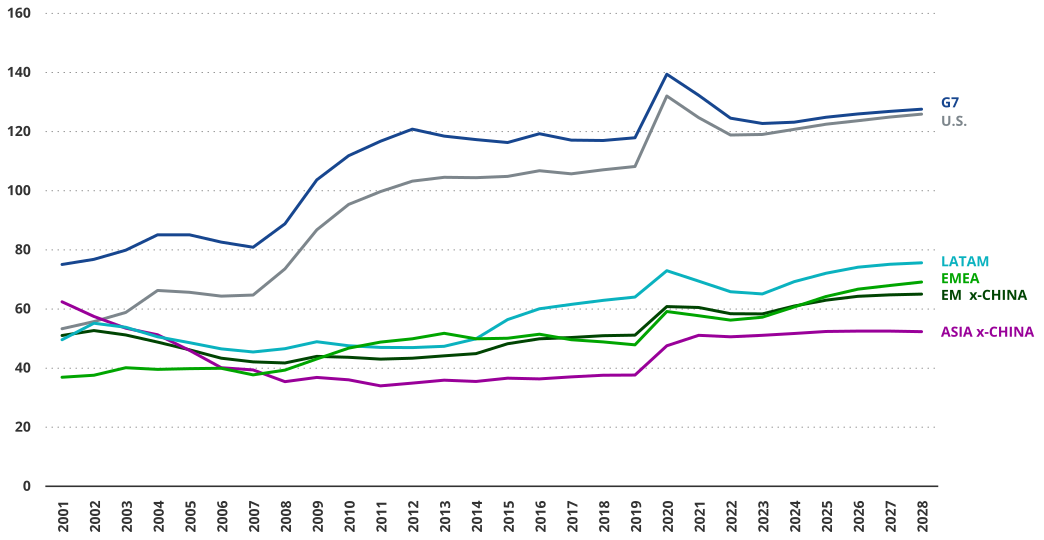
Source: VanEck Research; International Monetary Fund; Bloomberg LP. Data as of June 2025. LATAM represents Latin America; G7 represents Canada, France, Germany, Italy, Japan, the United Kingdom, and the United States; EMEA represents Europe, the Middle East, and Africa; EM x-China represents Emerging Markets excluding China; Not intended as a prediction of future results. For illustrative purposes only. Past performance is no guarantee of future results.
The result is high real policy and market rates in EM. This initial condition of low debt levels allows central banks to focus primarily on inflation, as the maintenance of high real policy rates doesn’t create financing risks for its country’s government. This central bank independence is illustrated by the history of real policy rates in EM versus DM below. It shows what one would expect, consistently higher real interest rates than DM.
Real Policy Rates in EM Exceed Those In DM
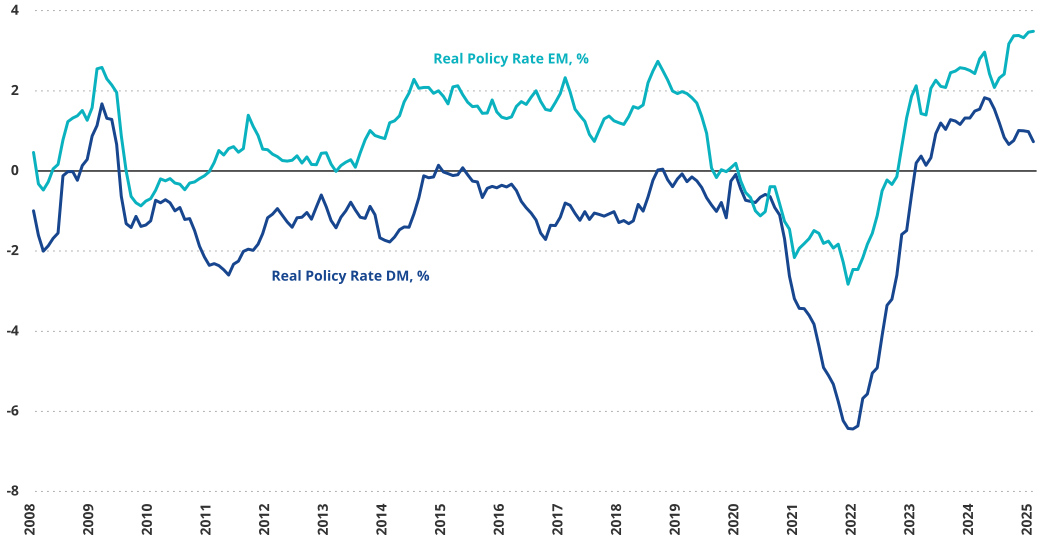
Source: VanEck Research; Bloomberg LP. Data as of June 2025. EM represents Emerging Markets; DM represents Developed Markets. Past performance is not indicative of future results.
Fiscal Dominance
The shift away from DM to EM is observable and tectonic. The chart below compares EM versus DM current accounts over the past 30 years. Prior to 1998, EMs were running large and persistent deficits and were responsible for the global financial crises in the 1990s. Since 1998, however, it’s the DMs that have been generating large and persistent deficits. DMs have also been responsible for the crises of the new millennium. We think this is due to “fiscal dominance”, a state in which monetary policy becomes subsumed to fiscal policy. Most generally, after the Latin American crises of the 80s and 90s, and the Asia and Russia’s crises in 1997 and 1998, EMs, along with the IMF agreed on a “Washington consensus”. Exchange rates were floated, and if inflationary, the central bank had to step in with high real rates. If that was recessionary, the recession was allowed. Thailand and Indonesia experienced 50% declines in USD GDP. Fiscal policy was austere, not stimulative. And insolvent financial and industrial institutions were allowed to fail, i.e. were not put on the government’s balance sheet. You can see the persistent surpluses generated due to these policies in the chart below. DM’s response to the many crises of the past two and a half decades have been the exact opposite. Policies were implemented, resulting in monetary policy enabling fiscal policy, and coordination was celebrated, insolvent financial institutions were guaranteed, recessions were prevented at all costs.
Almost 30 Years of EM Exceptionalism
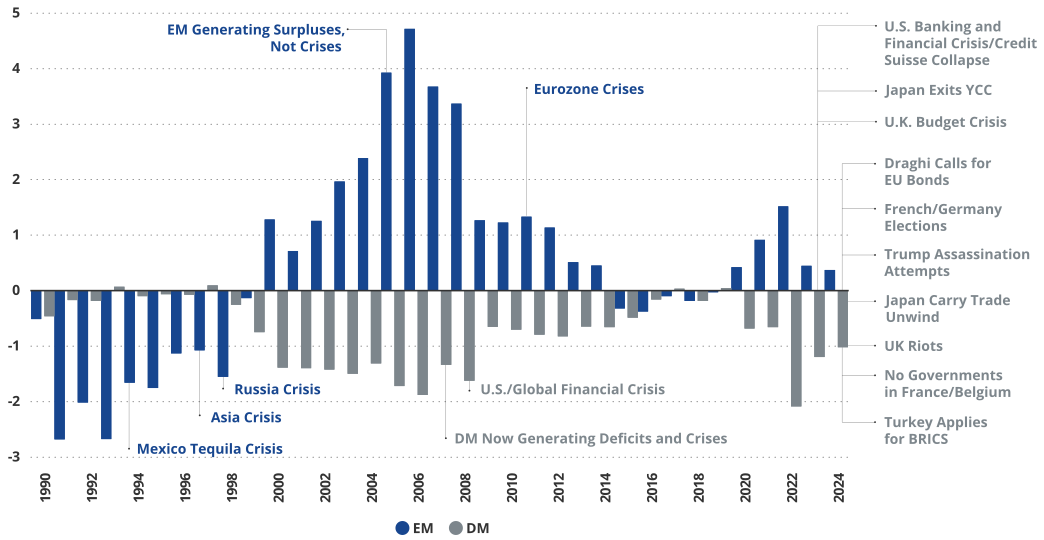
Source: VanEck Research; International Monetary Fund (IMF); Bloomberg LP. Data as of December 2024. EM represents Emerging Markets; DM represents Developed Markets Past performance is not indicative of future results.
Recommended subscription
EM Debt Deserves a Place in a Strategic Asset Allocation
In a world that is simultaneously worried about endless monetary experimentation and leverage in developed markets, but also looking for attractive yield, EMD has answers. Many emerging markets have strong fundamentals and bonds that pay high yields. DM debt, in many ways, is the opposite, with high leverage and limited compensation. This is why the 60/40 model is being re-evaluated—perhaps rightly so. But even if global debt deserves a lower allocation, we believe EMD deserves to be a bigger part of investors’ overall fixed income allocations.
VanEck Emerging Markets Bond Strategy
The VanEck Emerging Markets Bond ETF was one of the first blended emerging markets bond strategies in the market. The Strategy adopts a comprehensive approach, investing across the entire EM bond spectrum to maximize opportunity and manage risk in a complex global environment. Despite global disruptions such as the COVID pandemic, the war in Ukraine and economic troubles in China, the fund has consistently outperformed both global and U.S. bond benchmarks. VanEck’s active strategy, which focuses on fundamental value relative to bond risk premia, aims to capitalize on these shifts and avoid troubled issuers, making a compelling case for a diversified, actively managed EM bond allocation.
EMBX | VanEck Emerging Markets Bond ETF
To receive more Emerging Markets Bonds insights, sign up in our subscription center.

IMPORTANT DISCLOSURES
This is not an offer to buy or sell, or a recommendation to buy or sell any of the securities, financial instruments or digital assets mentioned herein. The information presented does not involve the rendering of personalized investment, financial, legal, tax advice, or any call to action. Certain statements contained herein may constitute projections, forecasts and other forward-looking statements, which do not reflect actual results, are for illustrative purposes only, are valid as of the date of this communication, and are subject to change without notice. Actual future performance of any assets or industries mentioned are unknown. Information provided by third party sources are believed to be reliable and have not been independently verified for accuracy or completeness and cannot be guaranteed. VanEck does not guarantee the accuracy of third party data. The information herein represents the opinion of the speaker(s), but not necessarily those of VanEck or its other employees.
An investment in the VanEck Emerging Markets Bond ETF may be subject to risks which include, among others, risks related to active management, credit, credit-linked notes, currency management strategies, derivatives, emerging market issuers, ESG investing, foreign currency, foreign securities, hedging, high portfolio turnover, high yield securities, interest rate, market, non-diversified, operational, restricted securities, investing in other funds, sovereign bond, special risk considerations of investing in African, Asian, and Latin American issuers, authorized participant concentration, no guarantee of active trading market, trading issues, fund shares trading, premium/discount and liquidity of fund shares, and cash transactions risks, all of which may adversely affect the Fund. Emerging market issuers and foreign securities may be subject to securities markets, political and economic, investment and repatriation restrictions, different rules and regulations, less publicly available financial information, foreign currency and exchange rates, operational and settlement, and corporate and securities laws risks.
Investing involves substantial risk and high volatility, including possible loss of principal. An investor should consider the investment objective, risks, charges and expenses of the Funds carefully before investing. To obtain a prospectus and summary prospectus, which contain this and other information, call 800.826.2333 or visit vaneck.com. Please read the prospectus and summary prospectus carefully before investing.
© Van Eck Securities Corporation, Distributor, a wholly owned subsidiary of Van Eck Associates Corporation.
Related Funds
IMPORTANT DISCLOSURES
This is not an offer to buy or sell, or a recommendation to buy or sell any of the securities, financial instruments or digital assets mentioned herein. The information presented does not involve the rendering of personalized investment, financial, legal, tax advice, or any call to action. Certain statements contained herein may constitute projections, forecasts and other forward-looking statements, which do not reflect actual results, are for illustrative purposes only, are valid as of the date of this communication, and are subject to change without notice. Actual future performance of any assets or industries mentioned are unknown. Information provided by third party sources are believed to be reliable and have not been independently verified for accuracy or completeness and cannot be guaranteed. VanEck does not guarantee the accuracy of third party data. The information herein represents the opinion of the speaker(s), but not necessarily those of VanEck or its other employees.
An investment in the VanEck Emerging Markets Bond ETF may be subject to risks which include, among others, risks related to active management, credit, credit-linked notes, currency management strategies, derivatives, emerging market issuers, ESG investing, foreign currency, foreign securities, hedging, high portfolio turnover, high yield securities, interest rate, market, non-diversified, operational, restricted securities, investing in other funds, sovereign bond, special risk considerations of investing in African, Asian, and Latin American issuers, authorized participant concentration, no guarantee of active trading market, trading issues, fund shares trading, premium/discount and liquidity of fund shares, and cash transactions risks, all of which may adversely affect the Fund. Emerging market issuers and foreign securities may be subject to securities markets, political and economic, investment and repatriation restrictions, different rules and regulations, less publicly available financial information, foreign currency and exchange rates, operational and settlement, and corporate and securities laws risks.
Investing involves substantial risk and high volatility, including possible loss of principal. An investor should consider the investment objective, risks, charges and expenses of the Funds carefully before investing. To obtain a prospectus and summary prospectus, which contain this and other information, call 800.826.2333 or visit vaneck.com. Please read the prospectus and summary prospectus carefully before investing.
© Van Eck Securities Corporation, Distributor, a wholly owned subsidiary of Van Eck Associates Corporation.