What the Iran War Means for Emerging Markets
April 10, 2026
Read Time 9 MIN
- The Iran conflict already has some permanent implications, elevating China, Latin America, much of Africa, while challenging the Gulf, and undermining Europe.
- EM bonds proved resilient once initial war-driven volatility settled, mirroring the early-2025 tariff selloff pattern where EM ultimately rallied.
- EMBX offers an attractive 30-day SEC yield of 5.6%.
The VanEck Emerging Markets Bond ETF (EMBX) was down 4.18% in March, compared to -4.41% for its benchmark, the 50% J.P. Morgan Government Bond Index - Emerging Markets Global Diversified (GBI-EM) and 50% J.P. Morgan Emerging Markets Bond Index (EMBI) and down 3.11% for the Global Agg. Year to date EMBX is down 0.90%, compared to -1.75% for its benchmark, and -1.09% for the Global Agg. We went into 2026 reducing some of our high beta EM local exposure, even raising cash early in the war. Before the war started, we went underweight all of MENA, and got completely out very early into the war, also in favor of cash (the MENA bonds remained stable until towards end-March). By end-March, we covered all of our underweights in high-beta local and reduced cash. Local currency exposure is higher at 52%, Carry is 6.84%, yield to worst is 9.29% and duration is 5.89.
What the Iran War Means for Emerging Markets
EMBX Average Annual Total Returns* (%) (In USD)
| Month End As of March 31, 2026 | 1 Mo | 3 Mo | YTD | 1 YR | 3 YR | 5 YR | 10 YR |
| EMBX (NAV) | -4.18 | -0.89 | -0.89 | 14.20 | 9.28 | 4.43 | 4.95 |
| EMBX (Market Price) | -3.78 | -0.20 | -0.20 | 14.87 | 9.49 | 4.55 | 5.02 |
| 50% GBI-EM/50% EMBI | -4.41 | -1.75 | -1.75 | 11.11 | 8.19 | 2.31 | 3.22 |
* Returns less than one year are not annualized.
The performance data quoted represents past performance. Past performance is not a guarantee of future results. Investment return and principal value of an investment will fluctuate so that an investor's shares, when redeemed, may be worth more or less than their original cost. Performance may be lower or higher than performance data quoted. Please call 800.826.2333 or visit vaneck.com for performance current to the most recent month ended.
Prior to 10/06/2025, the Fund operated as the VanEck Emerging Markets Bond mutual fund; performance shown before that date is that fund’s NAV performance (Class I, unadjusted for today’s ETF expenses).
The "Net Asset Value" (NAV) of a Fund is determined at the close of each business day, and represents the dollar value of one share of the fund; it is calculated by taking the total assets of the fund, subtracting total liabilities, and dividing by the total number of shares outstanding. The NAV is not necessarily the same as the ETF 's intraday trading value. Investors should not expect to buy or sell shares at NAV.
EMBX Total Expense Ratio – 0.76%. Van Eck Associates Corporation (the “Adviser”) will pay all expenses of the Fund, except for the fee payment under the investment management agreement, acquired fund fees and expenses, interest expense, offering costs, trading expenses, taxes and extraordinary expenses. Notwithstanding the foregoing, the Adviser has agreed to pay the offering costs until at least May 1, 2027. “Other Expenses” have been restated to reflect current fees.
EMLC Average Annual Total Returns* (%) (In USD)
| Month End As of March 31, 2026 | 1 Mo | 3 Mo | YTD | 1 YR | 3 YR | 5 YR | 10 YR |
| EMLC (NAV) | -5.48 | -2.32 | -2.32 | 11.21 | 6.01 | 1.67 | 1.75 |
| EMLC (Market Price) | -5.12 | -1.84 | -1.84 | 11.82 | 6.14 | 1.82 | 1.80 |
| GBIEMCOR (Index) | -5.45 | -2.27 | -2.27 | 11.73 | 6.30 | 1.90 | 2.17 |
| Performance Differential (NAV - Index) | -0.03 | -0.05 | -0.05 | -0.52 | -0.29 | -0.23 | -0.42 |
* Returns less than one year are not annualized.
The performance data quoted represents past performance. Past performance is not a guarantee of future results. Investment return and principal value of an investment will fluctuate so that an investor's shares, when redeemed, may be worth more or less than their original cost. Performance may be lower or higher than performance data quoted. Please call 800.826.2333 or visit vaneck.com for performance current to the most recent month ended.
Recommended subscription
Some changes are probably irreversible, regardless of the war outcome. The Gulf (UAE, Saudi, Kuwait, Oman, Bahrain, etc.) is likely forever changed, economically and politically. These are all excellent credits by-and-large, with high reserves and liquidity, and with even more problematic Bahrain solidly backed by Saudi. Egypt, a big name outside the Gulf is a completely different situation, but who doesn’t know that already. The problem for the Gulf from our perspective is that Gulf bonds are priced like the good credits they are, but the business model is being profoundly challenged, let’s put it that way. So, it’s not clear what exposure to the Gulf is really betting on – even a “positive” outcome (which is not straightforward to define) generates limited upside. Egypt is the only exception and we went long local currency during the last week of March after a major selloff. Political risk inside the Gulf should also be acknowledged as having risen, just as a matter of logic. Europe’s energy access is profoundly challenged along with this. Political relations, of which Europe has few in the region, will be key. Pakistan, China, and Russia have new elevated status. The 5-point plan announced by China and Pakistan’s foreign ministers in Islamabad over the last weekend of March is an important development; we remain stunned that it is getting little prominence in western media, though that probably strengthens our view. Your author enjoys his game theory and war-gaming, so feel free to reach out to us if you want to dig deep on this topic. The essence of the situation is that without a competing nuclear power, the Israel-Iran conflict (even or especially assuming USA fades) would have escalated inevitably. That inevitability is perhaps no more, with nuclear-armed Pakistan, and China, leading this new stage (Saudi, Turkey, and Egypt foreign ministers also attended). This was the real mark of a new stage in the war (one that we had been following as it developed…this is not “out-of-the-blue”). The fact that it appears unacknowledged only strengthens our view, these days. Latam and sub-saharan Africa gain greater importance, too, due to their commodity-exporting status. Asia faces headwinds, but CNY stability is an anchor. The US faces mostly political consequences, not economic.
Exhibit 1 – China Government Bonds Stable, While US Treasuries Fall
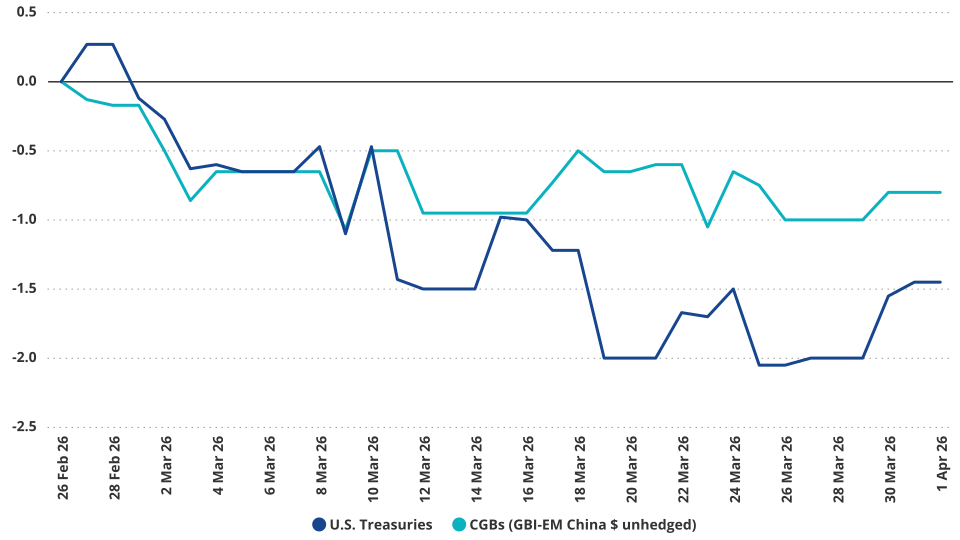
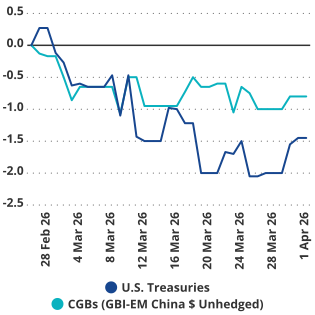
Source: Bloomberg As of April 1, 2026. U.S. Treasuries: (FTSE 10-year US Treasuries Index); CGBs: (represented by The J.P. Morgan GBI-EM China Dollar Unhedged Index). Past performance is no guarantee of future results.
But… Markets digested a lot of war news in March. There are clear signs that markets want to move on. The last Monday in March was a test. All the war-related news on popular media over the prior weekend was increasingly escalatory. Monday arrives and US Treasuries are finally stable, and Mexican peso is firm. Tuesday (March 31) and Wednesday (April 1) the path becomes clearer. You could say market and economic worries were also behind US efforts to off-ramp, although that is mind-reading. We should also note that emerging markets have many winners in a high-commodities price scenario, so our market has more to be excited about in any period of market stability. Pakistan and China are playing an important role in making any seemingly temporary stability more durable, as we argued above. We show the side-by-side exhibit (Exhibit 2) to compare major bond performances in the 2025 tariff rally, to the war-month of March. What we observe is that this war month of March 2026 saw similar underperformance of our EM bond benchmarks relative to US Treasuries or the Global Agg that we saw at the beginning of the 2025 rally – generalized “market risk” hit all bonds at first, only for emerging markets to re-assert once the dust settled.
Exhibit 2 – War Sell-off Looks Like Early Part of 2025 When EM Ended Up Rallying
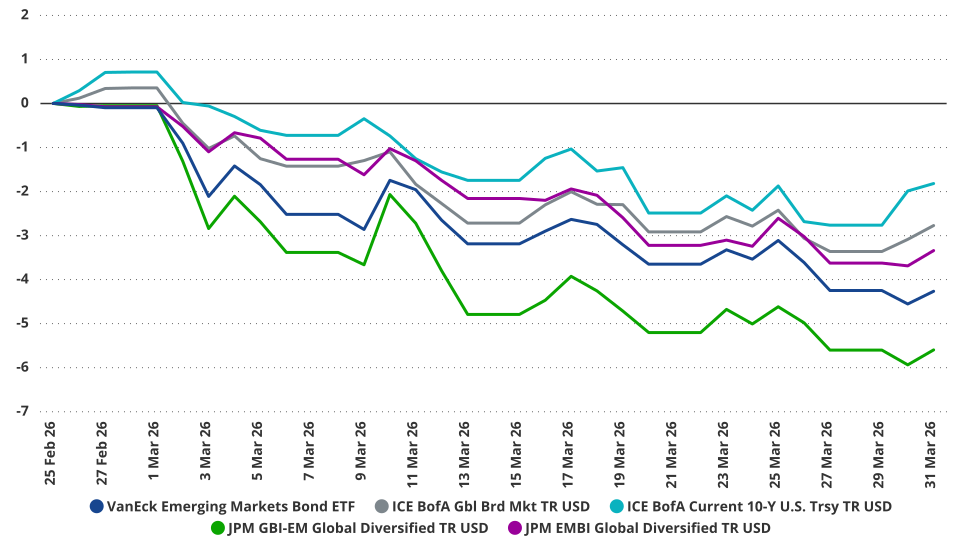
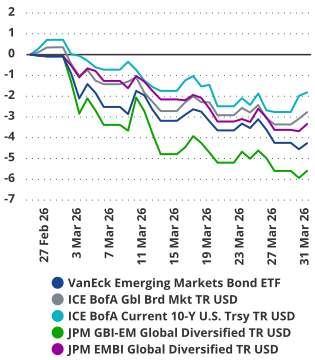
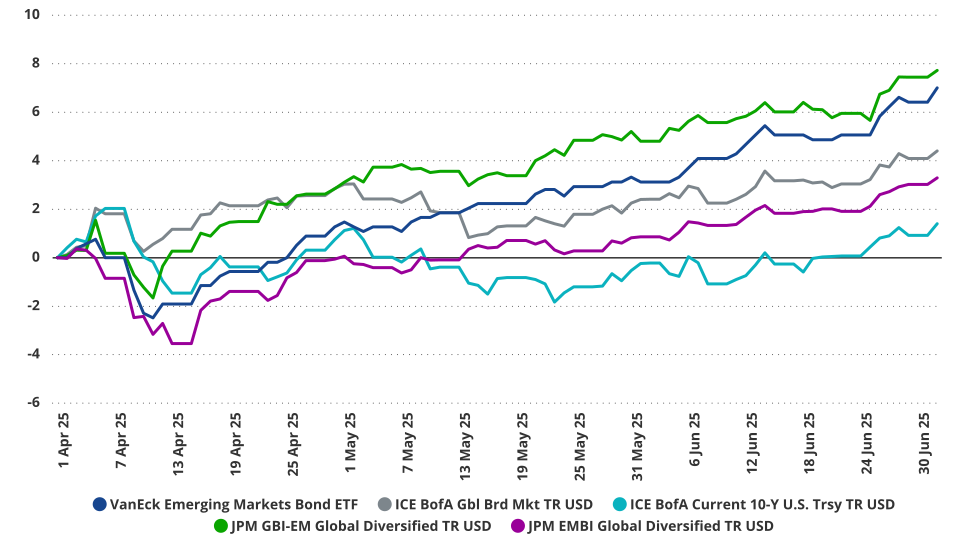
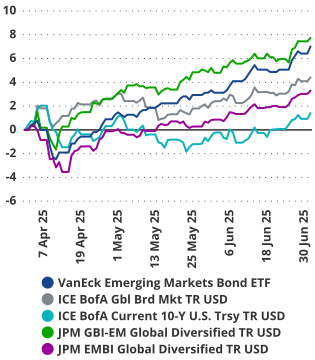
Source: Bloomberg as of March 30, 2026. EMBX: VanEck Emerging Markets Bond ETF; EMLC: VanEck JP Morgan EM Local Currency Bond ETF; EMBUX: VanEck Emerging Markets Bond Fund, Class I (predecessor to EMBX); EMB: (50% J.P. Morgan Government Bond Index - Emerging Markets Global Diversified (GBI-EM) and 50% J.P. Morgan Emerging Markets Bond Index (EMBI)); U.S. Treasuries; Global Agg: (Bloomberg Global Aggregat). Index performance is not representative of fund performance. It is not possible to invest directly in an index. Fund performance current to the most recent month end is available by visiting vaneck.com or by calling 800.826.2333.
What is the lesson, so far? As usual, the “risk” mostly applies to developed markets (Europe, Japan, UK, the US politically), with emerging markets having many winners and some losers. In fact, look at DM interest rates in March – they were the real losers from the Iran war with EM bonds simply collateral damage, accentuated by their major rally and inflows in 2025 through early 2026. EMs are not subject to “fiscal dominance”, so their central banks should and have maintained high real rates (we show Exhibit 3 as support, but it’s an old story). And, “geopolitical” risk can boost EM. The instances are varied, but the key channels are commodities prices, new alliances, and use of each others’ currencies in trade but increasingly as reserve assets.
Exhibit 3 – EM Real Policy Rates vs DM
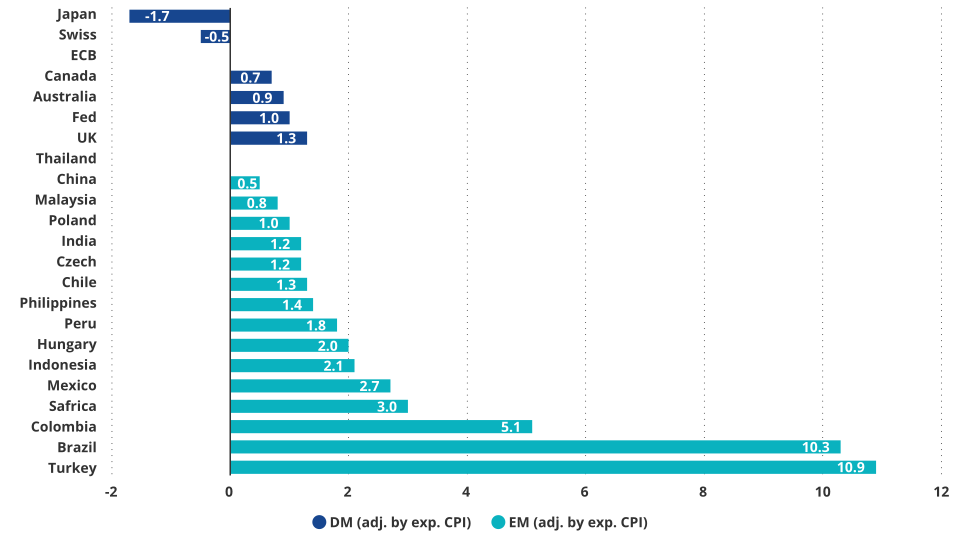
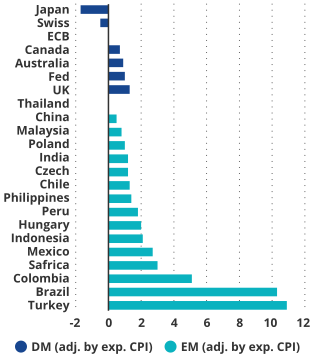
Source: Bloomberg as of March 2026.
EMBX | VanEck Emerging Markets Bond ETF
Exposure Types and Significant Changes
The changes to our top positions are summarized below. Our largest positions in March were Brazil, South Africa, Poland, Colombia and Malaysia:
- We increased our hard currency corporate exposure in Indonesia and China, as well as local currency exposure in China and Taiwan. The key theme here is relative “insulation” of these assets from the Middle East turbulence, with the resulting improvement of the technical test scores. China, in particular, is emerging as an island of stability among major EMs, with limited exposure to higher oil prices and a more advantageous geopolitical standing, which improved the technical, economic, and policy test scores for the country.
- We also increased our hard currency sovereign exposure in Angola and the Republic of Congo, both of which stand to benefit from the higher price of oil, which is their main export. This relationship strengthened the technical test scores for both countries.
- Finally, we increased our hard currency sovereign exposure in Uruguay, and local currency exposure in Chile, Peru, South Africa, Uganda, and Colombia. The key theme in this group is a big improvement in valuations and technicals after the Middle East-related turmoil and the resulting improvement in the technical test scores. Additional country-specific considerations included: (a) Chile’s lagging EM peers despite having a market-friendly administration; (b) Peru’s central bank deliberately standing on the sidelines and letting the steam off both in local rates and currency; (c) South Africa’s central bank maintaining policy credibility after adopting a lower inflation target; and (d) Colombia’s central bank frontloading rate hikes and the market being too pessimistic on the outcome of Colombia’s presidential election.
- We reduced our hard currency sovereign exposure in the United Arab Emirates, Saudi Arabia, Israel, Kuwait, Egypt, Morocco, and Oman. The key theme in this group was the regional proximity to the Middle East conflict, which significantly worsened the policy test scores for these countries. An additional consideration is that many of these bonds had long duration, which got hit due to higher oil prices, worsening the respective technical test scores.
- We also reduced our hard currency sovereign duration in Turkey, Malaysia, and Sri Lanka, and local exposure in the Czech Republic, as these countries are particularly vulnerable if oil prices stay high for longer in the case of the protracted conflict in the Middle East. In terms of our investment process, this worsened the technical and economic test scores for this group.
- Finally, we reduced our local currency exposure in Mexico and hard currency sovereign exposure in Bolivia. Bolivia’s case was relatively benign – the country paid off 30% of the bond in question. Mexico’s local bonds, however, looked overbought, which is a major disadvantage for a high-beta country during a major geopolitical conflict. These factors worsened the technical test score for Mexico.
To receive more Emerging Markets Bonds insights, sign up in our subscription center.

Disclosures
This is not an offer to buy or sell, or a recommendation to buy or sell any of the securities, financial instruments or digital assets mentioned herein. The information presented does not involve the rendering of personalized investment, financial, legal, tax advice, or any call to action. Certain statements contained herein may constitute projections, forecasts and other forward-looking statements, which do not reflect actual results, are for illustrative purposes only, are valid as of the date of this communication, and are subject to change without notice. Actual future performance of any assets or industries mentioned are unknown. Information provided by third party sources are believed to be reliable and have not been independently verified for accuracy or completeness and cannot be guaranteed. VanEck does not guarantee the accuracy of third party data. The information herein represents the opinion of the author(s), but not necessarily those of VanEck or its other employees.
Duration measures a bond’s sensitivity to interest rate changes that reflects the change in a bond’s price given a change in yield. This duration measure is appropriate for bonds with embedded options. Carry is the benefit or cost for owning an asset. Yield to worst is a measure of the lowest possible yield that can be received on a bond with an early retirement provision. Averages are market weighted. The yields presented do not represent the performance of the Fund. These statistics do not take into account fees and expenses associated with investments of the Fund.
30-Day SEC Yield is a standard yield calculation developed by the Securities and Exchange Commission that allows for fairer comparisons among funds. It is based on the most recent 30-day period. This yield figure reflects the interest earned during the period after deducting the Fund’s expenses for the period. It does not reflect the yield an investor would have received if they had held the Fund over the last twelve months assuming the most recent NAV.
All indices are unmanaged and include the reinvestment of all dividends, but do not reflect the payment of transaction costs, advisory fees or expenses that are associated with an investment in the Fund. Certain indices may take into account withholding taxes. An index’s performance is not illustrative of the Fund’s performance. Indices are not securities in which investments can be made.
The Fund’s benchmark index (50% GBI-EM/50% EMBI) is a blended index consisting of 50% J.P. Morgan Government Bond Index-Emerging Markets (GBI-EM) Global Diversified and 50% J.P. Morgan Emerging Markets Bond Index (EMBI). The J.P. Morgan GBI-EM Global Diversified tracks local currency bonds issued by Emerging Markets governments. The J.P. Morgan EMBI Global Diversified tracks returns for actively traded external debt instruments in emerging markets, and is also J.P. Morgan’s most liquid U.S. dollar emerging markets debt benchmark.
The Bloomberg Global Aggregate Index measures the performance of global investment grade fixed income securities.
The FTSE Treasury Benchmark 10 year measures the return of the 10 year U.S. Treasury.
The J.P. Morgan GBI-EM China Dollar Unhedged Index measures the performance of renminbi-denominated Chinese government bonds included in the GBI-EM universe, with returns expressed in U.S. dollars and unhedged for currency movements. Information has been obtained from sources believed to be reliable but J.P. Morgan does not warrant its completeness or accuracy. The Index is used with permission. The index may not be copied, used or distributed without J.P. Morgan’s written approval. Copyright 2026, J.P. Morgan Chase & Co. All rights reserved.
An investment in the VanEck Emerging Markets Bond ETF may be subject to risks which include, among others, risks related to active management, credit, credit-linked notes, currency management strategies, derivatives, emerging market issuers, ESG investing, foreign currency, foreign securities, hedging, high portfolio turnover, high yield securities, interest rate, market, non-diversified, operational, restricted securities, investing in other funds, sovereign bond, special risk considerations of investing in African, Asian, and Latin American issuers, authorized participant concentration, no guarantee of active trading market, trading issues, fund shares trading, premium/discount and liquidity of fund shares, and cash transactions risks, all of which may adversely affect the Fund. Emerging market issuers and foreign securities may be subject to securities markets, political and economic, investment and repatriation restrictions, different rules and regulations, less publicly available financial information, foreign currency and exchange rates, operational and settlement, and corporate and securities laws risks.
An investment in the VanEck J.P. Morgan EM Local Currency Bond ETF (EMLC) may be subject to risks which include, among others, risks related to foreign securities, emerging market issuers, sovereign bond, currency, foreign currency, interest rate, market, credit, high yield securities, liquidity, operational, non-diversified, investing in other funds, derivatives, sampling, index tracking, authorized participant concentration, no guarantee of active trading market, trading issues, fund shares trading, premium/discount and liquidity of fund shares, and cash transactions risks, all of which may adversely affect the Fund. Emerging market issuers and foreign securities may be subject to securities markets, political and economic, investment and repatriation restrictions, different rules and regulations, less publicly available financial information, foreign currency and exchange rates, operational and settlement, and corporate and securities laws risks.
Investing involves substantial risk and high volatility, including possible loss of principal. An investor should consider the investment objective, risks, charges and expenses of a Fund carefully before investing. To obtain a prospectus and summary prospectus, which contain this and other information, call 800.826.2333 or visit vaneck.com. Please read the prospectus and summary prospectus carefully before investing.
© Van Eck Securities Corporation, Distributor, a wholly-owned subsidiary of Van Eck Associates Corporation.
Related Funds
Disclosures
This is not an offer to buy or sell, or a recommendation to buy or sell any of the securities, financial instruments or digital assets mentioned herein. The information presented does not involve the rendering of personalized investment, financial, legal, tax advice, or any call to action. Certain statements contained herein may constitute projections, forecasts and other forward-looking statements, which do not reflect actual results, are for illustrative purposes only, are valid as of the date of this communication, and are subject to change without notice. Actual future performance of any assets or industries mentioned are unknown. Information provided by third party sources are believed to be reliable and have not been independently verified for accuracy or completeness and cannot be guaranteed. VanEck does not guarantee the accuracy of third party data. The information herein represents the opinion of the author(s), but not necessarily those of VanEck or its other employees.
Duration measures a bond’s sensitivity to interest rate changes that reflects the change in a bond’s price given a change in yield. This duration measure is appropriate for bonds with embedded options. Carry is the benefit or cost for owning an asset. Yield to worst is a measure of the lowest possible yield that can be received on a bond with an early retirement provision. Averages are market weighted. The yields presented do not represent the performance of the Fund. These statistics do not take into account fees and expenses associated with investments of the Fund.
30-Day SEC Yield is a standard yield calculation developed by the Securities and Exchange Commission that allows for fairer comparisons among funds. It is based on the most recent 30-day period. This yield figure reflects the interest earned during the period after deducting the Fund’s expenses for the period. It does not reflect the yield an investor would have received if they had held the Fund over the last twelve months assuming the most recent NAV.
All indices are unmanaged and include the reinvestment of all dividends, but do not reflect the payment of transaction costs, advisory fees or expenses that are associated with an investment in the Fund. Certain indices may take into account withholding taxes. An index’s performance is not illustrative of the Fund’s performance. Indices are not securities in which investments can be made.
The Fund’s benchmark index (50% GBI-EM/50% EMBI) is a blended index consisting of 50% J.P. Morgan Government Bond Index-Emerging Markets (GBI-EM) Global Diversified and 50% J.P. Morgan Emerging Markets Bond Index (EMBI). The J.P. Morgan GBI-EM Global Diversified tracks local currency bonds issued by Emerging Markets governments. The J.P. Morgan EMBI Global Diversified tracks returns for actively traded external debt instruments in emerging markets, and is also J.P. Morgan’s most liquid U.S. dollar emerging markets debt benchmark.
The Bloomberg Global Aggregate Index measures the performance of global investment grade fixed income securities.
The FTSE Treasury Benchmark 10 year measures the return of the 10 year U.S. Treasury.
The J.P. Morgan GBI-EM China Dollar Unhedged Index measures the performance of renminbi-denominated Chinese government bonds included in the GBI-EM universe, with returns expressed in U.S. dollars and unhedged for currency movements. Information has been obtained from sources believed to be reliable but J.P. Morgan does not warrant its completeness or accuracy. The Index is used with permission. The index may not be copied, used or distributed without J.P. Morgan’s written approval. Copyright 2026, J.P. Morgan Chase & Co. All rights reserved.
An investment in the VanEck Emerging Markets Bond ETF may be subject to risks which include, among others, risks related to active management, credit, credit-linked notes, currency management strategies, derivatives, emerging market issuers, ESG investing, foreign currency, foreign securities, hedging, high portfolio turnover, high yield securities, interest rate, market, non-diversified, operational, restricted securities, investing in other funds, sovereign bond, special risk considerations of investing in African, Asian, and Latin American issuers, authorized participant concentration, no guarantee of active trading market, trading issues, fund shares trading, premium/discount and liquidity of fund shares, and cash transactions risks, all of which may adversely affect the Fund. Emerging market issuers and foreign securities may be subject to securities markets, political and economic, investment and repatriation restrictions, different rules and regulations, less publicly available financial information, foreign currency and exchange rates, operational and settlement, and corporate and securities laws risks.
An investment in the VanEck J.P. Morgan EM Local Currency Bond ETF (EMLC) may be subject to risks which include, among others, risks related to foreign securities, emerging market issuers, sovereign bond, currency, foreign currency, interest rate, market, credit, high yield securities, liquidity, operational, non-diversified, investing in other funds, derivatives, sampling, index tracking, authorized participant concentration, no guarantee of active trading market, trading issues, fund shares trading, premium/discount and liquidity of fund shares, and cash transactions risks, all of which may adversely affect the Fund. Emerging market issuers and foreign securities may be subject to securities markets, political and economic, investment and repatriation restrictions, different rules and regulations, less publicly available financial information, foreign currency and exchange rates, operational and settlement, and corporate and securities laws risks.
Investing involves substantial risk and high volatility, including possible loss of principal. An investor should consider the investment objective, risks, charges and expenses of a Fund carefully before investing. To obtain a prospectus and summary prospectus, which contain this and other information, call 800.826.2333 or visit vaneck.com. Please read the prospectus and summary prospectus carefully before investing.
© Van Eck Securities Corporation, Distributor, a wholly-owned subsidiary of Van Eck Associates Corporation.