India: The Long-Duration Case
May 22, 2026
Read Time 11 MIN
Key Takeaways:
- Indian businesses have grown their underlying net worth consistently for two decades, through every crisis and market cycle.
- India has always traded at a premium to broader emerging markets and has earned it. Today that premium is near a 20-year low.
- The risks are real but well understood, and a decade of policy reform has reduced India’s sensitivity to the most significant one.
What 20 Years of Corporate Book Value Growth Tell Us About Investing in India Today
There are two ways to own India.
The first is a short-term bet: that India will outperform China, EM, or the S&P 500 over the next year or two. The second is a long-term position in the growth of Indian corporate book value. These are different investments. The first requires a prediction. The second requires patience. This piece is about the second.
Before going further, two terms matter.
Compounding is what happens when a business reinvests what it earns. Each year’s gains build on the previous year’s. Over time, small consistent growth rates produce large results. A business growing book value at 9% per year doubles it in roughly eight years. Doubles it again in eight more.
Book value per share is what a company owns minus what it owes, divided by shares outstanding. Think of it as the accumulated net worth of the business. It grows when a company earns more than it spends. It is a more stable measure than stock price, which moves daily with investor sentiment. Price tells you what the market thinks a business is worth today. Book value tells you what the business has built over time.
Unlike price performance, looking at book value growth strips sentiment out of the picture. Over the past 20 years, the MSCI India Index has grown book value per share at 9.4% per year in USD terms, on a total return basis including dividend reinvestment. That is the number this piece is built around.
Short-term traders and long-term investors are asking different questions.
When India underperforms, as it has over the past year, the instinct is to ask whether it will catch up. Will India beat China next year? Will it outperform broader EM? These are reasonable questions for a short-term trader. They are the wrong questions for a long-term investor.
India’s recent lag has a few straightforward explanations. Money rotated into China after its government signaled economic stimulus. India’s own market had gotten expensive and corrected. Near-term earnings growth slowed. South Korea and Taiwan performed well, pulling flows in their direction. None of this changed what the underlying Indian businesses were doing. They kept building book value. The economy kept growing.
India’s difficult periods do not look like collapse. They look like standing still while other markets run. The investment case is in two decades of steady book value growth. That case has not changed.
"The first requires a prediction. The second requires patience."
20 years of book value growth: the engine in numbers.
The case for India does not rest on a prediction. It rests on a record.
Over 20 years, the book value per share of the MSCI India Index, measured on a total return basis, has grown at 9.4% per year in USD terms. The same measure for the MSCI Emerging Markets Index has grown at 3.6% per year over the same period. India’s advantage: nearly 6 percentage points, every year, for 20 years.
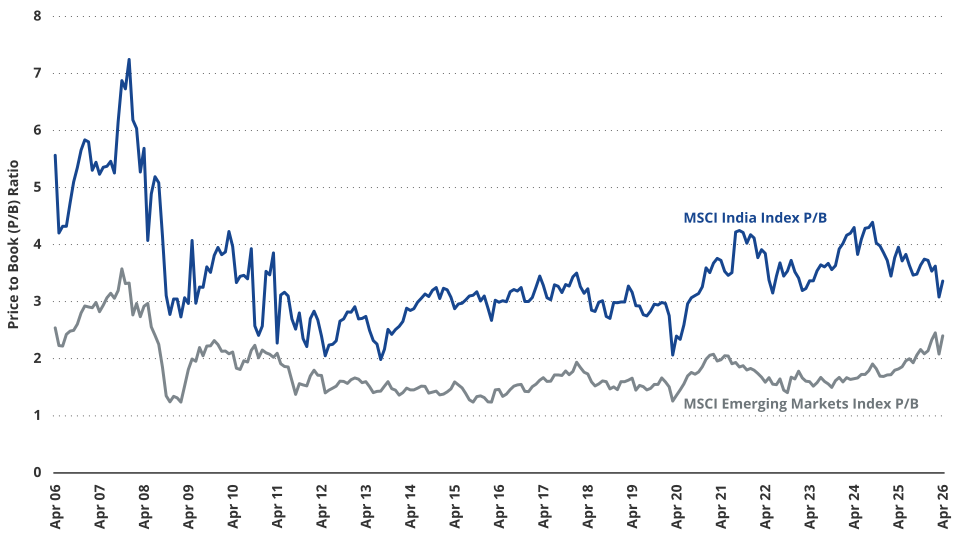
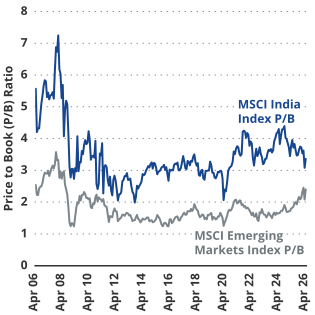
Over those same 20 years, the MSCI India Index delivered a total return of +261%. Here is where that return came from. Book value per share grew from $57 to $666, a gain of nearly 5x. At the same time, the price-to-book ratio fell from 5.57x to 3.36x. Investors were paying 40% less per dollar of book value at the end of the period than at the start. Those two forces multiplied together produce the +261% total return. Book value growth delivered above-market returns despite a significant while valuations became more attractive.
The return did not come from the market becoming more optimistic about India. It came from Indian businesses building book value for two decades while investors actually became less willing to pay for it. That is the durability argument. It does not require sentiment to improve. It requires only that the businesses keep doing what they have done.
Table 1: MSCI India vs MSCI EM, Key Metrics
| Metric | MSCI India Index | MSCI EM | India vs EM |
| The Earnings Engine , 20-Year Track Record (April 2006 to April 2026) | |||
| Book value growth per year, 20 years (USD) | 9.4% p.a. | 3.6% p.a. | India grows book value at more than 2x EM’s rate |
| Annualized total return, 20 years (USD) | 6.6% p.a. | 5.7% p.a. | +0.9 ppt per year |
| Total return, 20 years (USD) | +261% | +205% | India outperforms by ~56 ppt |
| Valuation (P/B) change over 20 years | 5.57x to 3.36x (contraction) | 2.54x to 2.40x (contraction) | Valuation was a headwind. Book value growth overcame it. |
| Where Valuations Stand Today | |||
| Current price-to-book ratio | 3.36x | 2.40x | India trades at a 1.40x premium to EM |
| 20-year average price-to-book | 3.49x | 1.82x | Historical average premium has been 1.93x |
| Current valuation vs own 20-year history | 55th percentile | 89th percentile | India is cheaper vs its own history than EM is vs EM’s history |
| India-to-EM premium vs its own 20-year history | Today: 1.40x | Hist. mean: 1.93x | 3rd percentile: India has rarely been this cheap relative to EM |
Source: Bloomberg, as of April 30, 2026. MSCI India Index and MSCI Emerging Markets Index, USD. April 28, 2006 to April 30, 2026 (20 years, 241 monthly observations). Index performance is not illustrative of fund performance. It is not possible to invest directly in an index. Past performance is not indicative of future results. See footnote 1.
Valuation: India has rarely been this cheap relative to EM.
India’s investment case above does not depend on India outperforming EM. But when you buy matters for any long-term investment, and on that measure the current entry point is worth examining. On the surface, India at 3.36x book looks expensive next to EM at 2.40x book. The raw number is the wrong place to start.
The right question is where each market stands relative to its own history. India at 3.36x sits at the 55th percentile of its own 20-year range, slightly above its own historical average. That is a fair price for what India has historically delivered. EM at 2.40x sits at the 89th percentile of its own 20-year range, close to its most expensive level in two decades. India is cheaper relative to its own history than EM is.
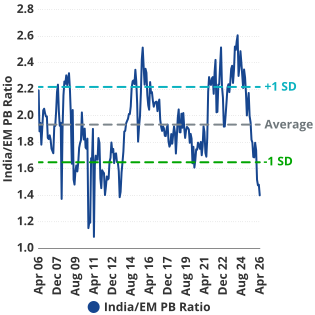
There is also a quality dimension. India has always traded at a premium to EM, and it has earned that premium by growing book value at more than twice EM’s rate for 20 years. The right way to measure that premium is as a ratio: India’s P/B divided by EM’s P/B. Today that ratio stands at 1.40x. The 20-year mean is 1.93x and the median is 1.91x. The current reading is more than one standard deviation below the 20-year mean, which sits at 1.65x. In plain terms, investors are paying significantly less of a premium for India’s superior growth today than they have on average over the past two decades. The question is not whether India deserves a premium. It does. The question is whether today’s premium is fair. At 1.40x, it is not just fair. It is cheap.
The geopolitical pressure that created this entry point was temporary. The valuation gap it opened is real.
Figure 1: India/EM P/B Premium, 20-Year Range
MSCI India vs MSCI EM – Price-to-Book Ratio, 20-Year History
India P/B Premium Over EM – At 13-Year Low
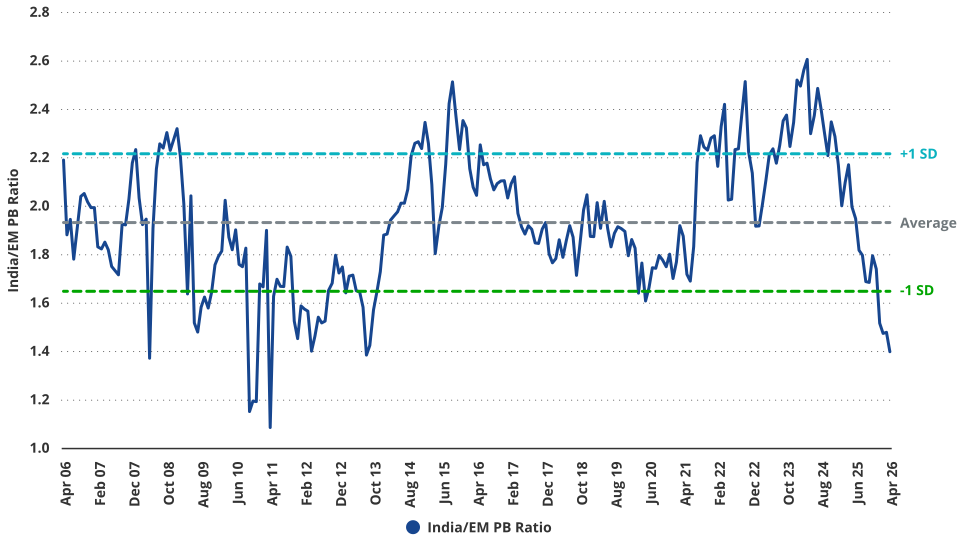
Source: Bloomberg, as of April 30, 2026. 241 monthly observations, April 28, 2006 to April 30, 2026. See footnote 2.
Recommended subscription
The war and oil: a real risk, a reformed system.
Oil price sensitivity is a recurring concern for India investors, and the current geopolitical environment in the Middle East warrants a direct response. The risk is real. India imports approximately 88-89% of its crude, spending roughly $161 billion on petroleum imports in FY2024-25. The sensitivity is meaningful:
| Oil price scenario | CAD impact (% GDP) | Inflation impact (bps) | GDP growth impact |
| $10/bbl increase | +0.3 to +0.4 ppt | +35 to +50 bps | Modest |
| $20/bbl increase | +0.6 to +0.8 ppt | +70 to +100 bps | Manageable |
| Extreme: ~$130/bbl | Significant | Elevated | Up to -0.8 ppt |
| Pre-2014 regime (same shock) | Amplified via fiscal deficit | Amplified | Greater damage |
Source: S&P Global Ratings, April 2026; Reserve Bank of India, Mint Street Memo No. 17. Row 2 derived from per-barrel sensitivities in cited sources. Row 4 based on Ministry of Finance subsidy data; see footnote 4. For illustrative purposes only. Not intended as a forecast or prediction of future results.
What most investors miss is that India’s relationship with oil has changed. Before 2014, the Indian government fixed the retail price of fuel. When oil prices rose globally, the government made up the difference, which blew a hole in the budget and fed through into inflation. At the peak, those subsidies cost $24.6 billion a year. That system no longer exists. Petrol prices were deregulated in 2010, diesel in 2014. Prices now adjust daily. By 2017, subsidies had fallen to $1.2 billion. When oil prices spike today, the government adjusts fuel taxes rather than writing subsidy checks. The shock is absorbed at the pump, not amplified through the budget.
On sourcing, India has diversified its crude basket from 27 countries to over 40. Russian crude, following sanctions-driven reductions from a peak above 35% of imports, now accounts for roughly 25%. The import basket has shifted before and will shift again in response to global supply conditions. India’s posture is pragmatic, not dependent on any single source.
Crude imports as a share of GDP have fallen from 8.5% in 2012 to around 4.8% today, not because India imports less oil, but because the services economy, now over 55% of GDP, has grown faster than energy consumption. Physical import dependency remains high at 88.5% and is projected to rise. The resilience argument is not that India needs less oil. It is that the same barrel does less economic damage than it did a decade ago.
How to access the thesis with VanEck
Investors looking to access the India book value growth story have multiple options. Passive and active strategies are both available, spanning broad market exposure, systematic growth-at-a-reasonable-price approaches, high-conviction active management, and a thematic sleeve focused on India’s digital economy. The right combination depends on how directly an investor wants to express the argument made in this piece.
| Ticker | Fund | How it expresses the thesis | Current entry context |
| INDZ | VanEck India Select ETF | Highest-conviction active. Core/satellite structure across market caps. Semi-annual reset eliminates deteriorating holdings. | Accessing at the 3rd percentile of India’s relative value vs EM. |
| GLIN | VanEck India Growth Leaders ETF | Broad India exposure built around a systematic process. MarketGrader scores 80 top-ranked Indian companies across 24 measures of growth, value, and financial health, with a filter to avoid companies priced excessively relative to their fundamentals. | The core broad-market allocation. Valuation discipline embedded in index construction. |
| DGIN | VanEck Digital India ETF | Digital transformation layer: Communication services, telecom, payments, e-commerce. Least oil-sensitive segment of the economy. | Sharper drawdown than the broader market brings entry levels back to attractive territory. |
Fund data as of April 2026. Past performance not indicative of future results. Not intended as a recommendation to buy or sell any securities referenced herein.
The investment case.
The case for India today does not require India to beat any other market. It requires only that Indian companies keep growing their book value at or near the rate they have sustained for 20 years, and that buying that growth at today’s price produces strong returns over the next five to ten years.
We believe that both conditions are currently met. The 20-year book value growth record is intact. India’s sensitivity to oil price shocks has been reduced by a decade of policy reform. And the price being paid today, at the 3rd percentile of India’s historical premium over EM, is, in our view, one of the most attractive entry points in 20 years.
What happens in Indian equities over the next 12 months is unknown. The 20-year record of book value growth is not.
To receive more Emerging Markets Equity insights, sign up in our subscription center.

IMPORTANT DISCLOSURES
- Book value per share (BV/S), price-to-book (P/B), and price data for the MSCI India Index and MSCI Emerging Markets Index: Bloomberg, as of April 30, 2026. All figures USD-denominated. Total return series; dividends assumed reinvested. April 28, 2006 through April 30, 2026 (20 years, 241 monthly observations). Book value per share figures reflect dividend reinvestment, which contributes to accumulated book value growth over the period.
- India/EM P/B premium percentile calculated from 241 monthly observations, April 28, 2006 through April 30, 2026. Bloomberg, as of April 30, 2026.
- India petroleum import data: Ministry of Petroleum and Natural Gas, Government of India. Crude import dependency figure (88.5%): Petroleum Planning and Analysis Cell (PPAC), FY2024-25.
- Oil price sensitivity estimates (CAD, inflation, GDP impact): Reserve Bank of India, Monetary Policy Reports, various; Indian Ministry of Finance, Economic Survey 2023-24.
- Fuel subsidy deregulation timeline and subsidy figures: Ministry of Finance, Government of India. Petrol deregulated 2010; diesel deregulated 2014; daily price revisions introduced 2017.
- Crude import sourcing (27 to 40+ countries): Petroleum Planning and Analysis Cell (PPAC). Russian crude share at peak (>35%) and following sanctions-driven reduction (~25%): PPAC Monthly Import Data; Reuters, January-March 2026.
- Crude imports as share of GDP (8.5% in 2012 to ~4.8% today): World Bank, Reserve Bank of India. Services sector as percentage of GDP (>55%): National Statistical Office, Government of India.
- IMF GDP growth forecasts for India (6.5-7.3% FY26) and global growth (3.1% in 2026): IMF World Economic Outlook, April 2026.
This is not an offer to buy or sell, or a recommendation to buy or sell any of the securities, financial instruments or digital assets mentioned herein. The information presented does not involve the rendering of personalized investment, financial, legal, tax advice, or any call to action. Certain statements contained herein may constitute projections, forecasts and other forward-looking statements, which do not reflect actual results, are for illustrative purposes only, are valid as of the date of this communication, and are subject to change without notice. Actual future performance of any assets or industries mentioned are unknown. Information provided by third party sources are believed to be reliable and have not been independently verified for accuracy or completeness and cannot be guaranteed. VanEck does not guarantee the accuracy of third party data. The information herein represents the opinion of the author(s), but not necessarily those of VanEck or its other employees.
An investment in the VanEck India Select ETF (INDZ) may be subject to risks which include, among others, special risk considerations of investing in Indian issuers, active management, materials sector, health care sector, consumer discretionary sector, convertible securities, depository receipts, emerging market issuers, equity securities, financials sector, foreign currency, foreign securities, high portfolio turnover, industrial sector, market, new fund, non-diversified, operational, preferred securities, small-, medium- and large-capitalization companies, authorized participant concentration, no guarantee of active trading market, trading issues, fund shares trading, premium/discount risk and liquidity of fund shares, and cash transactions risks, all of which may adversely affect the Fund. Emerging market issuers and foreign securities may be subject to securities markets, political and economic, investment and repatriation restrictions, different rules and regulations, less publicly available financial information, foreign currency and exchange rates, operational and settlement, and corporate and securities laws risks. Small-, medium- and large-capitalization companies may be subject to elevated risks.
An investment in the VanEck India Growth Leaders ETF (GLIN) may be subject to risks which include, but are not limited to, special risk considerations of investing in Indian issuers, foreign securities, emerging market issuers, foreign currency, depositary receipts, information technology sector, financials sector, industrials sector, consumer discretionary sector, micro-, small- and medium capitalization companies, cash transactions, equity securities, market, operational, index tracking, authorized participant concentration, no guarantee of active trading market, trading issues, passive management, fund shares trading, premium/discount, liquidity of fund shares, non-diversification and index-related concentration risks, all of which may adversely affect the Fund. Emerging market issuers and foreign securities may be subject to securities markets, political and economic, investment and repatriation restrictions, different rules and regulations, less publicly available financial information, foreign currency and exchange rates, operational and settlement, and corporate and securities laws risks. Micro-, small- and medium capitalization companies may be subject to elevated risks.
An investment in the VanEck Digital India ETF (DGIN) may be subject to risks which include, but are not limited to, special risk considerations of investing in Indian issuers, equity securities, small- and medium-capitalization companies, communication services sector, financials sector, consumer discretionary sector, information technology sector, emerging market issuers, foreign securities, foreign currency, depositary receipts, cash transactions, market, operational, index tracking, authorized participant concentration, no guarantee of active trading market, trading issues, passive management, fund shares trading, premium/discount, liquidity of fund shares, non-diversified and index- related concentration risks, all of which may adversely affect the Fund. Emerging market issuers and foreign securities may be subject to securities markets, political and economic, investment and repatriation restrictions, different rules and regulations, less publicly available financial information, foreign currency and exchange rates, operational and settlement, and corporate and securities laws risks. Small- and medium capitalization companies may be subject to elevated risks.
Investing involves substantial risk and high volatility, including possible loss of principal. An investor should consider the investment objective, risks, charges and expenses of a Fund carefully before investing. To obtain a prospectus and summary prospectus, which contain this and other information, call 800.826.2333 or visit vaneck.com. Please read the prospectus and summary prospectus carefully before investing.
© Van Eck Securities Corporation, Distributor, a wholly-owned subsidiary of Van Eck Associates Corporation.
Related Funds
IMPORTANT DISCLOSURES
- Book value per share (BV/S), price-to-book (P/B), and price data for the MSCI India Index and MSCI Emerging Markets Index: Bloomberg, as of April 30, 2026. All figures USD-denominated. Total return series; dividends assumed reinvested. April 28, 2006 through April 30, 2026 (20 years, 241 monthly observations). Book value per share figures reflect dividend reinvestment, which contributes to accumulated book value growth over the period.
- India/EM P/B premium percentile calculated from 241 monthly observations, April 28, 2006 through April 30, 2026. Bloomberg, as of April 30, 2026.
- India petroleum import data: Ministry of Petroleum and Natural Gas, Government of India. Crude import dependency figure (88.5%): Petroleum Planning and Analysis Cell (PPAC), FY2024-25.
- Oil price sensitivity estimates (CAD, inflation, GDP impact): Reserve Bank of India, Monetary Policy Reports, various; Indian Ministry of Finance, Economic Survey 2023-24.
- Fuel subsidy deregulation timeline and subsidy figures: Ministry of Finance, Government of India. Petrol deregulated 2010; diesel deregulated 2014; daily price revisions introduced 2017.
- Crude import sourcing (27 to 40+ countries): Petroleum Planning and Analysis Cell (PPAC). Russian crude share at peak (>35%) and following sanctions-driven reduction (~25%): PPAC Monthly Import Data; Reuters, January-March 2026.
- Crude imports as share of GDP (8.5% in 2012 to ~4.8% today): World Bank, Reserve Bank of India. Services sector as percentage of GDP (>55%): National Statistical Office, Government of India.
- IMF GDP growth forecasts for India (6.5-7.3% FY26) and global growth (3.1% in 2026): IMF World Economic Outlook, April 2026.
This is not an offer to buy or sell, or a recommendation to buy or sell any of the securities, financial instruments or digital assets mentioned herein. The information presented does not involve the rendering of personalized investment, financial, legal, tax advice, or any call to action. Certain statements contained herein may constitute projections, forecasts and other forward-looking statements, which do not reflect actual results, are for illustrative purposes only, are valid as of the date of this communication, and are subject to change without notice. Actual future performance of any assets or industries mentioned are unknown. Information provided by third party sources are believed to be reliable and have not been independently verified for accuracy or completeness and cannot be guaranteed. VanEck does not guarantee the accuracy of third party data. The information herein represents the opinion of the author(s), but not necessarily those of VanEck or its other employees.
An investment in the VanEck India Select ETF (INDZ) may be subject to risks which include, among others, special risk considerations of investing in Indian issuers, active management, materials sector, health care sector, consumer discretionary sector, convertible securities, depository receipts, emerging market issuers, equity securities, financials sector, foreign currency, foreign securities, high portfolio turnover, industrial sector, market, new fund, non-diversified, operational, preferred securities, small-, medium- and large-capitalization companies, authorized participant concentration, no guarantee of active trading market, trading issues, fund shares trading, premium/discount risk and liquidity of fund shares, and cash transactions risks, all of which may adversely affect the Fund. Emerging market issuers and foreign securities may be subject to securities markets, political and economic, investment and repatriation restrictions, different rules and regulations, less publicly available financial information, foreign currency and exchange rates, operational and settlement, and corporate and securities laws risks. Small-, medium- and large-capitalization companies may be subject to elevated risks.
An investment in the VanEck India Growth Leaders ETF (GLIN) may be subject to risks which include, but are not limited to, special risk considerations of investing in Indian issuers, foreign securities, emerging market issuers, foreign currency, depositary receipts, information technology sector, financials sector, industrials sector, consumer discretionary sector, micro-, small- and medium capitalization companies, cash transactions, equity securities, market, operational, index tracking, authorized participant concentration, no guarantee of active trading market, trading issues, passive management, fund shares trading, premium/discount, liquidity of fund shares, non-diversification and index-related concentration risks, all of which may adversely affect the Fund. Emerging market issuers and foreign securities may be subject to securities markets, political and economic, investment and repatriation restrictions, different rules and regulations, less publicly available financial information, foreign currency and exchange rates, operational and settlement, and corporate and securities laws risks. Micro-, small- and medium capitalization companies may be subject to elevated risks.
An investment in the VanEck Digital India ETF (DGIN) may be subject to risks which include, but are not limited to, special risk considerations of investing in Indian issuers, equity securities, small- and medium-capitalization companies, communication services sector, financials sector, consumer discretionary sector, information technology sector, emerging market issuers, foreign securities, foreign currency, depositary receipts, cash transactions, market, operational, index tracking, authorized participant concentration, no guarantee of active trading market, trading issues, passive management, fund shares trading, premium/discount, liquidity of fund shares, non-diversified and index- related concentration risks, all of which may adversely affect the Fund. Emerging market issuers and foreign securities may be subject to securities markets, political and economic, investment and repatriation restrictions, different rules and regulations, less publicly available financial information, foreign currency and exchange rates, operational and settlement, and corporate and securities laws risks. Small- and medium capitalization companies may be subject to elevated risks.
Investing involves substantial risk and high volatility, including possible loss of principal. An investor should consider the investment objective, risks, charges and expenses of a Fund carefully before investing. To obtain a prospectus and summary prospectus, which contain this and other information, call 800.826.2333 or visit vaneck.com. Please read the prospectus and summary prospectus carefully before investing.
© Van Eck Securities Corporation, Distributor, a wholly-owned subsidiary of Van Eck Associates Corporation.