S&P 500 Concentration Risk: What to Know Now
July 01, 2026
Read Time 5 MIN
Key Takeaways:
- The top 10 S&P 500 stocks now account for approximately 40% of the index, nearly double their share from a decade ago.
- International developed markets have recently traded at ~16x forward P/E vs. ~22x for the S&P 500, which may represent a valuation opportunity (MSCI EAFE, May 2026).
- VEFA seeks exposure to developed market companies outside the US and Canada, selected based on positive analyst sentiment signals.
Understanding Concentration Risk in the S&P 500
For investors using the S&P 500 as their primary equity allocation, a small number of mega-cap stocks now account for nearly 40% of the index, driving most of their returns and, in a downturn, most of their losses (VanEck, May 2026). Investors who have focused strictly on the US over the past decade have been rewarded with strong returns, but past performance is not a guarantee of future results, and a portfolio concentrated in a handful of names carries risks that broad diversification is designed to reduce.
What Is Concentration Risk?
Concentration risk occurs when portfolio returns are heavily dependent on a small number of stocks, sectors, or geographies. The S&P 500 itself is structurally concentrated at the index level, meaning even a passive allocation is top-heavy by design. While that concentration has rewarded investors over the past decade, holding only S&P 500 exposure means there is no buffer if that trend reverses. Concentration is not inherently bad, but it should be intentional.
How Concentrated Has the S&P 500 Become?
What was once a broadly diversified index has become increasingly top-heavy. A decade ago, the top 10 S&P 500 stocks accounted for roughly 18% of the index (VanEck, May 2016). Today that figure has nearly doubled, with the top 10 now representing close to 40% of the total index weight.
Top 10 Holdings Weight: S&P 500 vs. MSCI EAFE (2016 vs. 2026)
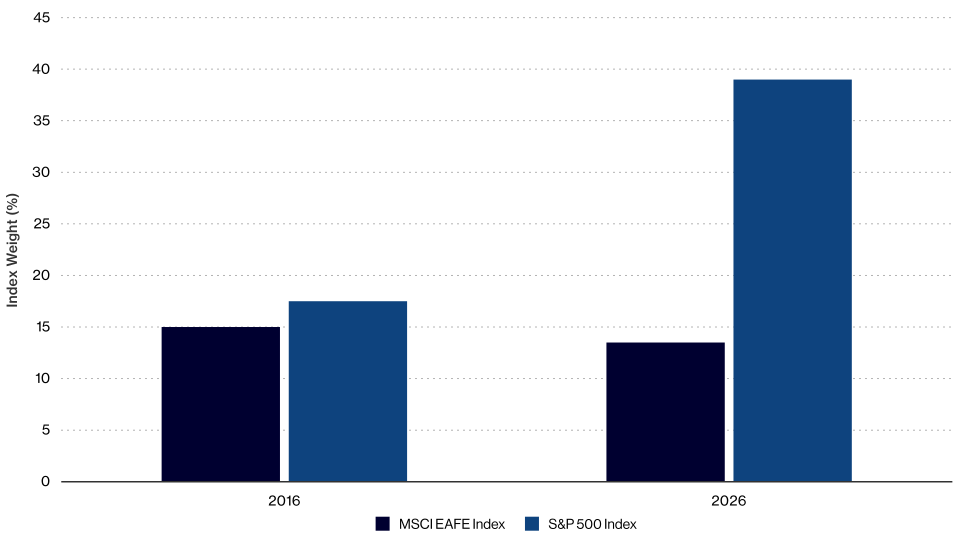
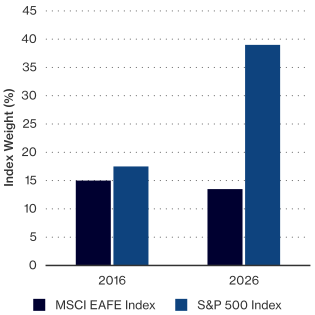
As of May 31, 2026 and May 31, 2016. Source: VanEck.
A passive S&P 500 allocation is now effectively an active sector bet, whether the investor intended it or not. By contrast, the MSCI EAFE index is significantly less concentrated, spreading risk more evenly across companies, sectors, and geographies.
Recommended subscription
Why Are Advisors Looking at International Diversification?
Several factors have converged to bring international diversification back into focus:
- Valuation gap: International markets trade at a meaningful discount to the S&P 500 on earnings multiples. The S&P 500 currently trades at a forward P/E of around 22x compared to roughly 16x for MSCI EAFE, a gap that has historically been a meaningful signal for relative returns.
- Unintentional sector bets: AI-driven concentration has quietly pushed many client portfolios into large overweights to tech and semiconductors that advisors often catch after the fact.
- Improving international fundamentals: European and Asian companies have shown encouraging signs of earnings improvement, supported by fiscal stimulus and corporate reform efforts, making the case for international exposure more than a valuation story.
What Does Developed International Exposure Actually Look Like?
Moving beyond the S&P 500 does not mean moving into speculative or illiquid markets. Developed international equities (as represented by MSCI EAFE) are large, profitable global companies, just listed outside the US and Canada. The MSCI EAFE universe covers large and mid-cap equities across Europe, Japan, and Australasia, including household names like Nestle, Toyota, ASML, and Novo Nordisk. The practical result is reducing the share of a portfolio that rises and falls with a small number of US mega-cap names, without sacrificing quality or liquidity.
How Can a Sentiment-Enhanced Approach Help Reduce Concentration Risk?
A broad EAFE allocation reduces concentration risk and provides geographic diversification, but holds the market with no tilt toward companies with improving fundamentals. An analyst sentiment-enhanced approach layers a sentiment signal on top of that diversification benefit, tilting toward companies where analyst revisions are trending positive. The result is geographic diversification plus a sentiment signal, rather than simply swapping US concentration for broad international exposure. This approach does carry some active risk relative to a plain EAFE index, but the strategy is designed to keep that risk within a defined range while still delivering the diversification benefit.
How Does VEFA Address S&P 500 Concentration Risk?
VEFA is designed to address the two challenges this blog outlines: the concentration risk embedded in an S&P 500-only allocation, and the missed opportunity of holding broad international exposure without any tilt toward improving fundamentals. The fund provides exposure to approximately 100 large and mid-cap developed market companies outside the US and Canada, selected based on positive analyst sentiment signals, and tracks the MSCI EAFE Analyst Sentiment Select Index (VanEck, May 2026). It rebalances quarterly and seeks to maintain ex-ante tracking error below 4% relative to MSCI EAFE (VanEck, May 2026).
VEFA | VanEck MSCI EAFE Analyst Sentiment ETF
To receive more Emerging Markets Equity insights, sign up in our subscription center.

Important Disclosures
This is not an offer to buy or sell, or a recommendation to buy or sell any of the securities, financial instruments or digital assets mentioned herein. The information presented does not involve the rendering of personalized investment, financial, legal, tax advice, or any call to action. Certain statements contained herein may constitute projections, forecasts and other forward-looking statements, which do not reflect actual results, are for illustrative purposes only, are valid as of the date of this communication, and are subject to change without notice. Actual future performance of any assets or industries mentioned are unknown. Information provided by third party sources are believed to be reliable and have not been independently verified for accuracy or completeness and cannot be guaranteed. VanEck does not guarantee the accuracy of third party data. The information herein represents the opinion of the author(s), but not necessarily those of VanEck or its other employees.
MSCI EAFE Index: The MSCI EAFE Index is an equity index which captures large and mid cap representation across 21 Developed Markets countries around the world, excluding the US and Canada. With 689 constituents, the index covers approximately 85% of the free float-adjusted market capitalization in each country (VanEck, May 2026).
MSCI EAFE Analyst Sentiment Select Index: MSCI EAFE Analyst Sentiment Select Index is based on MSCI EAFE Index, its parent index which includes large and mid-cap stocks across 21 Developed Markets countries around the world, excluding the US and Canada. The index uses an optimization process that aims to maximize the exposure to the Analyst Sentiment factor, while controlling for active risk, active specific risk and net ex-ante beta relative to the parent index.
MSCI ACWI IMI (All Country World Investable Market Index): a comprehensive stock market index capturing large, mid, and small-cap stocks across 23 Developed Markets (DM) and 24 Emerging Markets (EM). It covers roughly 99% of the global equity opportunity set, spanning over 9,000 securities
S&P 500 Index consists of 500 widely held common stocks covering the leading industries of the U.S. economy.
Index returns are not Fund returns and do not reflect any management fees or brokerage expenses. Certain indices may take into account withholding taxes. Investors can not invest directly in the Index. Returns for actual Fund investors may differ from what is shown because of differences in timing, the amount invested and fees and expenses. Index returns assume that dividends have been reinvested.
An investment in the Fund may be subject to risks which include, among others, risks related to investing in foreign securities, foreign currency, financials sector, industrials sector, health care sector, special risk considerations of investing in European, Japanese and United Kingdom issuers, depositary receipts, equity securities, issuer-specific changes, medium- and large-capitalization companies, market, operational, index tracking, authorized participant concentration, new fund, no guarantee of active trading market, trading issues, passive management, fund shares trading, premium/discount, liquidity of fund shares, non-diversified, and index-related concentration risks, all of which may adversely affect the Fund. Medium-, and large-capitalization companies may be subject to elevated risks.
Investing involves substantial risk and high volatility, including possible loss of principal. An investor should consider the investment objective, risks, charges and expenses of a Fund carefully before investing. To obtain a prospectus and summary prospectus, which contain this and other information, call 800.826.2333 or visit vaneck.com. Please read the prospectus and summary prospectus carefully before investing.
© Van Eck Securities Corporation, Distributor, a wholly owned subsidiary of Van Eck Associates Corporation.
Related Funds
Important Disclosures
This is not an offer to buy or sell, or a recommendation to buy or sell any of the securities, financial instruments or digital assets mentioned herein. The information presented does not involve the rendering of personalized investment, financial, legal, tax advice, or any call to action. Certain statements contained herein may constitute projections, forecasts and other forward-looking statements, which do not reflect actual results, are for illustrative purposes only, are valid as of the date of this communication, and are subject to change without notice. Actual future performance of any assets or industries mentioned are unknown. Information provided by third party sources are believed to be reliable and have not been independently verified for accuracy or completeness and cannot be guaranteed. VanEck does not guarantee the accuracy of third party data. The information herein represents the opinion of the author(s), but not necessarily those of VanEck or its other employees.
MSCI EAFE Index: The MSCI EAFE Index is an equity index which captures large and mid cap representation across 21 Developed Markets countries around the world, excluding the US and Canada. With 689 constituents, the index covers approximately 85% of the free float-adjusted market capitalization in each country (VanEck, May 2026).
MSCI EAFE Analyst Sentiment Select Index: MSCI EAFE Analyst Sentiment Select Index is based on MSCI EAFE Index, its parent index which includes large and mid-cap stocks across 21 Developed Markets countries around the world, excluding the US and Canada. The index uses an optimization process that aims to maximize the exposure to the Analyst Sentiment factor, while controlling for active risk, active specific risk and net ex-ante beta relative to the parent index.
MSCI ACWI IMI (All Country World Investable Market Index): a comprehensive stock market index capturing large, mid, and small-cap stocks across 23 Developed Markets (DM) and 24 Emerging Markets (EM). It covers roughly 99% of the global equity opportunity set, spanning over 9,000 securities
S&P 500 Index consists of 500 widely held common stocks covering the leading industries of the U.S. economy.
Index returns are not Fund returns and do not reflect any management fees or brokerage expenses. Certain indices may take into account withholding taxes. Investors can not invest directly in the Index. Returns for actual Fund investors may differ from what is shown because of differences in timing, the amount invested and fees and expenses. Index returns assume that dividends have been reinvested.
An investment in the Fund may be subject to risks which include, among others, risks related to investing in foreign securities, foreign currency, financials sector, industrials sector, health care sector, special risk considerations of investing in European, Japanese and United Kingdom issuers, depositary receipts, equity securities, issuer-specific changes, medium- and large-capitalization companies, market, operational, index tracking, authorized participant concentration, new fund, no guarantee of active trading market, trading issues, passive management, fund shares trading, premium/discount, liquidity of fund shares, non-diversified, and index-related concentration risks, all of which may adversely affect the Fund. Medium-, and large-capitalization companies may be subject to elevated risks.
Investing involves substantial risk and high volatility, including possible loss of principal. An investor should consider the investment objective, risks, charges and expenses of a Fund carefully before investing. To obtain a prospectus and summary prospectus, which contain this and other information, call 800.826.2333 or visit vaneck.com. Please read the prospectus and summary prospectus carefully before investing.
© Van Eck Securities Corporation, Distributor, a wholly owned subsidiary of Van Eck Associates Corporation.