BDCs: The Liquid Way to Access to Private Credit
February 24, 2026
Read Time 4 MIN
Business development companies (BDCs) are regaining momentum with attractive yields (BIZD 30-day SEC yield: 8.56% as of 2/18/2026) and credit risk largely priced in. For income-focused investors looking beyond traditional bonds, VanEck’s BDC Income ETF (BIZD) provides a diversified, liquid way to access the growing private credit market.
In a recent webinar, VanEck’s Coulter Regal, CFA and Nico Cortese, CFA discussed the key factors supporting BDCs, including their institutional scale, more conservative portfolio construction, and stable credit quality.
For the full discussion, watch the replay of High Yield Opportunities in BDCs.
Key takeaways:
- Investors are increasing allocations to private credit - The BDC market has grown rapidly, reflecting a broader institutional shift toward private credit (2:50).
- How BDCs offer consistent high yield potential relative to other income-oriented investments - At 11.3%, the MVIS US BDC Index dividend yield is nearly double those of leveraged loans and high yield bonds, and roughly triple the 10-year Treasury, creating a compelling income advantage in today’s market (4:56).
- More conservative portfolio construction - The BDC industry has meaningfully de-risked its portfolio construction over recent years (13:25).
- Insights from Houlihan Lokey’s BDC Monitor - Industry leverage has fallen, nonaccrual rates are low, and loan prices remain near par, signaling that the recent price weakness is a sentiment-driven discount, not a credit problem (15:15).
- Benefits of a diversified BDC investment approach - The VanEck BDC Income ETF (BIZD) provides broad, liquid access to the publicly traded BDC market, eliminating single-manager concentration risk while capturing the asset class’s income premium (26:45).

How Do BDC Yields Compare to High Yield Bonds, Leveraged Loans and Treasuries?
BDCs stand out as one of the highest-yielding income-oriented asset classes available today. As of December 31, 2025, BDCs' MVIS US Business Development Companies Index dividend yield was 11.3%, nearly double that of leveraged loans (6.8%) and U.S. high yield bonds (6.5%), and roughly triple the yield on 10-year Treasuries (4.2%). This yield advantage reflects the structural premium investors earn for accessing middle-market private credit through a publicly traded vehicle.
Investors Are Increasing Allocations to Private Credit
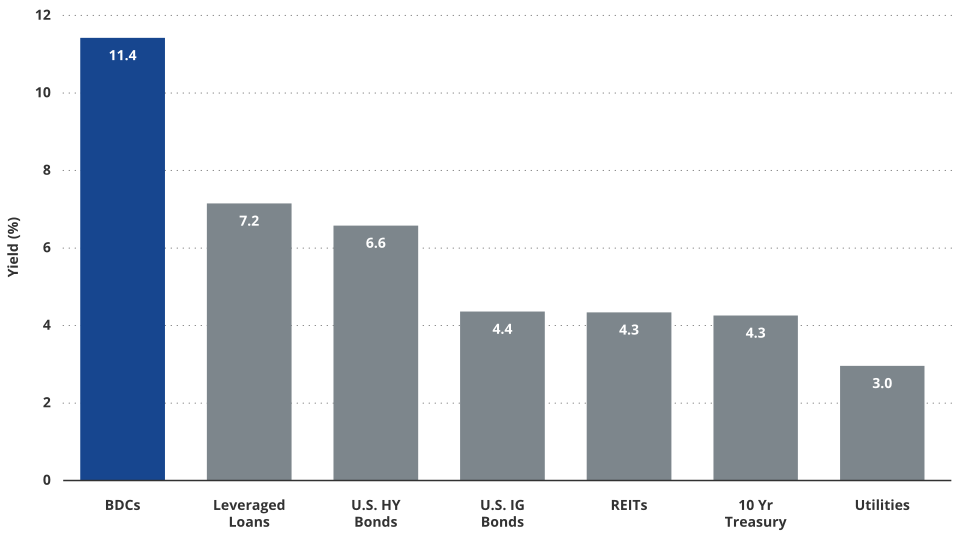
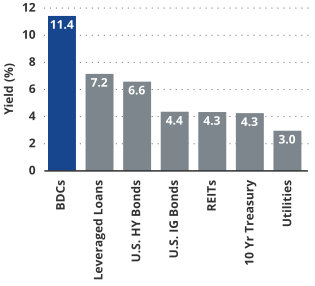
Source: FactSet and ICE Data Indices. Past performance is no guarantee of future results. Yield for Mortgage REITs, BDCs, Equity REITs, and Utilities Stocks represented by dividend yield. Yield for Leveraged Loans, U.S. HY Bonds, U.S. IG Bonds, and 10 Yr Treasury represented by yield-to-worst. Mortgage REITs represented by MVIS US Mortgage REITs Index; BDCs represented by MVIS US Business Development Companies Index, U.S. HY Bonds represented by ICE BofA US High Yield Index; U.S. IG Bonds represented by ICE BofA U.S. Corporate Index; U.S. 10 Yr Treasury represented by ICE BofA Current 10-Year US Treasury Index; Equity REITs represented by FTSE NAREIT All Equity REITs Index; Utilities Stocks represented by S&P Utilities Index; Leveraged Loans represented by Bloomberg US Leveraged Loan (Ba/B) Index. See important disclosures and descriptions at end.
BDC Credit Quality Remains Strong
Multiple indicators confirm that BDC credit quality is healthy. Nonaccrual rates, investments where borrowers have stopped making payments, sit at just 1.2% of total portfolios as of Q2 2025, well below the 5.2% peak during the COVID era and below pre-pandemic levels. Weighted average loan prices for first-lien debt remain near par at 99.3%, and the vast majority of BDC investments are priced above 97% of par value. PIK (payment-in-kind) income, a potential early warning sign of borrower stress, has also remained manageable at 6.4% of total interest income.
- Nonaccrual rates are at 1.2%, well below the COVID-era peak of 5.2% and below pre-pandemic levels.
- First-lien weighted average loan prices are near par at 99.3%.
- PIK income remains manageable at 6.4% of total interest income.
- Loan price distribution shows 87% of investments are priced above 97% of par.
BIZD: Diversified BDC Exposure in a Single ETF
The VanEck BDC Income ETF (BIZD) provides investors with diversified access to the publicly traded BDC market. Rather than picking individual BDCs, which carry concentration risk tied to specific managers, sectors, and borrower pools, BIZD offers broad exposure across the industry’s largest and most liquid names. For income-focused investors looking beyond traditional bonds, BIZD provides a way to capture the BDC yield premium with institutional-scale diversification and daily liquidity.
- BIZD offers diversified exposure across the largest publicly traded BDCs.
- The ETF eliminates single-BDC concentration risk tied to specific managers or borrower pools.
- Daily liquidity and broad diversification make it an accessible way to capture the BDC income premium.
BIZD | VanEck BDC Income ETF
To receive more Income Investing insights, sign up in our subscription center.

IMPORTANT DISCLOSURES
The performance data quoted represents past performance. Past performance is not a guarantee of future results. Investment return and principal value of an investment will fluctuate so that an investor’s shares, when redeemed, may be worth more or less than their original cost. Performance may be lower or higher than performance data quoted. Please call 800.826.2333, or click for performance current to the most recent month end.
Please click here for BIZD standardized performance.
30-Day SEC Yield - A standard yield calculation developed by the Securities and Exchange Commission that allows for fairer comparison among funds. It is based on the most recent 30-Day period. This yield figure reflects the interest earned during the period after deducting the Fund’s expenses for the period. It does not reflect the yield an investor would have received if they had held the Fund over the last twelve months assuming the most recent NAV.
Dividend Yield - Represents the annual dividends paid by index constituents divided by their market price, expressed as a percentage. The dividend yield referenced herein reflects the MVIS US Business Development Companies Index and does not represent the yield of BIZD.
Payment-in-kind (PIK) income represents interest that is accrued but not paid in cash. PIK may increase portfolio leverage and can be an indicator of borrower stress. There is no guarantee that PIK income will be realized as cash or result in positive investment returns.
This is not an offer to buy or sell, or a recommendation to buy or sell any of the securities, financial instruments or digital assets mentioned herein. The information presented does not involve the rendering of personalized investment, financial, legal, tax advice, or any call to action. Certain statements contained herein may constitute projections, forecasts and other forward-looking statements, which do not reflect actual results, are for illustrative purposes only, are valid as of the date of this communication, and are subject to change without notice. Actual future performance of any assets or industries mentioned are unknown. Information provided by third party sources are believed to be reliable and have not been independently verified for accuracy or completeness and cannot be guaranteed. VanEck does not guarantee the accuracy of third party data. The information herein represents the opinion of the author(s), but not necessarily those of VanEck or its other employees.
MVIS® US Mortgage REITs Index is a rules-based, modified market capitalization-weighted index designed to track the performance of U.S.-listed real estate investment trusts (REITs) that primarily invest in mortgage loans and mortgage-backed securities.
MVIS® US Business Development Companies Index is a rules-based, modified market capitalization-weighted index designed to track the performance of the largest and most liquid U.S.-listed business development companies (BDCs).
ICE BofA US High Yield Index is designed to track the performance of U.S. dollar-denominated, below investment grade (high yield) corporate debt publicly issued in the U.S. domestic market.
ICE BofA U.S. Corporate Index is designed to measure the performance of U.S. dollar-denominated investment grade corporate debt publicly issued in the U.S. domestic market.
ICE BofA Current 10-Year US Treasury Index is designed to track the performance of the current (on-the-run) 10-year U.S. Treasury note, as determined by the index provider.
FTSE NAREIT All Equity REITs Index is a market capitalization-weighted index designed to measure the performance of publicly traded U.S. equity real estate investment trusts (REITs) that own and operate income-producing real estate.
S&P Utilities Select Sector Index (commonly referred to as the S&P Utilities Index) is a market capitalization-weighted index designed to measure the performance of utilities companies included in the S&P 500® Index.
Bloomberg US Leveraged Loan (Ba/B) Index is designed to measure the performance of U.S. dollar-denominated, below-investment-grade (Ba/B rated), floating-rate institutional leveraged loans.
An investor cannot invest directly in an index. Returns reflect past performance and do not guarantee future results. Results reflect the reinvestment of dividends and capital gains, if any. Certain indices may take into account withholding taxes. Index returns do not represent Fund returns. The Index does not charge management fees or brokerage expenses, nor does the Index lend securities, and no revenues from securities lending were added to the performance shown.
Business Development Companies (BDCs) generally invest in less mature U.S. private companies or thinly traded U.S. public companies which involve greater risk than well-established publicly-traded companies. While the BDCs that comprise the Index are expected to generate income in the form of dividends, certain BDCs during certain periods of time may not generate such income. The Fund will indirectly bear its proportionate share of any management fees and other operating expenses incurred by the BDCs and of any performance-based or incentive fees payable by the BDCs in which it invests, in addition to the expenses paid by the Fund. A BDC’s incentive fee may be very high, vary from year to year and be payable even if the value of the BDC’s portfolio declines in a given time period. Incentive fees may create an incentive for a BDC’s manager to make investments that are risky or more speculative than would be the case in the absence of such compensation arrangements, and may also encourage the BDC’s manager to use leverage to increase the return on the BDC’s investments. The use of leverage by BDCs magnifies gains and losses on amounts invested and increases the risks associated with investing in BDCs. A BDC may make investments with a larger amount of risk of volatility and loss of principal than other investment options and may also be highly speculative and aggressive. The Fund and its affiliates may not own in excess of 25% of a BDC’s outstanding voting securities which may limit the Fund’s ability to fully replicate its index. An investment in the Fund may be subject to risks which include, among others, investing in BDCs, investment restrictions, financial sector, small- and medium-capitalization companies, equity securities, market, operational, index tracking, authorized participant concentration, no guarantee of active trading market, trading issues, passive management, fund shares trading, premium/discount and liquidity of fund shares, issuer-specific changes, and index-related concentration risks, all of which may adversely affect the fund. Small- and medium-capitalization companies may be subject to elevated risks.
Investing involves substantial risk and high volatility, including possible loss of principal. Bonds and bond funds will decrease in value as interest rates rise. An investor should consider the investment objective, risks, charges and expenses of the Fund carefully before investing. To obtain a prospectus and summary prospectus, which contains this and other information, call 800.826.2333 or visit vaneck.com/etfs. Please read the prospectus and summary prospectus carefully before investing.
© Van Eck Securities Corporation, Distributor, a wholly owned subsidiary of Van Eck Associates Corporation.
Related Funds
IMPORTANT DISCLOSURES
The performance data quoted represents past performance. Past performance is not a guarantee of future results. Investment return and principal value of an investment will fluctuate so that an investor’s shares, when redeemed, may be worth more or less than their original cost. Performance may be lower or higher than performance data quoted. Please call 800.826.2333, or click for performance current to the most recent month end.
Please click here for BIZD standardized performance.
30-Day SEC Yield - A standard yield calculation developed by the Securities and Exchange Commission that allows for fairer comparison among funds. It is based on the most recent 30-Day period. This yield figure reflects the interest earned during the period after deducting the Fund’s expenses for the period. It does not reflect the yield an investor would have received if they had held the Fund over the last twelve months assuming the most recent NAV.
Dividend Yield - Represents the annual dividends paid by index constituents divided by their market price, expressed as a percentage. The dividend yield referenced herein reflects the MVIS US Business Development Companies Index and does not represent the yield of BIZD.
Payment-in-kind (PIK) income represents interest that is accrued but not paid in cash. PIK may increase portfolio leverage and can be an indicator of borrower stress. There is no guarantee that PIK income will be realized as cash or result in positive investment returns.
This is not an offer to buy or sell, or a recommendation to buy or sell any of the securities, financial instruments or digital assets mentioned herein. The information presented does not involve the rendering of personalized investment, financial, legal, tax advice, or any call to action. Certain statements contained herein may constitute projections, forecasts and other forward-looking statements, which do not reflect actual results, are for illustrative purposes only, are valid as of the date of this communication, and are subject to change without notice. Actual future performance of any assets or industries mentioned are unknown. Information provided by third party sources are believed to be reliable and have not been independently verified for accuracy or completeness and cannot be guaranteed. VanEck does not guarantee the accuracy of third party data. The information herein represents the opinion of the author(s), but not necessarily those of VanEck or its other employees.
MVIS® US Mortgage REITs Index is a rules-based, modified market capitalization-weighted index designed to track the performance of U.S.-listed real estate investment trusts (REITs) that primarily invest in mortgage loans and mortgage-backed securities.
MVIS® US Business Development Companies Index is a rules-based, modified market capitalization-weighted index designed to track the performance of the largest and most liquid U.S.-listed business development companies (BDCs).
ICE BofA US High Yield Index is designed to track the performance of U.S. dollar-denominated, below investment grade (high yield) corporate debt publicly issued in the U.S. domestic market.
ICE BofA U.S. Corporate Index is designed to measure the performance of U.S. dollar-denominated investment grade corporate debt publicly issued in the U.S. domestic market.
ICE BofA Current 10-Year US Treasury Index is designed to track the performance of the current (on-the-run) 10-year U.S. Treasury note, as determined by the index provider.
FTSE NAREIT All Equity REITs Index is a market capitalization-weighted index designed to measure the performance of publicly traded U.S. equity real estate investment trusts (REITs) that own and operate income-producing real estate.
S&P Utilities Select Sector Index (commonly referred to as the S&P Utilities Index) is a market capitalization-weighted index designed to measure the performance of utilities companies included in the S&P 500® Index.
Bloomberg US Leveraged Loan (Ba/B) Index is designed to measure the performance of U.S. dollar-denominated, below-investment-grade (Ba/B rated), floating-rate institutional leveraged loans.
An investor cannot invest directly in an index. Returns reflect past performance and do not guarantee future results. Results reflect the reinvestment of dividends and capital gains, if any. Certain indices may take into account withholding taxes. Index returns do not represent Fund returns. The Index does not charge management fees or brokerage expenses, nor does the Index lend securities, and no revenues from securities lending were added to the performance shown.
Business Development Companies (BDCs) generally invest in less mature U.S. private companies or thinly traded U.S. public companies which involve greater risk than well-established publicly-traded companies. While the BDCs that comprise the Index are expected to generate income in the form of dividends, certain BDCs during certain periods of time may not generate such income. The Fund will indirectly bear its proportionate share of any management fees and other operating expenses incurred by the BDCs and of any performance-based or incentive fees payable by the BDCs in which it invests, in addition to the expenses paid by the Fund. A BDC’s incentive fee may be very high, vary from year to year and be payable even if the value of the BDC’s portfolio declines in a given time period. Incentive fees may create an incentive for a BDC’s manager to make investments that are risky or more speculative than would be the case in the absence of such compensation arrangements, and may also encourage the BDC’s manager to use leverage to increase the return on the BDC’s investments. The use of leverage by BDCs magnifies gains and losses on amounts invested and increases the risks associated with investing in BDCs. A BDC may make investments with a larger amount of risk of volatility and loss of principal than other investment options and may also be highly speculative and aggressive. The Fund and its affiliates may not own in excess of 25% of a BDC’s outstanding voting securities which may limit the Fund’s ability to fully replicate its index. An investment in the Fund may be subject to risks which include, among others, investing in BDCs, investment restrictions, financial sector, small- and medium-capitalization companies, equity securities, market, operational, index tracking, authorized participant concentration, no guarantee of active trading market, trading issues, passive management, fund shares trading, premium/discount and liquidity of fund shares, issuer-specific changes, and index-related concentration risks, all of which may adversely affect the fund. Small- and medium-capitalization companies may be subject to elevated risks.
Investing involves substantial risk and high volatility, including possible loss of principal. Bonds and bond funds will decrease in value as interest rates rise. An investor should consider the investment objective, risks, charges and expenses of the Fund carefully before investing. To obtain a prospectus and summary prospectus, which contains this and other information, call 800.826.2333 or visit vaneck.com/etfs. Please read the prospectus and summary prospectus carefully before investing.
© Van Eck Securities Corporation, Distributor, a wholly owned subsidiary of Van Eck Associates Corporation.