Bonds Are Down, CLOs Are Up: What the 10Y at 5% Is Saying
October 19, 2026
Read Time 6 MIN
Key Takeaways
- CLOs have historically outperformed the Agg when rates rise
- Floating coupons and low duration mean almost no price sensitivity to rising long term yields, while income resets higher as short term rates rise
- No two CLOs are the same, so active management and issuer selection matter even more when rates are this high
The Fed raised rates 25 basis points (bps) on September 16, its first hike since July 2023, and the 10-year US Treasury yield closed September at 5.29%, up from 3.97% at the end of February. Fixed rate bonds have felt the impact, as the Agg is down 2.69% and US Corporates are down 2.79%, while investment grade CLOs are up 3.78% and mezzanine CLOs are up 4.55%.
The difference in returns comes from the structure of the coupon. CLOs pay floating coupons that reset each quarter with SOFR, so higher short-term rates flow directly into income, and because CLOs have low duration, there is almost no price sensitivity when longer term yields rise. We made this argument in CLOs: A Rising Rate Alternative in early 2023. The Agg and US Corporates are fixed rate coupon paying bonds with a duration of approximate 6 years, meaning that a 1% increase in rates will decrease the bond price by approximately 6%, all else equal.
How did CLOs Perform when the 10-year Rose?
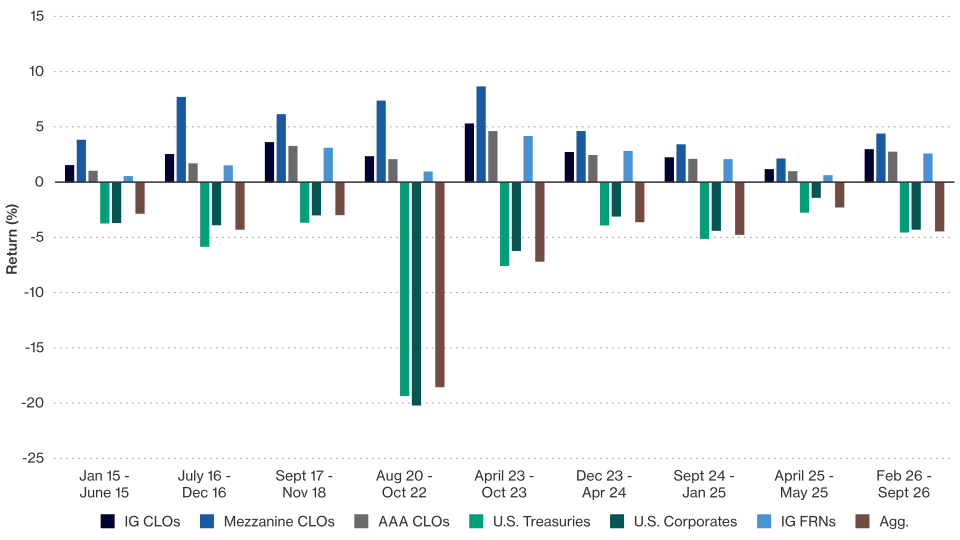
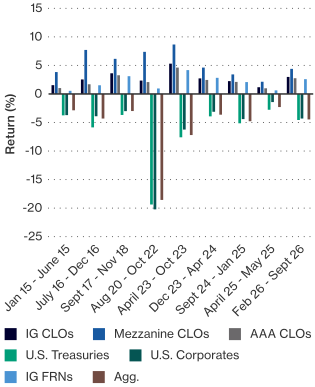
We looked at nine periods since 2015 when the 10-year US Treasury yield rose and compared returns across different fixed income exposures. Investment grade CLOs and mezzanine CLOs finished positive in all nine while the Agg, US Treasuries and US corporates finished negative in all. Bond losses mostly grew with the magnitude of the move on the 10-year, while CLO returns were unaffected. In the largest move, from August 2020 to October 2022, the 10Y rose 373 basis points and Treasuries lost 19.37% and the Agg lost 18.57%, while investment grade CLOs gained 2.35%, mezzanine CLOs gained 7.38% and AAA CLOs gained 2.08%.
On average, investment grade CLOs returned 2.72% across the nine periods, mezzanine CLOs 5.37%, AAA CLOs 2.33% and IG FRNs 2.05%, while US Treasuries, US Corporates and the Agg all posted negative returns (-6.30%, -5.60%, -5.68%, respectively).
CLOs have historically outperformed in rising-rate environments
| 10Y US Treasury |
+0.82% | +1.23% | +1.19% | +3.73% | +1.68% | +0.91% | +1.15% | +0.57% | +1.32% |
Source: VanEck, Morningstar Direct, J.P. Morgan, ICE Date Services. Investment grade CLOs: J.P. Morgan CLO IG Index. Mezzanine CLOs: J.P. Morgan CLOIE Balanced Mezzanine Index. AAA CLOs: J.P. Morgan CLO AAA Index, US Treasuries: ICE BofA US Treasury Index, US Corporates: ICE BofA US Corporate Index, IG FRNs: MVIS US IG Floating Rate Index and US Agg: ICE BofA US Broad Market Index. Past performance is not indicative of future results. Index performance is not representative of fund performance. It is not possible to invest directly in an index.
Recommended subscription
What happened to CLOs when the Fed Hikes?
Looking at all 20 Fed hikes from December 2015 to July 2023, the benefit of a floating coupon shows up over time rather than immediately. This occurs as the coupon adjusts with prevailing interest rates when it resets, usually quarterly.
One month after a hike, the difference is small, with investment grade CLOs averaging 0.34% against a 0.24% loss for Treasuries. At twelve months, investment grade CLOs averaged 5.95% against 1.20% for Treasuries and 2.12% for the Agg. Notably, investing outside of AAA CLOs benefited returns in all periods.
Average total return after Fed hikes, December 2015 to July 2023
| After hike | Investment grade CLOs (%) | Mezzanine CLOs (%) | AAA CLOs (%) | US Treasuries (%) | US IG (%) | IG FRNs (%) | US Agg (%) |
| 1 month | 0.34 | 0.46 | 0.33 | -0.24 | -0.03 | 0.34 | -0.17 |
| 3 months | 0.98 | 1.21 | 0.96 | -0.24 | 0.04 | 0.90 | -0.15 |
| 6 months | 2.51 | 3.65 | 2.33 | 0.02 | 1.15 | 2.04 | 0.36 |
| 12 months | 5.95 | 9.25 | 5.40 | 1.20 | 4.07 | 4.84 | 2.12 |
Source: VanEck, Morningstar Direct, J.P. Morgan, ICE Date Services. Investment grade CLOs: J.P. Morgan CLO IG Index. Mezzanine CLOs: J.P. Morgan CLOIE Balanced Mezzanine Index. AAA CLOs: J.P. Morgan CLO AAA Index, US Treasuries: ICE BofA US Treasury Index, US Corporates: ICE BofA US Corporate Index, IG FRNs: MVIS US IG Floating Rate Index and US Agg: ICE BofA US Broad Market Index. Past performance is not indicative of future results. Index performance is not representative of fund performance. It is not possible to invest directly in an index.
The rate cycle matters as well. During the slow 2015 to 2018 tightening, Treasuries averaged 3.54% over twelve months against 3.35% for investment grade CLOs, partly because after the late 2018 hikes, Treasuries rallied, while the Fed pivoted to rate cuts. In 2022 and 2023, when the Fed hiked quickly and the 10-year rose with it, investment grade CLOs averaged 8.09% over twelve months and mezzanine CLOs 12.39%, while Treasuries lost 0.72% and the Agg gained 0.46%. With the Fed hiking again and the 10-year rising rapidly above 5%, the current environment looks more like the second cycle than the first.
Spread Risk Is What Investors Should Look At
A floating coupon may protect against higher rates, but it does not protect when credit spreads widen, and that risk grows the lower you go down the capital structure. Mezzanine CLOs lost 5.11% in the three months after the December 2015 hike during the oil collapse, and they gained just 0.24% in the twelve months after the March 2022 hike. Investment grade CLOs were positive in every 12-month window after a hike, though results ranged widely, from 1.84% to 10.45%. No two CLOs are the same. Managers, vintages, collateral and deal terms differ, and two CLOs with identical collateral can perform differently because of structure. With rates this high, loan borrowers carry higher interest costs, so active management and issuer selection in CLO tranches matter even more.
CLOs Outperforming This Year
The bigger story this year has been the move in longer term yields. The 10-year Treasury yield is up 111 bps year to date, from 4.18% at the end of 2025 to 5.29% on September 30, although it dipped to 3.97% at the end of February. It was already at 5.01% on the day of the Fed’s decision, so roughly three quarters of the increase came before the hike. The increase reflects persistent inflation, higher energy prices tied to the conflict between the US/Iran and disruption around the Strait of Hormuz, expectations for tighter Federal Reserve policy and fiscal pressures from large deficits and heavy borrowing.
Within CLOs, going beyond AAA has paid off. Year to date, investment grade CLOs are up 3.78% and mezzanine CLOs are up 4.55% vs just 3.60% for AAA CLOs while the Agg is down 2.69%. The pattern holds across rising rate periods. Both investment grade and mezzanine CLOs finished ahead of AAA CLOs in the 10Y selloffs above and at every horizon after the Fed hikes, with twelve month returns averaging 5.40% for AAA CLOs, 5.95% for investment grade CLOs and 9.25% for mezzanine CLOs. Lower rated tranches pay more for taking that extra risk, which has added to returns. The tradeoff is higher volatility but year to date neither investment grade nor AAA CLOs have had a monthly drawdown.
VanEck's CLO Offerings
With the Fed back to raising rates and the 10 year above 5%, the floating rate structure remains a benefit and now comes with the structural protection the asset class has always offered. VanEck partnered with MetLife Investment Management on two actively managed CLO ETFs. The VanEck CLO ETF (CLOI) provides access to investment grade floating rate CLOs and the VanEck AA-BB CLO ETF (CLOB) provides actively managed access to mezzanine CLO tranches for investors seeking higher income within the CLO structure. In 2026, VanEck launched its first interval fund, the VanEck CLO Opportunities Fund (CLOIX), which invests primarily in equity and debt tranches of CLOs rated BBB or below.
To receive more Income Investing insights, sign up in our subscription center.

Important Disclosures
Source: VanEck, Morningstar Direct, J.P. Morgan, ICE Data Services and MVIS, as of September 30, 2026, unless otherwise noted.
Index definitions
- J.P. Morgan Collateralized Loan Obligation Index (CLOIE) tracks broadly syndicated, arbitrage US CLO debt.
- Investment grade CLOs: J.P. Morgan CLO IG Index is a subset of the CLOIE index that tracks AAA – BBB rated CLO.
- Mezzanine CLOs: J.P. Morgan CLOIE Balanced Mezzanine Index which tracks broadly syndicated, arbitrage US CLO debt rated AA to BB, comprised of 25% of each rating category.
- AAA CLOs: J.P. Morgan CLO AAA Index is a subset of the CLOIE index that only tracks the AAA rated CLO.
- US Treasuries: ICE BofA US Treasury Index tracks the performance of US dollar denominated sovereign debt publicly issued by the US government in its domestic market.
- US Corporates: ICE BofA US Corporate Index tracks the performance of US dollar denominated investment grade corporate debt publicly issued in the US domestic market.
- IG FRNs: MVIS US IG Floating Rate Index consists of U.S. dollar-denominated floating rate notes issued by corporate issuers and rated investment grade by at least one rating agency.
- US Agg: ICE BofA US Broad Market Index
- Tracks the performance of US dollar denominated investment grade debt publicly issued in the US domestic market, including US Treasury, quasi-government, corporate, securitized and collateralized securities.
- The J.P. Morgan CLO IG Index is designed to track the performance of U.S. dollar-denominated, investment-grade (rated AAA to BBB) CLO debt tranches.
- The J.P. Morgan CLO Balanced Mezzanine Index is designed to track the performance of U.S. dollar-denominated mezzanine CLO debt tranches rated AA to BB.
Index returns are not Fund returns and do not reflect any management fees or brokerage expenses. Certain indices may take into account withholding taxes. Investors can not invest directly in the Index. Returns for actual Fund investors may differ from what is shown because of differences in timing, the amount invested and fees and expenses. Index returns assume that dividends have been reinvested.
Risk Considerations
This is not an offer to buy or sell, or a recommendation to buy or sell any of the securities mentioned herein. The information presented does not involve the rendering of personalized investment, financial, legal, or tax advice. Certain statements contained herein may constitute projections, forecasts and other forward looking statements, which do not reflect actual results, are valid as of the date of this communication and subject to change without notice. Information provided by third party sources are believed to be reliable and have not been independently verified for accuracy or completeness and cannot be guaranteed. The information herein represents the opinion of the author(s), but not necessarily those of VanEck.
An investment in the VanEck AA-BB CLO ETF (CLOB) and VanEck CLO ETF (CLOI) may be subject to risks which include, but are not limited to, risks related to Collateralized Loan Obligations (CLO), debt securities, CLO manager, foreign currency, foreign securities, investment focus, newly-issued securities, extended settlement, affiliated fund investment, management and capital preservation, derivatives, currency management strategies, cash transactions, market, operational, authorized participant concentration, no guarantee of active trading market, trading issues, fund shares trading, premium/discount, liquidity of fund shares and non-diversified risks, all of which may adversely affect the Funds. Investments in debt securities may expose the Funds to other risks, such as risks related to liquidity, interest rate, floating rate obligations, credit, call, extension, high yield securities, income, valuation, privately-issued securities, covenant lite loans, and default of the underlying asset risks, all of which may impact the Funds’ performance. Derivatives may involve certain costs and risks such as liquidity, interest rate, and the risk that a position could not be closed when most advantageous.
An investment in the VanEck CLO Opportunities Fund-I (“CLOIX”) may be subject to risks which includes, among others, CLO, CLO equity tranche, debt securities, high yield securities, income, valuation, privately issued securities, covenant lite loans, SOFR, investment sourcing, defaulted securities, syndicated loan, correlation, liquidity (quarterly repurchases and underlying investments), leveraging, CLO manager, investment focus, newly issued securities, extended settlement, private credit, underlying fund, business development company, foreign currency, derivatives, repurchase policy, distribution and RIC status, new fund, market, active management, non-diversified, potential conflicts of interest, and minimal capitalization risks, all of which may adversely affect the Fund. Debt securities may be subject to additional risks, such as liquidity, interest rate, floating rate obligations, credit, call, and extension risks.
Investing involves substantial risk and high volatility, including possible loss of principal. An investor should consider the investment objective, risks, charges and expenses of the Funds carefully before investing. To obtain a prospectus and summary prospectus, which contain this and other information, call 800.826.2333 or visit vaneck.com. Please read the prospectus and summary prospectus carefully before investing.
© Van Eck Securities Corporation, Distributor, a wholly owned subsidiary of Van Eck Associate Corporation.
Related Funds
Important Disclosures
Source: VanEck, Morningstar Direct, J.P. Morgan, ICE Data Services and MVIS, as of September 30, 2026, unless otherwise noted.
Index definitions
- J.P. Morgan Collateralized Loan Obligation Index (CLOIE) tracks broadly syndicated, arbitrage US CLO debt.
- Investment grade CLOs: J.P. Morgan CLO IG Index is a subset of the CLOIE index that tracks AAA – BBB rated CLO.
- Mezzanine CLOs: J.P. Morgan CLOIE Balanced Mezzanine Index which tracks broadly syndicated, arbitrage US CLO debt rated AA to BB, comprised of 25% of each rating category.
- AAA CLOs: J.P. Morgan CLO AAA Index is a subset of the CLOIE index that only tracks the AAA rated CLO.
- US Treasuries: ICE BofA US Treasury Index tracks the performance of US dollar denominated sovereign debt publicly issued by the US government in its domestic market.
- US Corporates: ICE BofA US Corporate Index tracks the performance of US dollar denominated investment grade corporate debt publicly issued in the US domestic market.
- IG FRNs: MVIS US IG Floating Rate Index consists of U.S. dollar-denominated floating rate notes issued by corporate issuers and rated investment grade by at least one rating agency.
- US Agg: ICE BofA US Broad Market Index
- Tracks the performance of US dollar denominated investment grade debt publicly issued in the US domestic market, including US Treasury, quasi-government, corporate, securitized and collateralized securities.
- The J.P. Morgan CLO IG Index is designed to track the performance of U.S. dollar-denominated, investment-grade (rated AAA to BBB) CLO debt tranches.
- The J.P. Morgan CLO Balanced Mezzanine Index is designed to track the performance of U.S. dollar-denominated mezzanine CLO debt tranches rated AA to BB.
Index returns are not Fund returns and do not reflect any management fees or brokerage expenses. Certain indices may take into account withholding taxes. Investors can not invest directly in the Index. Returns for actual Fund investors may differ from what is shown because of differences in timing, the amount invested and fees and expenses. Index returns assume that dividends have been reinvested.
Risk Considerations
This is not an offer to buy or sell, or a recommendation to buy or sell any of the securities mentioned herein. The information presented does not involve the rendering of personalized investment, financial, legal, or tax advice. Certain statements contained herein may constitute projections, forecasts and other forward looking statements, which do not reflect actual results, are valid as of the date of this communication and subject to change without notice. Information provided by third party sources are believed to be reliable and have not been independently verified for accuracy or completeness and cannot be guaranteed. The information herein represents the opinion of the author(s), but not necessarily those of VanEck.
An investment in the VanEck AA-BB CLO ETF (CLOB) and VanEck CLO ETF (CLOI) may be subject to risks which include, but are not limited to, risks related to Collateralized Loan Obligations (CLO), debt securities, CLO manager, foreign currency, foreign securities, investment focus, newly-issued securities, extended settlement, affiliated fund investment, management and capital preservation, derivatives, currency management strategies, cash transactions, market, operational, authorized participant concentration, no guarantee of active trading market, trading issues, fund shares trading, premium/discount, liquidity of fund shares and non-diversified risks, all of which may adversely affect the Funds. Investments in debt securities may expose the Funds to other risks, such as risks related to liquidity, interest rate, floating rate obligations, credit, call, extension, high yield securities, income, valuation, privately-issued securities, covenant lite loans, and default of the underlying asset risks, all of which may impact the Funds’ performance. Derivatives may involve certain costs and risks such as liquidity, interest rate, and the risk that a position could not be closed when most advantageous.
An investment in the VanEck CLO Opportunities Fund-I (“CLOIX”) may be subject to risks which includes, among others, CLO, CLO equity tranche, debt securities, high yield securities, income, valuation, privately issued securities, covenant lite loans, SOFR, investment sourcing, defaulted securities, syndicated loan, correlation, liquidity (quarterly repurchases and underlying investments), leveraging, CLO manager, investment focus, newly issued securities, extended settlement, private credit, underlying fund, business development company, foreign currency, derivatives, repurchase policy, distribution and RIC status, new fund, market, active management, non-diversified, potential conflicts of interest, and minimal capitalization risks, all of which may adversely affect the Fund. Debt securities may be subject to additional risks, such as liquidity, interest rate, floating rate obligations, credit, call, and extension risks.
Investing involves substantial risk and high volatility, including possible loss of principal. An investor should consider the investment objective, risks, charges and expenses of the Funds carefully before investing. To obtain a prospectus and summary prospectus, which contain this and other information, call 800.826.2333 or visit vaneck.com. Please read the prospectus and summary prospectus carefully before investing.
© Van Eck Securities Corporation, Distributor, a wholly owned subsidiary of Van Eck Associate Corporation.