Green Bond Market Resilience in 2025
September 25, 2025
Read Time 6 MIN
Key Takeaways:
- Data centers have become a dominant theme in USD green bonds, fueled by AI’s demand for energy-efficient infrastructure.
- Leadership in the energy transition has shifted to China, while emerging markets increasingly drive USD issuance.
- Despite slower 2025 issuance, corporates have accounted for two-thirds of USD green bond issuance YTD, up from 50% in 2020.
2025 has been a challenging year for the global green bond market amid negative sentiment around sustainable investing and rollbacks in climate change policies in the U.S. and Europe. These factors have weighed on the market with global green bond issuance declining 32% YoY1. Cumulative global green bond issuance is approaching $4 trillion, falling well short of the $7.5 trillion needed per year by 2030 to achieve a net-zero future.1
Despite headwinds within sustainable investing and a retrenchment from the climate politics seen in the 2010s, the energy transition has continued at a torrid pace. Christina Figueres, former head of the U.N. Framework Convention on Climate Change and instrumental in establishing the Paris Agreement, said, “It’s not about climate politics anymore, it’s about climate economy.” In 2024, for example, twice as much was invested in renewable energy than fossil fuels, and 93% of new power came from green sources2. We expect this to continue, and accordingly, there will be a vast amount of financing needed to fund the investment required. We believe green bonds can continue to play a large role in meeting this need.
USD Green Bond Issuance Leading up to 2025
USD-denominated green bonds are an important part of the global green bond market, accounting for 28% of all cumulative global issuance through July 2025. At $550 billion, U.S. issuers make up more than fifty percent of cumulative USD-denominated green bond issuance. U.S. corporations and government-backed entities account for the majority of that, in approximately equal amounts.
USD-Denominated Green Bonds Form a Significant Part of the Global Market
Total Green Bond Issuance

Data: Climate Bonds Initiative, July 2025.
Over the past five years, USD-denominated green bond issuance has exhibited a mixed trend. Rising from $83.3 billion in 2020 to a record $156.3 billion in 2021 and stabilizing around $130 billion in 2023 and 2024. There has been a sharp decrease in YTD issuance, with only $60.6 billion issued as of July 2025 versus $99 billion over the same period last year. The decrease in USD bonds is in line with the overall decline in green-labelled bonds YTD amid the rollback of climate policies in the U.S. and Europe. Some issuers may be choosing to issue bonds without the green label to fund the same types of projects, while they wait for more clarity on climate policy or for market sentiment to shift.
USD-Denominated Issuance Trends Over the Past Five years
5Yr US Green Bond Issuance
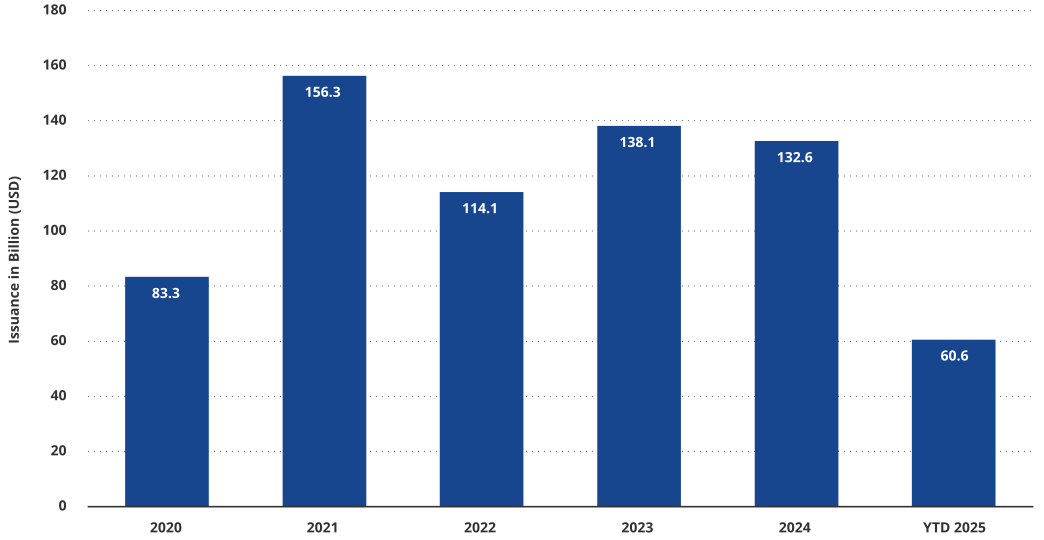
Data: Climate Bonds Initiative, July 2025.
Recommended subscription
In 2025, global green-labelled supply slowed, and U.S. corporations have become more selective with “green” branding amid political backlash. Despite slower 2025 issuance, corporates have accounted for two-thirds of USD green bond issuance YTD, up from 50% in 2020.3
USD annual issuance shows an increase in asset-backed issuance (e.g., EV loan ABS, green mortgage-backed securities) and loan-market funding of green capex since 2022. The EUR-denominated market also saw a slight increase in green loans and ABS, although green bonds remain the preferred method of issuance.
Key Observations and Top 10 USD Green Bond Issues of 2025
So far this year, $60.8 billion of dollar-denominated green bonds have been issued through July 2025, with 55% of them coming from U.S. corporations and government-backed entities. Issuers from China (10.7%), Ireland (5.9%), U.A.E. (4.4%), and South Korea (4.1%) have also issued USD-denominated green bonds this year. We believe non-U.S. issuance will continue to be a significant, and perhaps growing, part of the U.S. dollar green bond market. Although the U.S. has stepped away from taking a role in global climate leadership, its role has always been met with skepticism. China has moved in a completely different direction and is now the undisputed leader in green energy. In the 12-month period ending in June, for example, more solar power has been installed domestically in China than the United States has ever brought online.4 Its role globally, particularly in other emerging markets, and its low-cost solar panels and electric vehicles now dominate the market. In other words, the green transition appears to be alive and well outside the U.S., and projects will continue to require financing. Given that much of this activity is in emerging markets, we expect a high share of this funding to be in U.S. dollars for the foreseeable future.
Top 10 USD-Denominated Green Bond Issuers of 2025
| Issuer | USD Green Issuance (US$ bn) | Entity Type | Country |
| Vantage Data Centers LLC | 5.0 | Non-Financial Corporate | USA |
| Smurfit Kappa Treasury ULC | 2.7 | Non-Financial Corporate | Ireland |
| Fannie Mae | 2.5 | Government-Backed Entity | USA |
| SWCH Commercial Mortgage Trust 2025-DATA | 2.4 | Financial Corporate | USA |
| DayOne Data Centers Singapore Pte Ltd | 1.7 | Non-Financial Corporate | Singapore |
| Hapag-Lloyd AG | 1.6 | Non-Financial Corporate | Germany |
| California Community Choice Financing Authority | 1.5 | Government-Backed Entity | USA |
| Stack Infrastructure Inc | 1.4 | Non-Financial Corporate | USA |
| Industrial & Commercial Bank of China Ltd | 1.3 | Financial Corporate | China |
| Saudi Electricity Sukuk Programme Co | 1.2 | Government-Backed Entity | Saudi Arabia |
Data: Climate Bonds Initiative, July 2025.
So far this year, data center infrastructure has dominated USD-denominated green bond issuance, with Vantage, DayOne, and Stack Infrastructure collectively accounting for nearly $8 billion year-to-date. As artificial intelligence (AI) companies scale up the need for energy-efficient, large data centers are expected to grow, which could provide a tailwind for the issuance of green bonds to fund these upcoming projects. Five of the top ten issuers are U.S.-based, underscoring the country’s significant presence in USD-labelled green finance despite headwinds, particularly across technology, housing, and community energy sectors. California’s Community Choice Financing Authority illustrates the ongoing innovation in municipal-scale public finance, while corporates such as Smurfit Kappa and Hapag-Lloyd highlight strong industrial uses of green capital in packaging and shipping. At the same time, multinational issuers, including ICBC of China and Saudi Electricity, have further contributed to supply of USD green bonds this year.
Looking Ahead
Over 60% of 2025 USD green bonds were benchmark-sized ($500M+), boosting liquidity and institutional appeal. Gulf Cooperative Council (GCC) has continued to support the USD green bond supply with 92% of all GCC-labelled green bonds being issued in USD.
Supranational bonds from the World Bank and European Investment Bank have helped USD green bonds maintain a considerable share of the market. USD-denominated green bonds are expected to be steady at about 25% of global green bond issuance.5 Over the last five years, robust supranational, corporate, emerging market and sovereign-linked issuance underscores the geographic breadth of the USD green bond market.
GRNB | VanEck Green Bond ETF
Green bonds offer investors a way to build sustainable core fixed income portfolios without significantly affecting risk and return and leverage the size and diversity of the global bond markets to help achieve climate goals. VanEck Green Bond ETF (GRNB) provides access to a diverse group of issuers who are proactively investing in climate solutions, including renewable energy, green buildings, clean transportation and more. An investment of $1 million in GRNB yields annual impact equivalent to 872 MWh of renewable energy generated, 718 MT of CO2 avoided, and 14 Hectares of land conserved or reforested.6
To receive more Income Investing insights, sign up in our subscription center.

IMPORTANT DISCLOSURES
1 Green bond issuance dives almost a third amid climate backtracking.
2 Source: New York Times, September 16, 2025.
3 Climate Bonds Initiative, data as of July 2025.
4 Source: New York Times, September 16, 2025.
5 HSBC Green Bond Market Update, July 2025.
6 Data as of 9/30/2024.
This is not an offer to buy or sell, or a recommendation to buy or sell any of the securities, financial instruments or digital assets mentioned herein. The information presented does not involve the rendering of personalized investment, financial, legal, tax advice, or any call to action. Certain statements contained herein may constitute projections, forecasts and other forward-looking statements, which do not reflect actual results, are for illustrative purposes only, are valid as of the date of this communication, and are subject to change without notice. Actual future performance of any assets or industries mentioned are unknown. Information provided by third party sources are believed to be reliable and have not been independently verified for accuracy or completeness and cannot be guaranteed. VanEck does not guarantee the accuracy of third-party data. The information herein represents the opinion of the author(s), but not necessarily those of VanEck or its other employees.
An investment in the Fund may be subject to risks which include, among others, green bonds, special risk considerations of investing in Asian, and European issuers, foreign securities, emerging market issuers, foreign currency, credit, interest rate, floating rate, high yield securities, supranational bond, government-related bond, restricted securities, securitized/asset-backed securities, financials sector, utilities sector, market, operational, call, sampling, index tracking, authorized participant concentration, no guarantee of active trading market, trading issues, passive management, fund shares trading, premium/discount and liquidity of fund shares, and index-related concentration risks, all of which may adversely affect the Fund. Emerging market issuers and foreign securities may be subject to securities markets, political and economic, investment and repatriation restrictions, different rules and regulations, less publicly available financial information, foreign currency and exchange rates, operational and settlement, and corporate and securities laws risks.
Investing involves substantial risk and high volatility, including possible loss of principal. Bonds and bond funds will decrease in value as interest rates rise. An investor should consider the investment objective, risks, charges and expenses of the Fund carefully before investing. To obtain a prospectus and summary prospectus, which contain this and other information, call 800.826.2333 or visit vaneck.com. Please read the prospectus and summary prospectus carefully before investing.
© Van Eck Securities Corporation, Distributor, a wholly-owned subsidiary of Van Eck Associates Corporation.
Related Funds
IMPORTANT DISCLOSURES
1 Green bond issuance dives almost a third amid climate backtracking.
2 Source: New York Times, September 16, 2025.
3 Climate Bonds Initiative, data as of July 2025.
4 Source: New York Times, September 16, 2025.
5 HSBC Green Bond Market Update, July 2025.
6 Data as of 9/30/2024.
This is not an offer to buy or sell, or a recommendation to buy or sell any of the securities, financial instruments or digital assets mentioned herein. The information presented does not involve the rendering of personalized investment, financial, legal, tax advice, or any call to action. Certain statements contained herein may constitute projections, forecasts and other forward-looking statements, which do not reflect actual results, are for illustrative purposes only, are valid as of the date of this communication, and are subject to change without notice. Actual future performance of any assets or industries mentioned are unknown. Information provided by third party sources are believed to be reliable and have not been independently verified for accuracy or completeness and cannot be guaranteed. VanEck does not guarantee the accuracy of third-party data. The information herein represents the opinion of the author(s), but not necessarily those of VanEck or its other employees.
An investment in the Fund may be subject to risks which include, among others, green bonds, special risk considerations of investing in Asian, and European issuers, foreign securities, emerging market issuers, foreign currency, credit, interest rate, floating rate, high yield securities, supranational bond, government-related bond, restricted securities, securitized/asset-backed securities, financials sector, utilities sector, market, operational, call, sampling, index tracking, authorized participant concentration, no guarantee of active trading market, trading issues, passive management, fund shares trading, premium/discount and liquidity of fund shares, and index-related concentration risks, all of which may adversely affect the Fund. Emerging market issuers and foreign securities may be subject to securities markets, political and economic, investment and repatriation restrictions, different rules and regulations, less publicly available financial information, foreign currency and exchange rates, operational and settlement, and corporate and securities laws risks.
Investing involves substantial risk and high volatility, including possible loss of principal. Bonds and bond funds will decrease in value as interest rates rise. An investor should consider the investment objective, risks, charges and expenses of the Fund carefully before investing. To obtain a prospectus and summary prospectus, which contain this and other information, call 800.826.2333 or visit vaneck.com. Please read the prospectus and summary prospectus carefully before investing.
© Van Eck Securities Corporation, Distributor, a wholly-owned subsidiary of Van Eck Associates Corporation.