Position for Higher Yields with CLOs and EM Debt
November 17, 2025
Read Time 5 MIN
Key Takeaways:
- The Fed’s rate-cutting cycle is likely to be shallow and, as inflationary pressures may persist, we expect continued volatility and potentially higher, longer-term yields.
- CLOs offer higher income and lower volatility than many fixed income sectors, supported by structural protections and a strong track record through multiple cycles.
- Emerging markets bonds stand out for their attractive yield and strong fundamentals.
At its recent October meeting, the Federal Reserve’s rate cut was expected—but the press conference that followed was the real event. While the Fed trimmed rates by 25 basis points, the message was clear: future cuts are far from guaranteed.
In a recent webinar, VanEck’s Fran Rodilosso and Bill Sokol discuss how this backdrop is creating opportunities in two areas that can deliver attractive income without taking excessive duration or credit risk: Collateralized loan obligations (CLOs) and emerging markets bonds.

CLOs: Engineered for Income with Built-in Risk Protections
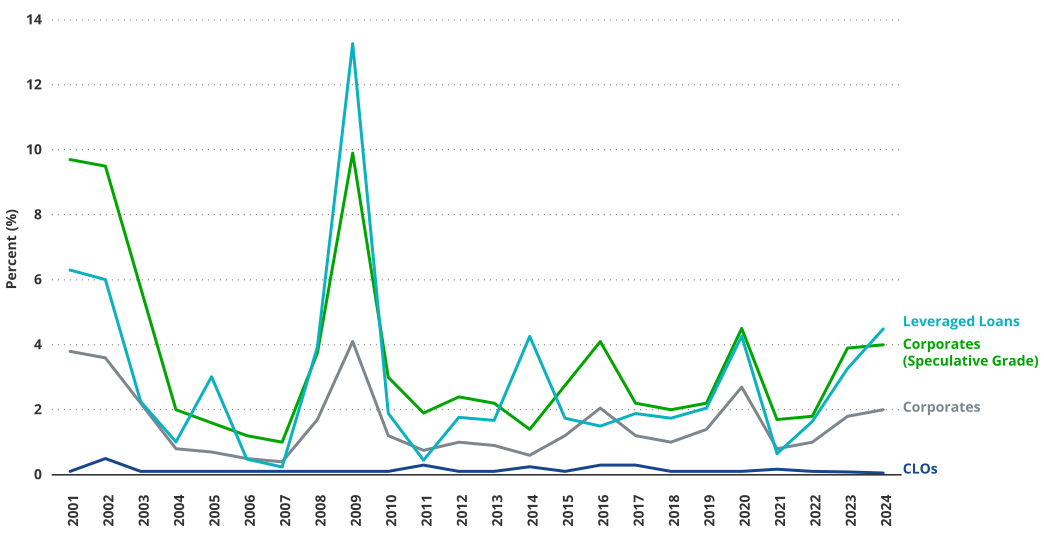
CLOs are structured pools of senior secured loans, and the asset class has quietly become one of the most resilient sources of credit income in the market. CLOs’ unique structure channels cash flows through a “waterfall” that prioritizes payments to the most senior tranches first, while lower tranches absorb risk. The built-in risk protections of CLOs have resulted in a very strong track record of low defaults, especially versus other corporate credit investments.
Resilience to Defaults
Annual global defaults rates1: CLO vs Corporates and Leveraged Loan (2001 - 2024)
US CLO defaults by original rating1 (1994 - 2024)
| Issued pre-GFC “CLO 1.0” | Issued post-GFC “CLO 2.0/3.0”2 | |||||
| Tranche Rating | # Ratings | # Defaults | % Defaulted (%) | # Ratings | # Defaults | % Defaulted (%) |
| AAA | 1,540 | 0 | 0.00 | 4,918 | 0 | 0.00 |
| AA | 616 | 1 | 0.20 | 3,817 | 0 | 0.00 |
| A | 790 | 5 | 0.60 | 3,178 | 0 | 0.00 |
| BBB | 783 | 9 | 1.10 | 3,167 | 0 | 0.00 |
| BB | 565 | 22 | 3.90 | 2,370 | 12 | 0.50 |
Source:1 S&P Global: Default, Transition, and Recovery: 2024 Annual Global Leveraged Loan CLO Default And Rating Transition Study and J.P. Morgan.2 CLO 2.0/3.0 are CLOs issued 2010 and after. Past performance is not indicative of future results. This is not an offer to buy or sell, or recommendation to buy or sell any of the securities mentioned herein. Default rate for CLOS and Corporate includes all rated entities. Corporate (Sec-grade) includes only companies rated BB+ and below. CLOs, Corporates (Speculative Grade), and Leveraged Loans represent aggregated default-rate data from S&P Global and J.P. Morgan research studies and are not investable indices. Tranche ratings (AAA–BB) reflect credit quality categories assigned by rating agencies, not benchmark indices.
In addition to its strong track record from a risk perspective, the CLO asset class has historically offered greater compensation for risk compared to similarly rated bonds, a characteristic that holds true in the current market environment. This is illustrated in the chart below, which compares credit spreads of CLOs versus corporate bonds. These higher spreads mean that CLOs can provide attractive yield even in periods where the Fed is cutting rates, which along with built-in risk protections make CLOs a compelling source of relative value.
Consistent Spread Pickup Compared to Similarly Rated Bonds
CLO vs Corporate Bond Average Spread by Rating1 (in bps as of 9/30/2025)

1 Source: JP Morgan and ICE Data Services. Using OAS for corporate bonds and discount margins for CLOs. AAA Rated CLOs represented by J.P. Morgan CLO AAA Index, AA Rated CLOs represented by J.P. Morgan CLO AA Index, A Rated CLOs represented by J.P. Morgan CLO A Index, BBB Rated CLOs represented by J.P. Morgan CLO BBB Index, BB Rated CLOs represented by J.P. Morgan CLO BB Index, B Rated CLOs represented by J.P. Morgan CLO B Index. AAA Rated Corps represented by the ICE BofA AAA US Corporate Index, AA Rated Corps represented by the ICE BofA AA US Corporate Index, A Rated Corps represented by the ICE BofA A US Corporate Index, BBB Rated Corps represented by the ICE BofA BBB US Corporate Index, BB Rated Corps represented by the ICE BofA BB US High Yield Index and B Rated Corps represented by the ICE BofA Single-B US High Yield Index. Past performance is no guarantee of future results. Index performance is not representative of fund performance. It is not possible to invest directly in an index.
Emerging Markets Bonds: Attractive Yield and Diversification Potential
Emerging markets debt has been one of 2025’s strongest performers, with local currency bonds outpacing U.S. and global developed-market benchmarks by a wide margin. The asset class also offers attractive yields relative to other areas of the fixed income market.
Attractive Yield Potential
Yield Comparison (as of 9/30/2025)
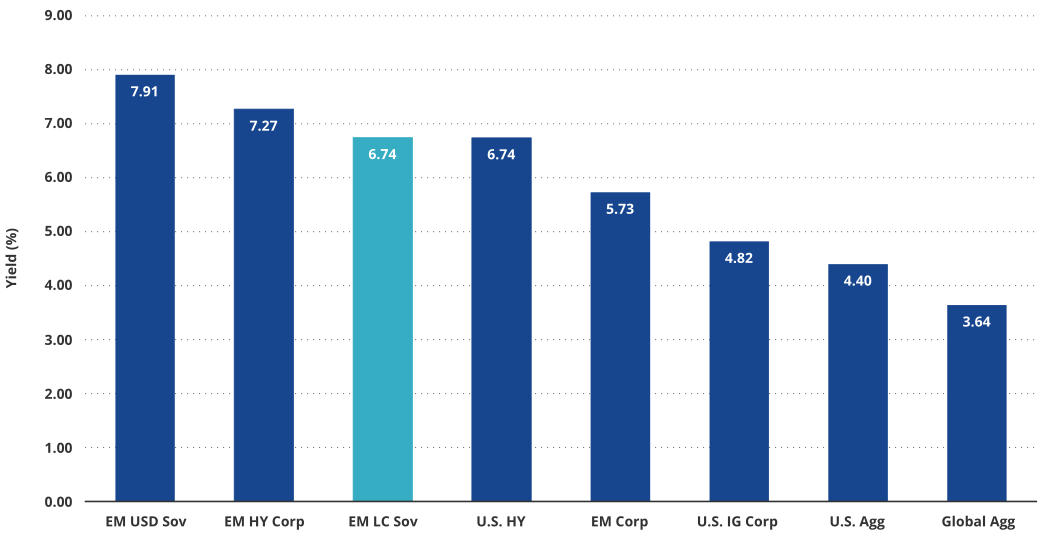
Source: VanEck, Bloomberg, J.P. Morgan, ICE Data Indices, LLC. US HY is represented by the ICE BofA US High Yield Index. EM LC Sov is represented by the J.P. Morgan GBIEM Global Core Index. EM HY Corp is represented by the ICE BofA Diversified HY US Emerging Markets Corporate Plus Index. EM USD Sov is represented by the JPM EMBI Global Diversified Index. EM Corp is represented by the ICE BofA EM Diversified Corporate Index. US IG Corp is represented by the ICE BofA US Corporate Index. US Agg is represented by the ICE BofA US Broad Market Index. Global Agg is represented by the ICE BofA Global Broad Market Plus Index. Data as of 9/30/2025. Real yield is the nominal yield minus the forecasted rate of inflation. Past performance is no guarantee of future results. Index performance is not representative of fund performance. It is not possible to invest directly in an index.
Strong Fundamentals
In addition to these strong returns and attractive yields, EM bonds are underpinned by strong fundamentals. Unlike developed markets, EM sovereigns entered this cycle with lower debt-to-GDP ratios, stronger fiscal positions, and positive current accounts. Many central banks hiked earlier and more aggressively post-COVID, leaving them with ample room to ease now.
EM Nations Have Lower Debt than DMs
Gross Debt to GDP (%)
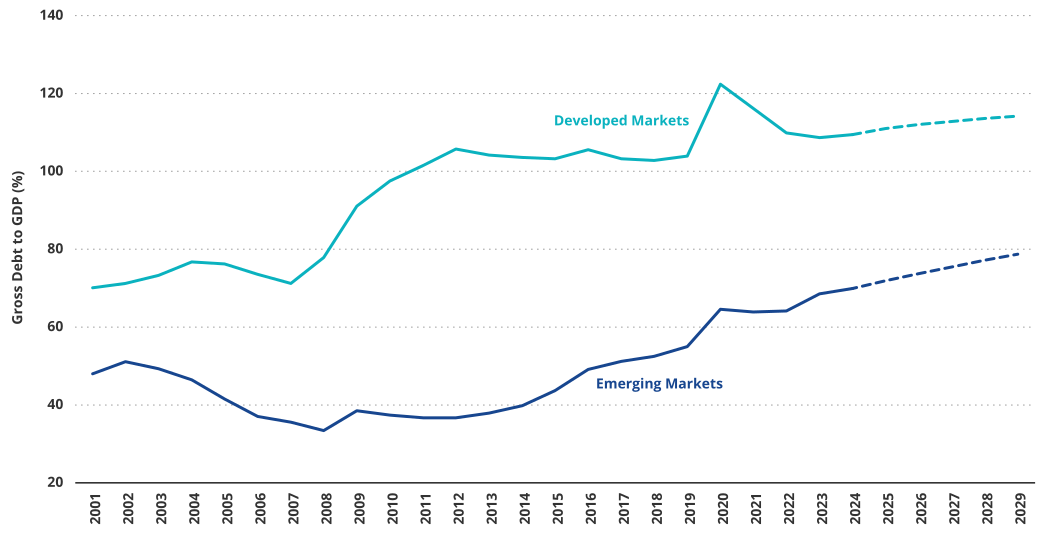
Source: International Monetary Fund, as of April 2025. EM: Emerging markets; DM: Developed Markets. For illustrative purposes only. Not intended as a forecast or prediction of future results. Past performance is no guarantee of future results. Index performance is not representative of fund performance. It is not possible to invest directly in an index. Emerging Markets and Developed Markets represent aggregated IMF country group data, not investable indices.
How to Invest
After years of relentless tightening, the Fed’s shift marks a new phase for income investors—one defined by modest easing, persistent inflation, and opportunity beyond traditional core bonds. In this landscape:
- CLOs provide structural insulation, attractive yield, and proven resilience
- Emerging markets bonds offer yield, diversification, and improving fundamentals
VanEck offers exposure to these asset classes through the following:
To receive more Income Investing insights, sign up in our subscription center.

IMPORTANT DISCLOSURES
This is not an offer to buy or sell, or a recommendation to buy or sell any of the securities, financial instruments or digital assets mentioned herein. The information presented does not involve the rendering of personalized investment, financial, legal, tax advice, or any call to action. Certain statements contained herein may constitute projections, forecasts and other forward-looking statements, which do not reflect actual results, are for illustrative purposes only, are valid as of the date of this communication, and are subject to change without notice. Actual future performance of any assets or industries mentioned are unknown. Information provided by third party sources are believed to be reliable and have not been independently verified for accuracy or completeness and cannot be guaranteed. VanEck does not guarantee the accuracy of third party data. The information herein represents the opinion of the speaker(s), but not necessarily those of VanEck or its other employees.
The J.P. Morgan Collateralized Loan Obligation Index (CLOIE) tracks the performance of broadly syndicated U.S. CLO debt. The J.P. Morgan CLO AAA, AA, A, BBB, BB and B Indices are subsets of CLOIE that measure market spreads of CLO tranches by credit-rating category.
ICE BofA U.S. Corporate Indices represent U.S. dollar-denominated investment-grade corporate bonds by rating (AAA through BBB), while the ICE BofA U.S. High Yield Indices—including the BB and Single-B sub-indices—track below-investment-grade corporate debt issued in the U.S. market.
Emerging-markets debt benchmarks include the J.P. Morgan GBI-EM Global Core Index, which measures local-currency sovereign bonds issued by emerging-market countries; the J.P. Morgan EMBI Global Diversified Index, which tracks U.S.-dollar-denominated sovereign and quasi-sovereign emerging-market debt; the ICE BofA EM Diversified Corporate Index, which measures U.S.-dollar-denominated emerging-market corporate debt; and the ICE BofA Diversified HY U.S. Emerging Markets Corporate Plus Index, which focuses on below-investment-grade emerging-market corporates.
Broad market benchmarks are represented by the ICE BofA U.S. Broad Market Index, which measures investment-grade debt across U.S. government, corporate, securitized, and collateralized sectors, and the ICE BofA Global Broad Market Plus Index, which captures comparable investment-grade debt issued in both domestic and international markets.
Any indices listed are unmanaged indices and include the reinvestment of all dividends, but do not reflect the payment of transaction costs, advisory fees or expenses that are associated with an investment in a Fund. Certain indices may take into account withholding taxes. An index’s performance is not illustrative of a Fund’s performance. Indices are not securities in which investments can be made.
The principal risks of investing in VanEck ETFs include sector, market, economic, political, foreign currency, world event, index tracking and non-diversification risks, as well as fluctuations in net asset value and the risks associated with investing in less developed capital markets. The Funds may loan their securities, which may subject them to additional credit and counterparty risk. ETFs that invest in high-yield securities are subject to subject to risks associated with investing in high-yield securities; which include a greater risk of loss of income and principal than funds holding higher-rated securities; concentration risk; credit risk; hedging risk; interest rate risk; and short sale risk. ETFs that invest in companies with small capitalizations are subject to elevated risks, which include, among others, greater volatility, lower trading volume and less liquidity than larger companies. Please see the prospectus of each Fund for more complete information regarding each Fund's specific risks.
Investing involves substantial risk and high volatility, including possible loss of principal. An investor should consider the investment objective, risks, charges and expenses of the Funds carefully before investing. To obtain a prospectus and summary prospectus, which contain this and other information, call 800.826.2333 or visit vaneck.com. Please read the prospectus and summary prospectus carefully before investing.
© Van Eck Securities Corporation, Distributor, a wholly owned subsidiary of Van Eck Associates Corporation.
Related Funds
IMPORTANT DISCLOSURES
This is not an offer to buy or sell, or a recommendation to buy or sell any of the securities, financial instruments or digital assets mentioned herein. The information presented does not involve the rendering of personalized investment, financial, legal, tax advice, or any call to action. Certain statements contained herein may constitute projections, forecasts and other forward-looking statements, which do not reflect actual results, are for illustrative purposes only, are valid as of the date of this communication, and are subject to change without notice. Actual future performance of any assets or industries mentioned are unknown. Information provided by third party sources are believed to be reliable and have not been independently verified for accuracy or completeness and cannot be guaranteed. VanEck does not guarantee the accuracy of third party data. The information herein represents the opinion of the speaker(s), but not necessarily those of VanEck or its other employees.
The J.P. Morgan Collateralized Loan Obligation Index (CLOIE) tracks the performance of broadly syndicated U.S. CLO debt. The J.P. Morgan CLO AAA, AA, A, BBB, BB and B Indices are subsets of CLOIE that measure market spreads of CLO tranches by credit-rating category.
ICE BofA U.S. Corporate Indices represent U.S. dollar-denominated investment-grade corporate bonds by rating (AAA through BBB), while the ICE BofA U.S. High Yield Indices—including the BB and Single-B sub-indices—track below-investment-grade corporate debt issued in the U.S. market.
Emerging-markets debt benchmarks include the J.P. Morgan GBI-EM Global Core Index, which measures local-currency sovereign bonds issued by emerging-market countries; the J.P. Morgan EMBI Global Diversified Index, which tracks U.S.-dollar-denominated sovereign and quasi-sovereign emerging-market debt; the ICE BofA EM Diversified Corporate Index, which measures U.S.-dollar-denominated emerging-market corporate debt; and the ICE BofA Diversified HY U.S. Emerging Markets Corporate Plus Index, which focuses on below-investment-grade emerging-market corporates.
Broad market benchmarks are represented by the ICE BofA U.S. Broad Market Index, which measures investment-grade debt across U.S. government, corporate, securitized, and collateralized sectors, and the ICE BofA Global Broad Market Plus Index, which captures comparable investment-grade debt issued in both domestic and international markets.
Any indices listed are unmanaged indices and include the reinvestment of all dividends, but do not reflect the payment of transaction costs, advisory fees or expenses that are associated with an investment in a Fund. Certain indices may take into account withholding taxes. An index’s performance is not illustrative of a Fund’s performance. Indices are not securities in which investments can be made.
The principal risks of investing in VanEck ETFs include sector, market, economic, political, foreign currency, world event, index tracking and non-diversification risks, as well as fluctuations in net asset value and the risks associated with investing in less developed capital markets. The Funds may loan their securities, which may subject them to additional credit and counterparty risk. ETFs that invest in high-yield securities are subject to subject to risks associated with investing in high-yield securities; which include a greater risk of loss of income and principal than funds holding higher-rated securities; concentration risk; credit risk; hedging risk; interest rate risk; and short sale risk. ETFs that invest in companies with small capitalizations are subject to elevated risks, which include, among others, greater volatility, lower trading volume and less liquidity than larger companies. Please see the prospectus of each Fund for more complete information regarding each Fund's specific risks.
Investing involves substantial risk and high volatility, including possible loss of principal. An investor should consider the investment objective, risks, charges and expenses of the Funds carefully before investing. To obtain a prospectus and summary prospectus, which contain this and other information, call 800.826.2333 or visit vaneck.com. Please read the prospectus and summary prospectus carefully before investing.
© Van Eck Securities Corporation, Distributor, a wholly owned subsidiary of Van Eck Associates Corporation.