The Trillion Dollar Market: How Green Bonds Are Supporting the Global Infrastructure Buildout
October 15, 2026
Read Time 10 MIN
Key Takeaways
- Green bonds let institutional investors hold, trade, and benchmark long-term infrastructure capital like any other fixed income allocation.
- Most green bonds carry the same credit risk as a conventional bond from the same issuer, and an IFC-Amundi analysis found the greenium fell below one basis point in 2025.
- GRNB offers a single vehicle for green infrastructure financing that can fit within a core bond allocation.
Like other bond funds, GRNB is subject to interest rate and credit risk, and its risk and return may differ from conventional bonds and broad bond indexes. For informational purposes only and not a recommendation to buy or sell any security or to adopt any investment strategy. Past performance is no guarantee of future results.
How Green Bonds Finance Global Infrastructure
Decarbonizing the global economy requires new power grids, clean transit networks, efficient water systems, and energy-efficient buildings. This build-out demands capital on a scale and timeline current public budgets cannot match. Green bonds have become an important source of funding for closing the gap. Green bonds direct long-term private capital toward physical assets with defined environmental outcomes. The structure lets institutional investors hold, trade, and benchmark that capital like any other fixed income allocation.
The Climate Bonds Initiative has recorded $4.7 trillion in total green bond issuance to date, a milestone that reflects the market's steady expansion since its early years.1 Infrastructure investment has long centered on renewable energy, green buildings, clean transportation, and water and wastewater management. The rise of artificial intelligence and its associated data center buildout has added a new dimension to that demand. McKinsey projects total infrastructure investment tied to AI and related power projects to reach $6.7 trillion by 2030,2 exceeding levels seen over the past two decades. Green bonds have captured a modest but growing share of that buildout. AI related bond issuance reached $250 billion in first half of 20263. We expect green-labeled financing to play an increasing role in data center infrastructure funding as the sector's needs grow.
What Is a Green Bond?
A green bond is a fixed income instrument whose proceeds are earmarked for projects or activities with a defined environmental benefit. Structurally, a green bond typically functions like any other bond, carrying a coupon, a maturity, and a credit rating tied to the issuer.
Why Green Bonds Are Important to Global Infrastructure Financing
Green bonds have become one of the clearest ways to close the world's growing infrastructure funding gap. OECD estimates put global infrastructure investment needs at $6.9 trillion a year through 2030.4 Actual global infrastructure spending across all sectors reached $4.4 trillion in 2024, according to PwC's Global Infrastructure Outlook.5 That leaves an annual shortfall of roughly $2.5 trillion between what the world is investing and what it needs to invest.
Chart: Annual Global Infrastructure Investment: Need vs. Actual


Sources: Average annual projected data (2016 -2030) OECD. Actual Global Investment, PWC.
Public budgets are not positioned to close that shortfall on their own. Sovereign debt levels are already elevated across most developed economies, constraining government spending. Closing that gap requires drawing in private capital, and green bonds offer a verified channel for that capital to reach specific infrastructure projects. Green bonds can play a significant role, because they are structurally the same as other bonds and provide both liquidity and transparency into the use of proceeds to investors. The use of proceeds disclosure names the infrastructure projects and sectors the bond will fund, whether it be a transmission grid upgrade, a rail network, or a renewable energy generation facility. Further, green bonds typically provide ongoing, standardized reporting that is externally verified against frameworks such as the ICMA Green Bond Principles, giving investors confidence that the capital reaches the projects it was raised for.
How Green Bond Proceeds Finance Infrastructure: Energy, Transport, Water & Buildings
Energy Transition: Power Generation & Grid Infrastructure
Renewable energy is the largest use-of-proceeds category in the green bond market, financing utility-scale wind and solar generation ahead of any other project type. At about 15% exposure to Utilities sector6, GRNB holds bonds from global power producers that are investing in renewable energy infrastructure around the world. Berkshire Hathaway and Xcel Energy’s utility subsidiaries are among the fund’s top renewable energy holdings.
An increasingly important part of a shift to renewable energy mix is connecting renewable power to aging incompatible grids. Green bonds now finance not just the renewable power generation facilities but also grid modernization, the upgrades to aging transmission and distribution networks needed to bring that power online. GRNB bonds from MidAmerican Energy and PacifiCorp specifically call out grid investments such as smart meters and power control systems as eligible use of proceeds categories in their green financing framework.
Clean Transportation: Rail, EV Infrastructure & Urban Mobility
Clean transportation is the second-largest green bond use-of-proceeds category, and sovereign and municipal issuers have driven much of that volume. New York's MTA has built a strong track record in the U.S. municipal market, having issued $15.6 billion in CBI aligned green bonds to date.7 International development banks such as the Asian Development Bank, a GRNB holding, have funded clean transportation projects across Asia. Rail and mass transit electrification has one of the longest track records of any green bond use-of-proceeds category, giving investors a deep base of historical issuance and performance data to underwrite against.
Water Infrastructure: Treatment, Efficiency & Resilience
Water is one of the fastest-growing categories in the green bond market, as water scarcity is increasingly a physical climate risk in its own right. The projects in this category tend to carry regulated monopoly revenues, long asset lives, and environmental metrics that are easier to verify than in some other categories. Fixed income investors value all three characteristics. Water-related projects carry a multi-decade payback profile, from treatment plants to pipe networks to stormwater systems.
Green Buildings: Energy Efficiency & Low-Carbon Construction
Buildings account for roughly a third of global energy consumption, according to the UN Environment Programme8, making them central to reducing global emissions. Green bond proceeds in this category fund LEED- and BREEAM-certified new construction, as well as retrofit financing for existing buildings. GRNB holdings include bonds from Alexandria Real Estate, Boston Properties (BXP), and Vornado Realty, leading names in energy efficient building infrastructure. Retrofit financing often carries larger emissions-reduction opportunity, since many existing buildings predate modern efficiency standards.
Who Finances Infrastructure Through Green Bonds?
Sovereign Issuers
Sovereign issuers bring scale and liquidity that few other participants can match, and their bonds often set market standards for the rest of the industry. France and Germany lead global cumulative green bond issuance among sovereign issuers. The EU itself has become one of the largest green bond issuers in the world through its NextGeneration EU program, which is authorized to raise up to €250 billion in green bonds through 2026.9
Sovereign issuance has also expanded well beyond Europe. China issued its first sovereign green bond in April 202510, a milestone for a country that had built one of the world's largest green bond markets almost entirely through state-owned enterprises and local governments rather than direct sovereign issuance. Saudi Arabia's Public Investment Fund became the first sovereign wealth fund to issue a green bond. It has raised $10.9 billion11 through the program and has fully allocated capital to renewable energy, green buildings, and clean transportation projects.
Development Banks: Multilateral Institutions as Market Anchors
Development banks created this market and continue to anchor it. The European Investment Bank issued the world's first labeled green bond in 2007. The World Bank followed in 2008 with an issuance widely credited with establishing the template the market still runs on today: use-of-proceeds criteria, second-party review, and impact reporting. These institutions play an outsized role in emerging-market infrastructure funding, where private capital is scarce and risk is perceived as high. The EIB-led Global Green Bond Initiative puts that role into practice. Its first-loss equity capital absorbs early losses, drawing in institutional investors who would otherwise steer clear of emerging-market green bonds.
Corporate Issuers: Utilities, Real Estate & Industrials
Corporate issuance has grown faster than sovereign issuance in recent years, and utilities have driven most of that growth. Globally, corporate green bond issuance reached a record $323.7B in 2025.12 Utilities accounted for 48%13 of all non-financial corporate global green bond issuance since 2020. Energy generation, power transmission and grid modernization are some of the capital-intensive projects that green bonds are helping to finance. Industrials and materials are other fast-growing sectors driven by battery makers, packaging, paper producers and steel makers. Technology and telecom issuance has been steady at about $7 to $10 billion a year, with data center financing emerging as a new avenue.14 GRNB reflects that tilt directly. Utilities are the fund's largest sector exposure, at roughly 15% of the portfolio.15
Financial Institutions: Banks as Green Lending Intermediaries
Banks are a distinct issuer type in the green bond market. Green bonds issued by banks typically finance projects spanning categories such as renewable energy, green buildings, and sustainable transportation, or loans to finance these projects. GRNB's U.S. bank exposure includes green bonds from JPMorgan Chase and Fifth Third Bancorp that are funding renewable energy and green building projects across the United States. The fund's broader financial institution exposure leans more heavily on European issuers like ABN AMRO and ING, alongside other banks outside the US.
Recommended subscription
Green Bonds as a Fixed Income Investment: What Investors Need to Know
Most green bonds carry the same credit risk profile as a conventional bond from the same issuer. Green bonds may allow investors to “green” their core fixed income allocation without significantly altering the risk and return profile of their portfolio. The green bond market is mainly comprised of sovereigns, supranationals, and quasi-sovereign issuers, alongside a fast-growing corporate segment. The market is EUR-dominant, though USD-denominated issuance remains a well diversified and meaningful segment, spanning corporate and public-sector issuers alike.
Another debated aspect of the green bond market is the "greenium," whether green bonds carry lower yields than conventional debt. We believe this reflects an imbalance of supply and demand. Where a premium does appear, it tends to be small and inconsistent across different market segments. A joint IFC-Amundi analysis found the global greenium fell below one basis point in 202516, less than half of what it was in prior years, with the premium for emerging-market issuers effectively disappearing as supply caught up with investor demand.17 Overall, we have not observed a structural, significant premium, allowing investors to include green bonds within a diversified core bond portfolio without significantly impacting risk and return.
Some investors treat new-project financing as the stronger form of impact, a question of "additionality," since refinancing an already-built asset does not in itself reduce any new emissions. While new projects and investment is needed to achieve climate goals, this critique overlooks a structural feature of the assets involved. Infrastructure projects, including renewable energy, and clean transportation, are long-dated by nature. A wind farm or transit system does not stop delivering environmental benefits once its bond matures. Refinancing carries the asset forward under the same green reporting and verification standards. It also frees up capital the issuer can redeploy toward further green activity.
GRNB | VanEck Green Bond ETF
How to Invest in Green Bond Infrastructure Financing with GRNB
GRNB, VanEck's Green Bond ETF, tracks the S&P Green Bond U.S. Dollar Select Index, giving investors a single vehicle for green infrastructure financing. Renewable energy is GRNB's largest allocation at 41% of the portfolio, followed by green buildings at 20% and clean transportation at 18%. The remainder spans energy efficiency (7%), water and wastewater management (5%), natural resources and land use (3%), circular economy technology (2%), and other categories (4%).18
GRNB Use of Proceeds Allocation
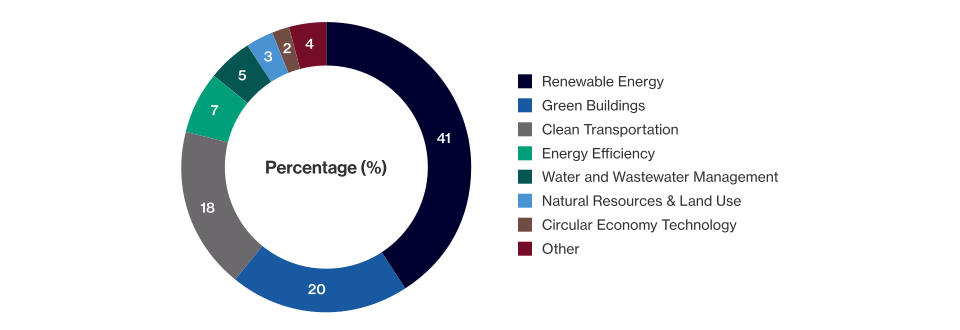
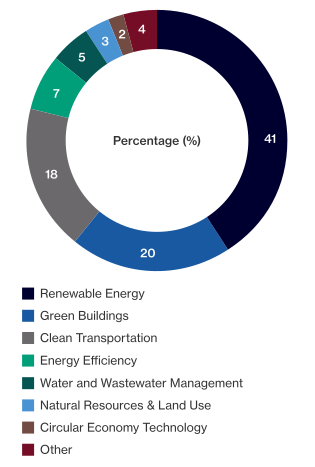
Source: VanEck as of 9/30/2025.
The fund's issuer composition reflects how the green bond market is actually built. Utilities are the largest corporate sector by issuer type, at roughly 15% of the portfolio.19 These are the companies building and financing power generation, transmission, and grid modernization. Development banks and government-related financing agencies account for about 12% of the portfolio.20 These institutions anchor infrastructure financing in markets where private capital alone falls short. Utilities and government-related financing institutions together account for approximately a quarter of the fund's total exposure.
Green Bonds and the Future of Infrastructure Finance
Meeting the world's infrastructure needs will likely require more private capital over time. Green bonds have emerged as one effective way to channel that capital toward long-duration infrastructure assets. GRNB offers investors a single vehicle for that opportunity that can fit seamlessly within a core bond allocation, built around the same categories driving the market's growth: renewable energy, clean transportation, water, and green buildings. As the infrastructure investment gap persists, the role green bonds play in closing it is likely to grow with it.
To receive more Income Investing insights, sign up in our subscription center.

Disclosures
1 Data as of 8/31/2026
3 https://www.jll.com/en-us/newsroom/data-center-demand-exceeds-expectations-in-h1-2026
4 G20/OECD Report on approaches for financing and investment in climate-resilient infrastructure.
6 FactSet data as of 9/22/2026
7 Climate Bonds Initiative data as of 8/31/2026
8 https://www.unep.org/topics/energy/buildings
9 https://ec.europa.eu/commission/presscorner/detail/en/ip_21_5207
11 CBI Data as of 8/31/2026.
12 CBI Data as of 8/31/2026.
13 CBI Data as of 8/31/2026.
14 CBI Data as of 8/31/2026.
15 FactSet data as of 9/22/2026.
16 https://www.ifc.org/content/dam/ifc/doc/2026/emerging-market-sustainable-bonds.pdf
17 https://www.ifc.org/content/dam/ifc/doc/2026/emerging-market-sustainable-bonds.pdf
18 GRNB Impact Report, Use of Proceeds data as of 9/30/2025.
19 FactSet data as of 9/22/2026.
20 FactSet data as of 9/22/2026.
Holdings as of 9/30/2026; subject to change; not a recommendation to buy or sell.
This is not an offer to buy or sell, or a solicitation of any offer to buy or sell any of the securities mentioned herein. The information presented does not involve the rendering of personalized investment, financial, legal, or tax advice. Certain statements contained herein may constitute projections, forecasts and other forward looking statements, which do not reflect actual results, are valid as of the date of this communication and subject to change without notice. Information provided by third party sources are believed to be reliable and have not been independently verified for accuracy or completeness and cannot be guaranteed. The information herein represents the opinion of the author(s), but not necessarily those of VanEck. Past performance is no guarantee of future results.
S&P Green Bond U.S. Dollar Select Index is comprised of U.S. dollar-denominated green bonds that are issued to finance environmentally friendly projects, and includes bonds issued by supranational, government, and corporate issuers globally.
Fund holdings will vary and are subject to change. For a complete list of fund holdings, please visit vaneck.com. Shares of the Fund are not individually redeemable and are issued and redeemed at net asset value only through certain authorized broker-dealers in large, specified blocks of shares.
An investment in the Fund may be subject to risks which include, among others, green bonds, investing in Asian, Chinese and emerging market issuers, foreign securities, foreign currency, credit, interest rate, floating rate, floating rate LIBOR, high yield securities, supranational bond, government-related bond, restricted securities, securitized/asset-backed securities, financial, utilities, market, operational, call, sampling, index tracking, authorized participant concentration, no guarantee of active trading market, trading issues, passive management, fund shares trading, premium/discount risk and liquidity of fund shares, non-diversified and concentration risks, all of which may adversely affect the Fund.
Investing in “green” bonds carries the risk that, under certain market conditions, the Fund may underperform as compared to funds that invest in a broader range of investments. Investing primarily in “green” investments may affect the Fund’s exposure to certain sectors or types of investments and will impact the Fund’s relative investment performance depending on whether such sectors or investments are in or out of favor in the market. The “green” sector may also have challenges such as a limited number of issuers, limited liquidity in the market and limited supply of bonds that merit “green” status, each of which may adversely affect the Fund.
Investing involves substantial risk and high volatility, including possible loss of principal. An investor should consider the investment objective, risks, charges and expenses of a Fund carefully before investing. To obtain a prospectus and summary prospectus, which contain this and other information, call 800.826.2333 or visit vaneck.com/etfs. Please read the prospectus and summary prospectus carefully before investing.
© Van Eck Securities Corporation, Distributor, a wholly owned subsidiary of Van Eck Associates Corporation.
Related Funds
Disclosures
1 Data as of 8/31/2026
3 https://www.jll.com/en-us/newsroom/data-center-demand-exceeds-expectations-in-h1-2026
4 G20/OECD Report on approaches for financing and investment in climate-resilient infrastructure.
6 FactSet data as of 9/22/2026
7 Climate Bonds Initiative data as of 8/31/2026
8 https://www.unep.org/topics/energy/buildings
9 https://ec.europa.eu/commission/presscorner/detail/en/ip_21_5207
11 CBI Data as of 8/31/2026.
12 CBI Data as of 8/31/2026.
13 CBI Data as of 8/31/2026.
14 CBI Data as of 8/31/2026.
15 FactSet data as of 9/22/2026.
16 https://www.ifc.org/content/dam/ifc/doc/2026/emerging-market-sustainable-bonds.pdf
17 https://www.ifc.org/content/dam/ifc/doc/2026/emerging-market-sustainable-bonds.pdf
18 GRNB Impact Report, Use of Proceeds data as of 9/30/2025.
19 FactSet data as of 9/22/2026.
20 FactSet data as of 9/22/2026.
Holdings as of 9/30/2026; subject to change; not a recommendation to buy or sell.
This is not an offer to buy or sell, or a solicitation of any offer to buy or sell any of the securities mentioned herein. The information presented does not involve the rendering of personalized investment, financial, legal, or tax advice. Certain statements contained herein may constitute projections, forecasts and other forward looking statements, which do not reflect actual results, are valid as of the date of this communication and subject to change without notice. Information provided by third party sources are believed to be reliable and have not been independently verified for accuracy or completeness and cannot be guaranteed. The information herein represents the opinion of the author(s), but not necessarily those of VanEck. Past performance is no guarantee of future results.
S&P Green Bond U.S. Dollar Select Index is comprised of U.S. dollar-denominated green bonds that are issued to finance environmentally friendly projects, and includes bonds issued by supranational, government, and corporate issuers globally.
Fund holdings will vary and are subject to change. For a complete list of fund holdings, please visit vaneck.com. Shares of the Fund are not individually redeemable and are issued and redeemed at net asset value only through certain authorized broker-dealers in large, specified blocks of shares.
An investment in the Fund may be subject to risks which include, among others, green bonds, investing in Asian, Chinese and emerging market issuers, foreign securities, foreign currency, credit, interest rate, floating rate, floating rate LIBOR, high yield securities, supranational bond, government-related bond, restricted securities, securitized/asset-backed securities, financial, utilities, market, operational, call, sampling, index tracking, authorized participant concentration, no guarantee of active trading market, trading issues, passive management, fund shares trading, premium/discount risk and liquidity of fund shares, non-diversified and concentration risks, all of which may adversely affect the Fund.
Investing in “green” bonds carries the risk that, under certain market conditions, the Fund may underperform as compared to funds that invest in a broader range of investments. Investing primarily in “green” investments may affect the Fund’s exposure to certain sectors or types of investments and will impact the Fund’s relative investment performance depending on whether such sectors or investments are in or out of favor in the market. The “green” sector may also have challenges such as a limited number of issuers, limited liquidity in the market and limited supply of bonds that merit “green” status, each of which may adversely affect the Fund.
Investing involves substantial risk and high volatility, including possible loss of principal. An investor should consider the investment objective, risks, charges and expenses of a Fund carefully before investing. To obtain a prospectus and summary prospectus, which contain this and other information, call 800.826.2333 or visit vaneck.com/etfs. Please read the prospectus and summary prospectus carefully before investing.
© Van Eck Securities Corporation, Distributor, a wholly owned subsidiary of Van Eck Associates Corporation.