High Yield Munis vs. Investment Grade: Key Differences
May 04, 2026
Read Time 7 MIN
Key Takeaways:
- High yield munis carry more credit risk but have defaulted at far lower rates than comparable corporate bonds.
- Investment grade munis offer stability and very low default rates, making them a core tax-efficient holding.
- The two segments play different roles. Most investors may benefit from owning both based on income needs and risk tolerance.
What Is the Difference Between High Yield and Investment Grade Munis?
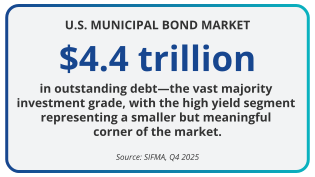
The muni market divides into two broad credit tiers. Investment grade bonds carry ratings of BBB- or higher, signaling strong capacity to service debt. These come from the issuers like established state and local governments, essential-service utilities, and agencies with long, stable revenue histories.
High yield munis sit below that line, rated below BBB- or unrated entirely. The issuers here look different. Charter schools, senior living facilities, land development projects, special-purpose entities. Creditworthiness depends less on taxing authority and more on project-level cash flows. The trade-off is straightforward: more credit risk, more yield.

How Does Credit Quality Affect Yield and After-Tax Income?
The basic mechanics is that lower credit quality means higher yield. But in the muni market, the tax exemption amplifies the math in a way that makes high yield munis stand out relative to taxable alternatives.
A high yield muni fund yielding 5% tax-free may translate to a taxable-equivalent yield north of 8% for an investor in the top federal bracket, and potentially higher once state tax savings are factored in. Investment grade munis offer lower nominal yield, but they still look competitive on a tax-equivalent basis against taxable bonds of similar credit quality. The question for most investors is how much incremental yield they need and how much credit risk they’re willing to take to get it.
Tax-Equivalent Yields by Federal Tax Bracket

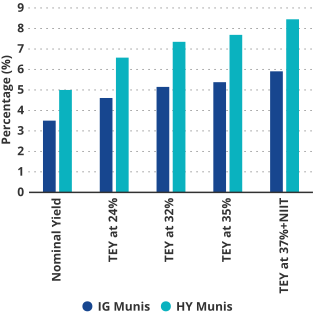
Source: Charles Schwab, December 4, 2025. Lord Abbett, April 14, 2026. For illustrative purposes only. Tax-equivalent yield = nominal yield / (1 - marginal tax rate). Nominal yields are approximate and based on index yields as of early 2026. NIIT = Net Investment Income Tax (3.8%).
Default Risk: How Do High Yield and Investment Grade Munis Compare?
Default rates across the muni market are low by almost any standard, but there is a meaningful difference between the two tiers.
Moody's historical data shows a 10-year cumulative default rate of roughly 0.1% for investment grade munis. Within the high yield tier, the most recent 5-year data (2019–2024) shows cumulative default rates of about 1% for BB-rated munis, 6% for B-rated, and 8% for CCC-C. For context, the comparable corporate figures over the same period were roughly 2%, 7%, and 32%. It's a real step up in risk, but context matters: muni issuers often have essential-service revenue backing, legal covenants that prioritize bondholders, and strong political incentives to avoid default. Even in the high yield tier, the underlying projects tend to serve core community needs like hospitals, schools, and housing, which supports cash flow stability even in weaker economic environments.
The takeaway isn't that high yield munis are risk-free. They're not. But at every rating tier, muni default rates have been a fraction of corporate defaults over the same period.
5-Year Cumulative Default Rates: Munis vs. Corporates
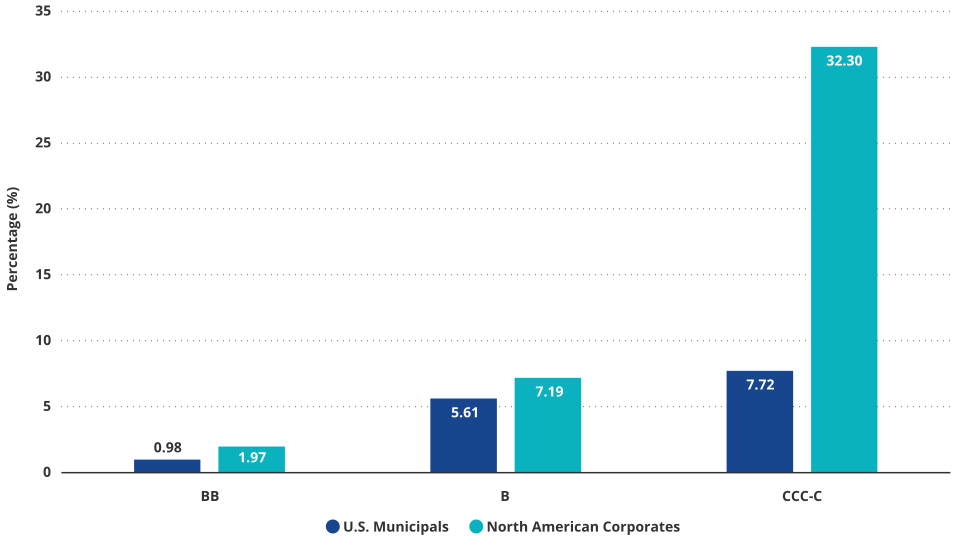
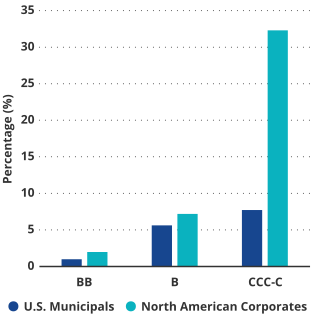
Source: Moody’s. As of September 2024. 5-year cumulative default rates, 2019 H2 – 2024 H1.
Recommended subscription
Sector Composition: Where Do the Differences Show Up?
The issuer mix across these two segments is fundamentally different, and it’s worth understanding why.
General Obligation: Dominates the investment grade universe. These are backed by the full taxing power of the issuer. You’ll find very few GO bonds in the high yield space.
Transportation: Airports, toll roads, and transit authorities are staples of investment grade issuance. High yield has some exposure here, but usually through smaller, project-specific revenue deals.
Healthcare: Large hospital systems with deep operating histories sit on the investment grade side. High yield skews toward smaller facilities, community hospitals, and senior living, where revenue concentration is higher.
Education: State universities and established school districts are investment grade. Charter schools and private institutions, which rely on enrollment-driven revenue, are high yield.
Housing and Development: State housing agencies issue investment grade debt. Land development and project-level housing deals are where high yield picks up.
Utilities: Water, sewer, and electric systems with long track records are core investment grade issuers. High yield exposure exists but tends toward smaller or newer utility operations.
The pattern is consistent. Investment grade clusters around issuers with taxing authority or essential-service monopolies. High yield is project-driven, where revenue hinges on the success of a specific venture. That’s the source of both the extra yield and the extra risk.
What Is the Tax Advantage Across High Yield and Investment Grade Munis?
Tax exemption is what makes the muni math work, and the benefit applies across both segments. Interest from most municipal bonds is exempt from federal income tax, and in many cases from state and local taxes for residents of the issuing state.
The tax-equivalent yield calculation (muni yield divided by one minus your marginal rate) is where this gets concrete. A muni yield that looks modest on a nominal basis can look very different after adjusting for taxes, especially at higher brackets. High yield munis amplify that dynamic. Their higher nominal yields can produce tax-equivalent numbers that are competitive with taxable high yield corporates, while carrying a significantly lower historical default rate. For income-focused investors in elevated tax brackets, that's a combination that's hard to replicate elsewhere in fixed income.
When Does High Yield Make Sense for Municipal Bond Investors?
High yield munis fit investors who want more income and can accept the credit risk and volatility that come with it. The math works best for investors in high federal and state tax brackets, where the after-tax pickup over investment grade is most pronounced.
There’s also a diversification argument. High yield munis are driven by different sectors and issuer types than either investment grade munis or high yield corporates. That means the return stream doesn’t always move with the rest of a fixed income portfolio. For investors with time on their side and a tolerance for short-term drawdowns, the compounding benefit of the yield advantage can be significant over a full market cycle.
When Does Investment Grade Make Sense for Municipal Bond Investors?
Investment grade munis are built for capital preservation and predictable income. The default rates are negligible by any reasonable standard, and recovery rates in the rare cases that do default are high.
The profile works especially well for retirees and pre-retirees drawing on their portfolios, or for anyone who wants tax-exempt income without introducing credit risk they have to actively monitor. In stressed markets, investment grade munis have historically held up better than lower-rated segments, which makes them an effective stabilizer when the rest of the portfolio is under pressure.
Access High Yield and Investment Grade Munis with VanEck
VanEck offers dedicated exposure to both sides of the muni market. The VanEck High Yield Muni ETF (HYD) tracks the ICE Broad High Yield Crossover Municipal Index and targets the below-investment-grade and crossover segment of the tax-exempt market. HYD carries a 30-day SEC yield of 4.39%* and manages over $4.1 billion in assets as of April 2026, making it one of the largest high yield muni ETFs available.
For investment grade exposure, VanEck offers three duration options to match different rate and income profiles. The VanEck Short Muni ETF (SMB) targets the short end of the curve. The VanEck Intermediate Muni ETF (ITM) covers the intermediate segment. The VanEck Long Muni ETF (MLN) targets long-duration, high-quality tax-exempt bonds.
Together, these four funds cover the full muni market spectrum. Investors can use them individually to target a specific credit or duration profile, or in combination to build a complete tax-exempt fixed income allocation calibrated to their bracket, income needs, and risk tolerance. Learn more at vaneck.com.
To receive more Municipal Bonds insights, sign up in our subscription center.

Important Disclosures
* HYD 30-day SEC yield as of 4/29/26: 4.39%
The performance data quoted represents past performance. Past performance is not a guarantee of future results. Investment return and principal value of an investment will fluctuate so that an investor's shares, when redeemed, may be worth more or less than their original cost. Performance may be lower or higher than performance data quoted. Please call 800.826.2333, or click for performance current to the most recent month end.
Please click here for HYD standardized performance.
30-Day SEC Yield - A standard yield calculation developed by the Securities and Exchange Commission that allows for fairer comparison among funds. It is based on the most recent 30-Day period. This yield figure reflects the interest earned during the period after deducting the Fund’s expenses for the period. It does not reflect the yield an investor would have received if they had held the Fund over the last twelve months assuming the most recent NAV.
This is not an offer to buy or sell, or a recommendation to buy or sell any of the securities, financial instruments or digital assets mentioned herein. The information presented does not involve the rendering of personalized investment, financial, legal, tax advice, or any call to action. Certain statements contained herein may constitute projections, forecasts and other forward-looking statements, which do not reflect actual results, are for illustrative purposes only, are valid as of the date of this communication, and are subject to change without notice. Actual future performance of any assets or industries mentioned are unknown. Information provided by third party sources are believed to be reliable and have not been independently verified for accuracy or completeness and cannot be guaranteed. VanEck does not guarantee the accuracy of third party data. The information herein represents the opinion of the author(s), but not necessarily those of VanEck or its other employees.
ICE Broad High Yield Crossover Municipal Index (MHYX) is intended to track the overall performance of the U.S. dollar denominated high yield long-term tax-exempt bond market.
An investment in the VanEck High Yield Muni ETF (HYD) may be subject to risks which include, among others, municipal securities, high yield securities, credit, interest rate, call, private activity bonds, industrial development bond, health care bond, California, New York, market, operational, sampling, index tracking, tax, authorized participant concentration, no guarantee of active trading market, trading issues, passive management, fund shares trading, premium/discount and liquidity of fund shares, and index-related concentration risks, all of which may adversely affect the Fund. High-yield municipal bonds are subject to greater risk of loss of income and principal than higher-rated securities, and are likely to be more sensitive to adverse economic changes or individual municipal developments than those of higher-rated securities. Municipal bonds may be less liquid than taxable bonds. A portion of the dividends you receive may be subject to the federal alternative minimum tax (AMT). There is no guarantee that the Fund's income will be exempt from federal, state or local income taxes, and changes in those tax rates or in alternative minimum tax rates or in the tax treatment of municipal bonds may make them less attractive as investments and cause them to lose value. Capital gains, if any, are subject to capital gains tax.
An investment in the VanEck Short Muni ETF (SMB) may be subject to risks which include, among others, municipal securities, credit, interest rate, special tax bond, pre-refunded municipal securities, California, New York, call, market, operational, sampling, index tracking, tax, authorized participant concentration, no guarantee of active trading market, trading issues, passive management, fund shares trading, premium/discount and liquidity of fund shares, and index-related concentration risks, all of which may adversely affect the Fund. Municipal bonds may be less liquid than taxable bonds. There is no guarantee that the Fund's income will be exempt from federal, state or local income taxes, and changes in those tax rates or in alternative minimum tax rates or in the tax treatment of municipal bonds may make them less attractive as investments and cause them to lose value. Capital gains, if any, are subject to capital gains tax. The Fund's assets may be concentrated in a particular sector and may be subject to more risk than investments in a diverse group of sectors.
An investment in the VanEck Intermediate Muni ETF (ITM) may be subject to risks which include, among others, municipal securities, credit, interest rate, call, California, New York, special tax bond, market, operational, sampling, index tracking, tax, authorized participant concentration, no guarantee of active trading market, trading issues, passive management, fund shares trading, premium/discount and liquidity of fund shares, and index-related concentration risks, all of which may adversely affect the Fund. Municipal bonds may be less liquid than taxable bonds. There is no guarantee that the Fund's income will be exempt from federal, state or local income taxes, and changes in those tax rates or in alternative minimum tax rates or in the tax treatment of municipal bonds may make them less attractive as investments and cause them to lose value. Capital gains, if any, are subject to capital gains tax. The Fund's assets may be concentrated in a particular sector and may be subject to more risk than investments in a diverse group of sectors.
An investment in the VanEck Long Muni ETF (MLN) may be subject to risks which include, among others, municipal securities, credit, interest rate, California, New York, Texas, call, health care bond, special tax bond, market, operational, sampling, index tracking, tax, authorized participant concentration, no guarantee of active trading market, trading issues, passive management, fund shares trading, premium/discount and liquidity of fund shares, and index-related concentration risks, all of which may adversely affect the Fund. Municipal bonds may be less liquid than taxable bonds. There is no guarantee that the Fund's income will be exempt from federal, state or local income taxes, and changes in those tax rates or in alternative minimum tax rates or in the tax treatment of municipal bonds may make them less attractive as investments and cause them to lose value. Capital gains, if any, are subject to capital gains tax. The Fund's assets may be concentrated in a particular sector and may be subject to more risk than investments in a diverse group of sectors.
Investing involves substantial risk and high volatility, including possible loss of principal. Bonds and bond funds will decrease in value as interest rates rise. An investor should consider the investment objective, risks, charges and expenses of the Fund carefully before investing. To obtain a prospectus and summary prospectus, which contains this and other information, call 800.826.2333 or visit vaneck.com/etfs. Please read the prospectus and summary prospectus carefully before investing.
© Van Eck Securities Corporation, Distributor, a wholly owned subsidiary of Van Eck Associates Corporation.
Related Funds
Important Disclosures
* HYD 30-day SEC yield as of 4/29/26: 4.39%
The performance data quoted represents past performance. Past performance is not a guarantee of future results. Investment return and principal value of an investment will fluctuate so that an investor's shares, when redeemed, may be worth more or less than their original cost. Performance may be lower or higher than performance data quoted. Please call 800.826.2333, or click for performance current to the most recent month end.
Please click here for HYD standardized performance.
30-Day SEC Yield - A standard yield calculation developed by the Securities and Exchange Commission that allows for fairer comparison among funds. It is based on the most recent 30-Day period. This yield figure reflects the interest earned during the period after deducting the Fund’s expenses for the period. It does not reflect the yield an investor would have received if they had held the Fund over the last twelve months assuming the most recent NAV.
This is not an offer to buy or sell, or a recommendation to buy or sell any of the securities, financial instruments or digital assets mentioned herein. The information presented does not involve the rendering of personalized investment, financial, legal, tax advice, or any call to action. Certain statements contained herein may constitute projections, forecasts and other forward-looking statements, which do not reflect actual results, are for illustrative purposes only, are valid as of the date of this communication, and are subject to change without notice. Actual future performance of any assets or industries mentioned are unknown. Information provided by third party sources are believed to be reliable and have not been independently verified for accuracy or completeness and cannot be guaranteed. VanEck does not guarantee the accuracy of third party data. The information herein represents the opinion of the author(s), but not necessarily those of VanEck or its other employees.
ICE Broad High Yield Crossover Municipal Index (MHYX) is intended to track the overall performance of the U.S. dollar denominated high yield long-term tax-exempt bond market.
An investment in the VanEck High Yield Muni ETF (HYD) may be subject to risks which include, among others, municipal securities, high yield securities, credit, interest rate, call, private activity bonds, industrial development bond, health care bond, California, New York, market, operational, sampling, index tracking, tax, authorized participant concentration, no guarantee of active trading market, trading issues, passive management, fund shares trading, premium/discount and liquidity of fund shares, and index-related concentration risks, all of which may adversely affect the Fund. High-yield municipal bonds are subject to greater risk of loss of income and principal than higher-rated securities, and are likely to be more sensitive to adverse economic changes or individual municipal developments than those of higher-rated securities. Municipal bonds may be less liquid than taxable bonds. A portion of the dividends you receive may be subject to the federal alternative minimum tax (AMT). There is no guarantee that the Fund's income will be exempt from federal, state or local income taxes, and changes in those tax rates or in alternative minimum tax rates or in the tax treatment of municipal bonds may make them less attractive as investments and cause them to lose value. Capital gains, if any, are subject to capital gains tax.
An investment in the VanEck Short Muni ETF (SMB) may be subject to risks which include, among others, municipal securities, credit, interest rate, special tax bond, pre-refunded municipal securities, California, New York, call, market, operational, sampling, index tracking, tax, authorized participant concentration, no guarantee of active trading market, trading issues, passive management, fund shares trading, premium/discount and liquidity of fund shares, and index-related concentration risks, all of which may adversely affect the Fund. Municipal bonds may be less liquid than taxable bonds. There is no guarantee that the Fund's income will be exempt from federal, state or local income taxes, and changes in those tax rates or in alternative minimum tax rates or in the tax treatment of municipal bonds may make them less attractive as investments and cause them to lose value. Capital gains, if any, are subject to capital gains tax. The Fund's assets may be concentrated in a particular sector and may be subject to more risk than investments in a diverse group of sectors.
An investment in the VanEck Intermediate Muni ETF (ITM) may be subject to risks which include, among others, municipal securities, credit, interest rate, call, California, New York, special tax bond, market, operational, sampling, index tracking, tax, authorized participant concentration, no guarantee of active trading market, trading issues, passive management, fund shares trading, premium/discount and liquidity of fund shares, and index-related concentration risks, all of which may adversely affect the Fund. Municipal bonds may be less liquid than taxable bonds. There is no guarantee that the Fund's income will be exempt from federal, state or local income taxes, and changes in those tax rates or in alternative minimum tax rates or in the tax treatment of municipal bonds may make them less attractive as investments and cause them to lose value. Capital gains, if any, are subject to capital gains tax. The Fund's assets may be concentrated in a particular sector and may be subject to more risk than investments in a diverse group of sectors.
An investment in the VanEck Long Muni ETF (MLN) may be subject to risks which include, among others, municipal securities, credit, interest rate, California, New York, Texas, call, health care bond, special tax bond, market, operational, sampling, index tracking, tax, authorized participant concentration, no guarantee of active trading market, trading issues, passive management, fund shares trading, premium/discount and liquidity of fund shares, and index-related concentration risks, all of which may adversely affect the Fund. Municipal bonds may be less liquid than taxable bonds. There is no guarantee that the Fund's income will be exempt from federal, state or local income taxes, and changes in those tax rates or in alternative minimum tax rates or in the tax treatment of municipal bonds may make them less attractive as investments and cause them to lose value. Capital gains, if any, are subject to capital gains tax. The Fund's assets may be concentrated in a particular sector and may be subject to more risk than investments in a diverse group of sectors.
Investing involves substantial risk and high volatility, including possible loss of principal. Bonds and bond funds will decrease in value as interest rates rise. An investor should consider the investment objective, risks, charges and expenses of the Fund carefully before investing. To obtain a prospectus and summary prospectus, which contains this and other information, call 800.826.2333 or visit vaneck.com/etfs. Please read the prospectus and summary prospectus carefully before investing.
© Van Eck Securities Corporation, Distributor, a wholly owned subsidiary of Van Eck Associates Corporation.