Beyond Hormuz: When Oil Markets Stop Reflecting Reality
April 22, 2026
Read Time 10+ MIN
Key Takeaways:
- Three simultaneous supply shocks—Russia, Hormuz and China—have no available circuit breaker.
- The Brent benchmark may no longer reflect real global crude pricing as Dubai/Oman diverges.
- Diesel and jet fuel shortages stem from a deficit of medium sour crude specifically, not crude overall.
- LNG and diesel shortages appear to be reinforcing each other in a compounding feedback loop.
- Conflict resolution will not restore the risk architecture that existed before Hormuz closed.
Hormuz is the headline, but the real story runs deeper. The market is pricing the Persian Gulf conflict as a temporary supply shock with a binary resolution, but we think that framing misses the deeper story.
Three simultaneous supply shocks are compounding each other, and there is no circuit breaker. The world entered this crisis already short of the specific crude that produces diesel and jet fuel. The benchmark most investors use to track oil may no longer be measuring what they think it is. The liquefied natural gas (LNG) and the diesel shortages appear to be feeding each other. And the policy consequences across Europe, Australia and Asia are likely to be significant and durable.
When the conflict ends, the physical damage, the insurance repricing and the institutional memory of closure will outlast the headlines.
This Is More Than a Temporary Supply Shock
The current disruption is not one geopolitical event. In our view, this is three overlapping structural shifts with no obvious off-ramp.
Russia's barrels rerouted permanently to Asia after Ukraine, putting the higher cost European refining system at an immediate disadvantage. US refineries, with lower energy costs and greater crude flexibility, were better positioned to adapt. Then Hormuz closed, stranding the Gulf barrels that had absorbed the Russian exit, while curtailing the Gulf refining complex supplying diesel and jet fuel to Europe, Australia and Asia. Then China tightened product exports. The crisis appears to have given Beijing justification to pressure Shandong teapot refiners, already running at reduced utilization, to cut throughput further and protect inventories.
The supply OPEC would use to stabilize the market depends on the same strait that has just closed. The US Strategic Petroleum Reserve is still in recovery from the Russia-Ukraine drawdown. Russia is sanctioned. There is, in our view, no fourth source of supply.
Beyond Brent: The World Is Pricing the Wrong Barrel
The original Brent field stopped producing in 2021, but the benchmark still carries its name. What the world calls Brent today is a basket of six grades, five declining North Sea crudes and WTI Midland, a Texas light sweet crude from the Permian Basin. Since WTI Midland's inclusion in May 2023 it has played an increasingly dominant role in setting the Dated Brent price.
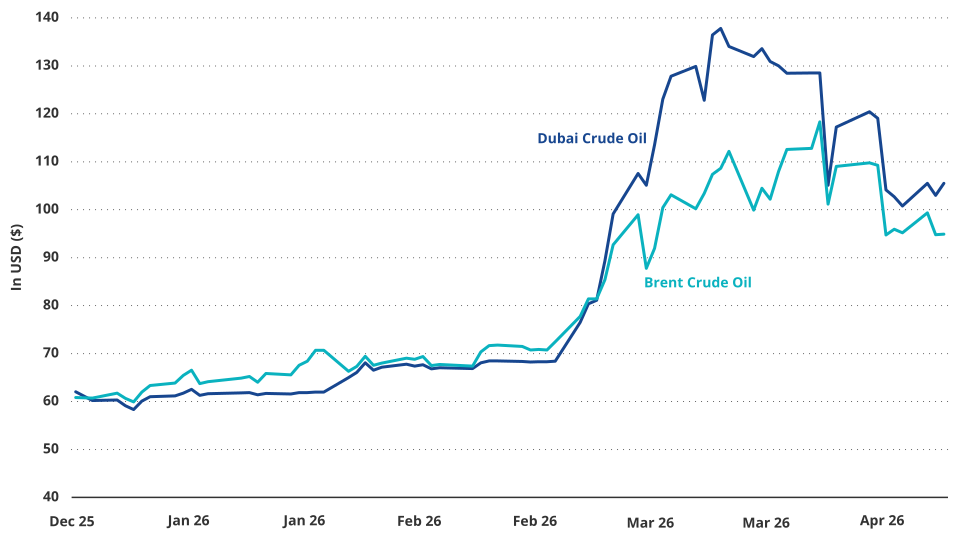
Meanwhile the medium sour Dubai/Oman benchmark prices most seaborne global oil trade flowing east to Asia, reflecting the actual barrel most of the world's complex refineries were built to process. The world could be in the early stages of a bifurcation: WTI anchoring the western hemisphere, Dubai/Oman anchoring the east. The Hormuz crisis may be the stress test. It did not create this divide, but made it impossible to ignore. When the Strait closes, Dubai/Oman appears to reprice violently for the eastern world while Brent moves on sentiment in the west. It is possible the market is still pricing a unified benchmark world that is quietly fragmenting underneath. The signals are early, but they are accumulating.
Brent vs. Gulf Medium Sour: A Growing Pricing Disconnect
Price Difference: Dubai Crude Oil - Brent Crude Oil
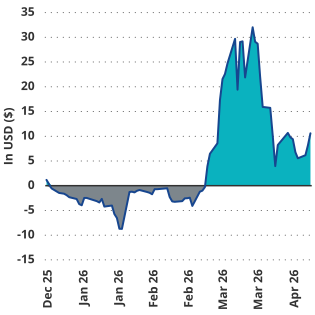
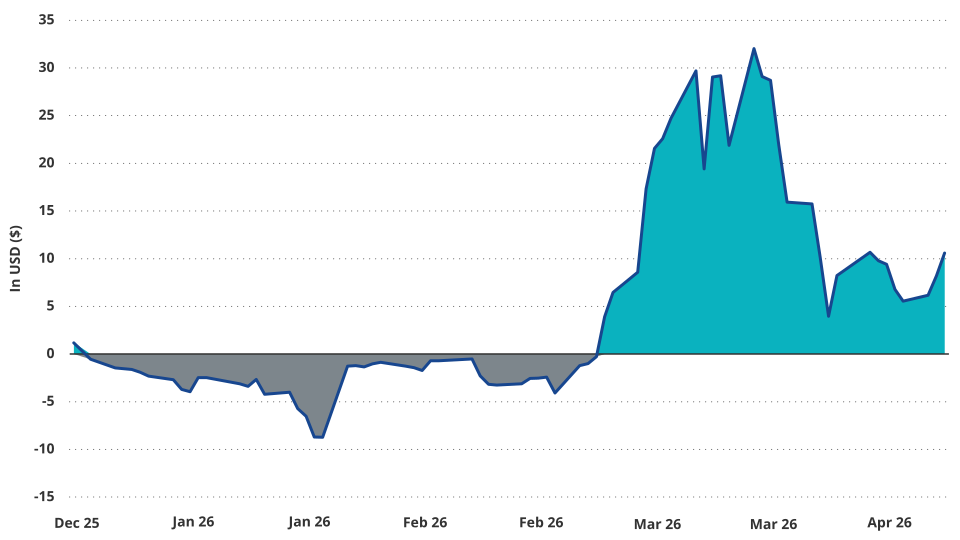
Source: Barclays, Bloomberg. Data as of 4/16/2026. For illustrative purposes only.
This raises a fundamental question about how global oil is priced. WTI is a landlocked crude priced at Cushing, Oklahoma. As it plays an increasingly dominant role inside Brent, one has to ask: is Brent quietly becoming WTI plus a freight adjustment? If so, most global oil pricing may be anchored to a benchmark designed for a very different world.
The counterargument is continued globalization. As North Sea production declines, WTI increasingly anchors global pricing. In practice, refiners confirm that WTI can already set the marginal price inside Brent when it is the lowest-cost deliverable barrel after adjusting for quality and freight.
The part we keep returning to is simpler. Neither WTI nor Brent appears to reflect the barrel that is actually short. The constraint today is not light sweet crude but heavy and medium sour grades broadly, with Gulf medium sour being the most material gap. That may be what this crisis has started to expose. Whether the market eventually builds the pricing infrastructure to match is the question we keep coming back to.
Crude Type—Diesel and Jet Fuel—Is the Real Bottleneck, Not Volume
Medium sour crude, approximately 29° to 35° API with sulfur between 1.5% and 2.5%, is the feedstock most complex refineries are built to process. It generates the highest yields of diesel and jet fuel. Russian Urals is almost a perfect chemical analogue to Gulf medium sour grades. When sanctions removed it from Western markets the world turned to the Gulf. When Hormuz closed the Gulf was gone too. The shortage that began with Russia-Ukraine was not resolved. It multiplied.
Diesel cracks and jet fuel spreads are widening not because there is a shortage of crude in aggregate, but because there is a shortage of the specific crude that produces them. In practice, we use diesel to move stuff and people. Roughly 75% of global diesel demand comes from transport, predominantly trucking, rail and marine vessels. Another 8% goes to agriculture and mining, which is still primarily about moving things: tractors, haul trucks and heavy equipment. Industry accounts for most of the rest.
Here is the circular argument that the market may not be pricing: the LNG shortage appears to be forcing Asia and Europe to lean harder on backup generation, which runs predominantly on diesel. Less gas means more diesel demand. Less medium sour means less diesel supply. The two shortages could be feeding each other.
Outside the Gulf, the world's heavy sour alternatives at meaningful scale are a Western Hemisphere story. Canadian oil sands, Venezuelan extra-heavy and Mexican Maya are all flowing toward the US Gulf Coast, arguably the one refining system in the world specifically built to process them. Following the general license issued weeks before this crisis began, Venezuelan barrels are redirecting away from China and toward the US, a structural shift happening quietly while the market watches Hormuz. US Gulf Coast refineries are processing discounted Western Hemisphere heavy sour crude and selling the output into a global product market starving of diesel and jet fuel.
In a world where Gulf medium sour is stranded and Russian Urals is sanctioned, the West’s heavy sour supply chain is becoming one of the most strategically significant energy corridors in the world. Not by design, but because everything else stopped flowing.
Energy Security an Economic Imperative
The strain on energy systems is global, but is unfolding differently across regions:
- Europe entered this crisis with gas storage at historically low levels, LNG dependency on a now disrupted corridor and an investment framework that has spent years penalizing hydrocarbon production through windfall profit taxes and regulatory uncertainty.
- Australia entered this crisis with strategic reserves below IEA obligations and limited domestic refining capacity, a vulnerability that sits uncomfortably alongside its status as one of the world's largest energy exporters (LNG and coal).
- Seven Asian nations have triggered emergency energy-saving measures due to critical supply risks.
- On March 25, South Korea launched a ₩25 trillion price-shock fund, while the Philippines declared a National Energy Emergency to implement price controls.
- Regionally, governments have mandated strict conservation, including Sri Lanka’s four-day work week and fuel quotas, Pakistan’s 50% cut to government fuel allowances, and public-sector remote work in Thailand.
The common thread is deferred investment in energy security infrastructure. This crisis has not created those vulnerabilities, but has made the cost of ignoring them visible. Energy security is not about what governments deem clean. It is about what keeps economies functioning when global supply chains are disrupted.
Resolution Does Not Mean Restoration
When the conflict ends, the physical damage, the insurance repricing and the institutional memory of closure will outlast the headlines by months if not years.
Marine insurance reprices risk based on demonstrated threat environments, not political statements. Even after a ceasefire, underwriters will likely require months of incident-free transits before premiums normalize, and the vessels, operators and charterers that restructured contracts around the closure will not unwind those decisions instantly.
Meanwhile, the physical disruptions remain acute. Qatar's Ras Laffan LNG complex and Saudi Arabia's Ras Tanura refinery and export terminal are still offline to seaborne trade. Even as crude tanker traffic collapsed, a few LPG cargoes were prioritized by the Iranians to cross through Hormuz, a signal that the conflict is disrupting not just energy but the raw material supply chains for plastics, fertilizers and chemicals underneath the global manufacturing economy.
The Strait of Hormuz has now been proven closeable, in real time, not theoretically. That is a lasting change to the risk architecture of global energy markets. The conflict ending removes the acute crisis, but not the knowledge that the crisis was possible. That knowledge has a price.
Where This Leaves Markets
The key question is not just which sector benefits from higher commodity prices, but which companies have built the full chain from resource to end market and whether that chain runs through open corridors or contested ones:
- PetroChina (1.35% of Fund assets as of 3/31/2026) connecting Russian wellbores to Chinese refineries and petrochemical plants.
- Chevron (2.60% of Fund assets as of 3/31/2026) moving Permian gas to Texas power generation.
- EQT (1.46% of Fund assets as of 3/31/2026) taking Marcellus gas to LNG export.
- TotalEnergies (3.20% of Fund assets as of 3/31/2026) from wellbore to LNG and power.
- BKV doing the same in the Barnett.
In a world where flows are fragile, controlling the full chain from production to consumption is the most defensible position in energy.
We think oil-levered equities offer a compelling opportunity. The market is still treating this as a temporary shock, but the impact on inventories and the back end of the crude curve is likely to be more persistent, and this is not reflected in valuations.
The widening spreads between crude types and the structural shortage of diesel are symptoms of a deeper imbalance. Together, they point to multiple demand drivers supporting crude oil from here.
The flow premium extends beyond energy. US refineries, ammonia producers and petrochemical companies running on Henry Hub-linked feedstock are gaining structural cost advantages over global competitors absorbing LNG spot prices that have tripled. In mining, those who maintained diesel inventories and secured term supply contracts are operating while those who ran lean are facing disruption at exactly the moment commodity prices are rising. The Persian Gulf still has the cheapest feedstock in the world. That advantage narrows considerably when you cannot get it out, or when the question becomes whether you can get it out and at what price.
It is a new world. The focus shifts to who has prepared for a world where the commodity actually gets there. Identifying those companies is the work of active commodity research. At VanEck that is the lens we apply to the VanEck Global Resources Fund.
In a conflict that stops flows, the most valuable thing in energy is not a barrel in the ground. It is a barrel that can still move, all the way to where it is needed.
GHAAX | Global Resources Fund - Class A
To receive more Natural Resources insights, sign up in our subscription center.

IMPORTANT DISCLOSURES
This is not an offer to buy or sell, or a recommendation to buy or sell any of the securities, financial instruments or digital assets mentioned herein. The information presented does not involve the rendering of personalized investment, financial, legal, tax advice, or any call to action. Certain statements contained herein may constitute projections, forecasts and other forward-looking statements, which do not reflect actual results, are for illustrative purposes only, are valid as of the date of this communication, and are subject to change without notice. Actual future performance of any assets or industries mentioned are unknown. Information provided by third party sources are believed to be reliable and have not been independently verified for accuracy or completeness and cannot be guaranteed. VanEck does not guarantee the accuracy of third party data. The information herein represents the opinion of the author(s), but not necessarily those of VanEck or its other employees.
Dated Brent (Brent Crude): Dated Brent is a benchmark price assessment for physical crude oil cargoes in the North Sea assigned specific delivery dates. It comprises a basket of six crude grades and is widely used as a global crude oil reference price.
WTI (West Texas Intermediate): WTI is a light, sweet crude oil grade produced primarily from the Permian Basin and priced at Cushing, Oklahoma. It serves as a major North American crude oil pricing benchmark and is the underlying commodity for oil futures contracts traded on the NYMEX.
Dubai/Oman Benchmark: The Dubai/Oman benchmark is a medium sour crude oil price assessment serving as the primary pricing reference for crude oil exported from the Persian Gulf to Asia. It is assessed by S&P Global Commodity Insights (Platts).
Hard asset investments are subject to risks associated with real estate, precious metals, natural resources and commodities and events related to these industries, foreign investments, illiquidity, credit, interest rate fluctuations, inflation, leverage, and non-diversification.
Commodities are assets that have tangible properties, such as oil, metals, and agriculture. Commodities and commodity-linked derivatives may be affected by overall market movements and other factors that affect the value of a particular industry or commodity, such as weather, disease, embargoes or political or regulatory developments. The value of a commodity-linked derivative is generally based on price movements of a commodity, a commodity futures contract, a commodity index or other economic variables based on the commodity markets. Derivatives use leverage, which may exaggerate a loss. Investments in commodities can be very volatile and direct investment in these markets can be very risky, especially for inexperienced investors.
Fund Holdings may vary. Visit https://www.vaneck.com/us/en/investments/global-resources-fund-ghaax/holdings/ for a complete list of holdings.
You can lose money by investing in the Fund. Any investment in the Fund should be part of an overall investment program, not a complete program. The Fund is subject to risks which may include, but are not limited to, risks associated with active management, agriculture companies, commodities and commodity-linked instruments, commodities and commodity-linked instruments tax, derivatives, direct investments, emerging market issuers, ESG investing strategy, foreign currency, foreign securities, global resources sector, market, operational, investing in other funds, small- and medium capitalization companies, special purpose acquisition companies, and special risk considerations of investing in Canadian issuers, all of which may adversely affect the Fund. Emerging market issuers and foreign securities may be subject to securities markets, political and economic, investment and repatriation restrictions, different rules and regulations, less publicly available financial information, foreign currency and exchange rates, operational and settlement, and corporate and securities laws risks. Small- and medium-capitalization companies may be subject to elevated risks. Derivatives may involve certain costs and risks such as liquidity, interest rate, and the risk that a position could not be closed when most advantageous.
Investing involves risk, including possible loss of principal. Please call 800.826.2333 or visit vaneck.com for a free prospectus and summary prospectus . An investor should consider investment objectives, risks, charges and expenses of the investment company carefully before investing. The prospectus and summary prospectus contain this and other information. Please read the prospectus and summary prospectus carefully before investing.© Van Eck Securities Corporation, Distributor, a wholly owned subsidiary of Van Eck Associates Corporation.
Related Funds
IMPORTANT DISCLOSURES
This is not an offer to buy or sell, or a recommendation to buy or sell any of the securities, financial instruments or digital assets mentioned herein. The information presented does not involve the rendering of personalized investment, financial, legal, tax advice, or any call to action. Certain statements contained herein may constitute projections, forecasts and other forward-looking statements, which do not reflect actual results, are for illustrative purposes only, are valid as of the date of this communication, and are subject to change without notice. Actual future performance of any assets or industries mentioned are unknown. Information provided by third party sources are believed to be reliable and have not been independently verified for accuracy or completeness and cannot be guaranteed. VanEck does not guarantee the accuracy of third party data. The information herein represents the opinion of the author(s), but not necessarily those of VanEck or its other employees.
Dated Brent (Brent Crude): Dated Brent is a benchmark price assessment for physical crude oil cargoes in the North Sea assigned specific delivery dates. It comprises a basket of six crude grades and is widely used as a global crude oil reference price.
WTI (West Texas Intermediate): WTI is a light, sweet crude oil grade produced primarily from the Permian Basin and priced at Cushing, Oklahoma. It serves as a major North American crude oil pricing benchmark and is the underlying commodity for oil futures contracts traded on the NYMEX.
Dubai/Oman Benchmark: The Dubai/Oman benchmark is a medium sour crude oil price assessment serving as the primary pricing reference for crude oil exported from the Persian Gulf to Asia. It is assessed by S&P Global Commodity Insights (Platts).
Hard asset investments are subject to risks associated with real estate, precious metals, natural resources and commodities and events related to these industries, foreign investments, illiquidity, credit, interest rate fluctuations, inflation, leverage, and non-diversification.
Commodities are assets that have tangible properties, such as oil, metals, and agriculture. Commodities and commodity-linked derivatives may be affected by overall market movements and other factors that affect the value of a particular industry or commodity, such as weather, disease, embargoes or political or regulatory developments. The value of a commodity-linked derivative is generally based on price movements of a commodity, a commodity futures contract, a commodity index or other economic variables based on the commodity markets. Derivatives use leverage, which may exaggerate a loss. Investments in commodities can be very volatile and direct investment in these markets can be very risky, especially for inexperienced investors.
Fund Holdings may vary. Visit https://www.vaneck.com/us/en/investments/global-resources-fund-ghaax/holdings/ for a complete list of holdings.
You can lose money by investing in the Fund. Any investment in the Fund should be part of an overall investment program, not a complete program. The Fund is subject to risks which may include, but are not limited to, risks associated with active management, agriculture companies, commodities and commodity-linked instruments, commodities and commodity-linked instruments tax, derivatives, direct investments, emerging market issuers, ESG investing strategy, foreign currency, foreign securities, global resources sector, market, operational, investing in other funds, small- and medium capitalization companies, special purpose acquisition companies, and special risk considerations of investing in Canadian issuers, all of which may adversely affect the Fund. Emerging market issuers and foreign securities may be subject to securities markets, political and economic, investment and repatriation restrictions, different rules and regulations, less publicly available financial information, foreign currency and exchange rates, operational and settlement, and corporate and securities laws risks. Small- and medium-capitalization companies may be subject to elevated risks. Derivatives may involve certain costs and risks such as liquidity, interest rate, and the risk that a position could not be closed when most advantageous.
Investing involves risk, including possible loss of principal. Please call 800.826.2333 or visit vaneck.com for a free prospectus and summary prospectus . An investor should consider investment objectives, risks, charges and expenses of the investment company carefully before investing. The prospectus and summary prospectus contain this and other information. Please read the prospectus and summary prospectus carefully before investing.© Van Eck Securities Corporation, Distributor, a wholly owned subsidiary of Van Eck Associates Corporation.