The Case for Real Assets: One of the Most Under-Owned Corners of the Market
September 17, 2026
Read Time 8 MIN
Key Takeaways
- Investors have put roughly $28 into bond funds for every $1 into commodity funds since 1997.
- Commodity allocations have never topped 2% of fund assets and sit near 0.9% today.
- Passive index funds have quietly cut real asset exposure, with energy falling from roughly 18% of the S&P 500 to near 4%.
Investors have spent three decades pouring money into stocks and bonds while largely ignoring commodities and other real assets. At the same time, the traditional equity portfolio has become increasingly concentrated in a handful of financial and technology companies.
That creates an unusual setup: many investors hold less intentional exposure to the physical economy at a time when portfolio concentration has been rising. This is the first post in a four-part series on real assets. We start with the simplest question: how did investors get so little exposure to them in the first place?
Commodity Fund Growth: $188B in Three Decades
Since July 1997, U.S. taxable bond funds have absorbed roughly $5.3 trillion in cumulative net flows. U.S. equity funds have taken in about $1.1 trillion. Commodity funds have taken in $188 billion - in total across 29 years.
In other words, for every dollar that found its way into a commodity fund, roughly $28 went into a bond fund.
Commodities Have Been Chronically Under-Owned
U.S. Fund Category Cumulative Net Flows

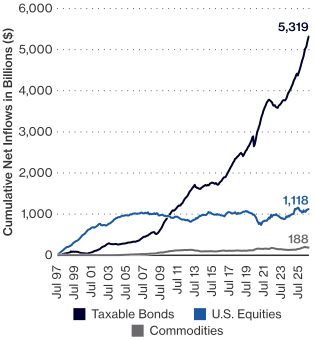
Source: Morningstar. Data as of June 30, 2026. Past performance is no guarantee of future results.
Commodity Performance Across Drawdowns
What stands out is the flatness of the line across an entire generation of markets. That span includes the commodity supercycle of the 2000s, the post-crisis reflation trade, the inflation shock of 2021 and 2022, and the metals rally that followed. Through all of it, commodity flows never inflected and commodity ownership never really became a durable part of investors’ portfolios.
Investor Behavior in Commodities
While flows tell us what investors are currently buying into, allocations tell us what they hold onto. On that measure the picture is arguably worse.
Commodities reached roughly 2.0% of total fund assets, excluding money market funds, in 2011. By 2015–2019, that share had fallen to roughly 0.5%. As of mid-2026, it sits near 0.9%, after briefly reaching 1.2% earlier this year.
Commodity Category % Total Assets (ex. Money Market Funds)


Source: Morningstar. Data as of June 30, 2026.
Timing the Commodities Cycle Falls Flat
Commodity ownership behaves as a series of spikes rather than a rising baseline. Investors tend to arrive after prices have already moved and leave once momentum fades. In nearly two decades of data, commodities have never established a durable seat at the allocation table.
A 2% allocation has been the ceiling, that covers everything in the category: gold, broad baskets, single commodities, and the funds that hold them.
Recommended subscription
How Has Real Asset Ownership Shifted?
The under-ownership problem is amplified by what investors own. Passive index funds are among the most widely held vehicles, and their sector exposures have shifted materially over the years.
Real asset sectors have structurally shrunk as a share of the S&P 500. Energy averaged roughly 18% of the index in the 1980s. It sits near 4% today. Materials and real estate together add only a few points more. Technology has moved in the opposite direction, from roughly 5% to roughly 28% on a decade-average basis.
Average Historical Sector Weights of S&P 500

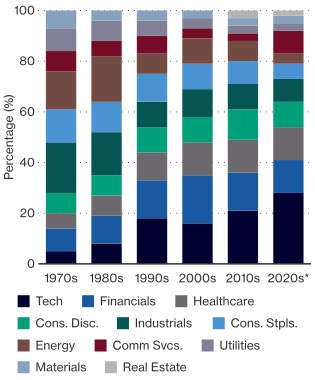
Source: VanEck. Data as of June 30, 2026. 2020s reflects the 2020 to 2026 year-to-date average. The 2018 GICS reclassification moved Alphabet, Meta and Netflix into Communication Services, which inflates that sector relative to earlier decades. Pre-1999 figures are estimates derived from historical financial data.
Some of that shift reflects genuine changes in the composition of the U.S. economy. But part of it is simply the arithmetic of market-cap weighting. Sectors that underperform get smaller in the index whether or not their economic role has changed. The consequence is that an investor building a portfolio from a core equity fund and a core bond fund is starting from less real asset exposure than at any point in the modern era, and whether they intended to or not.
Why Investors Should Diversify with Commodities
Persistent under-ownership might be easy to dismiss if the case for the asset class had weakened — but the historical diversification characteristics have largely held. Over the past 30 years, commodities have shown low correlation to nearly everything else a portfolio holds.
Commodities Add Low Correlation and Diversification
Commodities: 30-Year Correlation vs. Equities and Bonds

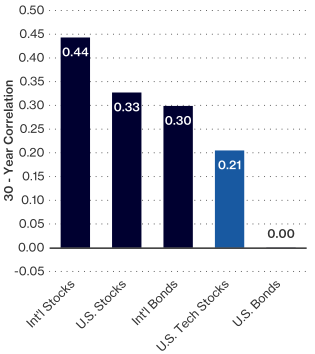
Source: VanEck, Morningstar. 30-year correlations based on monthly returns. Data as of June 30, 2026.
Commodities Correlation Explained
Commodities have carried a 0.44 correlation to international stocks, 0.33 to U.S. stocks, 0.30 to international bonds, 0.21 to U.S. technology stocks, and 0.00 to U.S. bonds.
The relevance of that has grown as equity benchmarks have become more concentrated. Information technology alone accounted for 37.9% of the S&P 500 as of August 31, 2026, according to S&P Dow Jones Indices. An investor who holds a total U.S. equity fund today holds a very different risk exposure than one who held the same product 20 years ago, and much of that risk now traces back to a single theme.
While correlations can rise sharply during liquidity shocks, over long periods, the numbers show that commodities have historically behaved differently from the stocks and bonds that make up most portfolios, a potentially important factor for allocators seeking diversification.
Are Real Assets Undervalued?
The reason to own real assets isn't simply that other investors don't. It's that most portfolios already have plenty of exposure to stocks and bonds, and not much to the things that drive the physical economy—energy, materials, commodities, infrastructure and land. Real assets bring a different set of risks and return drivers to the portfolio, and that can matter when stocks and bonds don't behave the way investors expect. After decades of owning less of the real economy, it may be worth asking whether portfolios have gone too far in the other direction.
VanEck Natural Resources and Commodities Solutions
VanEck has a history of investing in natural resources and commodities for over 50 years, offering investors actively and passively managed strategies, from physical commodities to natural resource equities. We offer specialized exposure to individual sectors and diversified solutions with broad exposure across sectors and industries.
| Symbol | Name | Agriculture / Agri-Food Technology |
Gold/ Precious Metals |
Base/ Industrial Metals |
Strategic/ Rare Earth Metals |
Renewable/ Alternative Energy |
Traditional Energy (Oil & Gas) |
Energy MLPs |
Infrastructure | REITs |
| GHAAX/ GHAIX | Global Resources Fund | ■ | ■ | ■ | ■ | ■ | ■ | |||
| CMCAX/ COMIX | CM Commodity Index Fund | ■ | ■ | ■ | ■ | |||||
| CMCI | CMCI Commodity Strategy ETF | ■ | ■ | ■ | ■ | |||||
| INIVX/ INIIX | International Investors Gold Fund | ■ | ||||||||
| CRAK | Oil Refiners ETF | ■ | ||||||||
| EINC | Energy Income ETF | ■ | ■ | |||||||
| GDX | Gold Miners ETF | ■ | ||||||||
| GDXJ | Junior Gold Miners ETF | ■ | ||||||||
| EMET | Copper and Electrification ETF | ■ | ■ | ■ | ||||||
| HAP | Natural Resources ETF | ■ | ■ | ■ | ■ | ■ | ■ | |||
| MOO | Agribusiness ETF | ■ | ||||||||
| NLR | Uranium and Nuclear ETF | ■ | ■ | |||||||
| OIH | Oil Services ETF | ■ | ||||||||
| OUNZ | VanEck Merk Gold ETF | ■ | ||||||||
| PIT | VanEck Commodity Strategy ETF | ■ | ■ | ■ | ■ | |||||
| RAAX | Real Assets ETF | ■ | ■ | ■ | ■ | ■ | ■ | ■ | ■ | ■ |
| REMX | Rare Earth and Strategic Metals ETF | ■ | ||||||||
| SLX | Steel ETF | ■ | ||||||||
| SMOG | Low Carbon Energy ETF | ■ |
More information, including recent performance and current holdings, can be found by clicking the fund names below:
Global Resources Fund: Actively-managed approach to companies with unique competitive advantages associated with traditional commodities and those leading the development of emerging resource applications and technologies.
International Investors Gold Fund: Proven fundamental, bottom-up process emphasizes stock selection based on industry experience to access opportunities across the gold mining sector.
CM Commodity Index Fund: A passively managed fund that offers diversified commodities exposure by spreading its exposure across multiple maturities and maintaining a constant maturity per commodity to mitigate the impact of negative roll yield.
CMCI Commodity Strategy ETF: A passively managed ETF that spreads its exposure across multiple maturities to offer diversified exposure and mitigates the impact of negative roll yield by maintaining a constant maturity per commodity.
VanEck Oil Refiners ETF (CRAK): Provides exposure to an industry that may generally benefit from lower oil prices, a segment that has historically interacted differently with oil prices and market dynamics than other energy segments.
VanEck Energy Income ETF (EINC): Offers exposure to MLPs and energy infrastructure companies that have historically exhibited attractive yield characteristics without burdensome K-1 tax reporting.
VanEck Gold Miners ETF (GDX): The nation's first ETF to offer direct exposure to the gold mining industry. Gold miners have historically shown leverage to gold prices, which can amplify returns when prices rise and losses when they fall.
VanEck Junior Gold Miners ETF (GDXJ): Access to junior gold miners, including smaller exploratory or early development phase companies that are responsible for many gold reserve discoveries worldwide.
Copper and Electrification ETF (EMET): Capture companies involved in the production of the metals that enable the energy transition from fossil fuels to cleaner energy sources and technologies.
VanEck Natural Resources ETF (HAP): Offers exposure to global companies involved in six natural resources segments (including agriculture, energy, metals and renewable energy).
VanEck Agribusiness ETF (MOO): Positioned to meet growing demand as global population growth is driving increasing food demand and the need for efficient agricultural solutions.
VanEck Uranium and Nuclear ETF (NLR): Access to an important segment of the nuclear energy market, which is a significant clean energy source at an inflection point from increasing demand.
VanEck Oil Services ETF (OIH): Invests in highly liquid companies in oil services industry, including both domestic and U.S. listed foreign companies, allowing for enhanced industry representation.
VanEck Merk Gold ETF (OUNZ): Provides investors with a convenient and cost-efficient way to invest in gold through shares with the option to take physical delivery.
VanEck Real Assets ETF (RAAX): Comprehensive allocation strategy that invests across real assets and seeks to reduce volatility by responding to changing market environments.
VanEck Rare Earth and Strategic Metals ETF (REMX): Provides access to the rare earth or strategic metals industry, which supplies key inputs to many of the world’s most advanced technologies.
VanEck Steel ETF (SLX): Access to the steel industry, an industry supporting global industrialization and economic expansion.
VanEck Low Carbon Energy ETF (SMOG): Exposure to low carbon energy that includes not only solar, wind and hydro companies, but also in more recently developing areas of the market such as electric vehicles, battery tech, hydrogen and fuel cells.
VanEck Commodity Strategy ETF (PIT): Actively managed exposure to a broad basket of commodity futures.
To receive more Natural Resources insights, sign up in our subscription center.

Important Disclosures
Index Definitions
Bloomberg Commodity Index: a broadly diversified index that tracks the performance of futures contracts on physical commodities across energy, metals, agriculture and livestock, weighted to limit concentration in any single commodity or sector.
Bloomberg Global Aggregate ex USD Index: a measure of investment grade debt from developed and emerging markets outside the United States, including treasury, government-related, corporate and securitized fixed rate bonds.
Bloomberg U.S. Aggregate Bond Index: a measure of the U.S. dollar-denominated, investment grade, taxable bond market, including treasuries, government-related and corporate securities, and securitized debt.
MSCI World ex USA Index: a free float-adjusted market capitalization index that measures equity market performance of developed markets excluding the United States.
S&P 500 Index: a market capitalization-weighted index of 500 leading publicly traded U.S. companies, widely regarded as a gauge of large cap U.S. equities.
S&P 500 Technology Sector Index: a subset of the S&P 500 Index comprising those constituents classified within the information technology sector under the Global Industry Classification Standard.
S&P GSCI Index: a production-weighted index of principal physical commodity futures contracts, designed to measure investment performance in the commodity markets.
Index returns are not Fund returns and do not reflect any management fees or brokerage expenses. Certain indices may take into account withholding taxes. Investors can not invest directly in the Index. Returns for actual Fund investors may differ from what is shown because of differences in timing, the amount invested and fees and expenses. Index returns assume that dividends have been reinvested.
Risk Considerations
This is not an offer to buy or sell, or a recommendation to buy or sell any of the securities, financial instruments or digital assets mentioned herein. The information presented does not involve the rendering of personalized investment, financial, legal, tax advice, or any call to action. Certain statements contained herein may constitute projections, forecasts and other forward-looking statements, which do not reflect actual results, are for illustrative purposes only, are valid as of the date of this communication, and are subject to change without notice. Actual future performance of any assets or industries mentioned are unknown. Information provided by third party sources are believed to be reliable and have not been independently verified for accuracy or completeness and cannot be guaranteed. VanEck does not guarantee the accuracy of third-party data. The information herein represents the opinion of the author(s), but not necessarily those of VanEck or its other employees.
VanEck Merk Gold ETF (OUNZ) Disclosures
VanEck Merk® Gold ETF: This material must be preceded or accompanied by a prospectus for the VanEck Merk Gold ETF (the “Trust”). Before investing, you should carefully consider the Trust’s investment objectives, risks, charges and expenses. This and other information is in the prospectus, a copy of which may be obtained by visiting vaneck.com/ounz or calling 800.826.2333. Please read the prospectus carefully before you invest. Investing involves significant risk, including possible loss of principal. The Trust is not an investment company registered under the Investment Company Act of 1940 or a commodity pool for the purposes of the Commodity Exchange Act. Shares of the Trust are not subject to the same regulatory requirements as mutual funds. Because shares of the Trust are intended to reflect the price of the gold held in the Trust, the market price of the shares is subject to fluctuations similar to those affecting gold prices. Additionally, shares of the Trust are bought and sold at market price, not at net asset value (“NAV”). Brokerage commissions will reduce returns. The sponsor of the VanEck Merk Gold ETF is Merk Investments LLC (the “Sponsor”). Van Eck Securities Corporation provides marketing services to the Trust.
The request for redemption of shares for gold is subject to a number of risks including but not limited to the potential for the price of gold to decline during the time between the submission of the request and delivery. Delivery may take a considerable amount of time depending on your location.
The Sponsor of the Trust is Merk Investments, LLC. The Marketing Agent for the Trust is Van Eck Securities Corporation.
© Merk Investments LLC. © Van Eck Associates Corporation.
VanEck ETFs and Mutual Funds
The principal risks of investing in VanEck ETFs and mutual funds include sector, market, economic, political, foreign currency, world event, index tracking, active management, social media analytics, derivatives, blockchain, commodities and non-diversification risks, as well as fluctuations in net asset value and the risks associated with investing in less developed capital markets. VanEck ETFs may also be subject to authorized participant concentration, no guarantee of active trading market, trading issues, passive management, fund shares trading, premium/discount risk and liquidity of fund shares risks. VanEck ETFs or mutual funds may loan their securities, which may subject them to additional credit and counterparty risk. ETFs or mutual funds that invest in high-yield securities are subject to subject to risks associated with investing in high-yield securities; which include a greater risk of loss of income and principal than funds holding higher-rated securities; concentration risk; credit risk; hedging risk; interest rate risk; and short sale risk. ETFs or mutual funds that invest in companies with small capitalizations are subject to elevated risks, which include, among others, greater volatility, lower trading volume and less liquidity than larger companies. Please see the prospectus of each Fund for more complete information regarding each Fund’s specific risks.
Investing involves substantial risk and high volatility, including possible loss of principal. An investor should consider the investment objective, risks, charges and expenses of a Fund carefully before investing. To obtain a prospectus and summary prospectus, which contain this and other information, call 800.826.2333 or visit vaneck.com. Please read the prospectus and summary prospectus carefully before investing.
© Van Eck Securities Corporation, Distributor, a wholly owned subsidiary of Van Eck Associates Corporation.
Related Funds
Important Disclosures
Index Definitions
Bloomberg Commodity Index: a broadly diversified index that tracks the performance of futures contracts on physical commodities across energy, metals, agriculture and livestock, weighted to limit concentration in any single commodity or sector.
Bloomberg Global Aggregate ex USD Index: a measure of investment grade debt from developed and emerging markets outside the United States, including treasury, government-related, corporate and securitized fixed rate bonds.
Bloomberg U.S. Aggregate Bond Index: a measure of the U.S. dollar-denominated, investment grade, taxable bond market, including treasuries, government-related and corporate securities, and securitized debt.
MSCI World ex USA Index: a free float-adjusted market capitalization index that measures equity market performance of developed markets excluding the United States.
S&P 500 Index: a market capitalization-weighted index of 500 leading publicly traded U.S. companies, widely regarded as a gauge of large cap U.S. equities.
S&P 500 Technology Sector Index: a subset of the S&P 500 Index comprising those constituents classified within the information technology sector under the Global Industry Classification Standard.
S&P GSCI Index: a production-weighted index of principal physical commodity futures contracts, designed to measure investment performance in the commodity markets.
Index returns are not Fund returns and do not reflect any management fees or brokerage expenses. Certain indices may take into account withholding taxes. Investors can not invest directly in the Index. Returns for actual Fund investors may differ from what is shown because of differences in timing, the amount invested and fees and expenses. Index returns assume that dividends have been reinvested.
Risk Considerations
This is not an offer to buy or sell, or a recommendation to buy or sell any of the securities, financial instruments or digital assets mentioned herein. The information presented does not involve the rendering of personalized investment, financial, legal, tax advice, or any call to action. Certain statements contained herein may constitute projections, forecasts and other forward-looking statements, which do not reflect actual results, are for illustrative purposes only, are valid as of the date of this communication, and are subject to change without notice. Actual future performance of any assets or industries mentioned are unknown. Information provided by third party sources are believed to be reliable and have not been independently verified for accuracy or completeness and cannot be guaranteed. VanEck does not guarantee the accuracy of third-party data. The information herein represents the opinion of the author(s), but not necessarily those of VanEck or its other employees.
VanEck Merk Gold ETF (OUNZ) Disclosures
VanEck Merk® Gold ETF: This material must be preceded or accompanied by a prospectus for the VanEck Merk Gold ETF (the “Trust”). Before investing, you should carefully consider the Trust’s investment objectives, risks, charges and expenses. This and other information is in the prospectus, a copy of which may be obtained by visiting vaneck.com/ounz or calling 800.826.2333. Please read the prospectus carefully before you invest. Investing involves significant risk, including possible loss of principal. The Trust is not an investment company registered under the Investment Company Act of 1940 or a commodity pool for the purposes of the Commodity Exchange Act. Shares of the Trust are not subject to the same regulatory requirements as mutual funds. Because shares of the Trust are intended to reflect the price of the gold held in the Trust, the market price of the shares is subject to fluctuations similar to those affecting gold prices. Additionally, shares of the Trust are bought and sold at market price, not at net asset value (“NAV”). Brokerage commissions will reduce returns. The sponsor of the VanEck Merk Gold ETF is Merk Investments LLC (the “Sponsor”). Van Eck Securities Corporation provides marketing services to the Trust.
The request for redemption of shares for gold is subject to a number of risks including but not limited to the potential for the price of gold to decline during the time between the submission of the request and delivery. Delivery may take a considerable amount of time depending on your location.
The Sponsor of the Trust is Merk Investments, LLC. The Marketing Agent for the Trust is Van Eck Securities Corporation.
© Merk Investments LLC. © Van Eck Associates Corporation.
VanEck ETFs and Mutual Funds
The principal risks of investing in VanEck ETFs and mutual funds include sector, market, economic, political, foreign currency, world event, index tracking, active management, social media analytics, derivatives, blockchain, commodities and non-diversification risks, as well as fluctuations in net asset value and the risks associated with investing in less developed capital markets. VanEck ETFs may also be subject to authorized participant concentration, no guarantee of active trading market, trading issues, passive management, fund shares trading, premium/discount risk and liquidity of fund shares risks. VanEck ETFs or mutual funds may loan their securities, which may subject them to additional credit and counterparty risk. ETFs or mutual funds that invest in high-yield securities are subject to subject to risks associated with investing in high-yield securities; which include a greater risk of loss of income and principal than funds holding higher-rated securities; concentration risk; credit risk; hedging risk; interest rate risk; and short sale risk. ETFs or mutual funds that invest in companies with small capitalizations are subject to elevated risks, which include, among others, greater volatility, lower trading volume and less liquidity than larger companies. Please see the prospectus of each Fund for more complete information regarding each Fund’s specific risks.
Investing involves substantial risk and high volatility, including possible loss of principal. An investor should consider the investment objective, risks, charges and expenses of a Fund carefully before investing. To obtain a prospectus and summary prospectus, which contain this and other information, call 800.826.2333 or visit vaneck.com. Please read the prospectus and summary prospectus carefully before investing.
© Van Eck Securities Corporation, Distributor, a wholly owned subsidiary of Van Eck Associates Corporation.