The New Arms Race is a Metals Race
August 07, 2026
Read Time 8 MIN
Key Takeaways
- The global rearmament surge — led by a record $1.5 trillion U.S. defense request and NATO's pledge to reach 5% of GDP is fundamentally a hardware build-up, making it a metals order in disguise.
- China has weaponized its dominance over critical metals, controlling 97%+ of samarium, 98% of gallium, and 83% of tungsten, by restricting exports and cutting off military buyers.
- U.S. law banning Chinese-sourced defense magnets takes effect in January 2027, creating mandated demand that domestic supply cannot yet meet.
- The market has bid up defense stocks, not the materials beneath them — resource equities are, in our view, an under-owned way into the rearmament theme.
Hollowed Out and Exposed
The hole took three decades to dig. After the Cold War, the West let its defense base wither — stockpiles sold off, NATO spending falling to 1.4% of GDP by 2014.1 Today the U.S. builds just 0.1% of the world’s ships and barely a third of its target submarines.2 The strain is live: in the 2026 Iran campaign it fired over 1,000 Tomahawk and 1,100 JASSM cruise missiles – munitions it cannot replace for years.3 China absorbed the capacity the West abandoned, leaving the F-35, Arleigh Burke destroyers, and Virginia-class submarines dependent on the very rival they were built to deter.
Europe’s Defense Spending: Disarmament → Reversal → Acceleration
The reversal is abrupt. Global defense spending jumped 9.7% in real terms in 2024, and reached $2.9 trillion in 2025.4 Europe led the surge, with Germany crossing 2% of GDP for the first time since 1992.5
At NATO’s June 2025 Hague Summit, 31 of 32 members pledged 5% of GDP by 2035 — more than double today’s guideline.6
European NATO Member Military Spending as a Share of GDP (Percentage Change by Period)
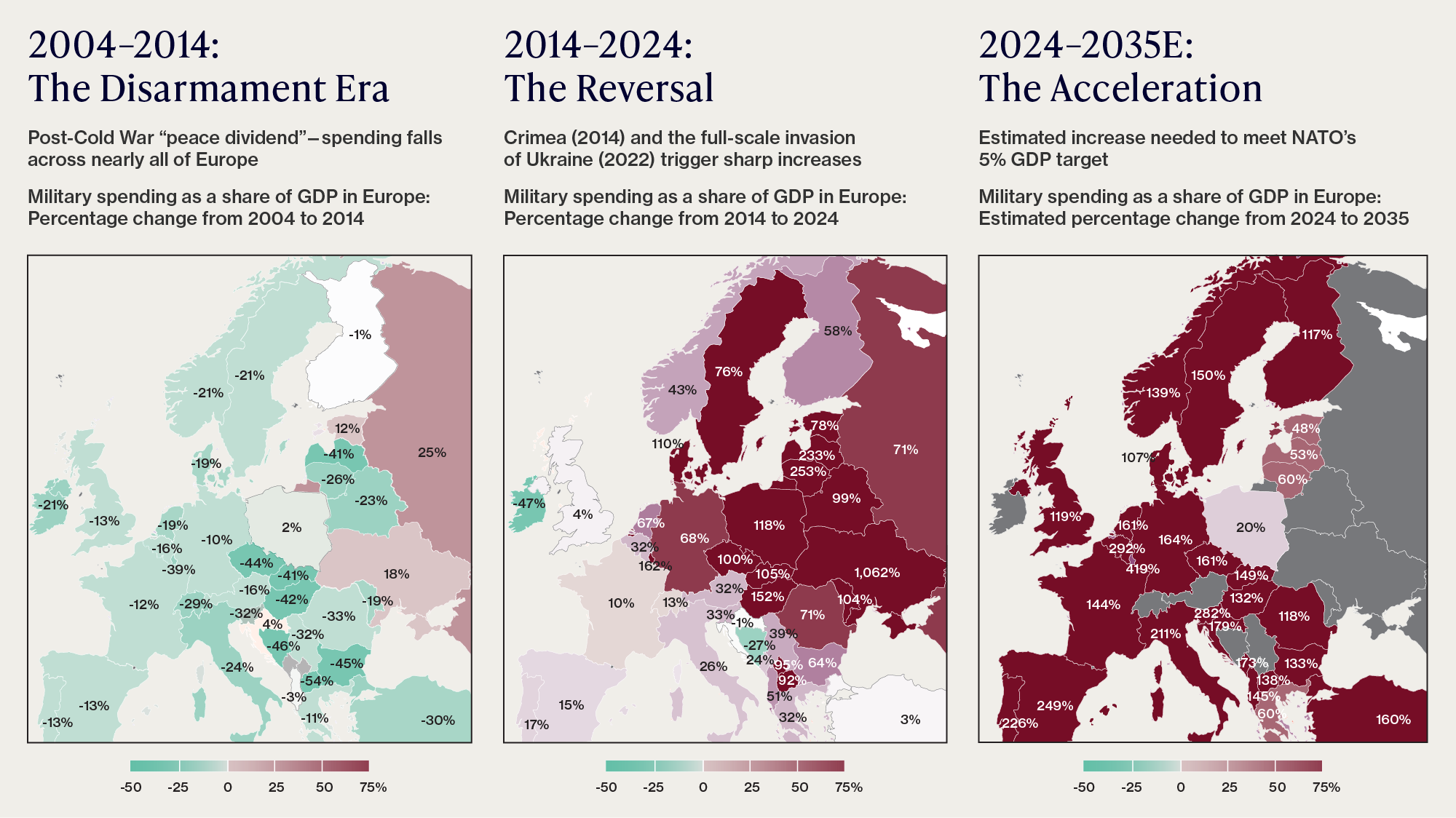

Source: VanEck calculations based on data from the Stockholm International Peace Research Institute (SIPRI, 2025), as published in Intereconomics (2026), “Can Europe Deliver NATO’s Five Percent?” For illustrative purposes only. Not a projection of future results.
The U.S. alone is requesting $1.5 trillion for 2027 — the largest military buildup since WWII, a 44% increase over 2026.7
We Have Been Here Before
The last great rearmament — WWII and Korea — drove one of history’s largest commodity supercycles. By 1950, shortages of copper, steel, aluminum, and tungsten so slowed U.S. arms production that Washington bartered wheat for foreign bauxite, chrome, and tin. The metals, not the armies, set the pace. They may again.
Sources: OSD Historical Office, Rearming for the Cold War; CSIS, Minerals at War (2026); Geopolitical Monitor.
The “Arsenal of Freedom”
This build-up is overwhelmingly equipment. NATO members now direct 32% of budgets to procurement, above the alliance’s 20% floor; if the 5% pledge is met, spending over the next decade could approach $30 trillion — with nearly $10 trillion on hardware alone.8
The Pentagon calls it the “Arsenal of Freedom” — not more troops, but a rebuilt production base, with more than half the money going to procurement and next-generation weapons.9
The spending is structural, not cyclical – locked in by legislation, not the market.
Demand Without Discrimination
Every military platform draws from the same basket of metals — a fighter jet and a destroyer never share a battlefield, but they compete for the same aluminum, copper, tungsten, and rare earths.
Key Metals and Minerals Inside Major Defense Systems
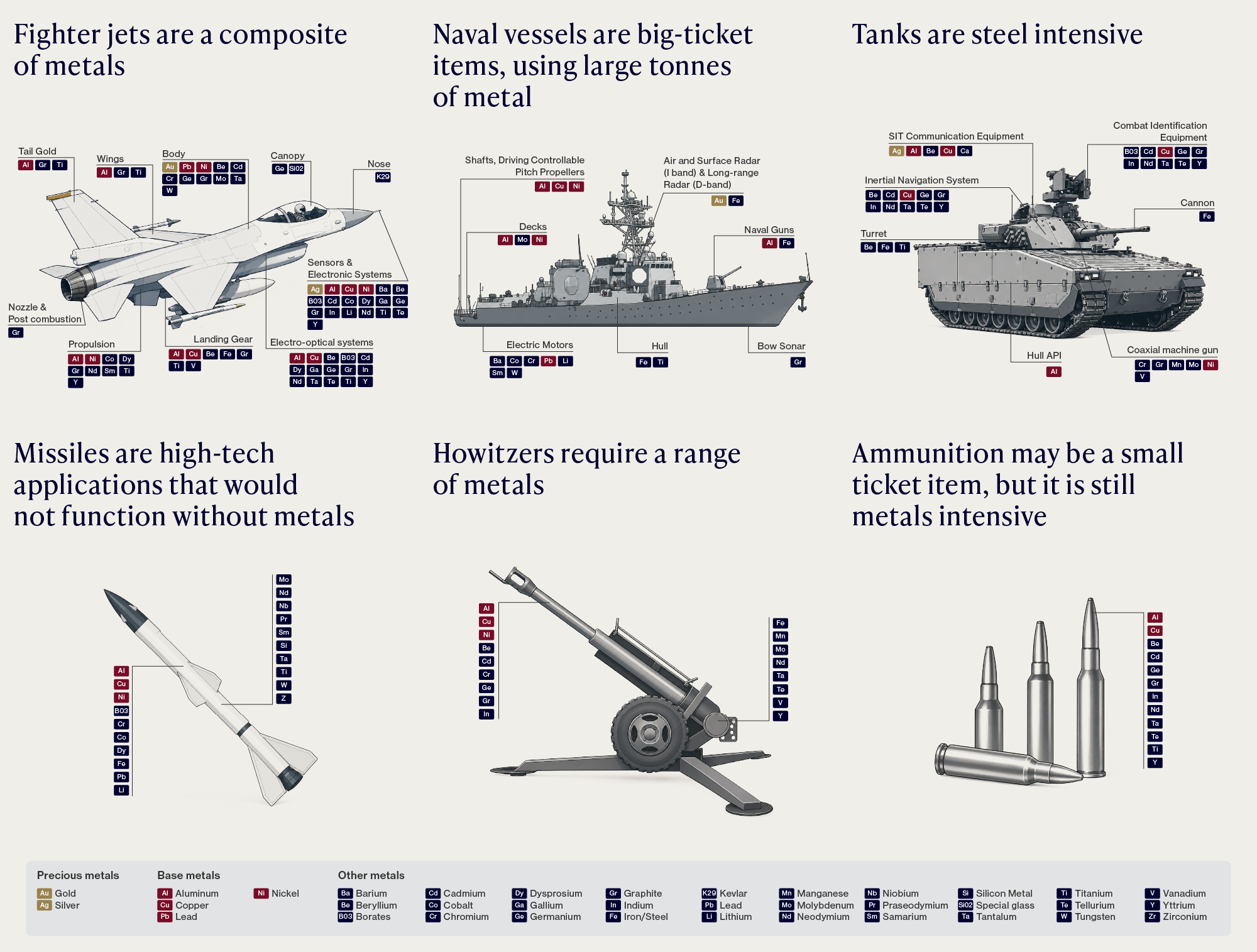

Source: Benedetta Girardi, Irina Patrahau, Giovanni Cisco and Michel Rademaker, “Strategic Raw Materials for Defence: Mapping European Industry Needs,” The Hague Centre for Strategic Studies (2020); via BofA Global Research. For illustrative purposes.
Defense is a relatively small share of those markets today, but it is a fast-growing, legally mandated source of demand — and it is accelerating into a market already tight and concentrated. Goldman Sachs estimates Europe’s rearmament alone will lift the region’s industrial-metals demand about 6% by 2027.10 Two forces then compound: that rising demand, and a scramble to secure supply outside China. For investors, that points to the miners and processors outside China — positioned to benefit from rising demand and the premium on secure supply, an exposure that few portfolios currently hold. What that means differs sharply by metal — so take them one at a time.
The Backbone of Every Platform: Steel
Steel is the most fundamental defense input by tonnage — a single aircraft carrier requires roughly 70,000 tonnes.11 Defense is only ~2% of global steel demand, but it is climbing fast – and volume is not the story; grade is. That share is not fixed either: at the height of the Korean War build-up, defense claimed as much as 20% of U.S. steel output.12 A sustained rearmament could lift that call again — a tightening we do not believe the market has priced. The platforms that define modern warfare run on specialty steel: submarine pressure hulls, that only a handful of mills can produce, the proprietary Eglin steel casing used in the bunker busters deployed in Iran, and a single Pennsylvania plant supplying up to 95% of the Navy’s armor plate.13 As record FY2026 procurement ramps into these tight supply chains, pricing power flows to the few producers qualified to make it.
U.S. Navy Shipbuilding: Displacement Tonnage Under Construction
Naval tonnage under construction has grown ~80% since 2014 and rises further under the Navy's plan
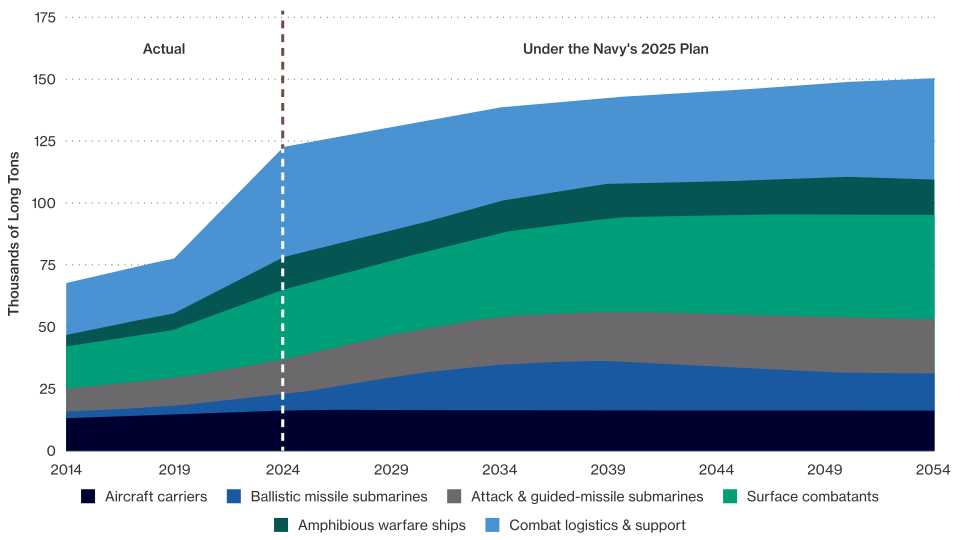
Source: Congressional Budget Office, Challenges Facing the Navy's and Coast Guard's Shipbuilding Programs, April 2026 (cbo.gov/publication/62258). Displacement (lightship) is a proxy for steel demand. Category splits recreated by VanEck from CBO Figure 4. For illustrative purposes only. Not a projection of future results.
Recommended subscription
From the Hull to the Fuze: Copper
Copper conducts the war — moving the power, carrying the data, and lining the munitions, from a warship’s miles of wiring to a Tomahawk’s guidance and the band that spins every artillery shell. In 2021, military production consumed 2.19 million tonnes — over 10% of the world’s refined output — and has compounded at roughly 14% a year since.14 Growth has room to run: drone- and missile-heavy warfare consumes more copper per dollar than ever. And demand cannot be displaced — copper is heading into deficit, mine supply barely growing, and in a market this tight the marginal tonne sets the price, and the producers who can supply it capture the margin.
The Metal America Stopped Making: Aluminum
Aluminum makes modern warfare. The drones, cruise missiles, and above all the kamikaze munitions swarming today’s battlefield are light and expendable — and light means aluminum. Fired and flown by the thousand and never recovered, aluminum becomes a recurring draw, not a one-time cost. Yet America has all but stopped smelting it: once the world’s largest primary aluminium producer, the U.S. has gone from 24 operating smelters to four.15 Meanwhile defense demand has more than doubled since 2009 and is set to climb further by 2030.16 America now imports much of a metal without which it cannot fight — already on the national stockpile list. Rebuilding that supply at home is now a strategic priority, and the scarce Western producers and fabricators left are where the value sits.
The Chokepoint: Rare Earths
Rare earths steer the war. The magnets that guide a missile, aim a radar, and power the F-35 all run on them — above all samarium-cobalt, built to hold its magnetism in a battlefield’s heat, where ordinary magnets fail. The dependency is real: in 2022 the Pentagon halted F-35 deliveries over a Chinese-made magnet alloy, resuming only under a waiver.17 And demand is surging — mostly for a different magnet: the neodymium in EVs and robots, which has doubled since 2015 and rising ~30% more by 2030.18
For defense, this was never a volume story; it’s a control story — and China controls it. China produces 97% of the world’s samarium and has weaponized that grip, choking off anything bound for the military.19 Washington’s answer is force of capital: an equity stake in a domestic producer, a price floor at double the market. And from January 2027, U.S. law bars any defense magnet that has touched China at any step.20 The U.S. barely makes them — so Washington is underwriting the companies that will, the same producers riding the EV-and-robot boom.
The Minor Metals, Major League:
Gallium makes the Patriot’s radar; germanium, the infrared optics in night-vision sights and heat-seeking missiles; antimony, the hardened bullet core and the tracers and flares that light the night; tungsten, the penetrators that punch through armor — the “war metal,” dense and unforgiving. None are needed in bulk; all are irreplaceable. And China controls the lot — 98% of gallium, 83% of tungsten, 68% of germanium, and 48% of antimony.21 It has already pulled the trigger — cutting off gallium, germanium, and antimony in 2024, tightening tungsten in 2025 — and even after a 2025 truce, the block on military buyers remains in place. The risk here was never running low; it’s being cut off, one license at a time. The opportunity is the mirror image: the Western producers of what Beijing won’t sell — scarce, and increasingly backed by government demand.
What Happens When China Turns Off the Tap
Price increase for defense-critical minerals following Chinese export restrictions
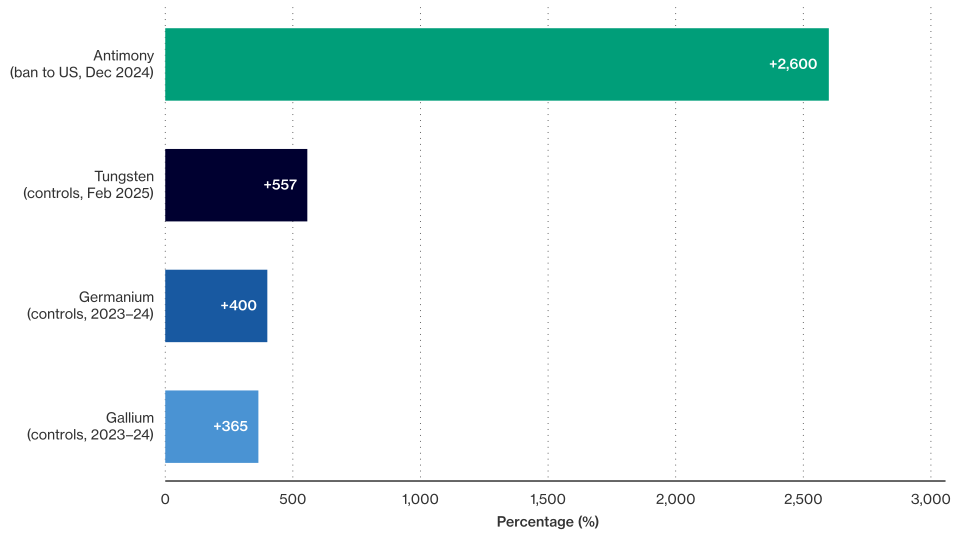
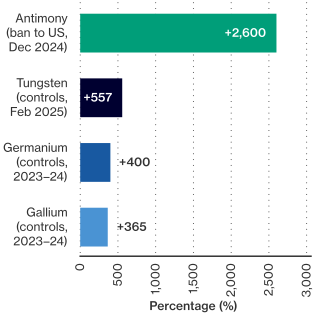
Source: Fastmarkets, USITC, OilPrice/Reuters (2024–2026). Increases measured from pre-control to peak/recent prices; windows differ by mineral. Chart by VanEck.
Where the Value Accrues:
Strip away the platforms and the politics, and it comes down to one thing. Demand is committed — defense budgets are legislated, multi-year, and climbing. Supply is not — thin, concentrated, and, for the materials that matter most, controlled by the very adversary the West is arming against. Markets still price defense as a story about contractors and platforms; the deeper, more durable opportunity, in our view, lies in the metals beneath them — and the producers and fabricators that supply them. Once a metal becomes a national-security priority, the West stops buying on price and pays whatever it takes to secure it — price floors, stockpiles, reshoring. Rare earths already show it. The uplift itself — defense demand climbing off a low base — is, in our view, largely missing from where these producers trade today. Natural resources have always shaped economies, now they shape the balance of power, at the intersection of economic and national security. The question is whether markets have priced that in. We do not believe they have.
We have taken the national-security half of that intersection. Economic security is next.
To receive more Natural Resources insights, sign up in our subscription center.

Important Disclosures
1 U.S. Department of Defense, “Strategic and Critical Materials in the Defense National Stockpile,” Report to Congress, December 1998.
2 J.P. Morgan, “U.S. Defense Industrial Base,” Revised Edition, 2026; Congressional Budget Office, Challenges Facing the Navy’s and Coast Guard’s Shipbuilding Programs, April 2026.
3 CBS News, “Rapid pace of interceptor and precision-guided weapons use worries Trump administration,” July 23, 2026.
4 SIPRI, Trends in World Military Expenditure, 2025, April 2026.
5 NATO, Defence Expenditure of NATO Countries (2014–2025), August 2025; https://news.yahoo.com/germany-hits-2-gdp-nato-054459619.html
6 NATO Hague Summit Declaration, June 2025.
7 U.S. Department of Defense, FY2027 Budget Request Overview Book, April 2026; White House, “Rebuilding Our Military: FY2027 Budget Fact Sheet,” April 2026.
8 NATO, Defence Expenditure of NATO Countries (2014–2025), Table 8a, August 2025.
9 White House, “Rebuilding Our Military: FY2027 Budget Fact Sheet,” April 2026; Michael E. O’Hanlon, “A Better Way to Spend $350 Billion at the Pentagon,” Brookings Institution, June 24, 2026; U.S. Department of Defense, FY2027 Budget Request Overview Book, April 2026; White House, “Rebuilding Our Military: FY2027 Budget Fact Sheet,” April 2026.
10 Goldman Sachs (2025): Economic Research: Global Market daily: Defense: Another Boost to base Metals Demand (Struyven/ Dinsmore/ Waltham).
11 American Iron & Steel Institute, cited via the National Iron & Steel Heritage Museum.
12U.S. Army War College, “U.S. Readiness for the Korean Conflict”; USNI Proceedings, “Industrial Mobilization in the U.S.,” October 1953.
13 https://www.steelmuseum.org/carrier_exhibit_2018/coatesville_steel.cfm
14 https://mwi.westpoint.edu/as-americas-military-rearms-it-needs-minerals-and-lots-of-them/
15 https://www.aluminum.org/PowerUp
16BofA Global Research: From mine to missile: the metals behind modern defence, July 2025.
18IEA, “Rare Earth Elements: Pathways to Secure and Diversified Supply Chains” (2025).
19Center for Strategic and International Studies (G. Baskaran), October 2025.
21U.S. Geological Survey and CSIS (2024–2026).
This is not an offer to buy or sell, or a recommendation to buy or sell any of the securities, financial instruments or digital assets mentioned herein. The information presented does not involve the rendering of personalized investment, financial, legal, tax advice, or any call to action. Certain statements contained herein may constitute projections, forecasts and other forward-looking statements, which do not reflect actual results, are for illustrative purposes only, are valid as of the date of this communication, and are subject to change without notice. Actual future performance of any assets or industries mentioned are unknown. Information provided by third party sources are believed to be reliable and have not been independently verified for accuracy or completeness and cannot be guaranteed. VanEck does not guarantee the accuracy of third-party data. The information herein represents the opinion of the author(s), but not necessarily those of VanEck or its other employees.
You can lose money by investing in the Fund. Any investment in the Fund should be part of an overall investment program, not a complete program. The Fund is subject to risks which may include, but are not limited to, risks associated with active management, agriculture companies, commodities and commodity-linked instruments, commodities and commodity-linked instruments tax, derivatives, direct investments, emerging market issuers, equity securities, ESG investing strategy, foreign currency, foreign securities, global resources sector, market, gold and silver mining companies, growth investing, operational, investing in other funds, small- and medium capitalization companies, special purpose acquisition companies, and special risk considerations of investing in Canadian issuers, all of which may adversely affect the Fund. Emerging market issuers and foreign securities may be subject to securities markets, political and economic, investment and repatriation restrictions, different rules and regulations, less publicly available financial information, foreign currency and exchange rates, operational and settlement, and corporate and securities laws risks. Small- and medium-capitalization companies may be subject to elevated risks. Derivatives may involve certain costs and risks such as liquidity, interest rate, and the risk that a position could not be closed when most advantageous. Investments in gold and silver mining companies may be impacted by various factors, such as industry competition, the price of gold and silver bullion, inflation, currency exchange rates, environmental or labor costs, worldwide economic, financial and political, as well as other potential factors.
Investing involves substantial risk and high volatility, including possible loss of principal. An investor should consider the investment objective, risks, charges and expenses of a Fund carefully before investing. To obtain a prospectus and summary prospectus, which contain this and other information, call 800.826.2333 or visit vaneck.com. Please read the prospectus and summary prospectus carefully before investing.
© Van Eck Securities Corporation, Distributor.
Related Funds
Important Disclosures
1 U.S. Department of Defense, “Strategic and Critical Materials in the Defense National Stockpile,” Report to Congress, December 1998.
2 J.P. Morgan, “U.S. Defense Industrial Base,” Revised Edition, 2026; Congressional Budget Office, Challenges Facing the Navy’s and Coast Guard’s Shipbuilding Programs, April 2026.
3 CBS News, “Rapid pace of interceptor and precision-guided weapons use worries Trump administration,” July 23, 2026.
4 SIPRI, Trends in World Military Expenditure, 2025, April 2026.
5 NATO, Defence Expenditure of NATO Countries (2014–2025), August 2025; https://news.yahoo.com/germany-hits-2-gdp-nato-054459619.html
6 NATO Hague Summit Declaration, June 2025.
7 U.S. Department of Defense, FY2027 Budget Request Overview Book, April 2026; White House, “Rebuilding Our Military: FY2027 Budget Fact Sheet,” April 2026.
8 NATO, Defence Expenditure of NATO Countries (2014–2025), Table 8a, August 2025.
9 White House, “Rebuilding Our Military: FY2027 Budget Fact Sheet,” April 2026; Michael E. O’Hanlon, “A Better Way to Spend $350 Billion at the Pentagon,” Brookings Institution, June 24, 2026; U.S. Department of Defense, FY2027 Budget Request Overview Book, April 2026; White House, “Rebuilding Our Military: FY2027 Budget Fact Sheet,” April 2026.
10 Goldman Sachs (2025): Economic Research: Global Market daily: Defense: Another Boost to base Metals Demand (Struyven/ Dinsmore/ Waltham).
11 American Iron & Steel Institute, cited via the National Iron & Steel Heritage Museum.
12U.S. Army War College, “U.S. Readiness for the Korean Conflict”; USNI Proceedings, “Industrial Mobilization in the U.S.,” October 1953.
13 https://www.steelmuseum.org/carrier_exhibit_2018/coatesville_steel.cfm
14 https://mwi.westpoint.edu/as-americas-military-rearms-it-needs-minerals-and-lots-of-them/
15 https://www.aluminum.org/PowerUp
16BofA Global Research: From mine to missile: the metals behind modern defence, July 2025.
18IEA, “Rare Earth Elements: Pathways to Secure and Diversified Supply Chains” (2025).
19Center for Strategic and International Studies (G. Baskaran), October 2025.
21U.S. Geological Survey and CSIS (2024–2026).
This is not an offer to buy or sell, or a recommendation to buy or sell any of the securities, financial instruments or digital assets mentioned herein. The information presented does not involve the rendering of personalized investment, financial, legal, tax advice, or any call to action. Certain statements contained herein may constitute projections, forecasts and other forward-looking statements, which do not reflect actual results, are for illustrative purposes only, are valid as of the date of this communication, and are subject to change without notice. Actual future performance of any assets or industries mentioned are unknown. Information provided by third party sources are believed to be reliable and have not been independently verified for accuracy or completeness and cannot be guaranteed. VanEck does not guarantee the accuracy of third-party data. The information herein represents the opinion of the author(s), but not necessarily those of VanEck or its other employees.
You can lose money by investing in the Fund. Any investment in the Fund should be part of an overall investment program, not a complete program. The Fund is subject to risks which may include, but are not limited to, risks associated with active management, agriculture companies, commodities and commodity-linked instruments, commodities and commodity-linked instruments tax, derivatives, direct investments, emerging market issuers, equity securities, ESG investing strategy, foreign currency, foreign securities, global resources sector, market, gold and silver mining companies, growth investing, operational, investing in other funds, small- and medium capitalization companies, special purpose acquisition companies, and special risk considerations of investing in Canadian issuers, all of which may adversely affect the Fund. Emerging market issuers and foreign securities may be subject to securities markets, political and economic, investment and repatriation restrictions, different rules and regulations, less publicly available financial information, foreign currency and exchange rates, operational and settlement, and corporate and securities laws risks. Small- and medium-capitalization companies may be subject to elevated risks. Derivatives may involve certain costs and risks such as liquidity, interest rate, and the risk that a position could not be closed when most advantageous. Investments in gold and silver mining companies may be impacted by various factors, such as industry competition, the price of gold and silver bullion, inflation, currency exchange rates, environmental or labor costs, worldwide economic, financial and political, as well as other potential factors.
Investing involves substantial risk and high volatility, including possible loss of principal. An investor should consider the investment objective, risks, charges and expenses of a Fund carefully before investing. To obtain a prospectus and summary prospectus, which contain this and other information, call 800.826.2333 or visit vaneck.com. Please read the prospectus and summary prospectus carefully before investing.
© Van Eck Securities Corporation, Distributor.